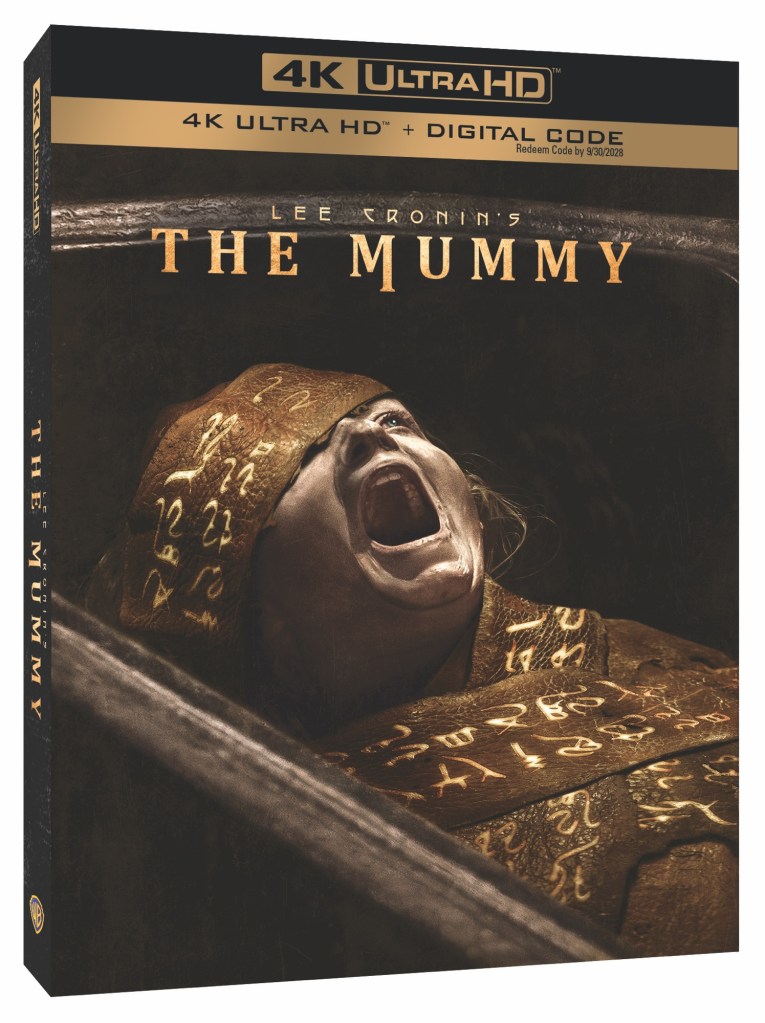
Warner Bros. Discovery Home Entertainment is bringing one of the year’s best horror movies to home video. “Lee Cronin’s The Mummy” is a genuinely unsettling chiller that sees Cronin putting his own unique spin on the often told Mummy tale. It’s an unabashedly grisly horror spectacle that will have you squirming one minute and unexpectedly laughing the next. And now you can do it in the comforts of your own home.
“Lee Cronin’s The Mummy” will be available to own on 4K Ultra HD + Digital Copy July 14th. See below for a full synopsis of the film as well as release information including a list of special features.
About the Film:
Year: 2026
Runtime: 134 Minutes
Director: Lee Cronin
Screenwriter: Lee Cronin
Cast: Jack Reynor, Laia Costa, May Calamawy, Natalie Grace, Veronica Falcón, Shylo Molina, Billie Roy, Hayat Kamille, May Elghety, Husam Chadat, Mark Mitchinson
Rated R for for strong disturbing violent content, gore, language and brief drug use
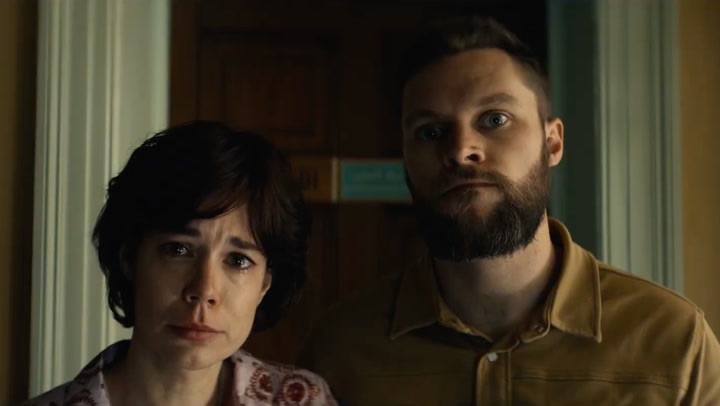
The young daughter of a journalist disappears into the desert without a trace—eight years later, the broken family is shocked when she is returned to them, as what should be a joyful reunion turns into a living nightmare.
Hot off the record-setting resurrection of EVIL DEAD RISE, writer/director Lee Cronin turns to one of the most iconic horror stories of all time with an audacious and twisted retelling: LEE CRONIN’S THE MUMMY.
Special Features:
“Lee Cronin’s The Mummy” on Digital, 4K UHD, and Blu-ray contain the following special features:
The Making of Lee Cronin’s The Mummy – Director Lee Cronin reveals his striking vision for a terrifying new mummy tale of heart and horror. Explore the film’s claustrophobic atmosphere and meticulous filmmaking as it delivers emotion and relentless terror!
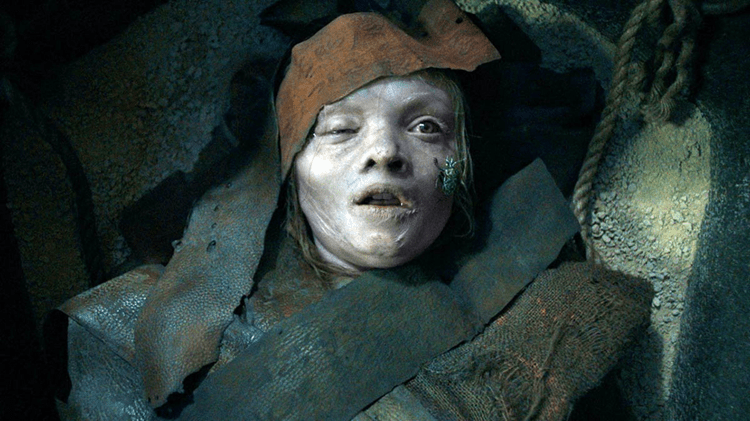
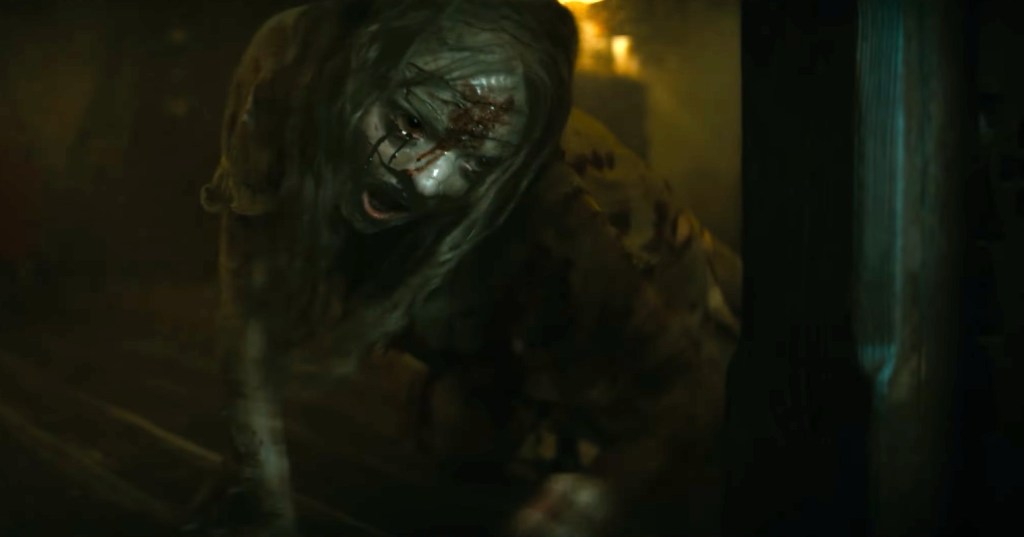
A Bloody and Grotesque Spectacle – Blood, bugs and toenails fuel this inside look at the film’s wild SFX and practical filmmaking magic! Cast and crew also reveal how Natalie Grace transforms into a demon-possessed vessel through intense prosthetics and chilling physicality.
Possession and Ancient Demons – Explore the story’s Egyptian roots and demonic rituals. Detective Zaki and the family investigate Katie’s disappearance as the cast reveals the visceral reality of filming possession and terror while building the film’s many unforgettable scenes.
Deleted Scenes
Commentary by Writer/Director/Executive Producer Lee Cronin
“Office Romance” is the latest dime-a-dozen romantic comedy to come down the streaming pipeline. It’s also among the more inconsistent ones as director Ol Parker struggles to make something worthwhile out of its many romcom clichés and misguided swings. Jennifer Lopez puts in the work and ultimately makes the film tolerable. But she can only carry so much of the load. And she can’t make the movie’s numerous uninspired choices make sense.
Lopez plays Jackie Cruz, the hardened CEO of a major airline AirCruz. The business was founded by her father Jack (Edward James Olmos) who still pops up every so often. But it’s Jackie who turned the fledgling business into a massively successful company. It hasn’t been easy, especially with a constantly critical board breathing down her neck. For that reason, Jackie has created an intimidating and almost unapproachable presence at work, intensely focusing on the job rather than making any real human connections.
After her ruthless hotshot attorney Peter (Bradley Whitford) chokes on a burrito and is hospitalized, Jackie hands over the day-to-day operations of AirCruz’s legal department to the company’s number-two attorney, Daniel Blanchflower (Brett Goldstein). He’s sharp, savvy, and handsome (a romcom prerequisite) but a bit oafish once he meets Jackie for the first time. A mutual attraction is evident, but any sparks are instantly quenched by an embarrassingly dumb gag – one of many that plague this movie.
Image Courtesy of Netflix
Despite her company’s strict “no fraternizing” policy, a forbidden romance blooms, putting both Jackie and Daniel in precarious professional positions. I won’t spoil where things go from there, but it isn’t too hard to figure out. That’s because “Office Romance” follows the very same blueprint that so many others do. (1) Two good-looking people unexpectedly fall in love. (2) An eventual conflict threatens it all. (3) They overcome it to have their ‘Happily Ever After” moment.
While the predictability is one issue, it’s the lack of romantic chemistry that is far more glaring. The script (co-written by Goldstein and Joe Kelly) doesn’t put the time into building anything resembling an authentic central relationship. Instead it wastes too much energy on humor that simply doesn’t land. The attempts at raunchy comedy are especially cringe-inducing and often feel as though they belong in an entirely different movie.
The supporting characters don’t fare well either. Olmos isn’t given enough to do. Betty Gilpin is trapped inside a one-dimensional and tiresome comic relief role. Jodie Whittaker is wasted as Daniel’s foulmouthed incarcerated sister. And there is a smattering of generic office workers who do little more than fill up space in certain scenes. That leaves it all up to Lopez and Goldstein who sadly don’t have nearly enough good material to make this romcom misfire worth a watch.
Netflix has been good to Millie Bobby Brown. She gained worldwide recognition for her role in the insanely popular Netflix streaming series “Stranger Things”, which premiered in 2016 and ran for five successful seasons. She also struck gold in 2020 with “Enola Holmes”, an infinitely charming mystery movie based on author Nancy Springer’s book series “The Enola Holmes Mysteries”. An equally delightful sequel followed in 2022, and now she’s back with the third entry.
“Enola Holmes 3” features more of the same cheeky humor and playful self-awareness that made the previous two films so enjoyable. New director Philip Barantini and returning screenwriter Jack Thorne once again tap into the comedic friction between a fiercely independent young woman clashing with the rigid norms of Victorian-era London. And they use the familiar tricks from the previous films including Enola’s witty narration and constant breaking of the fourth wall.
Image Courtesy of Netflix
But while the pieces are all there and Brown is still as energetic and charismatic as ever, “Enola Holmes 3” is easily the weakest installment of the three movies. Its issues start with the central mystery which is never as cohesive or compelling as its predecessors. Plot holes and contrivances are littered throughout and become more noticeable in the second half. Thankfully Brown makes them easier to endure with her infectious spirit that pours out of a role she’s quite clearly comfortable with.
But an even bigger hurdle is the glaring on-the-nose messaging. The Enola Holmes films have always had social commentary cleverly woven into the fabric of their stories. But here it’s obvious to the point of being clunky. The movie admirably seeks to tackle the serious topic of British colonialism. But it does so with the subtlety of a sledgehammer. And while Enola’s fight for independence and autonomy has organically blended into her past stories, it’s more force-fed this time around, right through to the ham-fisted ending.
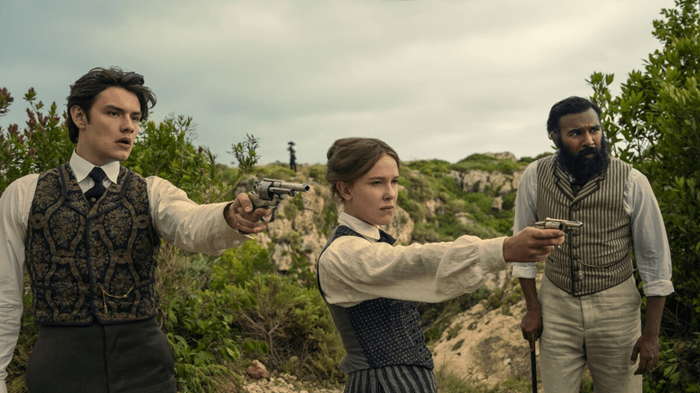
Following the events of the second film, “Enola Holmes 3” sees our titular protagonist preparing to marry Tewkesbury (Louis Partridge) in a lavish ceremony in Malta. All of the pomp isn’t really Enola’s cup of tea. But Tewkesbury’s aristocratic family, led by his snooty mother (Hattie Morahan), plan a sizable wedding fit for the rich and pampered. Because she loves Tewkesbury, Enola goes along for the ride, much to the chagrin of her renowned brother Sherlock (Henry Cavill), who thinks getting married is beneath her.
Enola’s wedding day is thrown into chaos after she learns that Sherlock has gone missing, possibly kidnapped. So she leaves Tewkesbury at the alter and sets out on what is meant to be her most challenging and most dangerous case yet. But she’ll need a lot of help if she is to find Sherlock. And she gets it from a number of supporting players including Sherlock’s friend and confidant, Dr. Watson (Himesh Patel), her own radical outlaw mother Eudoria (Helena Bonham Carter), and even the heartbroken puppy dog Tewkesbury.
Image Courtesy of Netflix
The mystery is its most fun early on as Enola searches for clues while remembering Sherlock’s training. The movie wastes no time leading her down a trail of arson and murder as she parses through potential suspects. Perhaps the local British government is involved. And what role does the crazed (and heavily rewritten) Professor Moriarty (Sharon Duncan-Brewster) play? Established in the previous film as a victim of a corrupt system, this Moriarty remains a dramatic shift from the criminal mastermind working from the shadows that Sir Arthur Conan Doyle envisioned.
Everything from the buildup to the inevitable clash between Enola and Moriarty underwhelms. Character motivations are murky and their actions can be even more baffling. Meanwhile Cavill’s Sherlock spends most of his time offscreen which deprives us of their playful brother/sister camaraderie. Still Brown keeps the energy high and she’s such a delight in a role she seems meant to play. Unfortunately this time around the heavy-handed material routinely lets her down.
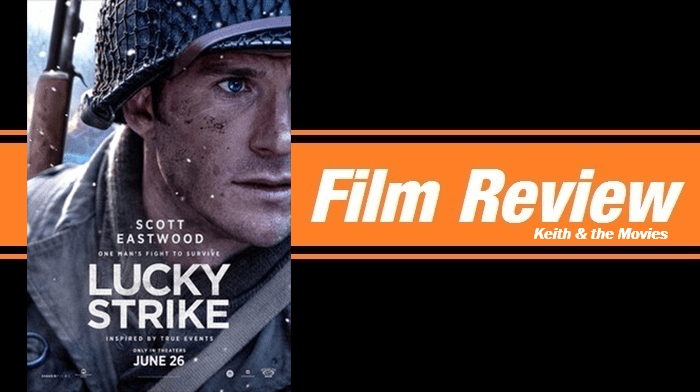
Scott Eastwood plays a soldier stranded behind enemy lines in “Lucky Strike”, the latest World War II action thriller that is inspired by incredible true events. Director Rod Davis Lurie, working from a script he wrote with Marc Frydman, pulls from numerous real-life accounts of American troops who found themselves alone deep in enemy territory during the costly and consequential Battle of the Bulge.
“Lucky Strike” (a title based on an interesting link to the long-running cigarette brand) tells a fairly straightforward yet consistently engaging story about a soldier, armed only with his wits and a new radio, who must survive a variety of encounters in order to reach a rally point. It’s not unlike similar stories that have been told. But Lurie keeps us glued to the screen by making every encounter meaningful and by raising the stakes higher and higher.
Image Courtesy of Saban Films
The setting is December, 1944 in eastern Belgium’s Ardennes Forest. Eastwood plays Captain John Castle, the leader of an army engineering battalion who specializes in mining roads and blowing up bridges to stop enemy advancements. He and his team receive orders to cross into Nazi territory and block a critical road in order to keep a ruthless SS Panzer Division from reaching their fuel depots. But in no time, the mission goes terribly wrong.
While wiring their explosives, the team is hit with a surprise attack. All of Castle’s men are killed, leaving only him and the Army’s prototype radio – a backpack-sized Motorola SCR-300 nicknamed Lassie, to navigate the Nazi-infested countryside and make it to an Allied safe zone some 30 kilometers away. As Castle follows Lassie’s lead across the rugged and frigid terrain, he is both caringly aided and violently opposed by the different people he meets along the way.
Image Courtesy of Saban Films
Again, Lurie and Frydman ensure that each of Castle’s encounters carry meaningful dramatic weight. Whether it’s a sympathetic farm family who offer him refuge or a heavily armed Nazi patrol who puts him in their crosshairs. As for Eastwood, he delivers a performance that impressively balances his character’s courage amid peril with his feelings of utter fear and desperation. He’s tasked with carrying most of the load for a sizable chunk of the movie and he’s up to the task.
Lurie skillfully stages the action in ways that often thrusts us into the middle of it. And the lensing from DP Lorenzo Senatore ensures the tension is palpable throughout. To its credit, “Lucky Strike” isn’t a prototypical war movie. Instead, it turns into a harrowing survival thriller that surprises at numerous points on its gritty and perilous journey. The film is bookended by a part of the story that doesn’t quite click into place as intended. But the meat of the movie delivers the kind of immersive experience that anyone can get into.
Robert Eggers has established himself as one of the most distinctive filmmakers of our time. Simply put, you know a Robert Eggers movie when you see it. His love for period horror and folklore has permeated every feature he has made including his last film – 2024’s “Nosferatu”. Now he’s back with another Gothic chiller inspired by a classic tale. “Werwulf” looks as if it could exist in the same dark and terrifying world as “Nosferatu”. Look no further than the new trailer to see what I mean.
Set in 13th-century England, “Werwulf” stars Aaron Taylor-Johnson as a local farmer who comes face-to-face with a curse that has fallen upon a small village. What is the curse? The film’s title pretty much says it all. Eggers brings back several of his favorite stars including Lily-Rose Depp, Willem Dafoe, and Ralph Ineson. And he once again incorporates a strikingly distinct visual style which only adds to the terror. Dark, visceral, unsettling – just some of the adjectives the fittingly describe this wickedly good first-look.
“Werwulf” roars into theaters on December 25th. Check out the trailer below and let me know if you’ll be seeing it or taking a pass.
The legend of Robin Hood has been told on screen in a wild variety of ways. Their range has included Errol Flynn’s 1938 swashbuckling classic, Disney’s 1973 animated reimagining, Kevin Costner’s 1991 popcorn blockbuster, the hysterical 1993 spoof from Mel Brooks, and the more serious-minded 2010 Ridley Scott telling. The latest is the aptly titled “The Death of Robin Hood” and it is dramatically different from any other iteration that came before it.
“The Death of Robin Hood” doesn’t fit into any of the more popular molds that we have seen before. There’s nothing light, merry, or charming about it. Instead, it’s a bleak and gritty adaptation of the 17th-century ballad “Robin Hood’s Death”. Writer-director Michael Sarnoski (“Pig”, “A Quiet Place: Day One”) offers up a fresh and compelling reimagining of Robin Hood. He builds a fascinating character arc that’s rooted in savage violence but evolves into a deeper and almost meditative study of guilt, self-forgiveness, and mortality.
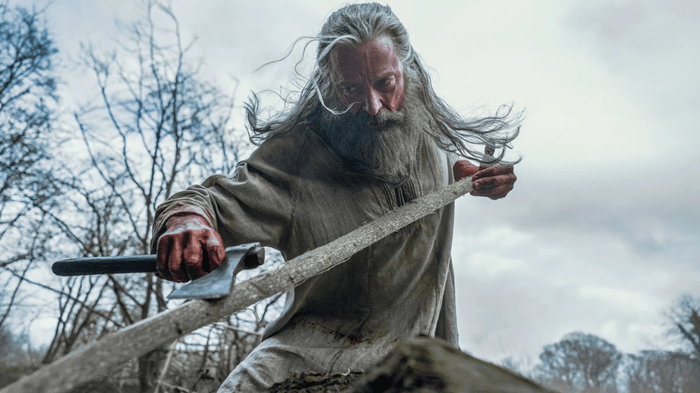
Sarnoski’s vision is impressive on its own. But it would never be fully realized without the gravitas brought by the film’s star, Hugh Jackman. With his long stringy gray hair, matching beard, weathered skin, and world-weary eyes, Jackman deftly conveys the numerous layers to this Robin. He’s legitimately terrifying as a murderous outlaw whose true self defies the local legend describing him as a hero who “protects the meek”. Yet he’s grown to despise the man he has become. He is haunted by the generations of his victims and he sees no moral reckoning outside of the worthy death he longs for.
Image Courtesy of A24
The first 30 minutes gives us a good taste of the man Robin has been. Set in 1247, these early scenes are grisly and violent, with Sarnoski destroying the Robin Hood myth that we and the locals have clinged to. It’s most viscerally realized when Robin is visited by his longest and most loyal friend, Little John (Bill Skarsgård). Now living under the name Edward, John has made a new life for himself with his beloved wife and their young daughter.
But John has come to his old friend in desperate need of help. He recruits Robin to help him rescue his family and retake his farm from the clutches of some old enemies. The gruesome chain of events that follow shock by the sheer intensity of the violence. Brutes soaked in blood and caked in mud fight with a primal ferocity, crushing bones with maces, puncturing organs with jagged blades, searing flesh with burning torches. It’s pure savagery which Sarnoski visualizes with unflinching clarity.
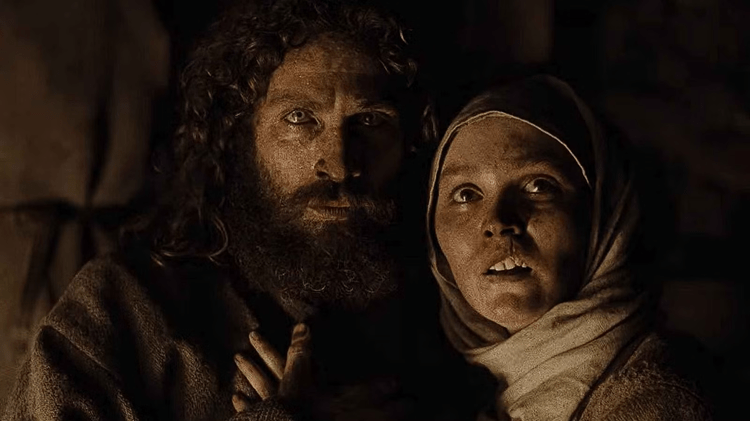
Robin is seriously injured and later wakes up at a remote island priory under the care of an abbess named Sister Brigid (Jodie Comer) who begins nursing him back to health. It’s here that the film takes a dramatic turn, shifting its focus from Robin as a man of violence to Robin as a shattered soul who is crumbling under the weight of his own guilt. He keeps his identity hidden and begins blending in with the others being cared for by Sister Brigid, from orphan children to a wise but nameless leper (Murray Bartlett).
Image Courtesy of A24
But Robin’s old life threatens to resurface after the unexpected reappearance of Little John’s traumatized daughter, Margaret (movingly played by newcomer Faith Delaney). She brings with her a looming sense of danger from the mainland that lasts for the remainder of the film. Yet Sarnoski remains committed to methodically maneuvering us through Robin’s internal reckoning. It’s more than simply deromanticizing of a myth. He takes his time exploring his more personal interests, right through to the payoff which is itself counter to what we expect.
A key reason for the film’s effectiveness can be found in Jackman’s deeply committed performance. It’s stripped-down and solemn yet full of conviction as the 57-year-old star balances bearing and releasing the emotional weight of past sins. Comer too is a key strength, portraying Sister Brigid as sturdy and stoic yet tender in moments that finally allow her to let down her guard. And all are canvassed by the richly textured 35mm cinematography of DP Pat Scola. There’s never a moment where the film doesn’t impress through his lens.
“The Death of Robin Hood” is the kind of revisionist counter-programming that won’t be for everyone. Purists hoping for another playful spin on the noble bandit who steals from the rich and gives to the poor won’t find that here. Instead, this film is for those interested in looking beyond the myth. And anyone hoping for something bigger and more blockbustery will be confounded by the more intimate scale. It’s more aimed at those wanting a breather from summer popcorn productions. In those regards, Michael Sarnoski hits exactly what he aims for. And I was enthralled the entire way.











 Keith & the Movies