
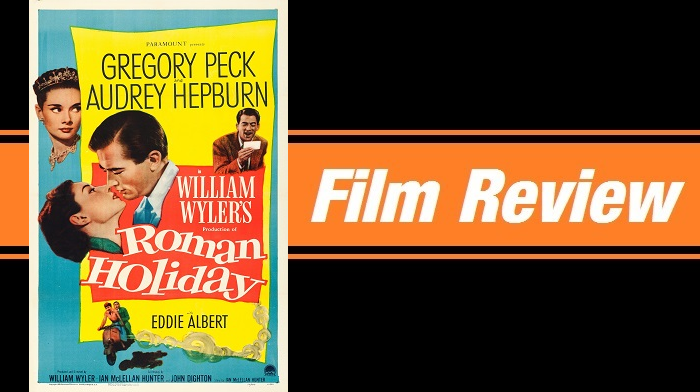
At the risk of sounding cliche, they just don’t make movies like this anymore, especially romantic comedies. The 1953 classic “Roman Holiday” from director William Wyler remains a blueprint for a genre that notoriously struggles with originality these days. The beloved film turns 70 this year and to celebrate its anniversary, “Roman Holiday” is having special screenings at select theaters all around the country. And on the eve of Valentines Day, what better time to see it.
“Roman Holiday” brought together the unlikely pair of Gregory Peck and Audrey Hepburn. It was a star-making role for a young Hepburn who at that point had mostly appeared in bit parts. But her performance in “Roman Holiday” caught the world’s eye. Her co-star Gregory Peck played a big part. He recognized Hepburn was going to be a star and was instrumental in getting her name out. Interestingly Peck wasn’t Wyler’s first choice. The director wanted Cary Grant, but Grant turned it down believing he was too old for the part (Peck once famously said that anytime he received a comedy script he knew Grant must have turned it down first).
The story for “Roman Holiday” was written by Dalton Trumbo but it was credited to Ian McClellan Hunter. At the time, Trumbo was one of the Hollywood Ten and had been blacklisted for his “communist ties” and failure to cooperate with Congress. To make things even more interesting, “Roman Holiday” won the Academy Award for Best Story (as the category was known at the time). Hunter would accept the award and it wasn’t until 2011 that Trumbo received full credit for his work.

Trumbo’s fairytale follows Ann (Hepburn), a princess of an unmentioned country who is on a European tour-stop in Rome. Ann is young and adventurous and has had enough of the strict itineraries and stuffy hobnobbing. She wants to experience life outside of her tightly controlled confines. One evening, after the royal family doctor gives her a sedative to calm her anxiety, she sneaks out before it kicks in, ready to take in the sites and sounds of Rome on her own.
Enter American reporter Joe Bradley (Peck). He stumbles across Ann who has fallen sound asleep next to a fountain. He doesn’t recognize her at first, but after a comical series of events he learns her identity and sees her as a big story and a potential career boost. One that could land him a coveted job back in New York.
Joe doesn’t reveal to Ann that he recognizes her, and Ann tries to keep her identity secret. He calls on a photographer friend of his, Irving Radovich (Eddie Albert), to secretly snap some photos of Ann for their big story as the three spend a playful day exploring Rome. But true to rom-com form, Joe begins to have feelings for Ann. So he’s faced with a decision: does he give in to his feelings or cash them in for a big payday?
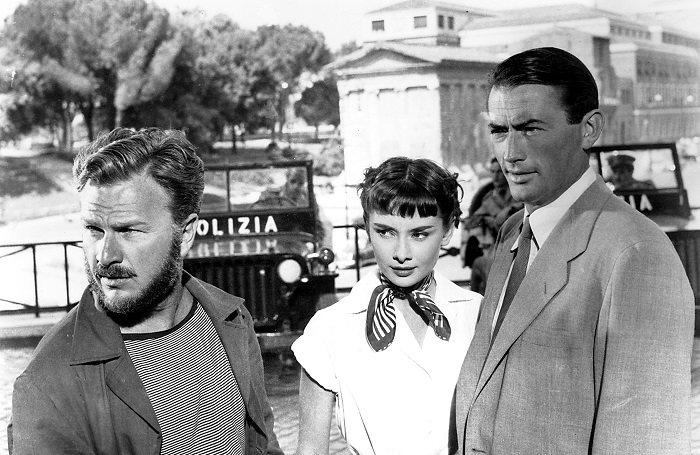
The film was shot entirely in Rome by DPs Henri Alekan and Franz Planer. Shooting on location wasn’t quite as common as it is today, and the expense increased the budget so much that the original plans to shoot the film in color were scrapped. Regardless, it was the right choice. Rome, with all its history and beauty, plays a significant supporting role, and some of the movie’s more magical scenes feature Ann and Joe at some of the city’s famous locations. (A favorite is a playful moment at the famed Mouth of Truth where Peck pretends his arm is stuck in the monument and lets out a scream. It’s said Hepburn knew nothing of the gag and was genuinely startled, letting out a scream of her own. It was completely spontaneous and Wyler captured it in one take).
“Roman Holiday” would go on to earn 10 Academy Award nominations. Aside from Trumbo’s win, it was also awarded for Best Costume Design, and perhaps most notably for Best Actress. The win would catapult Audrey Hepburn, who was relatively unknown at the time, into the spotlight and open the door to what would be a stellar career. Peck was right with his appraisal of the young actress and she was always appreciative. The two remained close friends for the rest of their lives. The roots of their shared admiration is clearly seen in “Roman Holiday”, and is a big reason they’re such a memorable on-screen couple.
I still love “Roman Holiday” – the sparkling chemistry of its leads; its keen sense of humor; how it captures and incorporates the beauty and vibrancy of Rome. To this day it continues to be a movie easy to get lost in, which is what you want, especially from a romantic comedy. I want to be swept away with the characters. I want the story to be inviting, the humor to be smart, and the romance to be genuine. We get all of that and more in “Roman Holiday” which is a big reason why it’s still considered an all-time great, even after 70 years.
 Keith & the Movies
I saw this film as a Blind Spot a few years ago and really enjoyed it. I thought it was an amazing film and I would like to revisit it one of these days.
BTW, Elon really fucked Twitter up bad. I don’t see anymore messages on anyone’s Twitter scroll.
I love it so much. That central chemistry is so good. As for Twitter, that’s one of the most bizarre policy decisions I’ve ever heard of.
Jeff Fatt’s birthday is 17 sleeps away 💜
This is a great film and I love how hard Gregory Peck went behind the scenes so that Audrey would get her due with this.
YES! That’s one of the great behind the scenes stories about ROMAN HOLIDAY.