

Released on June 20, 1974, the rightly heralded “Chinatown” has firmly held its status as a classic for 50 years. Part old-fashioned film noir, part searing takedown of the ruling class and their institutions – “Chinatown” would go on to earn eleven Academy Award nominations, eleven BAFTA nominations, and nine Golden Globes nominations. But beyond all the accolades, what defines “Chinatown” most is how brilliantly it holds up today.
My last rewatch of “Chinatown” was inspired by Sight and Sound magazine’s most recent “Greatest Films of All Time” poll. For those unfamiliar with it, the poll has been taken every ten years since 1952. A select group of film critics and industry insiders are asked to vote for the ten greatest movies of all time. It has generally been a highly regarded poll partly due to the exclusivity of its voting body. But 2022 brought both controversy and skepticism, with S&S boosting its voters to 1,639 hand-picked participants (there were 145 in the 2002 poll; 846 in 2012). Naturally it resulted in some dramatic and head-scratching changes to list.
Here’s the thing, I didn’t revisit “Chinatown” because of its prominent place on the latest S&S list. No, instead it was because the landmark 1974 classic was booted from the list entirely. On the surface it seems like a mind-blowing omission and a real shock to the poll’s credibility (“The Godfather Part II”, “Rio Bravo”, “Raging Bull” and others also got the boot). So I fired up the film to see if something had changed. Nope, it still hits every mark and impressed me more this time than during any of my previous viewings. Sorry Sight and Sound. You got this one wrong.
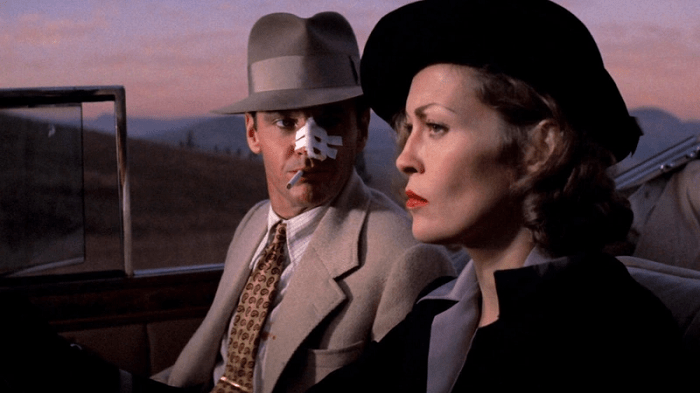
“Chinatown” comes from director Roman Polanski, a blemish that alone probably cost the film several S&S votes. But the pure quality of the movie itself stands on its own. As does the exceptional Oscar-winning screenplay from the late Robert Towne. As does the cool and charismatic lead performance from Jack Nicholson – arguably the best of his career. As does the stellar supporting work from Faye Dunaway and John Huston. As does the period set design and costumes. As does Jerry Goldsmith’s transporting score. I feel like I could go on and on.
Set in 1937 Los Angeles, Nicholson plays a private detective named J. J. “Jake” Gittes. One afternoon a woman (Diane Ladd) identifying herself as Evelyn Mulwray comes to his office. She suspects her husband, Hollis Mulwray (Darrell Zwerling), is having an affair and she wants Gittes to find out. He takes the job and upon investigating learns that Mulwray is the chief engineer at LA’s Department of Water and Power. Gittes starts tailing Mulwray, eventually snapping some photos of him with a young woman – photos that mysterious end up in the newspaper.
The next day Gittes is confronted by the real Evelyn Mulwray (Dunaway) who hits him with a lawsuit. Steamed that he’s been used by someone to disgrace Hollis Mulwray, Gittes and Evelyn cut a deal. He’ll find out who set up her husband, and she’ll drop the lawsuit. Seems simple enough, but of course it’s not. What started as an infidelity case soon gives way to lies, city corruption, and (as in most good noirs) murder. Even worse, there’s something far more sinister underneath it all.
For lovers of classic noirs, “Chinatown” fits snugly within the bygone genre and feels right at home next to the many films that undoubtedly inspired it. Yet Polanski and Towne add their own special seasoning which makes this more than just a copy-and-paste experience. Much of it is in the way Polanski plays with POV or how he shoots his sun-baked Los Angeles (DP John A. Alonzo received an Oscar nomination). But it’s also evident in Polanski’s willingness to tinker with genre conventions, to the point that we’re never certain where he’s taking us.
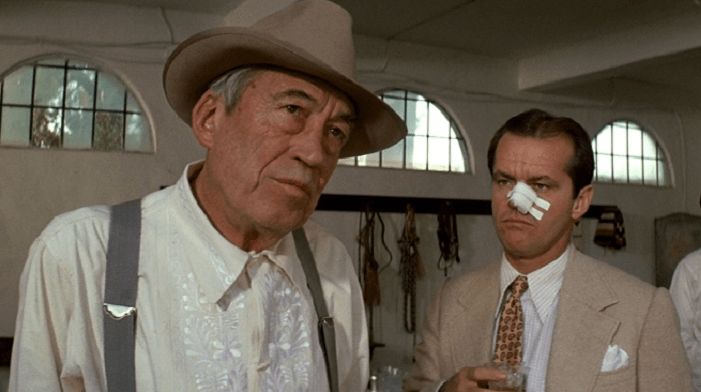
Then you have Towne’s absorbing screenplay. It has a few signature noir movie twists with everything being revealed at the very end (Interestingly, Polanski added some grit to the ending, changing it up in a way that initially frustrated Towne. Later, Towne would admit that Polanski’s climactic finish was the right choice). But there is so much more to Towne’s dense and complex story. He offers a deep and compelling spin on the California Water War and all the political deception and chicanery that went with it.
Towne also does some incredible character work. Written specifically for Nicholson, Gittes is a cynical wisecracking sleuth but with an uncommon sense of decency at his core. Dunaway’s Evelyn is an elegant and high-class femme fatale who does her best to hide her fragility. And of course there’s the devilishly good John Huston playing Evelyn’s wealthy and powerful father, Noah Cross. Towne fleshes them all out through his crackling dialogue and his patient attention to detail. They all have roles to play within his winding story, but they are also given plenty of room to develop.
“Chinatown” spends a lot of time covering a lot of ground, yet it’s surprisingly efficient. There’s simply no wasted scenes, no meaningless lines, and no throwaway moments. And while the disgraced director’s post-“Chinatown” offenses undoubtedly hang over his work, there’s a richness to Polanski’s direction. And I love how he entrusts his audience to follow along. In the end, every facet of great filmmaking can be found in “Chinatown”. And I hate to say it, but it’s hard to take a “Greatest Films of All Time” list seriously that doesn’t include this 1974 gem.

 Keith & the Movies
I do love this film though it’s not my favorite Polanski film (there’s four films of his in my list (https://letterboxd.com/thevoid99/list/roman-polanski-ranked/) that I consider to be his better films) but I do think it is a monumental achievement. To be kicked out of the Sight & Sound list is just terrible though let’s hope it comes back in 8 years time.
That’s a strong list. And you’re right…getting booted from S&S is utterly ridiculous. Really speaks to the lists credibility IMO.
I understand them wanting to put more films by women in that list but that wasn’t the way to go. Plus, how can you make a list of films when a few of these films aren’t available worldwide in various streaming services like Godard’s Histoire(s) du cinema?