

Throughout his thirty-year career, Joel Edgerton has shown himself to be an incredibly versatile actor. It’s a fact that is highlighted by the sheer array of roles he has taken on, whether in gritty crime films like “Animal Kingdom”, twisted psychological thrillers like “The Gift”, or hushed yet affecting human dramas such as “Loving”. His latest film falls into that latter category. In “Train Dreams”, Edgerton’s performance is quiet and understated yet with deep emotional depth. It’s a tremendous turn.
“Train Dreams” is the sophomore directing effort from Clint Bentley who also wrote the screenplay with his frequent writing partner Greg Kwedar. The two are coming off an Academy Award nomination for “Sing Sing”. Now they’re adapting Denis Johnson’s award-winning work which began as a 2002 short story in The Paris Review before being published as a novella in 2011. The duo bring the heart of Johnson’s story to the screen under Bentley’s assured direction. It results in one of the year’s very best films.
“Train Dreams” is a deeply affecting snapshot of life, with all of its joys and tragedies, as seen through the eyes of one man trying to find his place in a changing world. In one sense it plays like an echo of a bygone era, when the world seemed bigger and taming it came at the expense of men on the margins who tirelessly worked in the background of the rapidly expanding America. It’s also a moving and firmly grounded character study, spanning decades of one such man’s life.
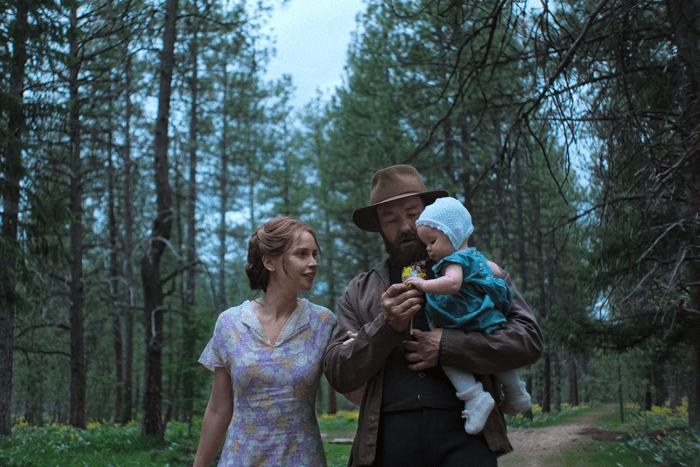
The story opens in the early 20th century during the boom of Western expansion. It follows Robert Grainier (Edgerton), an unremarkable man by the world’s standards who works as a logger in the Pacific Northwest. It’s solitary work done mostly by solitary men – a description that fits Robert well. He’s a hard worker who blends right in with the beautiful yet rugged wilderness. But underneath his burly exterior is a gentle and soft-spoken soul who mostly keeps his thoughts to himself. He’s more of an observer than a talker, yet we learn so much about him through Edgerton’s ability to speak volumes with very few words.
Robert takes a job with a railroad company, building a lengthy trestle bridge over a river gorge. It’s decent money, but it’s a decision he soon regrets. Robert witnesses the senseless killing of a Chinese immigrant co-worker in the name of justice. Despite not having a part, the guilt of not stopping it haunts Robert, prompting him to wrestle with an existential question for the remainder of the movie, “Do the bad things we do follow us in life?” After the job, he leaves the railroad and goes back to logging.
Robert’s solitude is interrupted when he meets and instantly falls for the forthright Gladys (Felicity Jones). In no time, the two end up married. They purchase an acre of land where they build a cabin on the banks of the tranquil Moyie River. Shortly after, they have a baby girl. For Robert, it’s the happiest he has ever been. And for the first time in his life he feels as if he has found his purpose. But just as he would get used to being at home, logging season would roll back around. And the jobs were taking him further and further away from home.
From the elegant opening frames, it’s obvious that Bentley is remarkably in-sync with the story he’s telling and the period he’s recreating. There is a poetic lyricism anchoring his storytelling which patiently progresses with an observant eye and a soul-stirring rhythm. There’s also a fascinating subtlety in Bentley’s handling of things, even later as Robert’s life takes a heart-shattering turn. Bentley maintains a quiet control of his material. And he knows what he has in Edgerton – an actor who can do heavy lifting with a single expression.
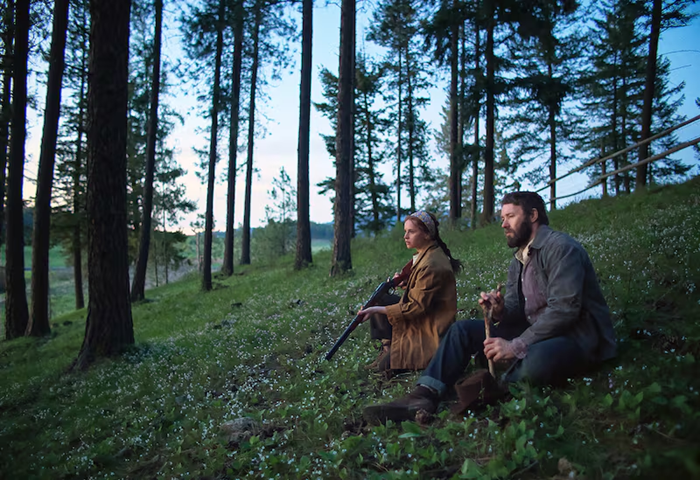
There’s also Bentley’s reliance on visual language to convey feeling while also visualizing this very distinct era. The rapturous cinematography of DP Adolpho Veloso utilizes natural lighting and an assortment of striking lens choices to capture evocative compositions that offer more than simple eye-candy. His Malickian view of nature uses the camera to show how big and vast his world is. Yet the same camera gives us rich moments of heartfelt intimacy. And it’s all complimented by Bryce Dressner’s stirring score.
While Edgerton’s sturdy stoicism and gut-wrenching authenticity firmly centers the story, some fine supporting work proves equally valuable. As Gladys, Jones finds the perfect balance between delicate and determined. A terrific Kerry Condon gets a small yet touching role as a U.S. Forestry Service worker. William H. Macy is an absolute scene-stealer playing Arn Peeples, a talkative old-timer who is good with dynamite and at avoiding hard work. And the story is guided by the mellow narration of Will Patton who also did the original audio reading for Johnson’s book.
“Train Dreams” astonishes, both as an unvarnished slice of American history and a contemplation of our intrinsic bond with nature. But it connects most as the soulful birth-to-death odyssey of one solitary man navigating a life of small triumphs and immense tragedies. Clint Bentley has delivered something so deftly crafted and richly organic while Joel Edgerton does his best work in a career full of dynamic performances. They transport us to an impeccably realized period that is ruggedly textured and lived-in. But it’s the deeply human moments between the superbly etched characters that left me speechless and overwhelmed.
VERDICT – 5 STARS

 Keith & the Movies
Your review brings great news. “Bentley maintains a quiet control of his material”. That’s what I was hoping for in this movie
It’s absolutely brilliant. I can’t praise this movie enough!
It’s a shame it is not going to play in theaters as it looks like a film that is meant to be played in the theaters. Instead, we have to deal with shitty Colleen Hoover bullshit, unnecessary sequels, and a bunch of lame shit.
It would have played insanely well on the big screen. Sadly we aren’t among the ‘limited release’ markets.
I’ll give it a go!
It’s phenomenal. I’ve seen it multiple times now and it has had quite an impact!
Pingback: The Top 10 Films of 2025 | Keith & the Movies