
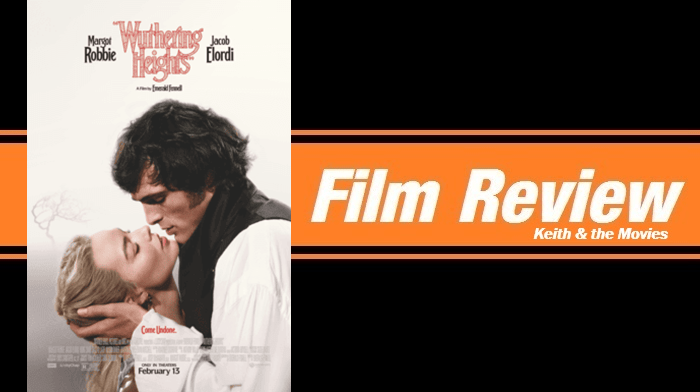
Emerald Fennell follows the empty shock value and cheap psychosexual spectacle of her previous film, “Saltburn” with an overheated and underdeveloped reimagining of a literary classic. Fennell’s new spin on “Wuthering Heights” is more in love with itself than with anything Emily Brontë put to page in her highly regarded 1847 novel. Sadly, it results in a surprisingly hollow and frustratingly scattershot exercise in overindulgence.
Fennell significantly reshapes Brontë’s story in a number of peculiar ways. So fans of the novel shouldn’t go in expecting a faithful adaptation. It starts with Fennell’s decision to transform the book’s dark, haunting, gothic tale into a soapy, sexually charged, period romance. Pseudo-eroticism is more of a focus than the raw dysfunction that Brontë explored. Also, any hint of the supernatural is erased. And main characters undergo jarring dramatic changes, often to fit within the film’s bawdy vision.
For the entirety of it unnecessarily long running time, Fennell’s story remains fixated on the relationship between Catherine (Margot Robbie) and Heathcliff (Jacob Elordi), essentially cutting out the entire second half of the novel. As a child, Catherine lived with her alcoholic and cartoonishly abusive father (Martin Clunes) in the family’s remote estate on the Yorkshire Moors. One day her father brings home an orphan boy he rescued from the street. The bossy and possessive Catherine names him Heathcliff and treats him as her pet. But over time the two children develop a close yet vaguely defined relationship.
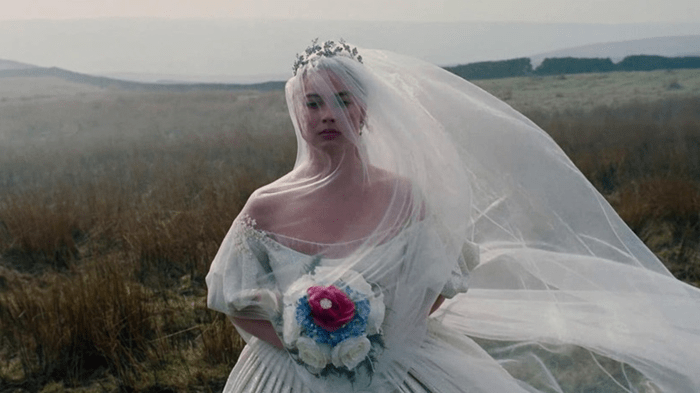
From there the film lurches forward several years with Catherine and Heathcliff now young adults yet still playfully cavorting around the neglected estate like children. That is until Catherine lays eyes on their wealthy new neighbors, the Lintons. With her father having gambled away the family’s fortune, Catherine maneuvers herself into the arms of Edgar Linton (Shazad Latif). When he overhears her plans to marry Edgar, a heartbroken Heathcliff rides away and doesn’t return.
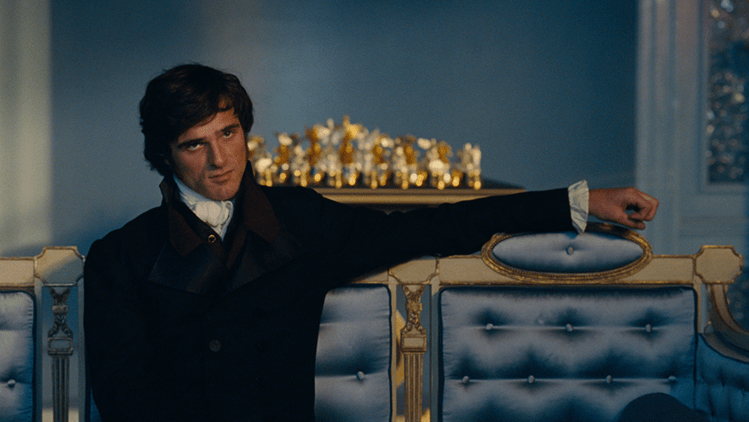
More years pass. Catherine is now married to Edgar and living a life of luxury at the Linton’s villa. But everything changes when Heathcliff suddenly returns, now mysteriously rich and more dapper than ever. Suddenly the emotions she never expressed come rushing to the surface and the two begin a torrid affair. But outside of rampant sex, Catherine refuses to commit to Heathcliff due to her marriage to Edgar and the child they’re expecting which she keeps a secret.
The rest of the story erratically bops from point to point, force-feeding us a wild array of emotions that always feel more contrived than organic. Following along is never easy because there’s never a steady measurement of passing time. Worse are the gaps in the story that lead to bizarre character shifts with little buildup, as well as undercooked relationships that never make sense. This is especially true for the increasingly mopey second half.
But while she leaves her characters and her stories begging for more attention, Fennell finds the time to inject her kinky fascinations, often to the detriment of her movie. Pointlessly crude flourishes are thrown in, seemingly to jolt the audience more than anything else. Meanwhile character work gets back-burnered to satisfy some lusty appetite. Take Edgar conveniently vanishing without a mention so that Catherine and Heathcliff can repeatedly and openly hook-up. As for Robbie and Elordi, they’re mostly served up as rain-soaked eye-candy, doing their best with what they’re given.
Whatever the goal, it’s hard to see 2026’s “Wuthering Heights” pleasing longtime fans of the novel or drawing new fans to it. But even if you take away its literary inspiration, Emerald Fennell’s latest even fails as a simple melodrama. The choppy storytelling impacts everything, including the characters who are left shuffling through ambiguity and absurdity. This despite the efforts of Robbie and Elordi, and great supporting turns from Alison Oliver and Hong Chau.
On a positive note, “Wuthering Heights” isn’t as galling or insufferable as “Saltburn”. And while its attempts at eroticism often feel silly and performative, the movie is visually sumptuous in ways that highlight Fennell’s impressive technical savvy. But overall it does nothing to recreate the excitement we felt with her debut film, “Promising Young Woman”. Instead it demonstrates a concerning trend where her expression is overwhelmed by excess.
VERDICT – 2 STARS

 Keith & the Movies
She peaked too soon with Promising YW! This sounds tawdry.
For sure. It’s not a ridiculous as Saltburn and it even has moments where it’s quite watchable. But its…not…good.
Haven’t read anything good about it at all, so I’ll pass.
Good move!
I’ll not pollute my 5star memory of the book with something like this.
Hard pass…
Very wise. Especially if you hold the original material dear.
I usually give out single digit 5star reads in a year. And I read 150 books a year, if that helps put things in perspective 😉
Wow! That’s admirable and really impressive.
Keith, I had to laugh at this: “Robbie and Elordi, they’re mostly served up as rain-soaked eye-candy,” I remember loving PYW, but when my older son told me about the plot of Saltburn (and who was in it) there was no way I was going to watch it. Let’s hope this is a humbling experience for the director and they do a better job on the next film.
LOL! It’s true – they’re always standing in the rain!!!! 🤣🤣🤣
I like them Wuthering original butterscotch
I’m sorry?
They are trying to make a play on words on “Worther’s Original Butterscotch” hard candies.
I take it from the lack of name and picture that you allow anonymous comments on your blog? If so, good for you!
I’m guessing that’s the gag. Not a great one, but ok. 🤣
Yeah. Since it wasn’t me, and this isn’t my blog, I didn’t want to say anything negative 😉
yeah
Best Birthday Ever 💜
I don’t get the hate for it. But going by some of the comments, if you didn’t like Saltburn then this was always going to be an uphill battle.
Saltburn was a fantastic movie, loved by so many (the reviews speak for themselves) and Wuthering Heights just blew this away.
This review is very contradictory, on the one hand saying it’s too long, the other saying it jumps forward too much?? I’ve seen it twice, both times the cinema was packed and both times everyone was in tears.
This is an adaptation and is Emerald’s vision and I think it is spectacular. Easily my film of the year so far and sits in my top 3 films of all time and as someone who goes to the cinema 2-3 times a week, that’s some achievement.
Anyone reading this review, watch it for yourselves with an open mind.
I appreciate you taking the time to read my take on WH.
The film’s length and it jumping forward too much aren’t contradictory. You can jump forward a lot in a long movie. And it’s not too long (IMO) strictly because of its running time. I’ve loved many movies that ran longer than it. It’s what you do within that running time that can make a movie seem to fly by or grind on for an eternity. That’s where we probably disagree most.
rubbish
I was looking forward to your review of this, because I’ve been trying to decide whether or not I wanted to give it a try. I miiiight skip it.
It’s definitely not something you should feel compelled to see at the theater. And you might want to approach it with caution if you’re a fan of Bronte’s novel. I’d really be interested in your take on it.
While I wouldn’t call myself the biggest Bronte fan, I do get a bit grumpy when any movie strays too far from the book!
Well…let’s just say this one strays waaaaaaay off. 🙂
As long as it’s horny and looks pretty, I’ll be good with it. lol
Well, it does look pretty.
Love the book. Movie was disappointing.
I think if you go in without any expectations you will love the movie. Sounds like this review is trying to compare it to her other movies? Which I never saw.. I also never read the book. Needless to say , I totally loved this movie and will go back and see it again.