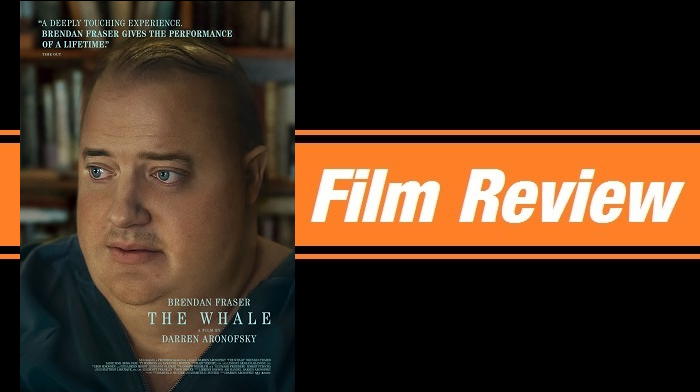
REVIEW: “The Whale” (2022)

The buzz for Darren Aronofsky’s “The Whale” has been deafening with most of the excitement swirling around Brendan Fraser’s lead performance. As a long-time appreciator of Fraser, it’s nice to see him back on screen with a meaty attention-getting role. I just wish he was attached to a better movie. As it is, “The Whale” sinks under its heavy theatrics, some frustrating character treatment, and occasions of off-putting insensitivity.

Penned by Samuel D. Hunter who’s adapting his own 2012 play, this stagy chamber piece is a hard movie to grasp. “The Whale” has enough baked-in subject matter to prompt quite a response, and it has a way of making us root for it. But getting past some of its questionable choices and shaky storytelling proved to be a big ask. Even worse, there’s a dull but nagging falseness to the film that no amount of melodrama could fully numb. And while Aronofsky demands our empathy (more so than earning it), his film can be as mean-spirited as it is heartbreaking.
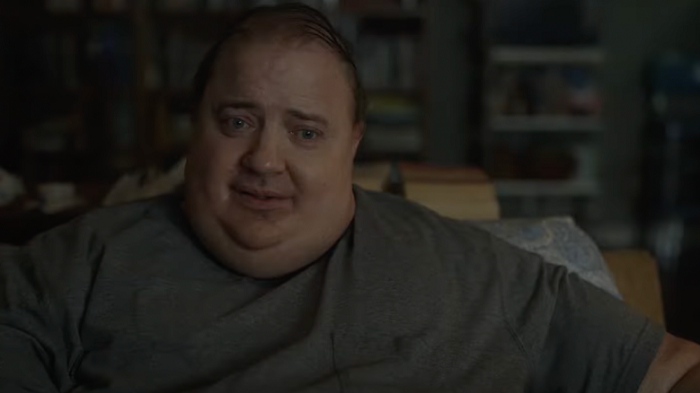
Fraser dons pounds of latex and makeup to play a morbidly obese man with congestive heart failure named Charlie. At 600 pounds, Charlie can barely get around and is home-ridden. He teaches college classes from his couch via Zoom, but hides his appearance from his online students by saying his laptop camera is broken. Even worse, Charlie has sunken into a deep depression following the death of his partner, a former student he ran off with, deserting his wife and eight-year-old daughter. The combination of grief and guilt has driven Charlie to eat himself to death.

The entire film takes place in Charlie’s dark stuffy house which contributes to its staginess. But Fraser holds our attention through a performance that features more than just a physical transformation. He’s also the movie’s emotional core. But for someone who is in nearly every scene, it’s surprising how little we learn about Charlie from Charlie. Instead, Aronofsky leans on four supporting characters who stop by the house from time to time. It shortchanges Fraser by forcing him to sit back, watch, and react to the speechifying of others.

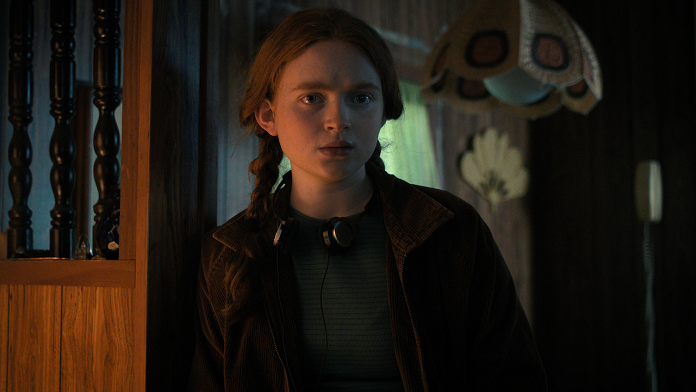
Easily the most interesting of the supporting characters is Liz (Hong Chau), Charlie’s lone friend and personal nurse. She’s irritable nearly to the point of being annoying early in the film. But we get a better grasp of her once the reasons for her frustrations surface. It’s a little different for Ellie (Sadie Sink), Charlie’s estranged daughter who’s still bitter because he abandoned her and her mother Mary (Samantha Moon). Sink is a terrific young actress, but Aronofsky keeps her stuck in one gear – perpetually angry and cruel to the point of being a bit robotic. It isn’t until her final scene that she’s actually given a chance to lower the temperature and show another side of her character.

The most poorly conceived character of the bunch is Thomas (Ty Simpkins), a door-to-door missionary who makes Charlie his own personal redemption project. Thomas belongs to some vague non-denominational church called New Life which is custom-made to be Aronofsky’s punching bag. It’s too easy of a target. But where Thomas’ story really goes off the rails is in the second half when Aronofsky introduces all sorts of corny, overwrought family drama. Thomas quickly goes from fairly interesting to annoying.
“The Whale” is weighed down by a few other frustrations. Take how the supporting characters unload their stories through glaringly staged monologues or confessions (their “big moments”). Or how the movie beats us to a pulp with its heavy-handed messaging rather than revealing it organically. You won’t find an ounce of subtlety anywhere.

But worst of all is how Fraser’s performance is sometimes lost under the heavy latex and makeup. Not due to anything he’s doing, but because Aronofsky’s gawking at the actor’s transformation sometimes veers too close to heartless voyeurism. There are times when the film seems to look at Charlie with disgust, which is at odds with its bigger message of finding a person’s beauty and goodness within. And no amount of hokey sentiment and emotional manipulation can fully earn our empathy, especially during the moments when the movie doesn’t seem to have any. “The Whale” is now showing in select theaters.

VERDICT – 2 STARS

First Glance: “Oppenheimer”

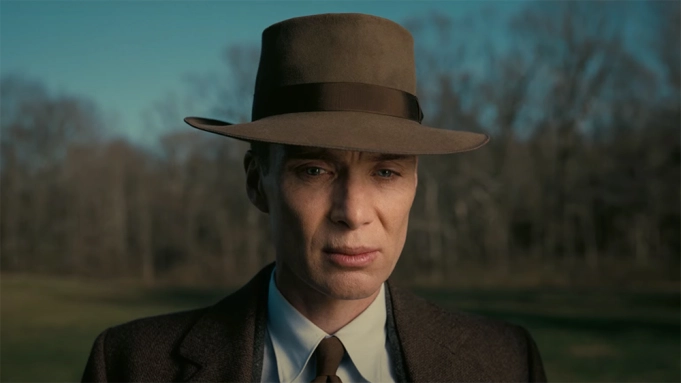
Is 2023 the year Cillian Murphy finally gets an Oscar nomination? It certainly looks like he has the material in Christopher Nolan’s “Oppenheimer”. Written and directed by Nolan, the film is his first since breaking away from Warner Brothers. It features a jam-packed cast that includes Murphy, Emily Blunt, Robert Downey Jr., Matt Damon, Rami Malek, Florence Pugh, Benny Safdie, Kenneth Branagh, and Josh Hartnett among others. That alone makes for an highly anticipated feature, but it’s the brand new trailer that really gets me excited.

The film sees Murphy as J. Robert Oppenheimer, a theoretical physicist whose role in the Manhattan Project earned him the title of “father of the atomic bomb”. The glimpses we get are of a conflicted man caught in what he feels is a no-win situation. The set and costume design looks spot-on, and you can already get a sense from the trailer than Nolan has done a ton of research. So we have a fascinating historical figure and a noted filmmaker with an incredible cinematic prowess. We might be in for something special.

“Oppenheimer” releases exclusively in theaters on July 21, 2023. Check out the trailer below and let me know if you’ll be seeing it or taking a pass.

REVIEW: “Bardo, False Chronicle of a Handful of Truths” (2022)

It seems we’re in an interesting phase where seasoned directors are using their platforms to reflect back on their pasts. Alfonso Cuarón did it with “Roma”. Last year, Kenneth Branagh did it with “Belfast”. Already this year, James Gray has done it with “Armageddon Time” and Spielberg with “The Fabelmans”. With “Bardo, False Chronicle of a Handful of Truths”, two-time Oscar winning director Alejandro González Iñárritu takes his shot, but not in any conventional sense.

Iñárritu has made a movie that demands we get into his headspace. If you can’t, odds are you’ll probably struggle with his latest film. For that reason I can see general audiences bowing out before the halfway mark. But for those who can get in sync with it, “Bardo” has a lot to offer. Of the above mentioned movies, it’s most like “Roma”, with its deeply intimate self-reflection and its cutting observations of the Mexican homeland. But what sets it apart are Iñárritu’s Fellini-like flourishes which can come across as pretentious and indulgent. But that actually plays directly into what the filmmaker is after.

With “Bardo”, Iñárritu gives us what can best be described as a narcissistic exercise in self-deconstruction. The film is undeniably self-regarding as Iñárritu makes himself a centerpiece. But there’s more going on here than some vainglorious self-promotion. Iñárritu takes a scalpel to his image and his success; his hubris and his insecurities, dissecting them the best way he knows how – cinematically. Yes, it’s a narcissistic work. But what better way for an auteur to probe and scrutinize the path they’ve traveled and the person they’ve become?

Image Courtesy of Netflix

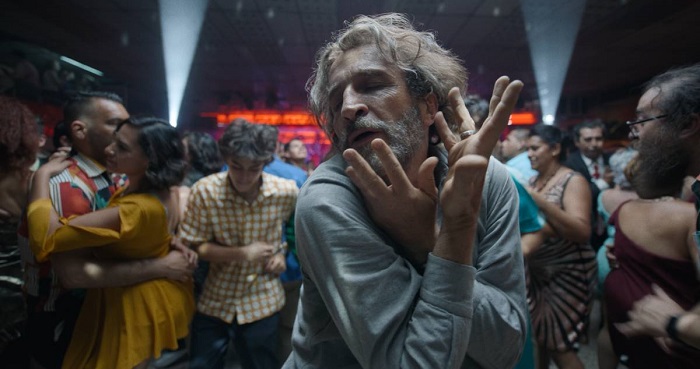
As with “Roma”, Mexico itself is an ever-present interest as Iñárritu seeks to reconnect with his homeland through his lead character and alter ego, Silverio (a magnetic Daniel Giménez Cacho). With the help of cinematographer Darius Khondji and Oscar-winning production designer Eugenio Caballero, Iñárritu envisions Mexico in a number of ways both real and surreal. It could be a scene of people collapsing at a crowded Mexico City intersection as Silverio helplessly looks on. Or an unsettling shot of him climbing a mountain of dead bodies in order to speak to Spanish conquistador Hernán Cortés who awaits at the top. There’s no shortage of alluring imagery.

Iñárritu’s story (which he co-wrote with Nicolás Giacobone) is just as immersive and incisive as the visuals. Its fractured free-flowing structure can be disorientating, and some segments make little sense on their own. But they’re individually compelling (a testament to Iñárritu’s vision) and hold our attention until everything is braided together in an emotionally satisfying final 15 minutes. In a way it does resemble a memory play, except here the people and places we see are dug out of Silverio’s unreliable memory and displayed through dreamlike recreations in his mind. Some feel painfully real while others have a Dali-like surreality. Some are deadly serious while others are utterly preposterous.

Silverio Gama is an acclaimed Mexican-born journalist and documentarian who left his home country for Los Angeles 15 years ago. Now he’s been named the recipient of a major award from the American Society of Journalists. Needing to prepare an acceptance speech, Silverio and his family travel to Mexico where he hopes to reconnect with his birth nation. But rather than find inspiration, he finds himself caught in an existential web. Soon he’s wrestling with everything from his own identity and mortality to his perception of Mexico itself, past and present. And as we’re thrust deeper inside of Silverio’s head, we’re quickly reminded that memories can’t be trusted. They tend to change as we change and are often shaped by emotion rather than truth.

Image Courtesy of Netflix

Regardless of how bonkers some scenes get, there’s always a deeper emotional tenor. For example, one of the earliest scenes takes place in a hospital operating room where Silverio’s wife Lucía (Griselda Sicilian) gives birth to their first child. I won’t spoil it, but something so utterly absurd happens that you can’t help but laugh. Yet the sheer weight of the moment has an effect that resurfaces many times throughout the story. It’s one of several instances of black comedy being fused with consequential drama.

“Bardo” can also be glaringly pretentious and self-indulgent, and Iñárritu is 100% aware of it. He’s constantly poking fun at himself and his movie. In one moment of glorious meta subversion, a character sharply critiques the very film we’re watching, relaying every real-life criticism that has been and will be hurled its way. Iñárritu’s self-awareness also shows in more biting scenes. Such as Silverio being chided for his haughtiness and hypocrisy by his wife, his son Lorenzo (Íker Sánchez Solano), and his daughter Camila (Ximena Lamadrid).

I don’t throw out the tag ‘labor of love’ often, but with “Bardo” it fits. In addition to directing, editing, co-writing, and co-producing, Iñárritu clearly sees some of himself in his lead character. In fact, with Cacho’s unruly hair, dark sunglasses and similar build, there are times you’ll swear you’re seeing Iñárritu on the screen. And you can sense the filmmaker’s touch in the searing self-critiques and the playful jabs; in the expressions of heartfelt joy and heart-crushing loss. It’s all conveyed through this near undefinable sensory experience and technical marvel. It’ll challenge you, but the ultimate payoff is worth the effort. “Bardo” is now streaming on Netflix.

VERDICT – 4.5 STARS

REVIEW: “Avatar: The Way of Water” (2022)

In 2009, the world of movies was forever changed by “Avatar”, a science fiction epic born from the mind of James Cameron. The movie was a box office phenomenon, and it remains the highest grossing film of all-time. Technically, “Avatar” was a groundbreaking film that pushed visual effects to entirely new heights. It also reintroduced 3D to the big screen, using it in the most dazzling and immersive way ever seen. Of course the 3D craze didn’t last, mainly because no one could match what Cameron was able to do with it.

But while “Avatar” was a technical marvel, its story was a letdown. It was basically ripped straight from “Dances with Wolves” but with a futuristic sci-fi angle rather than a historical one. It also suffered from Cameron’s heavy-handed sermonizing on everything from the environment to corporate America to the military. It wasn’t that he had a message. It was that he pounded us over the head without an ounce of nuance or subtlety.

After thirteen years, James Cameron is back on Pandora with “Avatar: The Way of Water”, a nearly $400 million sequel that once again pushes the art of movie special effects to the proverbial next level. It’s a jaw-dropping motion picture spectacle unlike anything I’ve seen on the big screen before. Not only does it demand to be seen in the theater, it once again sees Cameron doing things with 3D technology that no one else has ever done. Not to sound hyperbolic, but you have to see it to believe it.

Image Courtesy of 20th Century Studios

On the flip-side, Cameron isn’t best known for seamless storytelling and “Way of the Water” has its issues there. But the story is considerably better this time around, with Cameron getting away from the on-the-nose preachiness and giving us something that’s more intimate and that does a good job progressing the characters and their stories. I’m an admitted sucker for movies about family, and that theme resonates all throughout “The Way of the Water”. There’s also an overarching theme of empathy that plays out through multiple relationships.

Sam Worthington returns as Jake Sully, a former human and now full-on Na’vi. Over a decade has passed since the first film, and Jake is now chief of the Omaticaya forest tribe. There he and his wife Neytiri (Zoe Saldaña) happily raise their family which includes their oldest son Neteyam (Jamie Flatters), their headstrong second son Lo’ak (Britain Dalton), their youngest child Tuk (Trinity Jo-Li Bliss), their adopted teenage daughter Kiri (Sigourney Weaver), and their adopted human son Spider (Jack Champion) who was born of Pandora and rescued by Jake and Neytiri.

While Jake’s life seems ideal, he has long feared the return of the “sky people”, aka the Resources Development Administration from planet Earth. In the first film, the RDA came in the form of a science mission and a mining operation. But within the first few minutes of the sequel they make their return, scorching a huge section of the forest to build their massive base of operations. Rather than being accompanied by a small but aggressive security team, this time the RDA have brought a bigger military presence. And rather than mine, they’ve come to colonize – to find a new home for humanity after depleting their own world’s resources. Their first step – pacify the natives.

Leading the charge is the film’s main antagonist, Colonel Miles Quaritch (Stephen Lang), killed in the first movie but cloned as a Na’vi complete with all of his old uploaded memories. Quaritch is tasked with leading a unit of fellow recombinants to find and eliminate Jake Sully. Initially Jake, Neytiri and the Omaticaya fight back. But realizing the danger he brings to his family and people, Jake and Neytiri take their children and flee far away from the forest, eventually finding refuge with a water tribe called the Metkayina led by Chief Tonowari (Cliff Curtis) and his wife Ronal (Kate Winslet). But to no surprise, the ruthless and dogged Quaritch stays hot on their trail.

Image courtesy of 20th Century Studios

At a hefty three hours and twelve minutes, Cameron’s story covers a lot of ground. He spends a big chunk of his time on world-building, introducing his audience to a whole new part of Pandora. The Metkayina tribe make their home on a giant reef that’s full of exotic aquatic plant and animal life. Cameron and his creative teams go all out designing and visualizing this vivid underwater ecosystem with just as much time put into exploring the Metkayina culture. The movie does slow down a tad during this long middle stretch, but there’s always something new and often jaw-dropping to take in.

In addition to shooting in state-of-the-art 3D, the film also features underwater performance capture, an incredibly impressive feat requiring its own newly developed tech. Then there was the decision to shoot at a higher frame rate. There are several instances where Cameron bumps the standard 24 frames-per-second up to 48 fps, giving the film a more crisp and realistic appearance. It’s a choice that won’t be for everyone, and its clarity and quality may depend the theater screen you see it on. Personally, I loved the higher frame rate.

Of course “The Way of the Water” is also full of big eye-popping action which is something James Cameron knows a lot about. The set pieces are as thrilling as they are massive, and the above-mentioned technology really shines in them. The performances are also good with both Worthington and Saldaña especially shining. As for Lang, he’s mercifully dialed back and less hammy this time around, and the movie does some interesting things with his character. Again, the story may stumble in a few spots. But it’s still an exciting step up from the first movie. And as an experience, visiting Pandora has never felt so exciting and full of life. “Avatar: The Way of Water” is in theaters now.

VERDICT – 4.5 STARS

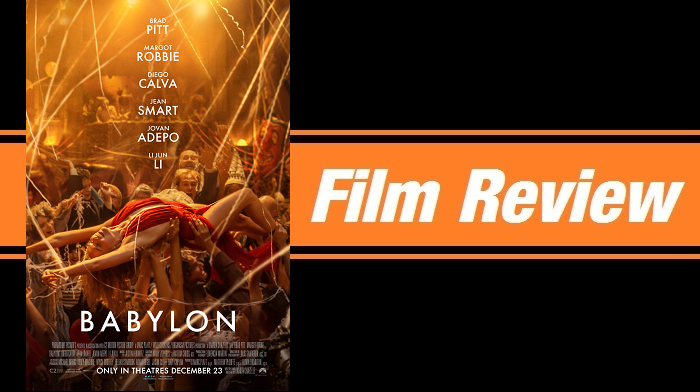
REVIEW: “Babylon” (2022)

Like three hours of fingernails scraping across a chalkboard but amped up 150 decibels, Damien Chazelle’s “Babylon” is a grating exercise that beats you down with its relentless self-indulgence. It’s a movie smitten with its own sense of grandeur and apparently pledged to the belief that the best way to depict unbridled decadence is to drown its audience in unbridled decadence. It’s a choice that wastes so much time relishing the excess, and not nearly enough on its characters and their stories.

After three straight bangers, “Babylon” is such a disappointing next movie from writer-director Chazelle. Here he’s sold himself on a coked-up ‘more-is-more’ vision that often plays like a smug and shameless vanity project. Other times it feels as if it just needs someone to step in, pull the reins, and tell Chazelle “No”. But as it is, “Babylon” seems beholden to its brash, gleefully vulgar, full-throttled approach, and the movie suffers for it.

I want to believe there’s a good Old Hollywood story buried somewhere among Chazelle’s numbing self-satisfying chaos. But even at an exhausting three hours (plus some), there aren’t enough pieces in “Babylon” to be certain. It certainly has the cast, the costumes, and the production design to recreate the era. But so much of the film’s attention is given to its own rowdy irreverent style that it fumbles its chance to tell a clear-eyed behind-the-scenes Hollywood story.

Image Courtesy of Paramount Pictures

“Babylon” sets out to chronicle the rise to stardom and eventual fall of a handful of characters in the late 1920s as Hollywood began its transition from silent films to talkies. It’s a good premise with plenty of potential. But rather than really digging into his characters, Chazelle revels in their self-destruction. So much so, that most of his later attempts at empathy ring hollow. And that’s emblematic of the larger tonal issues that plague the film, especially in the second half. Chazelle’s sudden turns towards the more serious can come across as half-hearted and clash with nearly everything else he gives us.

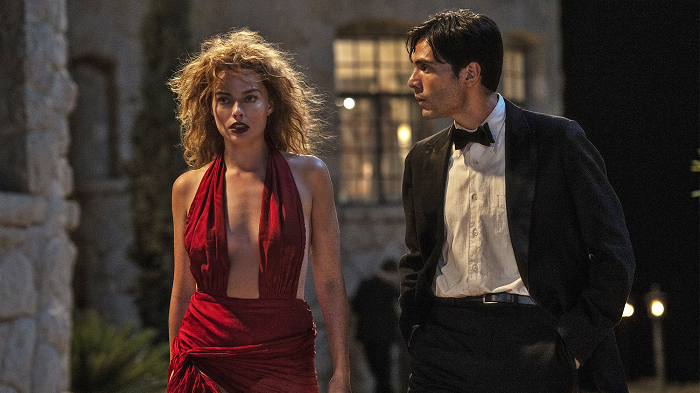
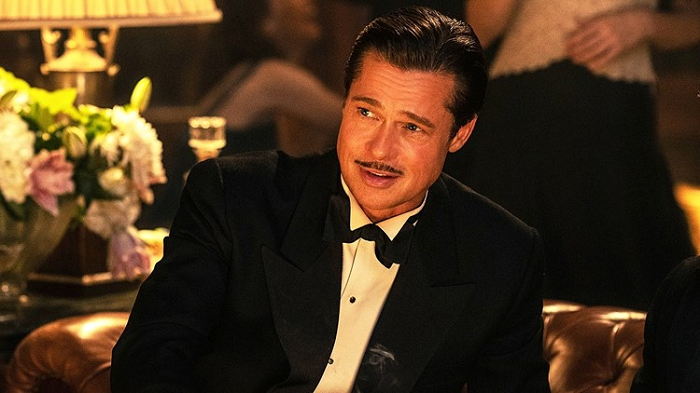
A cranked up Margot Robbie plays Nellie LaRoy, a self-christened star from New Jersey who just needs to get her foot in Hollywood’s door. Brad Pitt plays Jack Conrad, an established but aging silent movie star at a critical point in his career. Diego Calva plays Manny Torres, a studio film assistant who has always dreamed of working in the movies. Chazelle uses these three characters (and a few undercooked others) in his attempt to tell a story of a shifting industry and society. But while the three performances are up to par, the movie is far more interested in using them for its showier self-interests rather than giving any of their characters enough depth for us to care.

Nellie is a careening ball of self-destructive energy who hardly ever tones it down enough for us to get to know her. She’s little more than a hedonistic showpiece for Chazelle’s camera, constantly dialed up past 10, and often more of a caricature than a real person. Jack is the closest we get to a fully fleshed out character. But even with him, most of the details are either confined to two or three brief scenes or left out altogether. And then there’s Manny who should be our connection to the story but who is mostly relegated to standing off to the side. Oh, and he’s in love with Nellie for reasons I still haven’t quite figured out.

Image Courtesy of Paramount Pictures

As it turns out, the most interesting people we meet are two supporting characters. Jean Smart gets a bit part playing a tabloid Hollywood columnist named Elinor St. John who always seems to know more than she lets on. And Jovan Adepo plays Sidney Palmer, a Black jazz trumpeter who has the most grounded point-of-view of anyone in the film. But again, these are small roles and we only get tidbits of their stories. They’re great pieces that hint at what “Babylon” could have went for.

As “Babylon” hurtles forward, we’re treated to some great music and a number of elaborately staged set pieces. We’re even teased with some late scenes that hint at a slightly deeper interest in the characters. But whenever you think the movie has reeled itself in, we get more amped up nonsense. Take a long and draining final act sequence with Tobey Maguire (looking like death warmed-over). It’s one of many examples of Chazelle’s overconfidence in his instincts.

Fittingly I suppose, the film’s ending is as phony as anything I’ve seen in years. It’s meant to suddenly evoke some feelings in those who truly love movies. But it takes more than the flickering light of a theater projector and leeching off of a classic like “Singin’ in the Rain”, especially after everything Chazelle has thrown at us by that point. I didn’t feel any new love for cinema. I hadn’t learned anything about the history of Hollywood. I didn’t better appreciate the magic of moviemaking. Frankly, I was just thankful it was over. “Babylon” hits theaters December 23rd.

VERDICT – 1.5 STARS

REVIEW: “The Eternal Daughter” (2022)

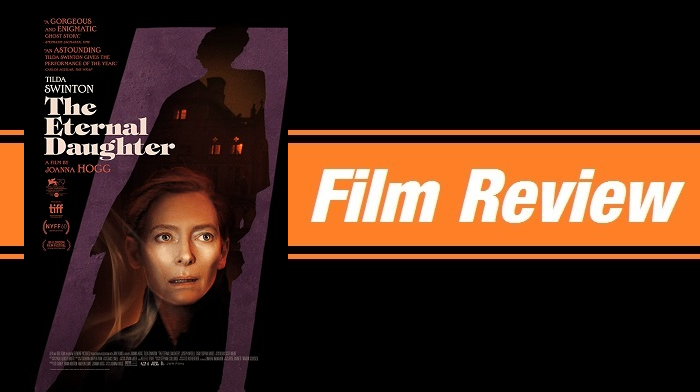
Tilda Swinton captivates in “The Eternal Daughter”, the latest from distributor A24 that for some reason seems to have fallen through the cracks this awards season. Sadly the film hasn’t received much of a push which is unfortunate considering it’s one of A24’s best films of 2022. Written and directed by Joanna Hogg, this poignant and haunting mother/daughter elegy begs to be contemplated as it tinkers with genre and subverts our expectations, all as Hogg pulls from some deeply personal places for inspiration.

“The Eternal Daughter” was shot during the COVID-19 lockdown which makes sense considering the mostly single location and minuscule cast. But whatever constraints were in place never make it onto the screen. That’s because Hogg’s keen control of her audience, both through her well managed direction and eloquently crafted script, never allows us time to ponder any of its limitations. Instead she keeps us firmly focused on her two main characters, Julie (Swinton) and her mother Rosalind (also Swinton).

Image Courtesy of A24

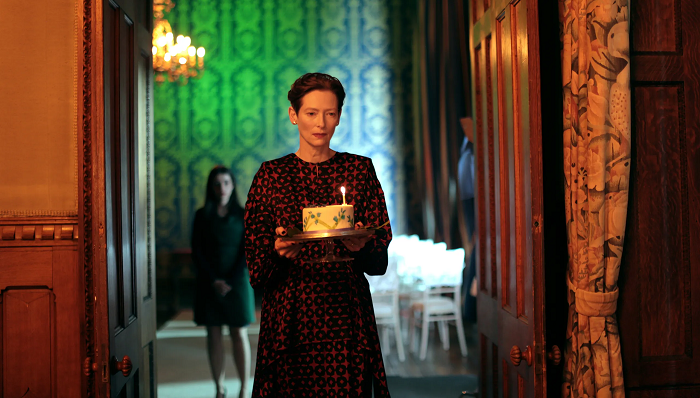
The movie begins with a chatty cabbie driving Julie and Rosalind across the foggy countryside, eventually arriving at Moel Faman Hall, a remote hotel set in an old rural manor. It’s somewhat of a mother and daughter getaway to celebrate Rosalind’s birthday but with some special meaning. We learn that Moel Faman Hall was where Rosalind grew up as a child, well before it was turned into a rustic bed-and-breakfast.

Upon arriving Julie goes to check in and is greeted by the seemingly empty hotel’s snooty and disinterested receptionist (a really good Carly-Sophia Davies) who takes them to their room. It’s not the room they reserved, but the receptionist doesn’t seem to care. Instead she hops in the car with her boyfriend and leaves for the evening. Quite the opposite is Bill (Joseph Mydell), the kindly nighttime concierge who pops up later and is always willing to lend a hand. He’s a tender soul with his own personal attachment to the hotel.

So Julie and Rosalind settle in for the evening. As they do, Hogg treats us to one of my favorite things about her film – the small intimate exchanges between mother and daughter, so natural and organic that they immediately triggered sweet memories of my own mother and grandmother and the relationship they shared. These tender moments are scattered all throughout the movie, and they’re aided by Swinton’s graceful dual-role performance which evolves into something even more impressive over time. It’s great work from Swinton who’s no stranger to handling this type of challenge.

Image Courtesy of A24

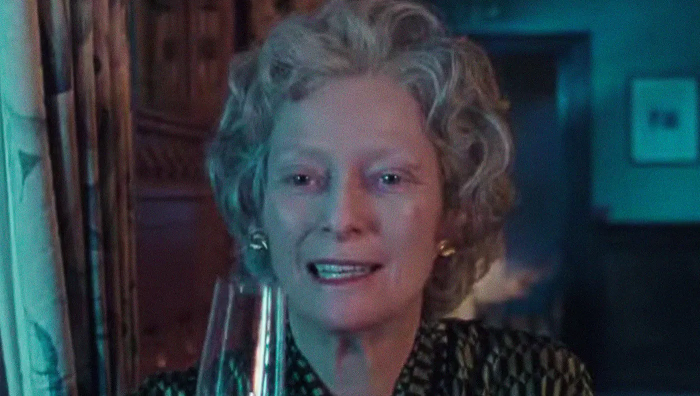
For Julie, what follows are several restless nights where she constantly hears unexplained noises from the vacant floors above and even sees a ghostly old lady peering out the windows. Hogg plays around with our perceptions, not just of what we see on screen but also in how we view her movie as a whole. Is it a horror movie? The drafty creaky interiors, the thick evening fog that engulfs the manor, even the eerie wailing music that feels plucked right out of an early “X-Files” episode make you wonder. But as Hogg patiently reveals her real interests, we begin to get a better grasp of what’s really going on. It just takes cracking her code to get to the heart of the movie.

Though modestly budgeted, “The Eternal Daughter” looks amazing in large part thanks to the textured 16mm cinematography from Ed Rutherford. There’s also some crafty camera trickery, even craftier editing, and terrific makeup design. It all beautifully serves this thematically rich drama which clearly comes from a place close to Hogg’s heart. And ultimately it’s that personal touch that makes her thoughtful self-reflection resonate as intensely as it does. “The Eternal Daughter” is now showing in select theaters.

VERDICT – 4.5 STARS