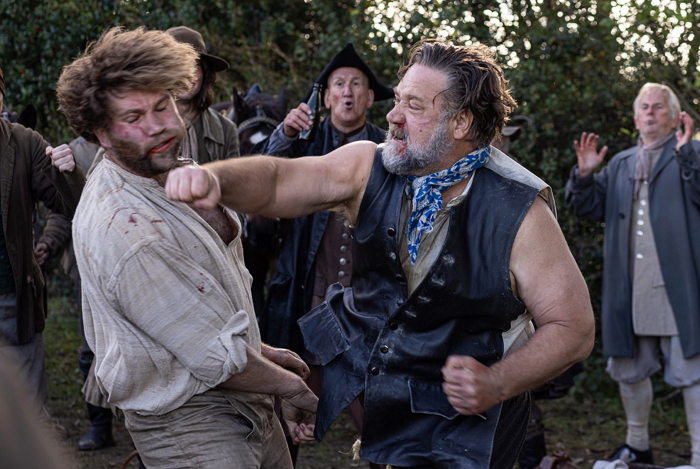
Russell Crowe, Ray Winstone, and Matt Hookings shine in the new trailer for “Prizefighter: The Life of Jem Belcher”. While it explores the life of the bare-knuckle fighter and first ever world champion, the film is also about the birth of boxing itself. The British-American feature is directed by Daniel Graham from a script penned by the film’s star, Hookings. It’s had a rocky production, marred by infighting and money issues. But it was finally finished with Amazon Prime set to distribute.
The story takes place at the turn of the 19th century. Hookings plays the titular character while Winstone plays his trainer and father-figure Bill Warr. A burly Russell Crowe plays Belcher’s rough and tough grandfather. Belcher seems to follows in his grandfather’s shoes, making the same mistakes but also excelling as a fighter. The period costumes and production design looks great and having the always reliable Crowe and Winstone onboard really adds to the appeal.
“Prizefighter: The Life of Jem Belcher” hits Amazon Prime Video on July 22nd. Check out the trailer below and let me know if you’ll be seeing it or taking a pass.
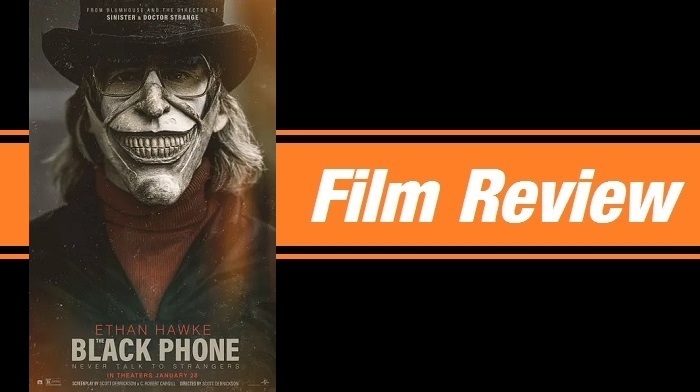
Ethan Hawke as a masked child-abducting psychopath in the late 1970s? Yep, I’m in. That’s part of the setup for “The Black Phone”, a spooky supernatural horror film from director Scott Derrickson (“Sinister”, “Doctor Strange”). I was onboard after first hearing the names involved. One great trailer and a creepy poster later and “The Black Phone” moved pretty high up on my ‘Most Anticipated’ list.
This Blumhouse produced chiller is based on a 2004 short story by Joe Hill, son of Stephen King. Derrickson co-wrote the script with his frequent collaborator C. Robert Cargill. For “The Black Phone”, the pair pull from several horror sub-genres, even injecting their story with a crafty crime-thriller element. But what it does best is capture its period setting and develop a truly menacing atmosphere. There are a couple of hard-to-miss oversights which had me scratching my head. But as a whole, the movie sucks you in and keeps you firmly planted on the edge of your seat.
Image Courtesy of Universal Pictures
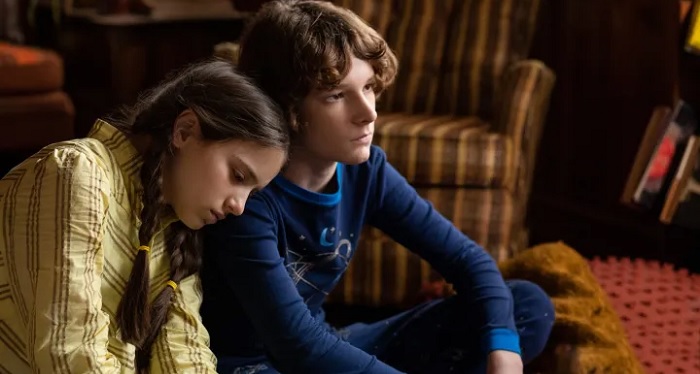
Set to a well conceived 1978 backdrop, the story unfolds in a tight-knit neighborhood in North Denver. A young boy named Finney (Mason Thames) has plenty to fear. He’s constantly hassled by a pack of punk bullies at school. His widowed father (Jeremy Davies) is an abusive drunk who takes out his loneliness and grief on his children. Oh, and then there’s the string of missing children in the area, some who Finney knows well.
At least Finney has his precocious little sister Gwen (a terrific Madeleine McGraw). The two are extremely close and often find refuge in each other. While Finney is a bit more reserved and non-confrontational, Gwen couldn’t be more different. She’s a fireball and (unfortunately) one way the filmmakers show it is with the tired and overdone potty-mouthed child trope which they milk for a cheap laugh or two. What makes Gwen so compelling isn’t her slinging f-bombs. It’s her come-and-go psychic abilities similar to ones her late mother possessed. It adds a compelling layer to the her character and the story.
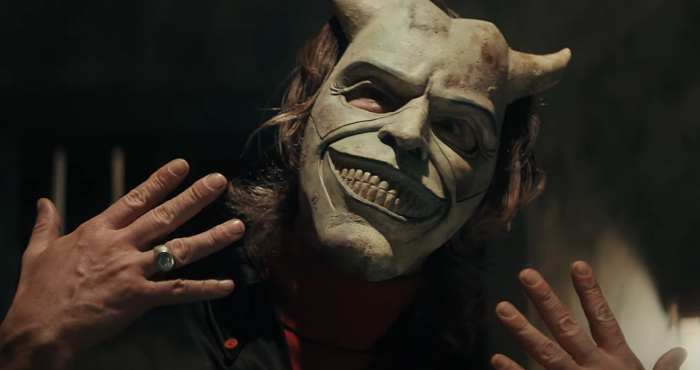
Strangely, despite the rash of neighborhood child abductions, parents seem pretty lax and let their kids roam the streets unattended. So it’s no surprise when Finney is snatched by the man dubbed “The Grabber”. Hawke plays him with an unsettling calm, laced with brief yet terrifying bursts of violence. I love Derrickson’s choice not to reveal his face. We get one slightly blurred image during Finney’s abduction. Otherwise his face remains mostly hidden by a hideously disturbing mask.
Interestingly, we never really learn anything about The Grabber. His anonymity is meant to add to the dread. He poses as a part-time magician who cruises around town in a black van with the words “Abracadabra” painted across it. There are also his black balloons that may or may not be a signature. The aura of mystery mostly works although the character does fit a tad too neatly into the movie serial killer archetype. Still Hawke is pretty great and his first foray as a true villain is quite effective.
Image Courtesy of Universal Pictures
Finney is thrown into a concrete soundproof basement with a dirty toilet, a mattress bolted to the floor, and a disconnected black rotary phone hanging on the wall. To the boy’s surprise, the phone periodically rings and on the other end are voices that I won’t spoil, by they offer tips to help him escape. And then you have Gwen’s dreams which seem to reveal hints to where her brother may be. In a sense these supernatural components offer a cool twist. But they also bring a “Stranger Things” vibe to parts of the story. That’s not necessarily a bad thing, but don’t expect something grittier and more grounded.
Though its story is hardly seamless, “The Black Phone” keeps its audience locked in by maintaining its sinister tone and building some true edge-of-your-seat suspense. And it’s a lot of fun watching Hawke dig into such an evil character. To no one’s surprise he’s really good. And while I wish there was a little more backstory to The Grabber, Hawke carves out such a frightening presence that you’re too engrossed to focus on the missing details. “The Black Phone” is out now in theaters.
I’ve never owned an Elvis Presley album. I’ve never been to Graceland. I’ve never watched his famous “Aloha from Hawaii” concert. I’ve never cared for his movies. Yet despite all of that, I fully understand the greatness of Elvis Presley. I’ve always recognized his long-lasting impact on American culture. And you can’t help but respect his legions of passionate fans who truly love the man dubbed the “King of Rock and Roll”.
Though I’m not what you would consider a true fan, I do like a handful of Elvis’ songs and it’s hard not to be fascinated by the larger-than-life presence he still maintains, some 45 years after his untimely death. That’s a big reason I was excited for “Elvis”, the new biographical odyssey from director and co-writer Baz Luhrmann. For me, the name Luhrmann comes packaged with uncertainty. I enjoyed his take on “The Great Gatsby” more than most. But I’ve struggled to connect with his style-driven filmmaking and haven’t particularly enjoyed his other movies (in fairness, I’ve yet to see “Strictly Ballroom”).
“Elvis” is quite the undertaking, and while Luhrmann’s style is certainly present, it never overpowers the film or festers into overindulgence. In fact, it often energizes the movie in a way similar to how Elvis himself would energize a crowd. Most importantly, Luhrmann shows enough restraint to keep this about the man himself. As a result, we get a film that brilliantly captures Elvis’ outer grandeur but also his inner demons. Call it an exhilarating cinematic portrait of triumph and tragedy.
Image Courtesy of Warner Bros. Pictures
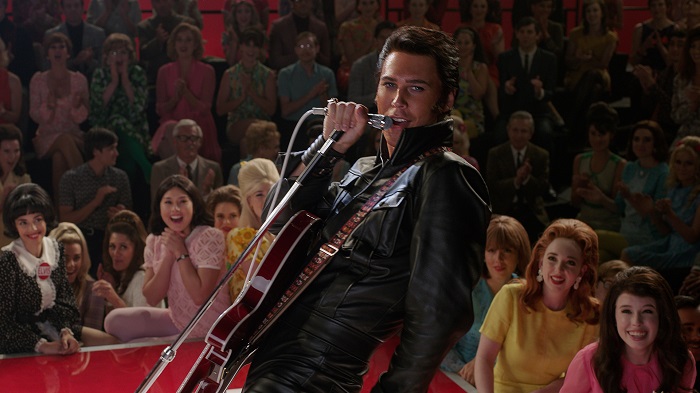
It can’t be easy taking on a lead role destined to be so heavily scrutinized. But Austin Butler not only takes it on, he gives a star-making turn that makes any qualms with his portrayal feel like nitpicks. It’s more than just a spot-on impression. Butler burrows into the very soul of Elvis, highlighting his many ups and later his devastating downs. It’s a tough ask for a young actor that’s made even tougher by Luhrmann’s feverish directing style. But Butler is magnetic in what is a nomination-worthy performance.
“Elvis” attempts to cover a ton of ground in its hefty 159-minute running time. From his poverty-ridden childhood to his final days pushing himself to perform despite his failing health. It makes many personal and career stops in between, never staying in one place very long (especially in the first half of the movie). I’m not sure how much will be new to the well-studied Elvis fan. But for people like me, there’s a lot to soak up. It’s like fever-pitch CliffsNotes for the Elvis uninitiated.
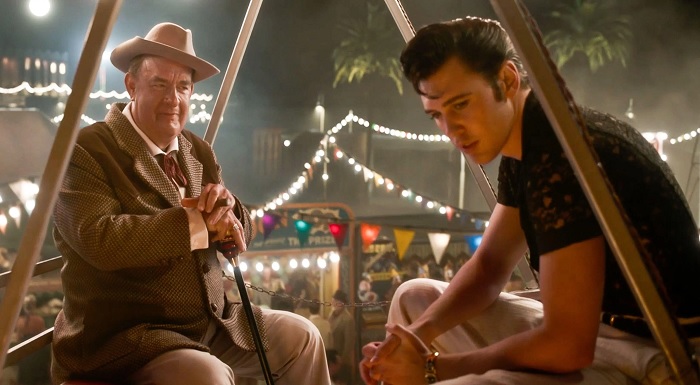
In an interesting move, Luhrmann and his team of co-writers (Sam Bromell, Craig Pearce, and Jeremy Doner) choose to tell much of the story from the perspective of Elvis’ long-time manager and promoter Colonel Tom Parker (played by Tom Hanks in various layers of latex and body suits). It’s framed as Parker on his deathbed, defending himself and his dubious reputation. Over the course of film, we’re asked the question: Was Colonel Tom Parker a villain or a visionary? The movie credits him as both, even making the case that Parker both made Elvis and killed him.
Image Courtesy of Warner Bros. Pictures
Col. Parker was a P.T. Barnum wannabe who saw gold in a good-looking young man from Memphis. Elvis was driving a truck by day to help support his family. When off work, he spent his time losing himself in the music of Beale Street. His long-held love for the Blues and African-American spirituals would forever shape his music. It was a song the younger Elvis recorded with Sun Records that caught the attention of Parker who quickly signed him and took him on his Southern tour which also featured country music artist Hank Snow (David Wenham).
Things take off in 1954 at the Shreveport-based Louisiana Hayride. That’s when Parker knew he had something special. Before long Elvis was his top draw. Parker secured his budding superstar client a deal with RCA Records, booked numerous television appearances, and tapped into the lucrative world of merchandising. Soon the “snowman” was raking in 50% of the “showman’s” earnings, taking advantage of Presley’s star wattage for his own personal gain
Luhrmann whips us through Elvis’ meteoric rise in popularity while also showing the harsh accusations of indecency and vulgarity he would face (The movie speaks to a deeper motive behind the outrage, namely Elvis’ connections with African-American music in the deeply segregated South). It touches on his short-lived tenure as a movie star, his triumphant comeback special in 1968, and his multi-year deal with The International Hotel in Las Vegas.
On the personal side, Luhrmann does a good job capturing Elvis’ closeness with his mother, Gladys (Helen Thomson) and the loving yet businesslike relationship with his father, Vernon (Richard Roxburgh). He shows us Elvis falling for and eventually marrying Priscilla Beaulieu (a very good but underutilized Olivia DeJonge). We see his purchase of Graceland and the pride he took in being able to support his family. And of course we see his genuine love for music and performing which shines most whenever Elvis took the stage.
Image Courtesy of Warner Bros. Pictures
But there was also the dark side of Elvis’ story. Luhrmann shows the crushing loss of his mother; his disappointment in his father; the revelation of Col. Parker’s double-dealing. We see his marriage crumble, watch his health deteriorate, and witness his growing reliance on pills. It culminates in a heartbreaking yet undeniably beautiful performance of “Unchained Melody” from 1977, just days before his tragic death at the age of 42.
While Luhrmann’s direction is key, Elvis is most vividly brought to life through Butler who pours his heart and soul into his portrayal. Everything about his performance clicks, from the few quiet moments to the high-energy stage numbers where his resemblance to Elvis really kicks in. It leaves you wanting more screen time for Butler. Unfortunately too much of the focus is on Parker who is both narrator and a steady presence throughout. The performance is fine, but too often all I could see was Tom Hanks in prosthetics rather than Colonel Tom Parker. I wanted more Butler.
At times Luhrmann’s kinetic pacing can make things a blur. And it doesn’t allow you to settle down and get comfortable during any stop the story makes on the Elvis Presley timeline. Normally that’s something I would struggle with. But here it feels right, especially for such an electrifying roller-coaster of a life. To Luhrmann’s credit, his film had its hooks in me from its first moments. And even though I’m not a big-time Elvis fan, this movie brought him to life in ways I wasn’t expecting. Now if you’ll excuse me, I’m off to plan a trip to Graceland. “Elvis” is now showing in theaters.
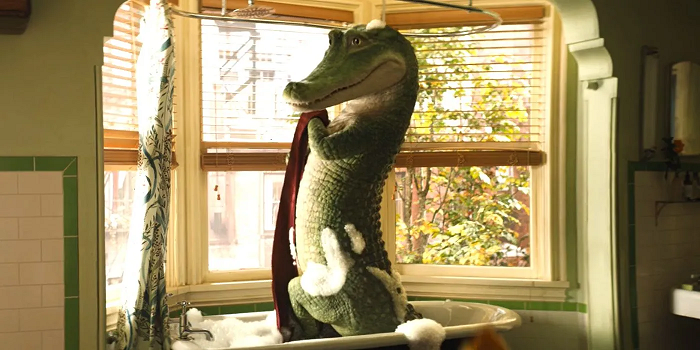
Look, I’m a big fan of Javier Bardem and I’ll watch pretty much watch everything he does. But even I may not be able to handle “Lyle, Lyle Crocodile”, the upcoming musical comedy set for release this fall. I say that after watching the first trailer which left me speechless (and not in the good way). The film revolves around an anthropomorphic crocodile that falls in with a New York City family (sounds strikingly familiar to Paddington and the Brown family in London, right?).
Shawn Mendes voices the titular talking croc who shocks the Primm family by showing up in their bathtub. Before long Lyle’s eccentric owner, Hector P. Valenti (Bardem) arrives to ease the family’s apprehension. But there has to be a villain and here it’s Mr. Grumps (Brett Gelman) who believes Lyle belongs in a zoo. Along with Bardem, the attractive cast also includes Constance Woo, Scoot McNairy, and Winslow Fegley. If only the movie looked half as good as the cast.
“Lyle, Lyle Crocodile” opens in theaters October 7th. Check out the trailer below and let me know if you’ll be seeing it or taking a pass.
There was a time when I was quite the basketball fan. It was back when college teams could keep players for more than a year and the NBA was brimming with personalities who went by such names as Magic, The Mailman, Clyde the Glide and Hakeem the Dream. I loved booing the Bad Boys from Detroit, cheering for the Seattle Supersonics (who always came up short), and watching Michael Jordan in his prime cement himself as the greatest of all-time.
But for me the NBA lost a lot of its grit and college basketball started to feel watered down as players began (understandably) jumping ship for pro ball. Still, the sport has never had a shortage of extraordinary and inspirational stories. And while I may no longer be an avid basketball fan, I’m still very much a movie guy who loves good stories. For decades movies have used basketball to tell some really good ones. Movies such as perennial favorite “Hoosiers”, William Friedkin’s underrated “Blue Chips”, or more recently 2020’s surprisingly great “The Way Back.”
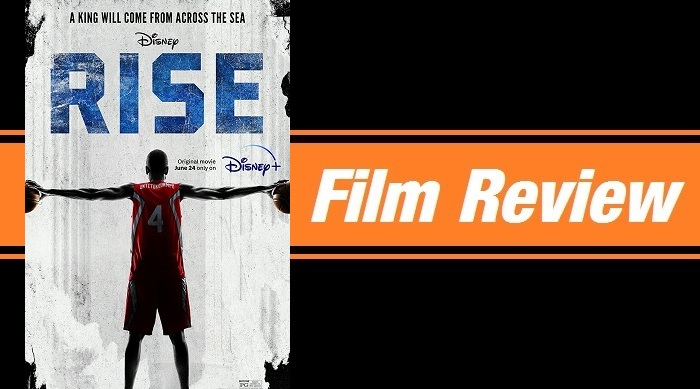
Whether you’re a basketball fan or not, the story of NBA Champion and two-time NBA MVP Giannis Antetokounmpo is about as inspiring as they come and it comes to light in Disney’s new film “Rise”. Directed by Akin Omotoso, written by Arash Amel, and with Giannis serving as executive producer, “Rise” is a biographical sports drama that dodges most of the snares that come packed with the genre. “Rise” does what most of the best ones do – it focuses as much (if not more) on character than basketball. In this case, it’s about a tight-knit family and their remarkable yet trying journey towards a better life.
Image Courtesy of Disney Studios
From the start, “Rise” puts the bulk of its attention to Giannis’ family and the hardships they endured before basketball. It opens in 1990 with a heartbreaking scene as Charles and Veronica Antetokounmpo (wonderfully played by Nigerian-American actors Dayo Okeniyi and Yetide Badaki) leave their infant son Francis with his grandparents in Lagos, Nigeria. They then make the arduous journey to Greece, dodging immigration roundups and finally landing in the north Athens neighborhood of Sepolia. Their plan was to quickly bring Francis over as soon as they’re settled, but they soon find themselves stymied by an impossible citizenship process.
“Rise” offers a surprisingly candid look at immigration, from the broken systems themselves to the suffering they can cause. The Antetokounmpo’s story is a prime example. In order to get legal residency in Greece, Charles or Veronica needed to have a payroll job. But they can’t get a payroll job without legal residency. This left them working low-paying jobs just to make ends meet. Meanwhile the looming threat of deportation made living a normal life next to impossible.
As the movie streaks forward, Charles and Veronica have four sons in Greece. Most of our time is spent with the oldest, Thanasis (Ral Agada) and of course Giannis (newcomer Uche Agada). Early on we see the boys hawking cheap souvenirs to tourists just to help their family get by. Later we see them stumble upon the game of basketball. Both Giannis and Thanasis are instantly hooked and begin sneaking across town just to play at a free youth club.
Image Courtesy of Disney+
Their parents eventually find out leading to some inevitable family tension. Veronica wants to let the boys play and have some semblance of a normal youth. Charles is a protector and is worried about his family’s status being exposed. It’s a dilemma that only intensifies as Thanasis and especially Giannis begin to excel at the game. Do they push towards the dream of playing professional basketball at the risk of revealing themselves to more and more people? It’s a question the movie tackles with a lot of heart.
Omotoso’s heavy focus on building this family’s dynamic is the biggest reason “Rise” works so well. We genuinely feel we know these characters from where they start to where the movie ends. We see the four brothers sleeping in the same twin bed. We see Giannis and Thanasis sharing the only pair of basketball shoes they can afford. We watch the hard-working Charles and Veronica do everything they can to shield their children from the precariousness of the family’s situation.
But we also see moments of love and happiness. And by the time the 2013 NBA Draft rolls around, we have such a rooting interest that we really don’t mind when the predictable feel-good elements kick in. That’s because “Rise” earns our emotional investment. And even though we ultimately know the outcome, the film’s payoff is just the kind heartwarming satisfaction we’re looking for. Sure, it’s a bit syrupy. But sometimes a little syrup hits the spot. “Rise” premieres today on Disney+.
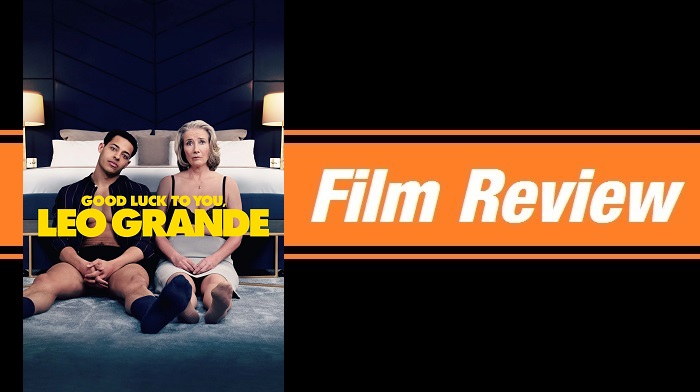
Yet another film from this year’s Sundance Film Festival’s crop that slipped by me. “Good Luck to You, Leo Grande” is a pandemic era feature from director Sophie Hyde that earned a lot of attention following its premier in January. The film explores themes of self-discovery and fulfillment in a way that is sure to resonate with most women. At the same time, it does so through a means that is sure to speak to some far more than others.
Emma Thompson and Daryl McCormack lead this intimate two-hander that mostly sustains its interest throughout its four-act structure. In this obvious COVID-era production, the two stars are handed a challenging task and manage it admirably. Meanwhile screenwriter Katy Brand’s story of a widowed former schoolteacher and a considerably younger sex worker mines a surprising amount of depth and personal detail from her two characters. Yet as a movie, “Good Luck to You, Leo Grande” starts strong, adds some compelling layers, but comes unglued in an unfortunate final act that never quite rings true.
Image Courtesy of Hulu
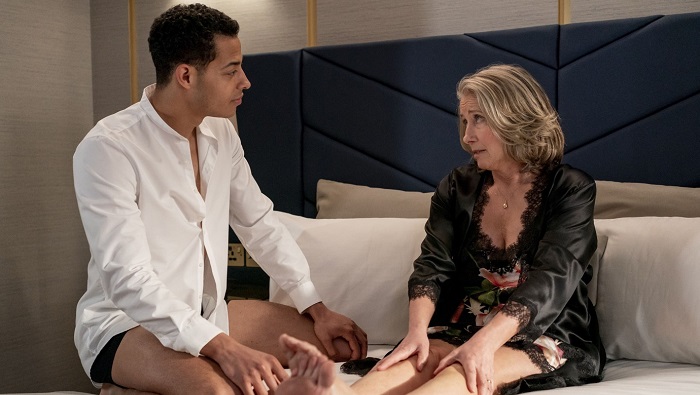
The movie opens with a woman (Thompson) entering a hotel room. Her name is Nancy and she looks to be in her mid-sixties (the movie never tells us). She’s clearly anxious and after changing shoes nervously begins checking out the place. We then shift to a coffee shop where a young man named Leo (McCormack), roughly in his late twenties, checks his phone and the heads outside. He has appointment with a new client at a nearby hotel. Of course, that client is Nancy.
Upon Leo’s arrival to Nancy’s hotel room, we learn he is sex worker and Nancy has prepaid for his “services”. The hunky Leo oozes self-confidence yet he’s gentle and almost saintly through Hyde’s lens. He says all the right words, has endless patience, and often speaks like he’s leading a therapy session. Nancy on the other hand is quickly overcome by second thoughts. Trepidation sets in as she wrestles with feelings of shame, embarrassment, and insecurity. Soon she’s scrambling for any excuse she can find to not to go through with it.
Leo pours a couple of glasses of champagne to help break the ice and lighten the mood. And so begins this 97-minute movie that takes place almost entirely in this single hotel room. While sex necessitates a portion of the story’s preoccupation, it’s not as salacious as the premise may sound. In fact, the most seductive element of “Good Luck to You, Leo Grande” is the honesty it brings to Nancy and Leo in the first two acts. It isn’t until the clunky final chapter that a frustrating sense of artificiality creeps in. And it’s here that the movie ends with an awkward sex montage which feels more like the script fulfilling a self-imposed expectation than a true ‘coming into her own’ moment for Nancy.
Image Courtesy of Hulu
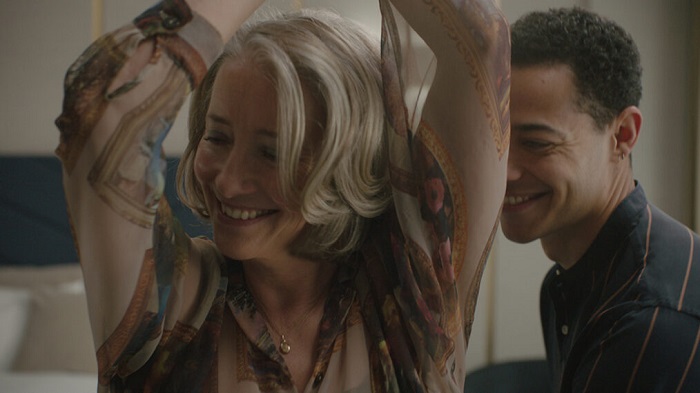
Far more compelling is watching Thompson and McCormack unpack their characters through their many dialogue-rich conversations. The performances are fantastic, especially from Thompson who’s a conduit for the audience and the conscience-driven questions many may have (even though the film’s positions are never in doubt). But when she really starts peeling back Nancy’s layers, we see a woman woefully uncomfortable in her own skin and full of regrets for the life she never lived. But we also see touches of haughtiness and condescension in how she talks about her two adult kids (one is “too boring”, the other has too much fun) or the kids she once taught in school.
Despite the solid performances, many moments of heartfelt sincerity, and its impressive juggling of tenderness and the risqué, “Good Luck to You, Leo Grande” still evolves into something pretty predictable. And there’s also the preposterous nature of the story. I certainly don’t claim to be an expert, but I can’t imagine this is how Leo’s particular pay-for-service business generally works. But worst of all is the slapdash fourth chapter that nearly undoes the film’s more encouraging message of finding contentment and discovering self-confidence. “Good Luck to You, Leo Grande” is now streaming on Hulu.







 Keith & the Movies