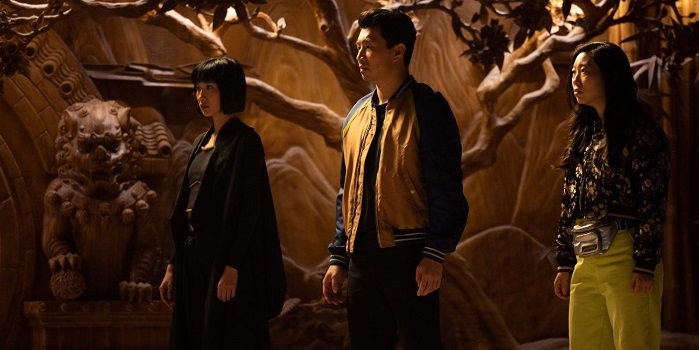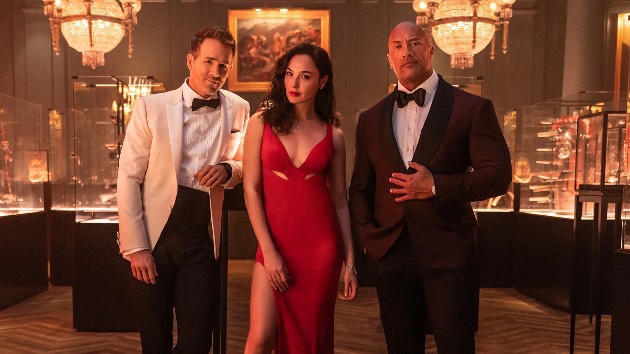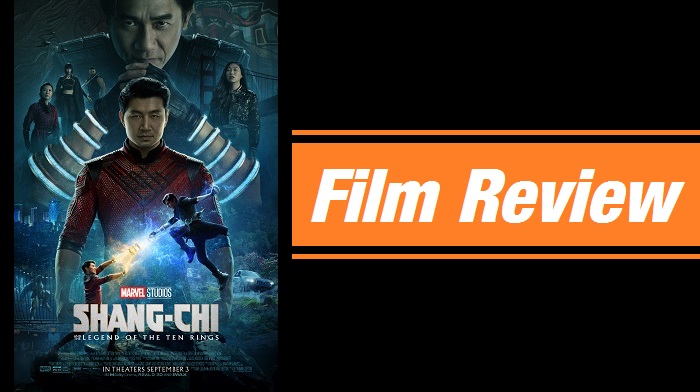
Marvel Studios seems prepped and ready for their next big box office blitz. “Black Widow” finally hits theaters in July. “Shang-Chi and the Legend of the Ten Rings” arrives in September. And then you have November’s “Eternals”, the star-studded superhero ensemble film co-written and directed by recent Oscar winner Chloé Zhao. That peculiar mix of filmmaker and material is enough to make me want to see the film. But outside of that I’m having a hard time getting excited for this particular MCU installment.
The new teaser trailer gives us just a glimpse of what this $200 million blockbuster has in store for loyal MCU followers. It’s great seeing Gemma Chan have such a prominent spot in the clips we get. We also see Angelina Jolie, Salma Hayak, Richard Madden, Kumail Nanjiani, Barry Keoghan, and others. We learn practically nothing about this secret team of immortal protectors, but we do get to see them all costumed up. I figure that will be enough for the multitude of Marvel die-hards, but I found it to be surprisingly generic. In fairness it is just a teaser. But I need more than famous faces in spandex.
“Eternals” hits theaters November 5th. Check out the trailer below and let me know if you’ll be seeing it or taking a pass.
Emilia Clarke stores away her English accent (and Mother of Dragons renown) in the new movie “Above Suspicion”, a grimy southern noir from Australian director Phillip Noyce. The film was shot all the way back in 2016 but is just now finding its way to American screens. That type of hesitation doesn’t exactly exude studio confidence. While watching the film it’s pretty easy to detect the cause for concern. At the same time, the movie is kept afloat by its compelling lead and just enough surface-level treatment of its true story inspiration to keep things interesting.
“Above Suspicion” is based on Joe Shakey’s book of the same name, a non-fiction work that tells the tragic story of Susan Daniels Smith. I’ll stay away from detailing Smith’s story as doing so would leave no real reason (other than Clarke) to watch the movie. I say that because one of the film’s biggest issues is that it leaves too much meat on the bone. The movie we get seems content with touching on the high points of the story which are certainly worth covering. But Noyce never seems confident in his approach to the material and screenwriter Chris Gerolmo can’t make the story as compelling as it should be.
Image Courtesy of Lionsgate
Clarke is the one real highlight here. She puts a nice accent onto dialogue that’s caught somewhere between authentic and full-blown Southern stereotype. Set in the Appalachian Mountain valley town of Pikeville, Kentucky in 1988, Clarke plays Susan Smith, a young mother whose life has been one bad beat after another. She’s always wanted to get out of Pikeville, yet she almost seems bound to the tragic hand she has been dealt. Instead she’s stuck living in a trailer park with her abusive ex-husband Cash (Johnny Knoxville). “There’s only two ways to make money in this town since the mine shut down,” she says at one point. “One is the funeral business and the other is selling drugs.” Cash is certainly no funeral director.
Stuck in a dead-end world of drugs and rural poverty, Susan sees a way out when ambitious clean-cut FBI agent Mark Putnam (Jack Huston) moves into town with his wife (Sophie Lowe) and their new baby. Hungry to climb his way up the Bureau’s ladder, Mark is there to track down a serial bank robber, something that would put a significant notch in his belt and get the attention he craves from his bosses.
When Susan and Mark eventually meet, he convinces her to become an informant. Professionally, their partnership proves fruitful for both of them. Mark gets closer to his big bust and Susan gets some much needed cash for every bit of information she provides. But then they cross the line and the two begin a steamy affair that quickly sours. Feeling he has too much at stake (professionally more so than at home), Mark decides to moves on. But Susan is having none of it which leads their story down a darker and more sordid path.
Image Courtesy of Lionsgate
As you can tell, there is plenty here for a good rural crime thriller especially with two capable leads like Clarke and Huston. Yet from start to finish, the movie remains as tepid as its generic title. It’s never boring. It simply fails to explore the human complexities that should be the centerpiece of a story like this. Even the film’s well-meaning style choices feel dated and unneeded. Susan’s narration, the drab color palette, the sweaty close-ups – none of it enhances the story or the characters in any meaningful way.
“Above Suspicion” has a story worthy of being told but it’s emphasis is too often on the wrong thing. It’s a shame because even amid the clichés and character types Emilia Clarke gives a strong performance that will probably go unseen by many. That’s because the film does little to stand out and set itself apart. And it isn’t helped by all the time spent sitting on the shelf and the almost non-existent promotion once it was finally set for release. Still, if you’re looking for something to watch at home you could do a lot worse, even though the film itself could have been a lot better. “Above Suspicion” is now streaming on VOD.
Auschwitz survivor Primo Levi wrote “Monsters exist, but they are too few in number to be truly dangerous. More dangerous are the common man, the functionaries ready to believe and to act without asking questions.” The thrust of that quote forms the backbone of Luke Holland’s engrossing new Holocaust documentary “Final Account”. In it Holland condenses twelve years of work and nearly 300 interviews into a 90 minute study of how passivity can open the door to great evil and how denial of one’s complicity can take many different forms.
There is a tag at the end of “Final Account” that captures Holland’s relationship to this subject – “In the memory of my murdered grandparents and millions of others.” This was a personal journey for Holland who sadly died from cancer shortly after completing the film. He sought to capture the German point-of-view from some of that generation’s few remaining voices. Some were simply witnesses; others were active participants. Either way it’s fascinating (and sometimes shocking) to hear them in their very own words now 75 years since the end of World War II.
Image Courtesy of Focus Features
When dealing with the Holocaust, movies of all types tend to examine it through the pained eyes of the countless victims. But Holland’s interview-focused documentary takes a different approach, seeking out those connected in different ways to the Nazi Party and Hitler’s Third Reich. Soldiers from the Waffen-SS, officers, bookkeepers, concentration camp guards, party officials – just some of the people Holland talks to who offer a startling array of responses to that dark time in German history.
The plethora of different opinions and perspectives coming directly from the mouths of people with first-hand knowledge is both fascinating and utterly unnerving. Elderly men and woman in the final stages of their own lives share feelings ranging from remorse and regret to outright denial. Some reminisce with an appalling tinge of nostalgia. One lady chuckles as she talks about hiding her SS boyfriend from American troops. While blindly defending an area concentration camp, a man states “most people benefited from it”. A former Nazi officer proudly shows off his service medals while defiantly defending Hitler’s “honor”.
Other people plead ignorance only to later undermine their claims by recalling distinct details such as the smell of human flesh as Jews were burned alive in a nearby camp. Many defended their passivity by saying they had no choice; that they would have been executed had they spoke or disobeyed. You see some of this when Holland sits down with a group of four women at a nursing home in Austria who offer different accounts of their days growing up close to a nearby work camp. “We knew nothing,” one says. “Everyone knew,” argues another.
Image Courtesy of Focus Features
Perhaps most enlightening are the scenes where Holland asks the interviewees what drew them to the Nazi Party. Nearly all were brought in when they were young, one as early as 9-years-old. Many were indoctrinated at school where teaching propaganda and anti-Jewish sentiment to children was a prominent part of Hitler’s recruitment. By the age of 14 many had joined Hitler’s Youth. For some “participation was mandatory,” we’re told. A few spoke of that time with a sense of shame, but most talked about it as if reflecting on ‘the good old days’.
Moments like those permeate nearly every frame of “Final Account”. Luke Holland stays away from anything showy and there is a minimal use of archived footage. It can make the film feel a little dry, but it allows him to focus on the people he interviews and their direct testimonies. Much of Holland’s questioning is designed to make them sit in front of his camera and express whether or not they should be considered perpetrators. Some genuinely wrestle with a question and more importantly the answer. But most have found unconvincing ways to exonerate themselves in their own minds, with some going as far as to proudly boast of having “no regrets”. Hearing people from our current day clinging to such venomous ideology is hard to stomach, but that is a big part of what makes Holland’s film so effective and powerful. “Final Account” hits select theaters today (May 21st).
“American Traitor: The Trial of Axis Sally” is the new film from Michael Polish that tells the story of Mildred Gillars, later given the nickname “Axis Sally”. She was an American broadcaster who shared propaganda over the airwaves for Nazi Germany during World War II. After the war she was taken into custody and put on trial by the US government. But it was quickly learned that her case was far from cut-and-dry.
The film sees Al Pacino in his first role since his Oscar-nominated work in “The Irishman”. He plays James Laughlin, an attorney tasked with defending Mildred Gillars (played by Meadow Williams) who faces eight counts of treason. “You are right now at this very moment the most hated person in America,” he tells her. I’m a sucker for a good courtroom drama and I’m interested in seeing how this one turns out. It may not be the best trailer, but the story is intriguing and watching Pacino is (almost) always a treat.
“American Traitor: The Trial of Axis Sally” comes out May 28th. Check out the trailer below and let me know if you’ll be seeing it or taking a pass.
It’s great seeing Eric Bana not just getting a leading role, but getting a really meaty one in a movie that lets him show why he’s such an underrated actor. “The Dry”, an Australian thriller from director Robert Connolly, marks Bana’s first feature film appearance since 2017. Written by Connolly and Harry Cripps, it’s an adaptation of Jane Harper’s 2016 crime novel of the same name about a man unexpectedly thrust into the middle of a brutal crime case and forced to reckon with a buried mystery from his past.
Connolly begins by locking us into his setting – the once thriving farm town of Kiewarra now decimated by a crippling drought (we learn it hasn’t rained in 324 days). What’s left of the economically depressed community now lives among dried-up riverbeds, sun-scorched fields, and the ever-present threat of bushfires. DP Stefan Duscio opens the film by panning over the dry barren landscape, his camera slowly moving across the cracked earth and endless acres of dusty parched wheat before honing in on a remote farmhouse. As the haunting cries of a baby echoes in the background, Duscio takes us inside where we make a gruesome discovery.
Image Courtesy of IFC FIlms
Bana plays Aaron Falk, a federal agent living in Melbourne who returns to his hometown of Kiewarra for the first time in over twenty years. He’s there to attend the funeral of a childhood friend named Luke (played in flashbacks by Martin Dingle-Wall). The story goes Luke murdered his wife and young son but left his infant child alive. He then went out near a dried-up pond and shot himself. No one in town questions it save for Luke’s grieving parents (Bruce Spence and Julia Blake). After the funeral they plead with Aaron to look into the case and see what he can find. He reluctantly agrees.
Aaron begins working with jittery and inexperienced local police sergeant Greg Raco (Keir O’Donnell) who is happy to have some help with the case. Aaron also reconnects with an old friend Gretchen (Genevieve O’Reilly). But not everyone in Kiewarra is happy to have him back. Not only do they resent him digging around in what they believe is a cut-and-dry double murder-suicide, but Aaron’s presence rekindles old suspicions that he was responsible for the death of a classmate named Ellie (BeBe Bettencourt) twenty years earlier.
This two-pronged story actually flows together nicely thanks to Connolly’s moody slow-burn approach which gives plenty of time to the characters and to sorting out the dual mysteries. On one hand the struggling townsfolk are still reeling from the present day tragedy. On the other you have the hard feelings and animosity rooted in the town’s troubled past and exacerbated by twenty years of lies, deception, and buried secrets. For some locals Aaron’s return causes those old wounds to fester. Meanwhile Aaron has to finally deal with the circumstances that led to him to leave Kiewarra in the first place.
Image Courtesy of IFC Films
Equally vital to the story are the flashbacks we get to Aaron’s teen years which flesh out his friendships with the bullish Luke, the tender Gretchen, and the troubled Ellie. Connolly expertly grafts these scenes into his main story, using them to feed us information and methodically fill in pieces to his puzzle. And the performances from the young cast call back to a happier much different Kiewarra. In fact even the cinematography stresses how things have changed. The flashbacks have an almost idyllic glow and highlight a time when the grass was green and muddy water reached the riverbanks. It’s a sharp contrast both physically and figuratively to the present day’s dry arid terrain.
“The Dry” isn’t a particularly original idea but it features enough fresh touches to give it its own unique identity. The whole thing is anchored by a terrific Eric Bana, weathered and stoic yet sensitive and empathetic. He plays his character at the just the right temperature, sinking into the stark backdrops and mixing well with the exceptional supporting players. He’s never been better. The story doesn’t shoot for the big showy climax and it ends a little abruptly. But for a movie that puts mood, atmosphere, and characters ahead of big twists and turns, it kinda makes sense. “The Dry” opens May 21st in theaters and on VOD.
Stephen Chbosky, best known for helming 2017’s “Wonder” and 2012’s “The Perks of Being a Wallflower”, is back in the director’s chair with the teen musical “Dear Evan Hansen”, an adaptation of the Tony Award winning stage play by Benj Pasek and Justin Paul. The film stars Ben Platt who won a Tony himself for starring in the stage version. The first trailer dropped yesterday and is a little hard to read. In fact you wouldn’t even know it was a musical until close to the end when Platt suddenly breaks out in song.
The 27-year-old Platt plays Evan Hansen, an insecure and isolated high school student who pens letters to himself as recommended by his therapist. A classmate played by Colton Ryan snatches one of Evan’s letters hours before committing suicide. The boy’s parents find the letter and think it was written from their son to Evan leading to complicated but well-meaning deception that sees Evan forming a close bond with the grieving family. The film sports quite a cast including Julianne Moore, Amy Adams, Kaitlyn Dever, Amandla Stenberg, and Danny Pino. The trailer really lays on the emotion and sure seems to lay out pretty much the entire story. I’m not sure what to think of it.
“Dear Evan Hansen” opens in theaters September 24th. Check out the trailer below and let me know if you’ll be seeing it or taking a pass.