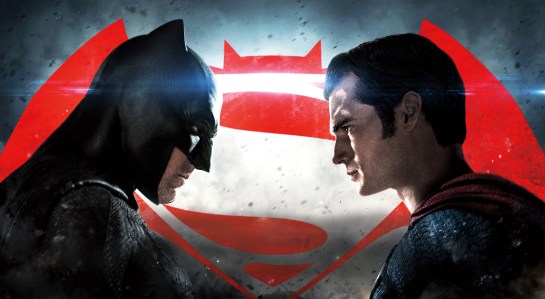
REVIEW: “Batman v Superman: Dawn of Justice”

BVS poster

Was there ever any realistic way this movie was going to satisfy? The mere title alone suggests a weighty and wildly ambitious undertaking. It also not-so-subtly hints at the film’s position as a launching point for a new cinematic universe for DC Comics and Warner Brothers. Iconic characters are re-introduced and portrayed by a host of new people. Oh, and Zack Snyder is back behind the camera. You see, there were plenty of reasons for apprehension.

At the same time I think “BvS” was destined to be a polarizing film. It was almost guaranteed a cynical approach from critics, many of whom proudly promote their superhero fatigue and who dislike it when a superhero movie dares to take itself seriously. And let’s be clear, this film takes itself VERY seriously. It is dark, dour, and whimsy-free. And while that has been the most popular point of criticism, for me it is a strength because “BvS” offers a nice contrast to the Marvel formula which many folks measure all superhero movies by. I welcome an alternative.

Perhaps the most interesting thing (and the most off-putting for some) is how Zack Snyder shows no interest in placating movie sensibilities. By that I mean he is clearly fixated on making a film that is devoted to its comic book roots. That makes sense of the aforementioned seriousness and the overall tone of the story and its characters. But it also accentuates the few instances where Snyder wildly misses his mark – instances where his devotion to his source material all but vanishes.

BvS1

While I don’t feel his previous film “Man of Steel” was nearly as bad as many think, I still maintain that Snyder is an odd choice to entrust your entire cinematic universe to. In this case Warner Bros. entrusted over $250 million to a director known to lean heavily on spectacle often at the expense of his story. “BvS” is certainly never short on spectacle but thankfully the story is never an afterthought. In fact the opposite is true this time around. “BvS” packs a ton of story into its bulging 150 minute running time.

“BvS” uses the much maligned finale of “Man of Steel” as the story’s launching point. Ben Affleck’s Bruce Wayne was in Metropolis the day Superman and General Zod battled, destroying half of the city and killing thousands of people. 18 months later he views Superman as a global threat who needs to be dealt with. He also sees conquering Superman as a cure for his frustrations with fighting a losing battle against crime in Gotham. As for Batman, thankfully the film doesn’t make us sit through another origin story. Just a brief crash course during the opening credits.

In this universe Bruce has been Batman for 20 years (At one point Alfred, played with expected precision by Jeremy Irons, chides him by saying “You’re too old to die young”). Here Bruce is even more bruised and hardened due to several devastating events in his life. Affleck is quite good as a withdrawn, moodier Bruce Wayne tormented by dreams of his past and an inner rage that is becoming harder to control. Affleck nicely handles the character’s emotional complexities, the physicality, and the mandatory Batman growling.

Across the bay in Metropolis Superman (Henry Cavill) finds himself loved by some and despised by others. In the aftermath of the Zod incident he has become the focus of public and media scrutiny as well as the target of several government inquiries. It’s a struggle for the conflicted Kryptonian who can’t seem to balance the adoration with the disdain. His alter-ego Clark Kent still pushes stories for the Daily Planet and has grown closer with Lois Lane (Amy Adams). I still consider Cavill to be a good Superman although at times he still struggles with being a tad too stiff and emotionless.

BvS2

But the film’s biggest wild card comes in the form of Jesse Eisenberg. Remember when I said Snyder shows a devotion to the comics. Well, just for a moment pretend I didn’t say that. Eisenberg plays a thirtysomething Lex Luther, the heir to his father’s fortune and most notably his company, Lexcorp. Eisenberg has some good moments but he also has several cringe-worthy and jarring deliveries. But the biggest problem is with how the character is written. Snyder and company don’t give us the shrewd, conniving businessman Lex Luther. Instead we get a version which is more loopy and manic. His similarities with the popular comic book villain are few. Perhaps it was an attempt to modernize the character. Unfortunately he often teeters between tolerable and downright annoying.

And of course there is Gal Gadot as Wonder Woman. Snyder chose to reveal her as a character early and that definitely raised the hype. I would have loved to have seen the reaction if we hadn’t been told about her role or seen her in the trailers. Inevitably some will be frustrated at her lack of screen time. Personally I loved her and aside from a few shaky line readings, Gadot exudes confidence in making Wonder Woman her own and planting herself firmly within this universe.

But how does the film bring all of these ingredients together? A popular gripe is that the story is convoluted and incoherent – that the characters are thin and their motivations are cloudy. I found “BvS” to be surprisingly coherent and pleasantly methodical with how it lays out its story. The motivations are clear although occasionally questionable. Snyder and company are deliberate in putting their pieces on the board, and while I never found it tiresome, this does add to a running time that probably should have been trimmed down.

And then there is the visual presentation – the meat and potatoes of any Zack Snyder film. “BvS” gives us so many fun scenes featuring these beloved pop culture icons. Snyder’s crafty eye guides Larry Fong’s fabulous cinematography from the quietest scene to the biggest action set piece. “BvS” looks consistently great at least until the very end. The action-fueled finale has a few stumbles both visually and narratively. It becomes a back-and-forth mixture of eye-popping visual effects and glaringly obvious CGI.

BvS3

But perhaps most fun is spotting the places where the film pulls from or pays homage to so many signature storylines from Batman and Superman’s comic book history. Some are actually integral parts to the story while others may be found in the form of well placed Easter eggs. And of course there are hints of what’s to come in future films. Sure some of these teases are obviously wedged into the story, but that didn’t make them any less entertaining and some are quite crafty. I had too much fun with them to nitpick about their inclusion. Fan service? Certainly, but I’m fine with it.

“BvS” does have some head-scratching moments that often clash with what you know about these characters. The finale is a bit too long and visually uneven. Eisenberg’s character and performance is all over the place and a bit of a distraction. After that I’m sure if I looked hard I could find several other things to pick apart, but frankly nothing else is near the magnitude to trump my enthusiasm for this film.

The dust is still settling from the critical lambasting as many have made “Batman v Superman” their cinematic punching bag of the moment. Thankfully my experience with the film was drastically different. I had no problem following the story, understanding the motivations, or investing in the characters. I love that these heroes aren’t copy and pasted from past films. I had no problems with it being dark, serious, and humorless. I wasn’t troubled by the dream sequences, the foreshadowing, the fan service. “BvS” left me smiling and genuinely excited for where the universe is heading. Perhaps it is the naive fanboy in me, but I can’t dismiss the fun I had with this film and I love it as an alternative to the obvious Marvel blueprint. Now I’m ready to see what is next.

VERDICT – 4.5 STARS

4.5 STARS

REVIEW: “Irrational Man”

IRRATIONAL POSTER

By now it has been well established that Woody Allen is the most hit-or-miss filmmaker of our time. When he hits his mark we get sharp, witty, and sometimes magical character studies. But when he shoots wide the results are often dull, plodding, or simply vainglorious exercises in nothingness.

At 79 years-old Allen continues his practice of churning out one movie each year. There’s something to admire about that. It is also admirable that he can still write and direct his films on his own terms. But the problems become obvious when you examine the collective quality of his work particularly in his later years. The sheer lack of consistency is glaring which leaves me wishing he would dump his annualized obsession.

IRRATIONAL1

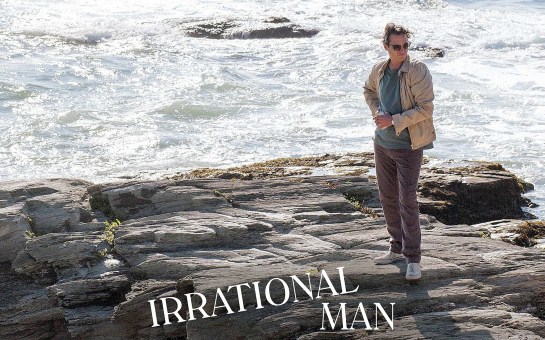
“Irrational Man” is a perfect example. It’s another clumsy and self-important mess of a film that feels like a handful of ideas thrown together and then connected by line after line of narration. It’s also Allen in full pseudo-intellectual mode with steady injections of existential thinking and human philosophy (“Irrational Man” is also the title of a popular philosophy book by William Barrett). Unfortunately none of Allen’s musings offer an ounce of weight to a movie in desperate need of it.

The meandering first act introduces us to Abe Lucas (played with waffling interest by Joaquin Phoenix). He’s a new philosophy professor at Braylin College. Wallowing in his own existential crisis, Abe a miserable, brooding recluse but still not without his fans. Rita (Parker Posey) is an unhappily married fellow professor who is instantly smitten with Abe. The two develop a quick and self-serving relationship but even it doesn’t pull Abe from his emotional mire.

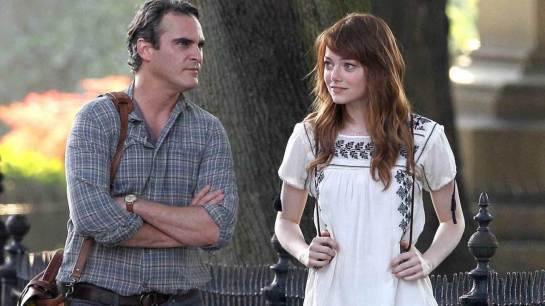
Things slowly begin to change for Abe as he grows closer to one of his students Jill played by Emma Stone (Yep, again we have Woody Allen creepily exploring the ‘older man and younger woman’ territory). At first she seems like a philosophy groupie but the two eventually become friends despite Abe’s emotional lethargy. Jill begins slowly chipping away at Abe’s walls. One serendipitous encounter with a troubled young mother later, and Abe has found a new purpose in life and his relationship with Jill turns romantic.

I won’t give it a way, but after about 40 minutes of blathering the plot’s direction makes an about-face and heads in a completely different and oddly intriguing direction. As absurd as it is, the plot turn does inject the film with some much needed narrative energy. Even it isn’t handled perfectly but it does give these characters more to do than just represent Allen’s self-reflections through long inflated conversations.

IRRATIONAL2

The new story angle isn’t enough to save “Irrational Man” from its plethora of problems. Even Woody Allen’s direction seems unsure of itself and several creative choices simply don’t work. Take the overuse of the Ramsey Lewis piano riff. It goes from catchy and stylish to boring and repetitive simply because Allen is constantly using it. There is also a surprising visual torpidity that is obvious throughout the entire film. The look of the movie is as bland and generic as anything Allen has ever done.

For all the promise the film teases and for any potential that may be there, ultimately “Irrational Man” comes across as paper-thin. There are also a number of indicators that this may have been a terribly rushed production. Whatever the reasons, perhaps now is the time for Allen to buck this yearly movie thing and concentrate on giving us one more of those truly magical experiences.

VERDICT – 2 STARS

2 Stars

The 2016 Blind Spot Series: “Ace in the Hole”

ACEposter

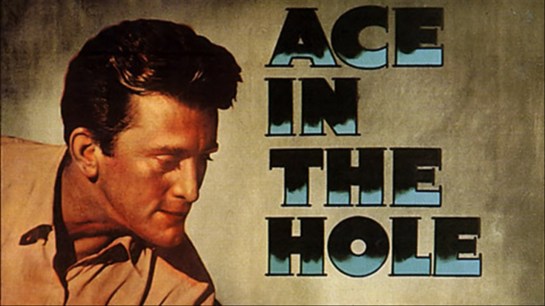
There is a black heart at the center of Billy Wilder’s searing 1951 noir “Ace in the Hole” (previously titled “The Big Carnival”). Wilder was never one to shy away from taking critical looks at American idealism and “Ace in the Hole” may have been his most cynical film. There is no coddling or repression. It’s a stinging indictment and no one gets off the hook.

“Ace in the Hole” was initially considered a failure. That was a first for Wilder and a surprise coming right on the heels of his immensely popular and Oscar-winning “Sunset Boulevard”. Audiences didn’t turn out and critics (many having their prides pricked by the film’s sharp edge) blasted the movie. But in truth “Ace in the Hole” was a film ahead of its time and over the years opinions have drastically changed.

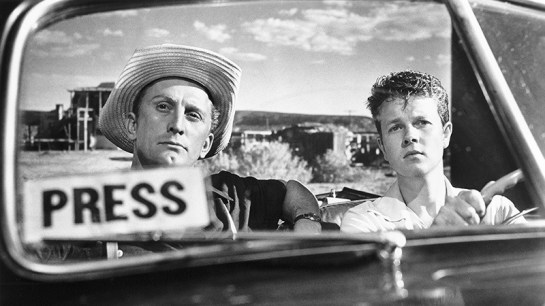
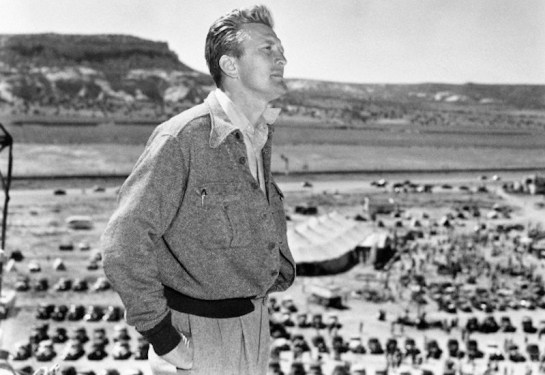
Kirk Douglas was an actor who could convincingly play the most noble of men or the vilest louse. Here he tackles the latter in the form of Chuck Tatum, a self-centered, bitter-tongued news reporter who has lost jobs in several major newspaper markets due to his hard drinking and insubordination. When his car breaks down in Albuquerque, New Mexico he bamboozles his way into a job with the small-time local paper.

ACE1

Porter Hall plays the earnest editor of the Albuquerque Sun-Bulletin who hires Tatum without knowing what he’s getting. Herbie Cook (Robert Arthur) is the paper’s young and ambitious photographer who naively falls under Tatum’s spell. The two are assigned to cover a rattlesnake hunt but on the way they come across a man named Leo (Richard Benedict) trapped in a collapsed cave under old Native American ruins.

Sensing a big score Tatum begins orchestrating an elaborate nationwide human interest story using all sorts of ruthless tactics to intensify the drama and to keep himself as the chief news source. He manipulates a corrupt sheriff and a spineless engineer to delay the rescue efforts, lure in sightseers, and stir up a media frenzy. Another player in Tatum’s disgusting game is Leo’s wife Lorraine (Jan Sterling), a cold-hearted snake of a woman who also sees opportunity in her husband’s misfortune.

© Copyright 2014 CorbisCorporation

Wilder and company offer up a biting exploration of unscrupulous predatory journalism and the insensitive lust to get ahead and be on top. It’s a blistering indictment that ruffled many feathers. Kirk Douglas would later say the film “hits too close to home” for some. But sensationalistic journalism isn’t the only target. There is a reason Tatum and the vultures he represents are successful. It’s because they feed the insatiable appetites of a public who gobbles up their stories. It’s the people, a thrill-seeking society, who gets the brunt of Wilder’s blow.

The set was constructed near Gallup, New Mexico and at the time it was one of the biggest ever constructed. Over 1,000 extras were brought in and the budget eventually exceeded $1.8 million. But it was well worth it. Getting the setting right was crucial and the extravagance helped feed the film’s central point. As a result the visual presentation is among Wilder’s best.

“Ace in the Hole” is a superb film and one that more people need to see. It has survived its initial drumming by critics and audiences to become a bold and insightful examination that still has every bit of bite that it had when it hit theaters on July 29, 1951. And Kirk Douglas doesn’t flinch in giving us one of his most memorable characters and one that still leaves an impression today.

VERDICT – 4.5 STARS
 

YOUR VOICES: On What Makes You Cry in A Movie

your-voices

Your Voices is a simple concept created to encourage conversation and opinions between movie lovers. It works like this: I throw out a certain topic or question and I’ll take time to make my case or share my opinions. Then it’s time for Your Voices. Head to the comments section and let fellow readers and moviegoers know your thoughts on the topic for that day!

Let’s get this out of the way. There is nothing wrong with crying at a movie. Women are more at peace with the fact, but men often can’t get past the silly predilections of macho manhood. Personally, I rarely cry or even tear up at movies. It isn’t that “I’m a man” therefore I don’t cry. It is just the way I’m wired. Movies still hit me on an emotional level but rarely to the point of tears.

INCEPTION

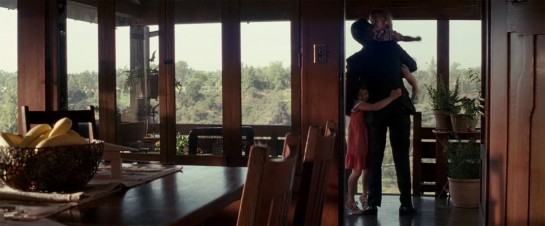
That being said I do find myself getting a bit misty when movies strike a few specific chords. The one that hits me the hardest is when a film features a big moment between a father and his son/daughter. Without a doubt, this became a thing for me the moment I had children of my own. That deep affection became real. When movies do it well it can be tender to the point of tears. They can also be emotionally devastating. So that’s what gets to me, but what about you? Now it’s time for Your Voices.

YOUR VOICES: What makes you cry in a movie?

I’ve shared my teary-eyed confession. Now it’s your turn. Do you ever cry at movies? If so, what is it that triggers those emotional faucets? If not, is there anything that at least gets you close? I would to hear Your Voices.

REVIEW: “Jafar Panahi’s Taxi”

TAXI poster

It’s hard to gain full appreciation for Jafar Panahi’s latest film without knowing a bit about his personal story. Panahi cut his filmmaking teeth by working with the great Abbas Kiarostami. He showed himself to be a major component of the Iranian New Wave movement with his 1995 acclaimed film “The White Balloon”. But while recognized as a brilliant and highly influential filmmaker, Panahi quickly found himself in the crosshairs of the Iranian government.

In 2010 Panahi was arrested along with his wife and daughter. He was charged with making propaganda films against the Iranian government and for committing crimes which threatened national security. He was sentenced to six years of house arrest, was forbidden to leave the country, and was given a 20 year ban on making movies or documentaries. Despite his steep sentencing, Panahi has continued to secretly make films and address many of his society’s ills.

TAXI1

“Taxi” is another bold movie where Panahi makes clever use of his obvious constraints. All conventional methods of filmmaking are out the window yet “Taxi” feels just as revealing and just as organic. It is basically a documentary but with a sly touch of drama. Its main focus is to show the varying degrees of life, personalities, ideals, hardships, and persecution in modern day Tehran society.

Panahi does this by simply posing as a cab driver. He drives around Tehran picking up as assortment of people and filming their conversations through carefully placed dash-cams. They cover all age groups, male and female, and come from a variety of unique (and sometimes troubling) perspectives. None are trained professional actors, but each offer some truly compelling insight into elements of the culture that Panahi clearly wants people talking about.

TAXI2

Panahi’s interaction with the people is often fascinating. Some are just quirky individuals who he allows to carry on. Take a fellow who sells pirated DVDs. At one point he actually recognizes Panahi, but that doesn’t stop him from his shady dealings. Other characters unknowingly offer Panahi the opportunity to indict certain mindsets without the director saying a word.

There are some interactions that feel a bit too scripted even though they have strong messages, and there are a couple of moments where the pacing sputters a bit. But at the same time “Taxi” always kept my attention, and it had me absorbing every encounter to find how they fit with Panahi’s vision. This wasn’t an easy project to pull off, but its strengths testify to the brilliance of its maker.

VERDICT – 4 STARS

4 Stars