
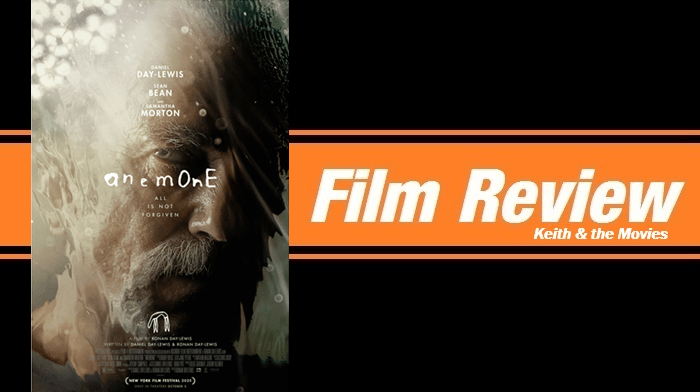
Danial Day-Lewis makes his triumphal return to acting after an eight year retirement in “Anemone”, delivering what should be one of the most talked about performances of the year. It’s yet another richly complex character for Day-Lewis to dissect and explore, and he does so with the kind of intensity and precision that has marked the three-time Oscar winner’s career.
This isn’t just a case of Day-Lewis simply returning to a craft he loves. “Anemone” is a true passion project which he co-wrote with his son, Ronan Day-Lewis. Also, the younger Day-Lewis directs his father in what is the 27-year-old’s feature film debut. Their intimate connection beyond the camera finds its way onto the screen, adding a compelling perspective on fathers and sons and the ties that bind them.
“Anemone” is a dark family drama with a piercing psychological edge that delves into some heavy and uncomfortable subject matter including childhood trauma, PTSD, strained family bonds, isolation, and self-condemnation versus self-forgiveness. It’s a visually captivating film where the camera is as essential as the pen when it comes to storytelling. Narratively it’s a methodical slow-burn, patiently and quite brilliantly unwinding its characters and the conflicts that have defined them.
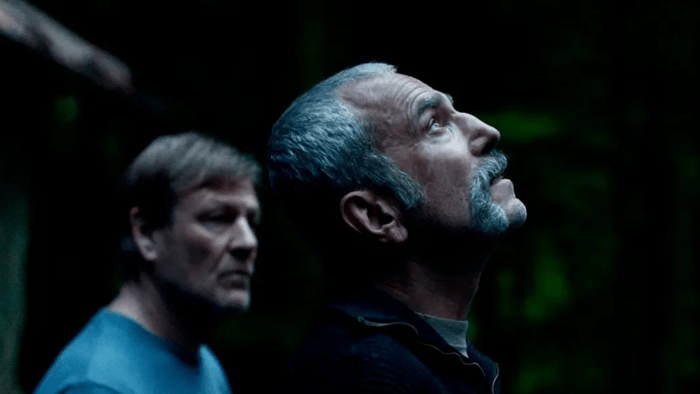
The elder Day-Lewis plays Ray Stoker, a damaged soul who has condemned himself to a life of isolation for reasons that painfully become clear as the story unfolds. Ray lives in a secluded one-room stone cabin, deep in the forest on a tiny patch of land that’s unreachable by vehicle. Ronan Day-Lewis and his DP, Ben Fordesman use the haunting beauty of nature to set the tone and to ground us in the setting. The churning clouds in the overcast skies. The thick forest canopy swaying in the heavy winds. The steady patter of rain on Ray’s tin roof. It’s a stunning bit of visual table-setting.
One afternoon Ray’s self-imposed disconnection from society is interrupted by an unannounced visit from his brother, Jem (Sean Bean). The tension between the two is obvious from first glance and the root of it is patiently revealed over the course of Jem’s stay. We watch as the two brothers spend the next few days together, revisiting ghosts of their pasts, picking at scabs from old wounds, and slowly piecing together their family history, ultimately arriving at the real reason for Jem’s visit.
The differences between Ray and Jem are striking, yet the bond of brotherhood is still real and present. We learn that they’re both men of violence, with pasts that have shaped who they have become. The key difference is one was able to find a measure of peace through faith while the other has built a wall around himself and his demons. Shades of bitterness, resentment, and contempt boil to the surface during their time together. But we also see moments of authentic connection.
Their time together is broken up with swings back to civilization where Jem’s wife Nessa (Samantha Morton) is having a hard time with her son Brian (Samuel Bottomley). He has found himself in trouble after nearly beating someone to death during military training. He’s been sent home where he struggles to understand his actions while Nessa worries that he’s following in some troubling footsteps. The connections between these scenes and Jem’s visit to Ray are better left unspoiled, but they add significant layers to the story that pay off in a powerful way.
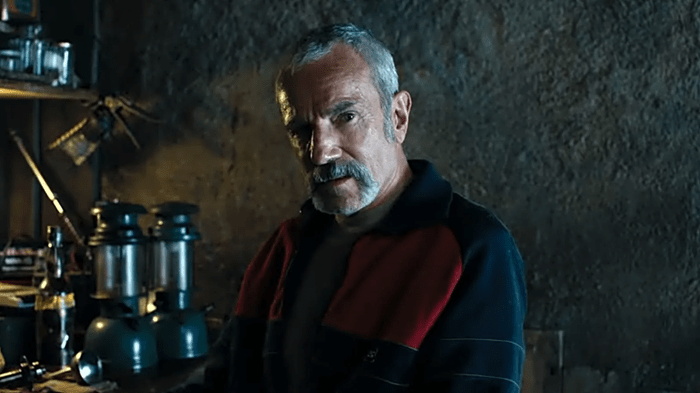
The film’s script is an impressive display of audacity, peculiarity, and incisiveness. It tells a mostly contained and character-centric story with an equal reliance on dialogue, performance, and visual language. While the dialogue is rich and Day-Lewis delivers some mesmerizing monologues, the moments of silence are just as captivating, especially between the brothers who sometimes seem as if they’re communicating telepathically.
As for the performances, Daniel Day-Lewis once again disappears within another enigmatic and complicated character. He burrows deep into Ray’s psychology, relaying his inner turmoil with a simmering rage and even slivers of sharp-edged humor that cut right to the bone. Yet Day-Lewis never loses sight of Ray’s humanity. Bean makes for a brilliant foil. He’s quiet but possesses a strong presence while remaining sharply focused and ever observant. He’s a crucial part of the film and a fixture in its very best scenes.
“Anemone” won’t be for everyone. Its dark themes and brooding tone can be a challenge. And it isn’t a movie driven by spoon-fed, by the book plotting. Its storytelling bucks nearly every convention, shrewdly oscillating between expressionistic and raw gritty realism. Yet it’s a movie bursting with artistic vision from a daring first-time director and anchored by a sublime return performance from a generation’s best actor. When you consider it altogether, “Anemone” is one of the year’s best films.
VERDICT – 4.5 STARS













 Keith & the Movies