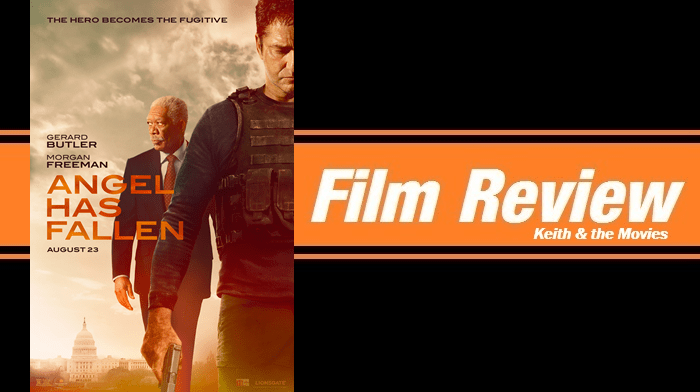
Ever heard of the phrase ‘a glutton for punishment’? Of course you have. But just in case, Oxford defines it as “a person who is always eager to undertake hard or unpleasant tasks“. Tasks like, I don’t know, watching Gerard Butler movies? By that definition I’m a walking example of ‘a glutton for punishment’.
I really can’t blame anyone but myself. It’s not like Butler doesn’t have a pretty telling track record. But I have this twisted fascination with his movie career which is marked by a bevy of stinkers and the extremely rare gem. And in case you’re wondering if his latest “Angel Has Fallen” is one of the gems…I wouldn’t go that far.
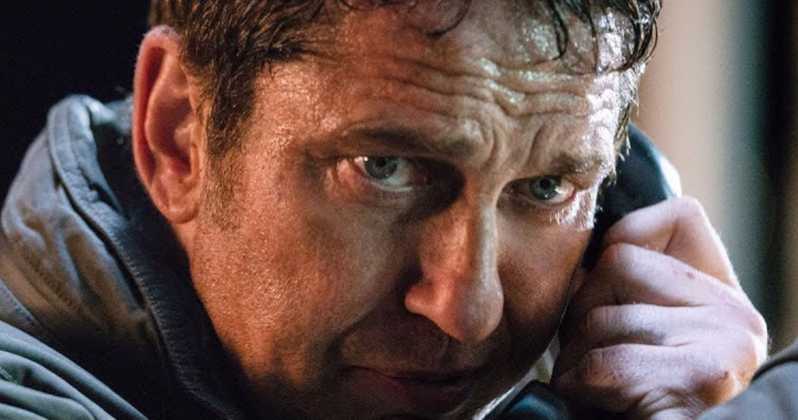
This is the third film in Butler’s Has Fallen series (for lack of a better title). It sees him reprising his role of Secret Service Superman Mike Banning. To be honest I had fun with the first film “Olympus Has Fallen”. It was a silly, fun throwback to the meat-headed action movies of the early 90’s. “London Has Fallen” failed miserably at capturing what made the first film entertaining. “Angel” falls somewhere in the middle.
Stuntman turned director Ric Roman Waugh helms this sequel that essentially follows the same blueprint as the previous films. Mike Banning is recommended by President Alan Trumball (Morgan Freeman) to replace the retiring Secret Service Director (played by the always fun Lance Reddick). But as the series has shown us, the job can take a pretty big toll and Banning’s body and psyche is letting him know it. Hilariously this seemingly important story-thread vanishes once the action kicks in.
While out on a country fishing trip, an assassination attempt is carried out with a swarm of high-tech drones. Banning barely saves the President’s life but everyone else including his Secret Service team are killed. The two lone survivors are taken back to Washington where the President is comatose and Banning finds himself framed for the attack. It doesn’t take much investigating before a tunnel-visioned FBI Agent Thompson (Jada Pinkett Smith) puts Banning under arrest. So much for all of that ‘service to his country’ bull.
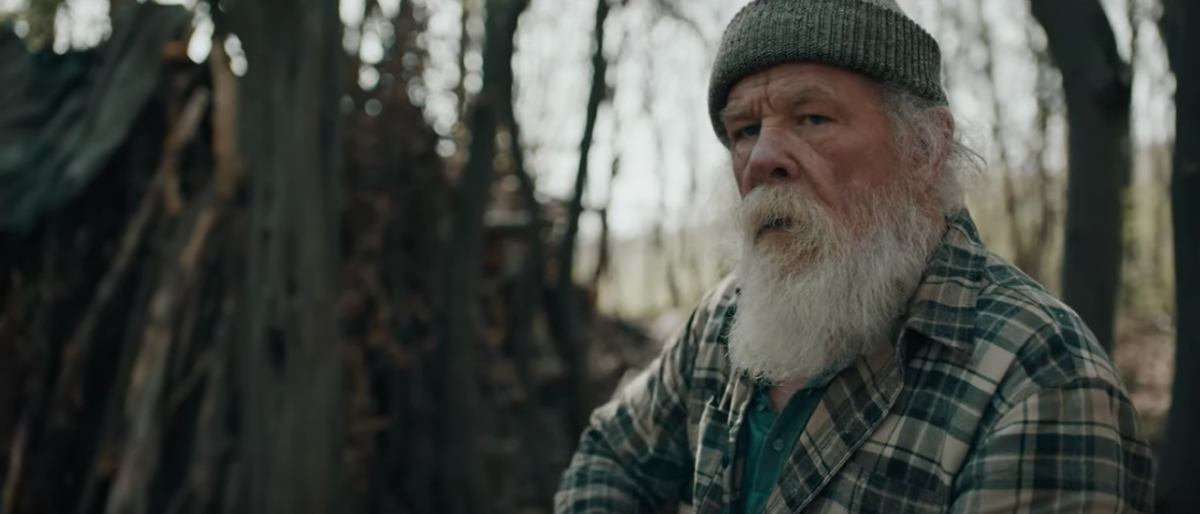
Of course like any good Gerry Butler movie, Mike doesn’t take it sitting down. He breaks out of custody and sets out to find who framed him and who wants the President dead. He has to seek the help of the last person he wants to see – his father Clay (Nick Nolte), a wooly, off-the-grid mountain hermit who (as you can probably guess) ran out on his family when Mike was a child. That is clearly the go-to offense for scorned fathers in movies. Nolte’s character adds a little levity but there is little new or fresh about him beyond that.
As you should expect, “Angel Has Fallen” leans heavily on its action. Some of it is fairly exciting and well shot. Other times it can be pretty generic, even frustrating especially when the scene-killing shaky-cam kicks in. And it’s all built around a paper-thin plot full of logic-defying silliness and ridiculous conveniences that are just there to get the story from Point A to Point B. By the way, am I the only one who wants to scream when a character won’t say the most obvious and necessary thing simply because a storyline hinges on their silence?
So basically this is another film worthy of being in Gerry Butler’s filmography. But feeling like a silver-lining kind of guy, I will say this is a step up from most of Butler’s recent efforts. Nolte earns a few chuckles, I really liked Danny Huston as one of Banning’s old military buddies, and the action can sometimes muster up some thrills. But that’s about all. Silly plot contrivances and head-scratching character decisions end up standing out more than the action. And for a movie like this, that’s not a good thing.
VERDICT – 2 STARS