
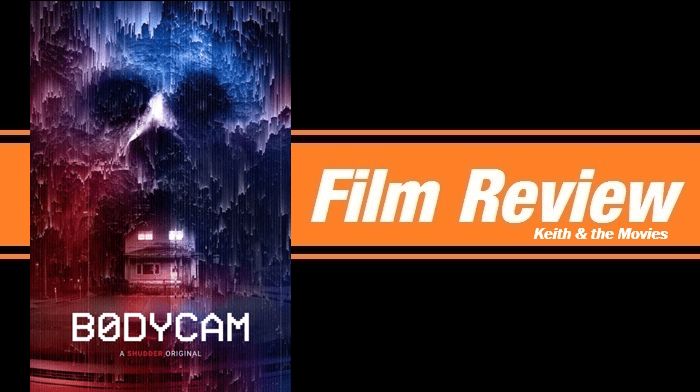
The found-footage craze ran its course with me some time ago. But credit to director Brandon Christensen for finding a fresh and clever use of it in his new horror film “Bodycam”. As its rather obvious title reveals, the film tells its entire story through the bodycams of two police officers, with some occasional shots coming from the dashcam of their patrol car. But rather than feeling like a gimmick (which it kinda is), there’s an authenticity here that gives the found-footage choice purpose.
Even more, Christensen’s use of foot-footage succeeds in doing what the best movies of its kind does. It immerses us in the moment while blurring our perception of what’s real and what isn’t. Unfortunately it also comes with the obligatory shaky cams, especially when things intensify, and the overuse of first-person perspective shots as the characters feel their way through the dark. But for the most part Christensen keeps us involved and often on the edges of our seats.
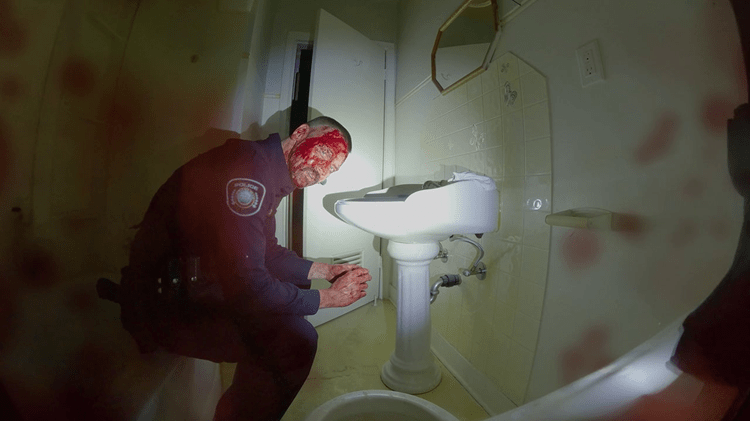
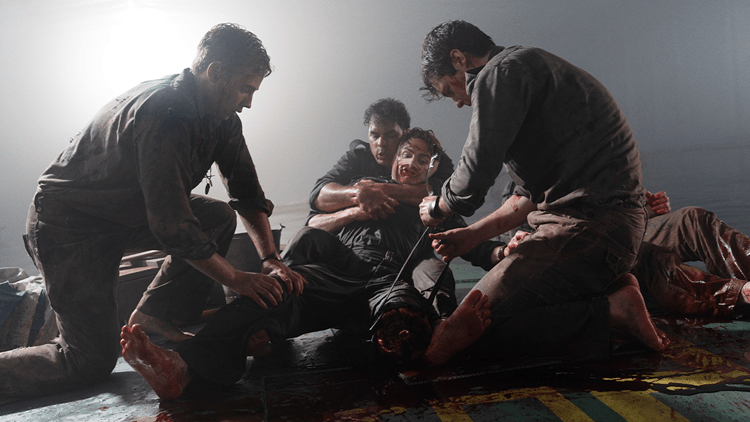
The story follows two policemen, Officer Bryce Anderson (Sean Rogerson) and Officer Jerome Jackson (Jaime M. Callica), who are dispatched to a seedy part of town to investigate a possible late-night domestic dispute. They arrive at the house which sits in a rundown neighborhood populated with wandering locals they call “tweakers”. Anderson and Jackson approach the home but get no answer at the door. After hearing a scream for help, they enter with flashlights on and guns drawn. They’ll soon wish they hadn’t.
As the officers search the house they make several chilling discoveries. One leads to an encounter where a frightened Bryce reactively guns down a man who lunges at him from out of the shadows. Jerome immediately wants to call it in to headquarters. But fearing they will be crucified by the press and the public, Bryce stops him and begins throwing together a cover story.
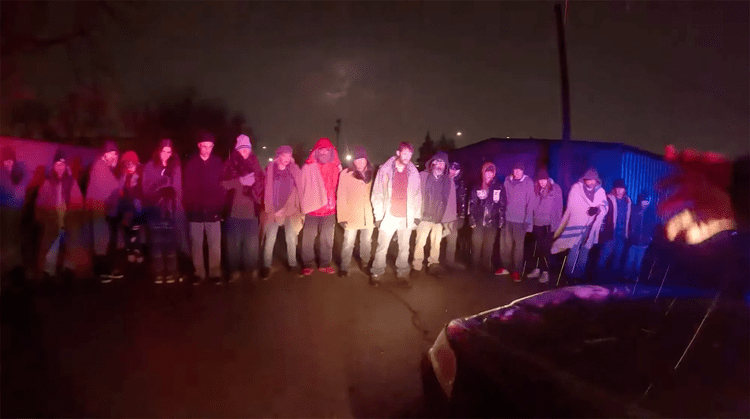
An immediate tension forms between Bryce’s fear and Jerome’s conviction. But far more threatening is the sinister force that latches onto them and won’t let go. “You take something from him, he takes something from you,” mutters the gathering tweakers. It’s here that Christensen turns his police procedural into a terrifying mix of the supernatural and the occult.
A handful of other characters pop in including Bryce’s pregnant wife Michelle (Elizabeth Longshaw), an underground tech whiz named Esposita (Angel Prater), and Jerome’s mother Ally (Catherine Lough Haggquist) who seems to know more about what’s going on than anyone else. But the two officers remain the centerpiece and their story takes some dark, twisted turns. And while it’s a horror story through and through, it dabbles in several themes including police accountability and more metaphorically the controlling grip of addiction.
Like nearly every found-footage movie out there, its effect begins to wear off the longer it goes on. But Christensen smartly winds things down at 75 minutes before his film overstays its welcome. It’s a move that not only keeps the style choice respectably fresh, but it keeps the story wound tight and constantly pushing forward. Overall, “Bodycam” is a tense and eerie Shudder Original that breathes some much-needed new life into the found-footage formula.
VERDICT – 3.5 STARS












 Keith & the Movies