
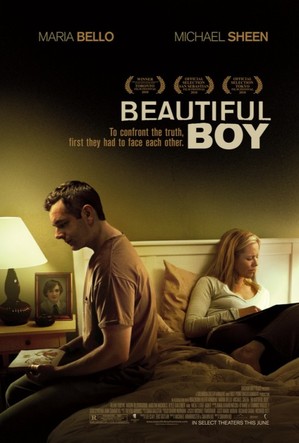
It’s hard to know how to take some movies inspired by real-life tragic events ripped from the newspaper headlines. They can sometimes be sobering and enlightening while others can be exploitative and irreverent. “Beautiful Boy” is a crushing drama that deals with the agony of a school shooting but from a different point of view. It’s obvious similarity to the 2007 Virginia Tech massacre is not by accident. Director and co-writer Shawn Ku’s connection to the college not only helped inspire the story but is one reason this intense subject matter is handled with such care and respect. The thrust of story doesn’t center on the horrible event itself. Instead its focus is on the devastating effects the massacre has on the shooter’s parents.
Maria Bello and Michael Sheen play Kate and Bill, a disconnected married couple on the road to separation. The one single thread holding them together is their son Sam (Kyle Gallner). Sam is a college freshman who has struggled adjusting to campus life. Sam calls home one night trying to hide his despondency from his parents. Bill and Kate attribute his emotion to the pressures of college life. But the next morning police arrive at their home to inform them that Sam has opened fire at his school killing 17 people before taking his own life. This all happens early in the movie while the rest of the film explores the brutal effects it has on Bill and Kate’s already strained relationship.

While Sam’s actions play a key role in the story they serve more as a backdrop. We don’t get inside Sam’s head and really examine his motives and some may have a problem with that. But it’s no problem for me since the movie’s intention is to look at a marriage on the brink of dissolution. Both Bello and Sheen deliver grounded performances that often times result in scenes driven by realistic, raw emotion. Their son’s acts cause them to face issues simmering beneath the surface of their marriage and their reactions feel natural and true. You watch as the chasm between them grows wider yet no one understands what they’re going through except each other. It’s an interesting dynamic that works more often times than not.
The movie does require the audience to automatically connect with Bill and Kate. We never get much insight into their relationship prior to the shooting. We see their relationship is strained but it’s hard to connect with them other than through their emotional devastation brought on by the loss of their son and the horrible circumstances surrounding it. I really felt for them especially as we see them deal with things such as the media camped out on their lawn, having to issue a public statement, and the stares of curious neighbors and co-workers all on top of their personal loss. But their relationship could have been easier to invest in if we were given more early in the film.

The movie also has an inconsistent visual style. At times it seems to be intentionally striving for a more artsy look with quick camera sweeps and strategic camera angles. Other times it looks very generic and by-the-book. I also wasn’t a big fan of the rather drab color palette. The movie seems soaked in blues and grays. Obviously this was intentional and I’m sure it was meant to convey the overall mood of the picture. But it was a little too much for me.
Even with its flaws “Beautiful Boy” can be a powerful film that handles some tricky and weighty subject matter with care and compassion. It was certainly a different approach seeing this type of horrifying event through the eyes of the parents and while their marriage isn’t opened as much as I wished, it’s impossible not to moved by the emotional distress this couple faces. Shawn Ku handles the material seriously and truthfully and some fine performances from Sheen and Bello help make up for the film’s shortcomings.


 Keith & the Movies