RETRO REVIEW: “Black Belt Jones” (1974)

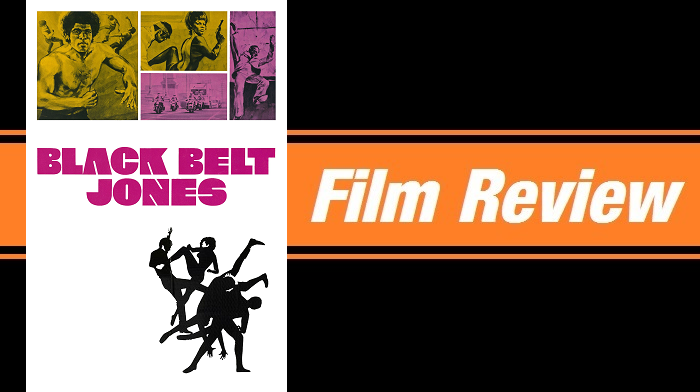
In 1974, Robert Clouse had just directed the highly revered Bruce Lee martial arts classic, “Enter the Dragon”. That film was an enormous box office success, earning a total of $400 million worldwide (which is over $2 BILLION today when adjusted for inflation). “Enter the Dragon” also starred a young Black martial artist named Jim Kelly. Clouse was so impressed with the charismatic Kelly that he cast him in his next movie, “Black Belt Jones”.

Checking off many blaxploitation boxes, “Black Belt Jones” offers up much of what you would expect from a wild genre mash-up of action, comedy, crime thriller, and of course kung-fu. It features much of what made blaxploitation films popular during their time. But it’s also hampered by their weaknesses which in this case are hard to look past despite the fun.

Kelly plays the titular Black Belt Jones, an expert martial artist thrust into a conflict between an old friend and the Mafia. Jones’ mentor, Wesley “Papa” Byrd (played by the great Scatman Crothers) runs Black Byrd Karate School. It’s located on a small patch of land in the middle of the city that the Mafia is desperate to get their hands on.

Image Courtesy of Warner Bros.

After local mob leader Don Steffano (Andre Philippe) gets wind that the city government is planning on building a huge civic center in the area, he begins gobbling up all the property in the neighborhood. He’s able to get everything but the karate school. So the Don sends a local drug dealer named Pinky (Malik Carter) to strong-arm Papa into selling his land. But when Pinky accidentally kills Papa, Black Belt Jones is forced to get involved.

Adding an extra wrinkle is Sydney Frazier (Gloria Hendry), Papa’s estranged daughter who comes into town determined to pay back those who killed her father. Hendry adds some spice to the story, portraying a young woman who is more than capable of taking care of herself. She and Kelly have some fun chemistry together. At least until Clouse overplays it by throwing together a hopelessly corny cat-and-mouse game on the beach. It’s meant to be romantic but instead is comically mawkish.

“Black Belt Jones” has some big laughs, often at unexpected moments. And while the screenplay doesn’t always help him, Jim Kelly is a fun and often charismatic lead. But the hokiness is hard to overlook, and even the most forgiving eye will have a hard time looking past the movie’s obvious limitations. Genre fans like myself will find something to enjoy. But there are plenty of better films for those wanting to dip their toes into the world of blaxploitation.

VERDICT – 2.5 STARS

Sundance Review: “Brief History of a Family” (2024)

From the earliest moments of “Brief History of a Family” first-time feature filmmaker Jianjie Lin has his audience in the palm of his hand. And he keeps us in his hand, along with our instincts and expectations, until late into the film where he loosens his grip and suddenly has us second guessing nearly everything we thought we knew. That’s just one part of the genius of this smart and crafty movie.

“Brief History of a Family” is a strikingly assured debut for Lin who writes and directs this absorbing thriller set in China following the 2016 rescission of the government’s one-child policy. The setting adds a sociopolitical layer to the story that mostly exists in the background yet looms over much of the story. But Lin’s interests go well beyond that. This becomes evident once he begins digging into the complex dynamics of an upper middle-class family following the arrival of an enigmatic young guest into their lives.

From the first moment we first see 15-year-old Yan Shuo (Xilun Sun) he’s a mystery. He’s quiet and reserved; a bit of an outcast. At school he gets beaned in the head with a ball by the more athletic Wei (Muran Lin). Feeling guilty, Wei invites Yan Shuo to his house to play video games. A little later, Wei’s parents ask Yan Shuo to stay for dinner. This sets in motion a story with all the markings of a family infiltration thriller. But are things really what they seem to be?

It takes no time for Lin to raise our suspicions and have us questioning Yan Shuo. Who is he? What are his intentions? Is he being truthful with this family? Xilun Sun’s performance adds to the mystery. He’s unreadable and impenetrable which prompts us to suspect him more. Wei and his parents attempt to learn more about him by asking about his family. But all they get are cryptic responses about his deceased mother and hard-drinking father. It’s enough to earn their sympathies and Yan Shuo becomes a regular at their home.

The subtle thriller elements become more pronounced the deeper Yan Shuo penetrates the family’s encapsulated lives. He wins the affections of Wei’s mother, Mrs. Tu (Ke-Yu Guo) by simply showing interest in her, listening to her stories, and helping in the kitchen. He wins over the stern Mr. Tu (Feng Zu) with his admiration of Bach and his academic drive. And he wins over Wei by keeping his parents off his back. As it all plays out, deep secrets and buried tensions surface. Feelings of disillusionment and disappointment as well as sorrow and regret shed more light on the family and where the story is going.

As the story percolates Lin’s visual creativity and technique is essential in creating tension and unease. Everything from his precise framing to his use of light and shadows to the sleek modernist architecture – it all helps Lin guide his audience to certain conclusions. There is a thematic correlation with some of the imagery. Other instances reveal a cunning filmmaker using imagery like a carrot on a stick. It’s a testament to Lin’s vision and DP Jiahao Zhang’s ability to realize it through his camera.

With “Brief History of a Family” Jianjie Lin subtly yet effectively speaks to a variety of political, cultural, and domestic issues. At the same time, he plays around with genre in some unexpected and crafty ways. Better yet, his handling of the material, character work, tone management, and visual imagination show a filmmaking acuity usually found in the more seasoned and accomplished. It’s a big reason why Lin should be on everyone’s ‘to-watch’ list.

VERDICT – 4 STORY

REVIEW: “The Beekeeper” (2024)

It seems director David Ayer may have an affection for unapologetically silly, over-the-top, 80’s action throwbacks. That’s precisely what we get with his new feature “The Beekeeper”, a movie that never once attempts to hide what it is or what it’s going for. I doubt that any amount of glaring self-awareness will change things for those who enter the theater with their noses in the air or their minds made up. But for everyone else, there’s some fun to be had here.

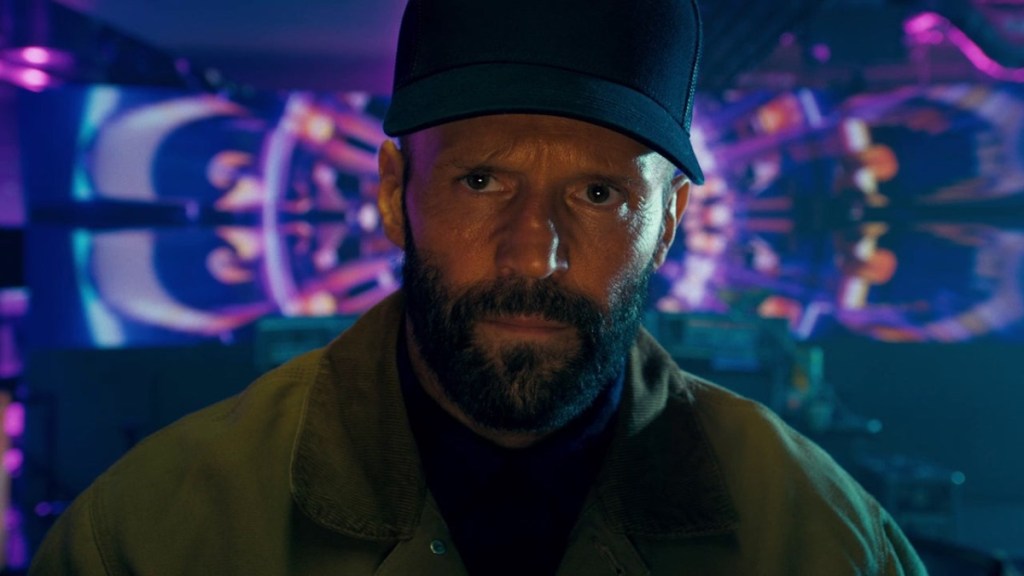
That isn’t to say “The Beekeeper” is some new action classic or that it’s free of flaws. The story is a combination of the conventional and outlandish. And the dialogue only gets hokier as the story progresses (“I lost my virginity in that barn” is just one glowing example). Yet the movie gets by in large part thanks to its lead, Jason Statham. He remains one of the more magnetic action movie stars working today. Statham possesses a steely charisma and an ability to wink at the audience without ever breaking character. All of that on top of his amazing physicality.

Here Statham plays Adam Clay, a quiet and content man who tends honey bee hives for a kindly widow named Eloise (Phylicia Rashad). We learn that Eloise took Adam in and lets him rent a space in her barn. To repay her generosity, Adam helped Eloise maintain her farm following the death of her husband.

Image Courtesy of Metro-Goldwyn-Mayer

One day Eloise gets a warning on her computer that she has a virus. Not knowing what to do, she calls the phone number on her screen. It turns out to be a phishing scam posing as an anti-virus software company. Eloise is connected to a clown named Garnett (David Witts) who tricks her into using her passwords to open up her bank accounts. Through data mining, his team instantly empties her life savings. They even drain the funds out of a children’s charity she operates. Devastated, Eloise takes her own life.

Her death sets off Adam who turns out to have a pretty interesting background. He’s actually retired from a clandestine program known as Beekeepers. The secret off-the-grid organization sends out its Beekeeper whenever a situation gets too big for law enforcement or the government. Armed with his ‘particular set of skills’, Adam sets out to find and dole out payback on the scammers who took advantage of Eloise. The trail leads him to a state-of-the-art multi-million dollar call center which he promptly destroys.

Adam’s actions get the attention of a rich and privileged twenty-something named Derek Danforth (Josh Hutcherson) who owns the call center and many others like it. Pampered and protected by his powerful mother (Jemma Redgrave), the snot-nosed Derek doesn’t like Adam interfering with his $9 million a month operation. So he sends Garnett and some heavily armed goons to deal with the problem. But Adam disposes of them and then sets out to cut the head off of the snake.

Image Courtesy of Metro-Goldwyn-Mayer

While all of that is going on there’s another side of the story involving Eloise’s semi-estranged daughter Verona (Emmy Raver-Lampman), an FBI agent investigating Adam’s warpath. These cliché riddled scenes aren’t at all compelling and often resemble some cheap, stripped-down television crime drama. Screenwriter Kurt Wimmer tries to make Verona and her FBI colleagues resemble a functioning Bureau. But they come across as inept and always ten steps behind.

Some interesting faces pop up along the way, most notably Jeremy Irons (I’m not sure how they got him onboard). He plays a former CIA Director employed by Derek’s mother to cover her son’s tracks. Among his resources is Minnie Driver playing an agent still active in the CIA. Both do good with what they’re given. Hutcherson is less convincing. He nails the obnoxious bratty stuff. But no amount of privilege can make him a believable business mogul.

That leaves Statham who puts the movie on his back and carries it through. The action scenes are electric and lean into the actor’s strengths. They get a little hard to decipher in the final 15 minutes, but Statham is effortlessly entertaining and a natural on-screen tough guy. He can’t fully cover all of the film’s issues. But for the most part Statham helps the movie deliver exactly what it promises. And for his many fans, that’s all they’re looking for. “The Beekeeper” is in theaters now.

VERDICT – 3 STARS

REVIEW: “The Bricklayer” (2024)

Between 1990 and 1993 Finnish filmmaker Renny Harlin directed back-to-back action-packed blockbuster hits “Die Hard 2” and “Cliffhanger”. In between the two films he produced the critically acclaimed award-winning indie “Rambling Rose”. Needless to say Harlin’s star was rising. But then came his 1995 pirate swashbuckler “Cutthroat Island”. It was a movie hampered by a troubled production that included several delays, numerous rewrites, friction on the set, and a budget that skyrocketed.

“Cutthroat Island” was a box office disaster and Harlin’s career took a hit as a result. To his credit, he has steadily worked since that unfortunate setback. Not on big budget or what you might call mainstream projects. But he’s still doing what he loves – making movies. His latest is “The Bricklayer”, an action thriller based on Paul Lindsay’s 2010 novel of the same name.

Written for the screen by Hanna Weg and Matt Johnson, “The Bricklayer” plays a lot like a prototypical spy flick but with an edge. It features secret agents, undercover missions, a rogue asset, a global conspiracy, and so on. But Harlin infuses his film with grittier action and much less spy movie gloss. It doesn’t cover the film’s noticeable blemishes, but it does make it reasonably entertaining for those with their expectations in the right place.

Image Courtesy of Vertical

The film stars Aaron Eckhart, a talented veteran actor deserving of a lot better roles than he tends to get. Here he plays Steve Vail, a grizzled and understandably hardened CIA field agent who enjoys classical jazz and has a special affection for masonry. Despite being effective in the field, the disillusioned Vail has found himself persona non grata at the agency. That is until a certain event in Thessaloniki, Greece forces the CIA to come calling.

We learn that three international journalists have been murdered within a month, the latest being a German reporter who happens to be an outspoken critic of U.S. intelligence activities across the world. The murder gives rise to theories that the CIA is behind the killings. At CIA headquarters in Langley, Virginia, a young and devoted agent, Kate Bannon (Nina Dobrev) makes an alarming discovery when scouring over surveillance footage from Greece.

Kate identifies Victor Radek (Clifton Collins Jr.) among the images from a Thessaloniki metro station. Radek was a former covert CIA operative who went rogue before supposedly dying 18 months ago. His one-time handler and close friend was Steve Vail. Kate and her boss, Director O’Malley (Tim Blake Nelson) fly to Philadelphia and meet with Vail. Believing Radek is killing journalists and framing the CIA, O’Malley sends Vail and Kate on a non-sanctioned mission to track down and apprehend Vail’s old friend.

From there it almost appears that the story is going to lean on that well-worn dynamic between the gruff seasoned agent and the young inexperienced rookie. It’s certainly an element to the story and Eckhart and Dobrev sell it well. But thankfully it’s not something Harlin dwells on. Instead he whisks us away to a series of gorgeous Greek locales, introducing us to a number of key players along the way. Most are mere archetypes rather than well-rounded characters, yet they service the story well.

Image Courtesy of Vertical

As for the story, it moves at a fairly rapid pace and holds your interest throughout. But all-in-all it’s a pretty conventional spy tale that’s helped along by a number of obvious conveniences. It’s also hampered by some glaringly corny dialogue (“I never do a job without my tools.” “Cryin’ is dyin’ kid.” Or “I was born on a Tuesday but not last Tuesday.”). Even more, the film’s central conflict doesn’t quite create a sense of peril nor does it raise the stakes to the degree needed for this kind of story.

As for the performances, Eckhart once again makes for a sturdy lead and Dobrev is a solid foil. Some of the supporting turns are a little shakier. I’m a huge Tim Blake Nelson fan, but his super-serious monotone delivery is borderline comical. As for Collins Jr., he makes for a serviceable but not especially interesting antagonist. He doesn’t quite bring gravitas or relay his character’s convictions in a compelling way.

Yet despite its flaws “The Bricklayer” remains a moderately fun spy film in large part due to Harlin’s propulsive direction and Eckhart’s vigorous lead performance. The action is exciting, highlighted by some well choreographed and intensely brutal fight sequences. And even though the script stumbles in spots, it’s entertaining enough and holds your attention. That may not sound like a ringing endorsement, but it’s more than I can say for some of the more heralded films from the last year. “The Bricklayer” releases January 5th in select theaters and on VOD.

VERDICT – 3 STARS

REVIEW: “The Boy and the Heron” (2023)

The renowned Studio Ghibli and animation legend Hayao Miyazaki return with their highly anticipated “The Boy and the Heron”. It’s the 82-year-old Miyazaki’s first feature film since 2013 – the year he announced his retirement after the release of the critically acclaimed “The Wind Rises”. But to the elation of his many fans, the beloved filmmaker had a change of heart and began working on a new feature-length project in 2016. After a lengthy production (one made lengthier by the COVID-19 pandemic) it has finally made its way to theaters.

To be completely honest and forthright, I’m hardly what you would call a Miyazaki connoisseur. I haven’t seen all of his movies nor have I ever felt inclined to. That’s not to say I haven’t respected him as a filmmaker. Quite the opposite. I’ve often lamented the fact that his movies have rarely registered with me in the same way they do with his legion of passionate fans. That said, Miyazaki’s career is nothing short of inspiring and his legacy is undeniable.

Image Courtesy of Studio Ghibli

“The Boy and the Heron” sees Miyazaki drawing from his own childhood to tell a warm-hearted coming-of-age story. It’s told from the perspective of 12-year-old Mahito (voiced by Soma Santoki), a character whose experiences echo Miyazaki’s in a number of ways. Both were deeply affected by the losses of their mothers. Both had fathers who worked for companies that manufactured parts for fighter planes. Both were part of families forced to evacuate to other cities due to bombings in World War II.

“The Boy and the Heron” gets its title from Genzaburō Yoshino’s 1937 novel of the same name, but their connection is largely thematic. This is very much an original Miyazaki story set in the turbulance of 1943. A few years after the loss of his mother and amid the growing chaos from the war, 12-year-old Mahito and his father Shoichi (Takuya Kimura) leave Tokyo for the countryside to live with Natsuko (Yoshino Kimura), Shoichi’s new pregnant wife who is the younger sister of Mahito’s late mother.

Still grieving his mother’s death, Mahito is cordial but lukewarm towards the kindly Natsuko. During the day, while Shoichi is away running a nearby air munitions factory, Mahito mostly avoids his ‘new mother’ and her gaggle of elderly maids. He spends chunks of his time exploring the grounds which is where he discovers a creepy old tower grown up and in disrepair. Even stranger is his encounter with a bizarre and pesky talking grey heron (Marsalis Suda).

Things move further into the fantastical after Natsuko wanders off into the forest and goes missing. As parties search for her in our world, Mahito, paired with the suspicious Grey Heron, venture into the tower which turns out to be a gateway to a parallel universe. It’s an bizarre place filled with wild characters, weird creatures, and profound truths that may help Mahito cope with his sadness and find happiness in what he still has.

Image Courtesy of Studio Ghibli

There is a lot in “The Boy and the Heron” that Miyazaki fans will recognize. There is the exquisite hand-drawn animation featuring painterly compositions with gorgeous backgrounds and rich detail. There are his classic themes of loss, grief, and childhood, all treated with his signature sense of optimism. It seems these and other Miyazaki trademarks have made the film a little too familiar for some ardent lovers of his work. But as someone who sees himself as more of an admirer than an authority, I found myself mostly swept away.

Admittedly the movie did lose me a bit in the second half where the wackiness reaches its height. Yet I was still captivated by how Miyazaki maintains his thematic connections throughout. And the way he steadily mirrors reality with the otherworldly is impression. It all leads to a truly touching ending that brings the entire story to a beautiful conclusion. As for Miyazaki, if this is his final feature, he has gifted us with something delightfully charming and artistically precious. “The Boy and the Heron” is in theaters now.

VERDICT – 4 STARS

REVIEW: “The Boys in the Boat” (2023)

George Clooney returns to the director’s chair with “The Boys in the Boat”, a biographical sports drama based on the true story of working class University of Washington rowers who defied all odds to represent the United States in the 1936 Summer Olympics in Berlin, Germany. The film is written for the screen by Mark L. Smith (“The Revenant”) who is adapting Daniel James Brown’s 2013 nonfiction book of the same name. It’s really good material.

Whether he hits or misses his marks, I’ve mostly enjoyed Clooney’s classical directing style (a style that’s rarely as appreciated today as it once was). With “The Boys in the Boat” he has delivered one of the bigger surprises of the year – a film with the kind of old-fashioned crowdpleaser quality that still resonates for many of us. It tells yet another inspirational underdog sports story yet one rich with humanity. And it takes place within a period setting that’s captured with impeccable authenticity.

Standing out among the film’s many strengths is the tough yet affecting performance from Callum Turner. He brings grit and pathos to the character of Joe Rantz. Abandoned by his father shortly after his mother died, Joe has been raising himself since he was 14-years-old. Set in 1936, we meet Joe living in the hull of a rusted out car. Each day he walks from his homeless community in Seattle to the University of Washington where he’s working on a degree in engineering.

Image Courtesy of Amazon MGM Studios

But Joe gets some bad news. He still owes for his current semester and he’s given two weeks to pay his balance or he’ll be kicked out. Desperate and unable to find a part-time job, Joe decides to try out for the rowing team after being told he can earn some money. He joins dozens of other young men vying for the eight open spots on Washington’s junior rowing crew. Overseeing the grueling tryouts is former rower and seasoned university coach Al Ulbrickson (a terrific Joel Edgerton).

To no surprise Joe makes the team which gets him in a dorm and helps pay for his school. But he quickly learns that rowing is all about the boat and the team you put in it. And as a brotherhood forms between the eight young men, they begin to realize some unexpected potential. Soon the junior crew is outshining the varsity team leaving Coach Ulbrickson with a decision – does he endure the scorn of his boosters and do the unthinkable? Does he take his junior crew rather than his varsity guys to the Olympic qualifiers?

Without question many of the film’s themes are familiar ones. Topics such as defying the odds and overcoming adversity are inherent to stories like this. But that doesn’t make them any less impactful especially when they’re handled as well as they are here. But beyond these more traditional ideas, it’s the movie’s setting that steers it into more unexpected waters.

Image Courtesy of Amazon MGM Studios

On the precipice of a Second World War, the 1936 Summer Olympics were held in Nazi Germany. Adolph Hitler saw hosting the event as a means of promoting his party’s antisemitic platform. It’s a necessary part of the film’s true account and Clooney approaches it smartly. He doesn’t linger on the obvious and he doesn’t give in to the urge to spell everything out. Instead he allows us to take it in and absorb it. The scarlet red Nazi banners and black swastikas; the appearance of Hitler himself, and the chilling cheers from the mass of supporters. Clooney lets his images speak rather than spinning us off on an unnecessary side story.

The performances are great throughout. I’ve mentioned Turner who is a revelation and Edgerton who seems to be able to plug into any role and nail it. There’s also a great turn from Peter Guinness who plays a wise old boatmaker and the team’s mentor. Hadley Robinson is utterly charming as Joe’s sweet but forward love interest. And then you have the collection of young actors who bring character and personality to the rowing team. It’s a fine ensemble.

In some ways “The Boys in the Boat” shares a common framework with many other sports movies. But narrowing this one down to just a ‘sports movie’ would be dismissive. There’s so much more to this uplifting and sincerely human feature. The heart-pounding races are brilliantly shot and edited while the production design and costumes help transport us. But it’s Clooney’s ability to create and define the personal stakes as well as deliver satisfying emotional payoffs that make “The Boy in the Boat” more than your run-of-the-mill feel-good sports flick.

VERDICT – 4.5 STARS