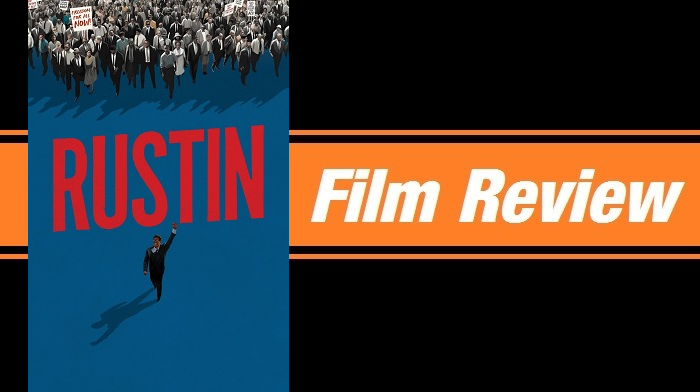
REVIEW: “Rustin” (2023)

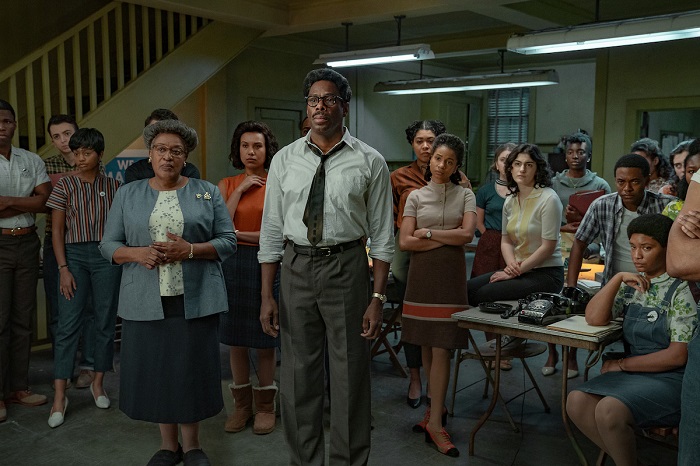
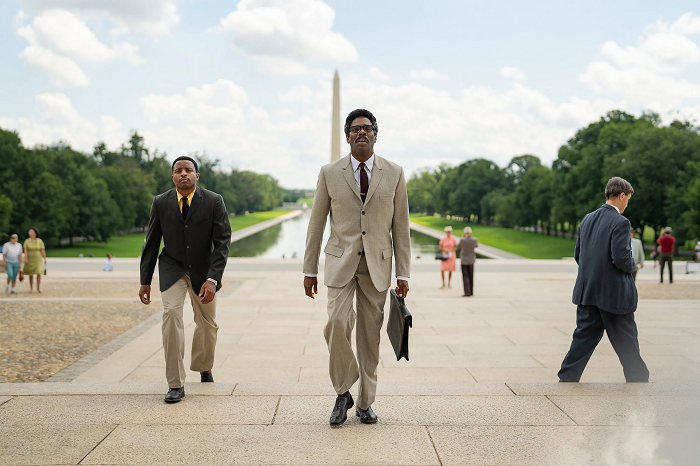
Colman Domingo gives his all in the frustratingly uneven biopic “Rustin”, the latest project from director and five-time Tony Award winning playwright George C. Wolfe. The film is the third feature from Barack and Michelle Obama’s Higher Ground Productions and is based on the true story of Bayard Rustin, a civil rights activist who was instrumental in organizing the 1963 March on Washington.

Co-written by Julian Breece and Dustin Lance Black, “Rustin” attempts to cover a lot of ground which is both admirable and its Achilles heel. Breeze and Black show that the story of Bayard Rustin is one that’s well worth telling. But it’s their rocky storytelling that left me thinking his story would have been better served as a documentary. As it is, “Rustin” is all over the place, skittishly bolting from one scene to the next, and never settling in one place long enough. It ends up shortchanging everything from the social activism to its half-baked love triangle.

Image Courtesy of Netflix

Domingo is handed a role that seems custom-made for Oscar attention and that’s not necessarily a good thing. Yet great actors have a way of overcoming that and Domingo almost does. He gives a performance that’s routinely too big, but not necessarily because of anything he is doing. It’s the script that has him constantly speaking in mini-monologues and stagy soliloquies. More organic conversations are often replaced by moments that seem aimed at Oscar voters. It’s a nagging issue that’s hard to overlook.

Again “Rustin” tries to cover plenty and in fairness there is a lot to Bayard Rustin’s story. Wolfe mostly keeps things focused on the days leading up to and surrounding the historical march on Washington. We see his falling out and eventually reconciliation with Martin Luther King Jr. (wonderfully played by Aml Ameen), his constant run-ins with NAACP head Roy Wilkins (a curiously cast Chris Rock), and his targeting by Representative Adam Clayton Powell, Jr. (the always stellar Jeffrey Wright).

Image Courtesy of Netflix

Wolfe puts a lot of time into Bayard’s planning of the march and his work in convincing the major civil rights leaders to get onboard. That proved easier said than done in large part because of internal disagreements. Then you had those who saw Bayard’s sexuality as a liability for their cause – a conflict that the film ham-fistedly force-feeds rather than explores.

I can’t speak to the overall accuracy of “Rustin” since he is someone I knew little about. That alone testifies to the need of a movie about his life. But unfortunately this hopscotch storytelling makes it hard to know what’s accurate and what’s not. This is especially true for characters like Wilkins and Powell who are written more as plot devices than historical figures. Just some of the problems that keep this mostly well-meaning biography from being the powerful film it could have been. “Rustin” opens in select theaters on November 3rd before streaming on Netflix November 17th.

VERDICT – 2 STARS

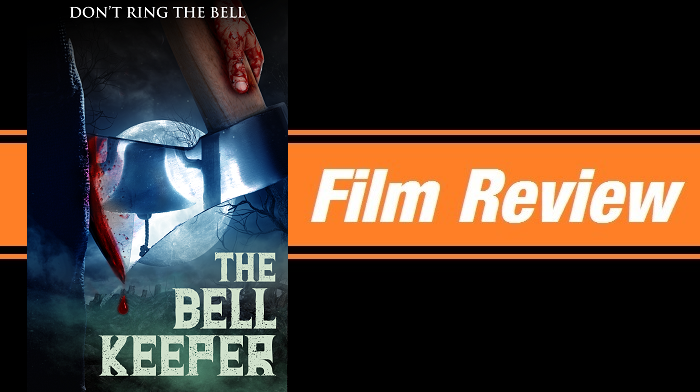
REVIEW: “The Bell Keeper” (2023)

The spooky movie season is in full bloody bloom with fans being treated to an assortment of horror films of all shapes, sizes, budgets, and sub-genres. One such chiller is “The Bell Keeper” from executive producer and star Randy Couture. This low budget feature has a few interesting ideas and it does what it can with the resources it has. But it’s a clear victim of its limitations and its almost endearing schlockiness quickly erodes into something tougher to bear.

Directed by Colton Tran and written by Joe Davison, “The Bell Keeper” attempts to add its own twist to some well-known horror conventions. Unfortunately those few flashes of originality get lost in the movie’s numerous mind-melting issues. It’s the kind of film you want to stay onboard with out of sheer appreciation for the passion and effort. But that gets increasingly hard to do and any good will we had is quickly lost.

The film’s problems don’t lie in its production quality. The filmmakers actually do a good job with what clearly was a minuscule budget. Instead it’s nearly everything else that brings the movie down – cringy dialogue, bad performances, obnoxious characters, a haphazard script and shoddy storytelling. And that’s not counting the hilariously bad finish where we’re inundated with hokey exposition, even worse dialogue, laughably bad ‘action’, and an awful final swing at an emotional ending that doesn’t connect at all.

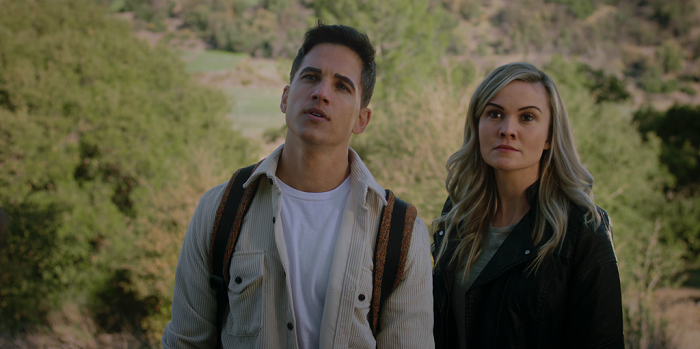
Storywise the movie follows a group of insufferable friends shooting a documentary aimed at debunking popular urban legends across the country. The group consists of the director, Holly (Cathy Marks), her cameraman and boyfriend, Matthew (Mike Manning), the doc’s prima-donna host, Megan (Alexis B. Santiago), and the meat-headed goof, Gabriel (Capri-Antoine Vaillancourt) whose role I still haven’t figured out.

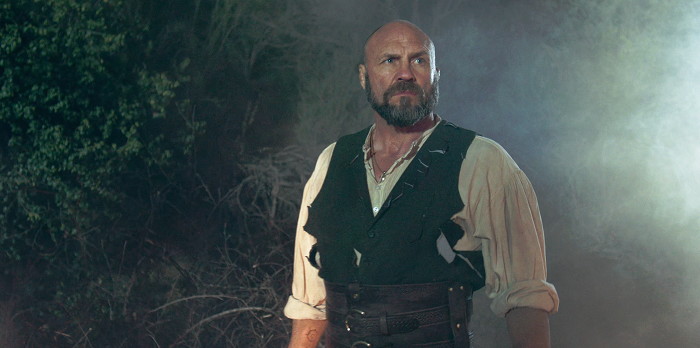
After recruiting Matthew’s pot-growing little brother Liam (Reid Miller) to shuttle them around in his Winnebago, the group heads off to Bell Lake. Once there, they pay a visit to a secluded campsite where many have allegedly vanished by the hand of an axe-wielding killer named Hank (Couture). Legend says if you ring an old church bell near the site it will summon Hank who…you know…gets to hacking.

Of course our dimwitted group rings the bell and Hank does indeed appear. I won’t spoil where things go but there is a neat little twist. Sadly it never goes anywhere interesting. Instead there is a bunch of silliness about a satanic priest, three sacrificed virgins, an evil curse, and a portal to Hell. It’s all just as silly as it sounds and not the slightest bit compelling.

A few other characters pop up including a great cameo from Bonnie Aarons (“The Nun”). We meet a young woman named Brittany (Kathleen Kenny) who is searching for her missing brother. She’s easily the most likable of the bunch and the lone bright spot. On the opposite side is Chaz Bono who gives a grimace-worthy performance playing one of the most unconvincing sheriffs you’ll ever see on screen. “Grimace-worthy” fits the movie as a whole which, despite its efforts, is never as good as its concept. Not even close. “The Bell Keeper” is available now on VOD.

VERDICT – 1.5 STARS

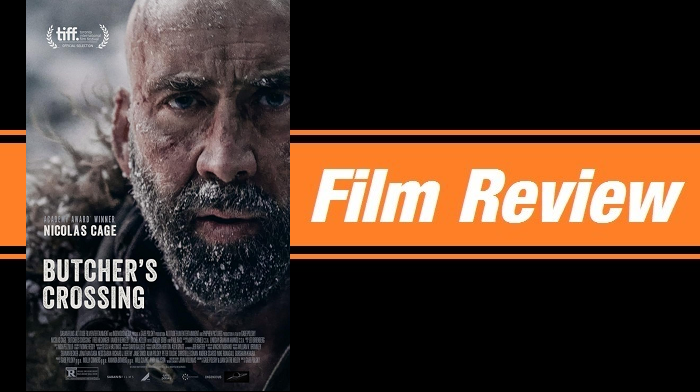
REVIEW: “Butcher’s Crossing” (2023)

I’m not sure there’s a genre that Nicolas Cage hasn’t dabbled in. The seasoned cult favorite has led mainstream action films, starred in small arthouse dramas, and played in hilarious off-beat comedies. He’s been in war movies, fantasy adventures, martial arts films. He’s done voicework in animated features, portrayed Marvel superheroes, and even took on the iconic role of Count Dracula.

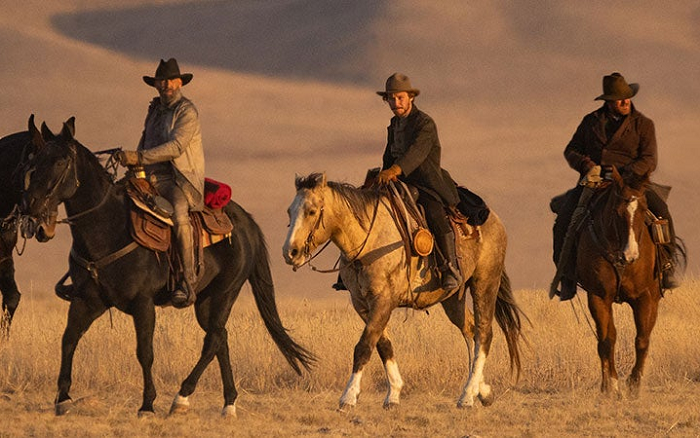
One genre Cage has revisited several times is the American Western. His latest film, “Butcher’s Crossing” sees him once again in the Old West, but this time within a refreshingly unique story. Directed, co-written (with Liam Satre-Meloy), and co-produced by Gabe Polsky, “Butcher’s Crossing” is based on the 1960 novel of the same name by John Williams. Contrary to the more romanticized views at the time, the book was an early deconstruction of the Old West and Polsky’s movie follows right in those footsteps.

The story opens in 1874 with an eager young man named William Andrews (Fred Hechinger) arriving in the small Kansas town of Butcher’s Crossing. Unfulfilled by life at Harvard, Will dropped out of school and travelled west in hopes of finding himself and experiencing what he in his naïveté perceives the American frontier to be. His first glimpse of the cold, unfriendly Butcher’s Crossing gives him pause. But he’s quick to toss aside his first impression, looking forward to what adventure might await.

Image Courtesy of Saban Films

Will’s first stop is to introduce himself to a crusty trader named McDonald (Paul Raci) who buys and sells buffalo hides at ever-changing market values. Will’s father once helped McDonald back east and Will hopes that connection will help get him into one of McDonald’s buffalo hunting parties. But McDonald denies him a spot, warning him that it’s a pitiless life that can ruin a man.

Not to be discouraged, Will convinces a self-employed buffalo hunter named Miller to take him on. Played by Cage who’s bald with a jet-black beard and a hard-to-decipher twinkle in his eye, Miller tells Will of a hunt deep in the uncharted wilds of the Colorado territory. It has more buffalo with thicker hides which of course means more money. All he needs is $500 to $600 to fund the hunt which Will agrees to supply with little hesitation.

Joined by a superstitious camp cook Charlie (a nearly unrecognizable Xander Berkeley) and a crass and brutish skinner named Fred (Jeremy Bobb), the four-man hunting party make the arduous journey to a sprawling patch of land high up in the Rocky Mountains. It’s there that they set up camp near a massive herd of buffalo and where Miller’s intensifying fixation leads the group down a physically and emotionally treacherous path.

Image Courtesy of Saban Films

Once it gets its pieces in place “Butcher’s Crossing” shows itself to have a sharp psychological edge. The notoriously savvy Cage makes the beguiling Miller fittingly hard to read. In one sense he’s an alluring larger-than-life presence that you can’t turn away from. But over time we can’t help but join Will in questioning Miller as his epic hunt devolves into a near maniacal obsession.

The movie’s slow-burn pacing proves to be a good fit for the story. The characters, their relationships, their circumstances – it all changes over the course of three grinding seasons in the mountains. The performances are authentic and nuanced, especially from Cage who is surprisingly (and effectively) restrained. And the stunning cinematography not only captures the natural beauty of the setting but also the remoteness of an untouched countryside.

While the film is rich with gorgeous scenery and picturesque horizons, Polsky often contrasts it with a compellingly uncomfortable close-up look at the buffalo trade. It’s a resonating conflict that brings out many of the film’s major themes. It leads to a final act that is harsh, brutal, and increasingly bleak. But it’s befitting for a story such as this – one that may have a few minor hiccups (such as underusing Rachel Keller) but that does a lot with its gritty and edgy premise. “Butcher’s Crossing” opens Friday (October 20th).

VERDICT – 4 STARS

REVIEW: “Blue Beetle” (2023)

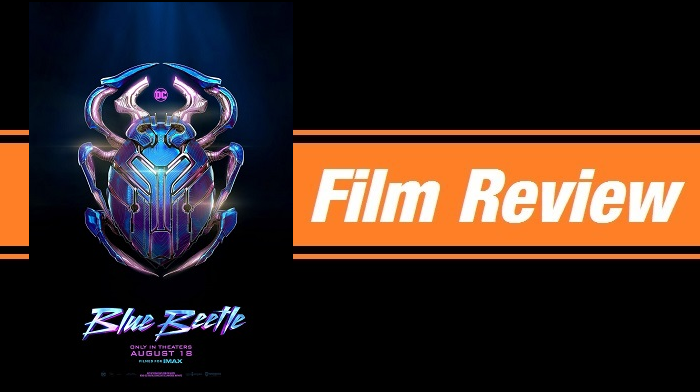
Perhaps the most unexpected of choices for a superhero movie was Blue Beetle, a comic book character who has had three distinctly different variants over the last 80-plus years. He’s never been what you would consider a top-tier superhero either in power or popularity. So following the box office disappointments that were “Black Adam”, “Shazam: Fury of the Gods”, and “The Flash” (soapbox: all of them deserved bigger audiences), it’s hard to see “Blue Beetle” being the big boost DC Studios needs.

But comic book movies have proven to be a weird thing and at times impossible to predict. “Blue Beetle”, from director Ángel Manuel Soto, has been touted by DC’s new creative head James Gunn as the first confirmed on-screen character in his own rebooted cinematic universe. That alone might spur the interest of those already invested in what Gunn is doing. I liked DC’s old guard (well, most of them) and remain unsure about Gunn. Unfortunately “Blue Beetle” doesn’t do anything to win my confidence in DC’s new direction.

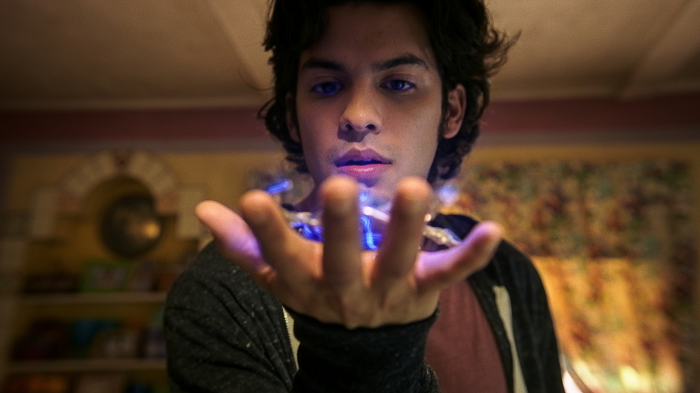
“Blue Beetle” is based on the most recent iteration of the titular character, Jaime Reyes (played by Xolo Maridueña). Fresh out of college, Jaime returns to his fictional hometown of Palmera City where he reunites with his tight-knit and spirited family. They include his noble father Alberto (Damián Alcázar) and his supportive mother Rocio (Elpidia Carrillo), his crass younger sister Milagro (Belissa Escobedo), his caring grandmother Nana (Adriana Barraza), and his conspiracy theorist uncle Rudy (George Lopez).

Image Courtesy of Warner Bros. Pictures

But it’s not all sunshine and roses. Jaime learns that a lot has changed while he was away. His father suffered a heart attack, they lost their family store, and now they’re about to lose their house. So rather than go to graduate school, Jaime pledges to help his family get back on their feet. He thinks he’s found a way after he’s offered an interview at mega-corporation Kord Industries by Jenny Kord (Bruna Marquezine), the niece of the company’s CEO Victoria Kord (Susan Sarandon). But things quickly fall apart.

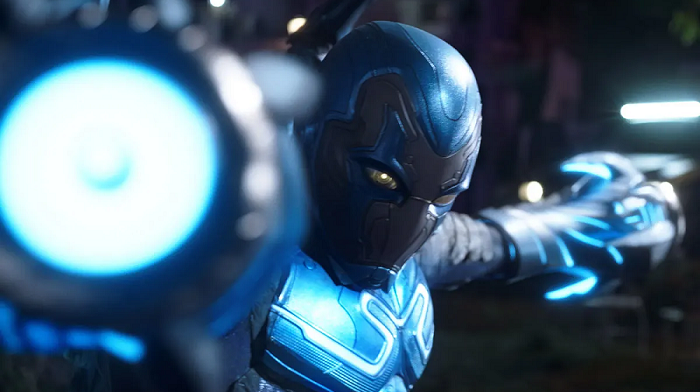
It turns out that Victoria has sinister plans that involve a “world destroying” alien weapon called the Scarab. Through a series of rather silly events Jaime finds himself in possession of the Scarab which (for some reason) chooses him as its new host and grants him superpowers. He gets some admittedly cool looking blue and black exoskeleton armor and the ability to conjure up energized weapons just by talking to the little voice that comes with it. How does all of that work? Heck if I know. The movie doesn’t explain much of anything.

And that’s the basic setup for this woefully by-the-numbers origin story. Gareth Dunnet-Alcocer’s copycat script is frustratingly predictable and formulaic to the point of feeling generic. And that’s a real shame considering the long overdue Latino representation. “Blue Beetle” is content with lazily latching onto Latino culture rather than telling an interesting and original story within it. Thankfully there are a couple of good scenes where Soto tones down the silliness and lets his characters breathe. But they’re few and far between.

Image Courtesy of Warner Bros. Pictures

It gets pretty maddening over time. The writing leans heavily on its domestic charms yet confines its characters within a conventional copy-and-paste story. Along the way it makes several heavy-handed statements on class, race, sexism, immigration, imperialism, etc., but none of them have bite. As for Maridueña, he shows moments of leading man promise. But even he’s dragged down by material that has him either screaming incessantly or acting like a Peter Parker knock-off.

To make matters worse, then you have the movie’s big baddie which (if only this was just hyperbole) is one of the worst villains in comic book movie history. I wish I was being overly dramatic, but Sarandon’s Victoria Kord is as clichéd and on-the-nose as any antagonist you’ll see. There’s nothing remotely interesting about her, her actions, her evil plan, her motivations. Even her shortchanged henchman (Raul Max Trujillo in a thankless role) is more compelling.

By the third act things really get hokey. The CGI kicks into overdrive – some of it is kinda cool; some of it is kinda suspect. And of course we get even more screaming from Maridueña. The warm and sudsy ending puts a nice cap on it all, but I wish it left me feeling like it was clearly wanted me to feel. Instead I was grumbling about all the wasted potential. Hey, at least the Bug ship (yes there’s a Bug ship) was pretty cool. But should a Bug ship be the best thing in a movie that has family as its centerpiece? Probably not.

VERDICT – 2 STARS

REVIEW: “Barbie” (2023)

It’s kinda weird for a film to have such a rabid cult following well before it’s ever seen. But such was the case for “Barbie”, the new film from director Greta Gerwig based on the popular Mattel fashion dolls which first launched way back in 1959. Many of the film’s passionate fans were brought onboard by the wild social media hype. Others were drawn in by the intense marketing campaign that saw Barbie slapped on everything from a Prada clothing line to a limited-edition Burger King cheeseburger. It was a buzz that went beyond mere anticipation.

The eye-catching “Barbie” trailers stoked even more excitement. Suddenly memes were being generated by the gross. Google was turning its search pages pink, Xbox designed a Barbie inspired gaming console, Airbnb was listing a real-life Barbie Malibu Dream House. It was all pretty crazy. So in many ways “Barbie” was conditioned to succeed well before anyone had laid eyes on it. And any reasonable hesitations were mostly swept away in the sea of pink, plastic, and product.

It all translated into a record-breaking opening weekend for Gerwig and Warner Brothers. In one sense it was great to see. I’m a long-time fan of Gerwig and her work so it’s good to see her star deservingly rise. In another sense it’s a little sad to see her moving to mainstream studio blockbusters. It will inevitably take a bite out of her terrific independent filmmaking. And what does it mean for Greta Gerwig the actress? She’s such a delight on screen and it’s reasonable to expect that we’ll see her in even fewer acting roles.

Image Courtesy of Warner Bros.

“Barbie” (co-written by Gerwig and her longtime partner in life and in movies, Noah Baumbach) is quite the shift for the director whose two previous efforts were “Lady Bird” and “Little Women”. If you strain you can catch glimpses of the Greta Gerwig who more than earned her stripes through years of great work on the indie scene. But just as much of the film seems aimed at satisfying the expectations of fans and (I’m sure to some degree) the demands of Mattel and WB executives. It leaves “Barbie” feeling like a weird amalgamation of indie ideas and studio pomp.

Part satire, part deconstruction, part heavy-handed manifesto, “Barbie” wears its worldview on its sleeve. Patriarchy is clearly its favorite target with some of its shots being genuinely clever and funny while others are so overt and on-the-nose that you could almost spoon-feed them to 7-year-olds. You won’t find an ounce of subtlety or nuance in the movie’s commentary nor is it presented in a way that will actually challenge our sociocultural systems. It’s also undermined by one nagging contradiction that I won’t spoil.

The film’s biggest strength is Margot Robbie who may seem like the obvious choice to play Barbie, but who brings some unexpected weight and depth to the character through her knock-out performance. We first meet her in the pastel and plastic Barbieland, a matriarchal society where all the Barbies run things and go by the same names. There’s President Barbie (Issa Rae), Weird Barbie (Kate McKinnon), Writer Barbie (Alexandra Shipp), Physicist Barbie (Emma Mackey), Doctor Barbie (Hari Nef), and so on (Robbie’s Barbie is referred to as Stereotypical Barbie for reasons that Gerwig makes impossible to miss).

Meanwhile the Kens hang out by the beach where Ryan Gosling’s version seeks to impress Robbie’s Barbie whenever she comes around. It quickly becomes evident that he’s smitten with her but she clearly doesn’t feel the same way. Other Ken versions are played by Simu Liu, Kingsley Ben-Adair, Scott Evans, Ncuti Gatwa, and others. We even get John Cena in a pretty cringy cameo.

The opening act is easily the film’s best as Gerwig has a blast playing around in Barbieland, introducing the Barbies and Kens, and having a lot of fun with the silly dynamics between them all. But things change after Robbie’s Barbie (who I’ll just call Barbie for the remainder of the review) begins having thoughts of mortality, discovers she has cellulite, and worst of all is suddenly flat-footed.

Barbie learns the only way to return things to normal is to travel to the real-word and find the little girl who is playing with her. So Barbie sets off in her pink Corvette convertible only to later find Ken stowed away in the backseat. She reluctantly allows him to tag along on her journey. By the way, it’s best not to try and make sense out of any of this. The movie certainly doesn’t. How Barbieland and the real-world connect; how children in the real-world effect dolls in Barbieland – from the movie’s POV who knows and who cares.

Image Courtesy of Warner Bros.

One problem with putting so much effort into hammering home its message is that the film shortchanges other parts of the story. While it packs a few laughs, the entire real-world segment feels rushed and frankly quite shallow. The biggest casualties are Gloria (America Ferrera) and her tween-ish daughter Sasha (Ariana Greenblatt). Gloria works at Mattel and only seems there to deliver a big attention-drawing second-half monologue. Sasha is rebelling against pretty much everything although we never really know why. Their troubled mother/daughter relationship should have been a key part of the story. Instead it comes across as a paper-thin side note.

By the time the movie returns to Barbieland for its third act the gags start to get old and some of the swings at humor feel a little forced. Still the film manages to land on a pretty solid note – a bit contrived but sweet and smile-inducing. It’s the road to that point that has its potholes. There are enough cool references to make little girls smile but enough sexual innuendo and double entendres to make parents squirm. The set design is incredible but gets lost in the second half’s noise. The theme of breaking out of boxes and finding our true selves is a great one but is drowned out by the movie’s more singleminded interest.

It’s 100% aware that I’m not the target audience and much of “Barbie” could have flown right over my head. I kinda doubt it though. I’m a huge Gerwig fan. I liked the nostalgic callbacks and the many spoofs. I like its cornball sense of humor (which is right up my alley). Even its patriarchal theme creates the perfect sandbox for a movie like this to play in. It’s the clunky execution, the surface-level storytelling, the see-through attempts at subversiveness, and the complete lack of restraint that ultimately weighs the movie down. “Barbie” is in theaters now.

VERDICT – 2 STARS

RETRO REVIEW: “The Boss” (aka “Wipeout!)(1973)

In the dark of night, a man in blue coveralls and carrying a long narrow case slips into the side door of a movie theater. He makes his way to a service elevator and heads up to the roof. Once there he walks across and enters a door that takes him down several stairs and to the projection booth. He opens up his case and pulls out a bolt-action rifle. In the theater below a mob boss and his wise guys sit watching a Swedish skin flick, unaware that a gun is pointing at them from above.

I won’t spoil how things play out, but the scene is an explosive start to writer-director’s Fernando Di Leo’s “The Boss” (which was also released as “Wipeout!”). Everything about it, from its conception to its execution, emphasizes Di Leo’s skill and tenacity as a genre filmmaker. It’s bloody and brutal and instantly sets the tone for this violent and sometimes sleazy poliziottesco crime noir.

“The Boss” is considered the be the third film in Di Leo’s Milieu Trilogy following “Caliber 9” and “The Italian Connection”, both from 1972. The killer in the above described scene is Nick Lanzetta (played by the late Henry Silva). He’s a hitman working for Don Giuseppe Daniello (Claudio Nicastro). Don Giuseppe has been a father figure to Nick, taking him in off the streets and raising him as one of his own. Now Don Giuseppe runs a crew in Palermo with Nick as his trusted right-hand-man.

While taking out the rival boss at the movie theater may have solved some problems, it also opened up others. A gangster named Cocchi (Pier Paolo Capponi) takes charge of what’s left of the dead Don’s crew and is intent on revenge. He has some men kidnap Don Giuseppe’s nympho daughter Rina (Antonia Santilli). As expected this sends Don Giuseppe into a panic. He wants Nick to find and rescue Rina but is told to stand down by the regional boss, Don Corrasco (Richard Conte). He’s an old-school Sicilian who detests Calabrians. Still he doesn’t want to start a full-blown gang war as too much noise would catch the attention of the big bosses in Rome.

But soon Nick finds himself caught in the middle. Corrasco wants him to keep an eye on Giuseppe to make sure he doesn’t make a deal with the kidnappers that would threaten the family. Giuseppe wants him to help get Rina back without alerting Corrasco. Like most good spaghetti gangster movies, a slew of characters are introduced and few are left standing at the end. Allegiances form, friends turn on friends, enemies get their comeuppances.

There are several interesting variables that add some cool layers to the story. Gianni Garko is terrific as Commissioner Torri, a dirty cop who’s impossible to read. And Marino Masé is really good playing Pignataro, a mob enforcer who helps Nick once the heat turns up. Both are crucial pieces of the story that keep things moving in unexpected directions. Not so good is Rina, who only seems there to serve as a plot device and to give the audience a woman to ogle. She’s a flimsy character and a distraction that often pulls us away from the good stuff.

Overlooking that one poorly judged annoyance, “The Boss” is a captivating mob thriller full of rich and fascinating characters and with a good eye for gritty gangland action. The story may have the markings of a conventional mob tale, but Di Leo’s shrewdly absorbing script and direction brings a fresh feel to a pretty straightforward genre flick. It’s propulsive and energetic, eventually reaching a bullet-riddled payoff that’s both fitting and satisfying.

VERDICT – 3.5 STARS