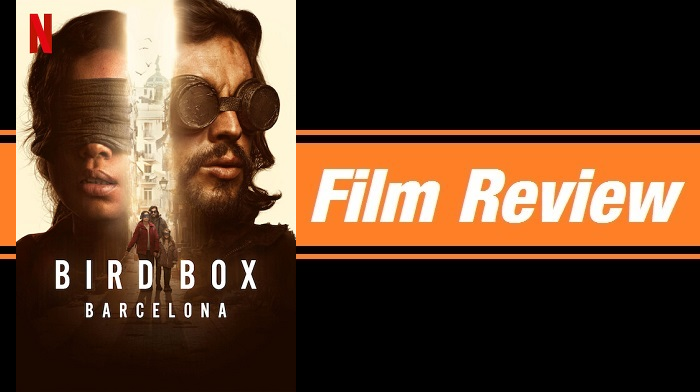
REVIEW: “Bird Box Barcelona” (2023)

(CLICK HERE to read my full review in the Arkansas Democrat-Gazette)

In December of 2018 Netflix released “Bird Box”, a movie that unexpectedly turned int an overnight sensation. It was a Sandra Bullock led post-apocalyptic horror thriller that quickly became the platform’s most-watched movie. Many were obsessed with it, setting social media ablaze. Others went even further as evident by the ‘Bird Box Challenge’ craze where antics ranged from silly stuff like people covering their eyes and walking into walls to a 17-year-old Utah girl crashing her car after driving blindfolded into oncoming traffic.

As for the movie itself, it remained a fan favorite for quite some time. Talks of a sequel quickly followed. Then in 2021 we got our first hint of what was to come. It would be a Spanish-language spin-off set within the same universe. It was to be written and directed by the filmmaking duo of Álex and David Pastor.

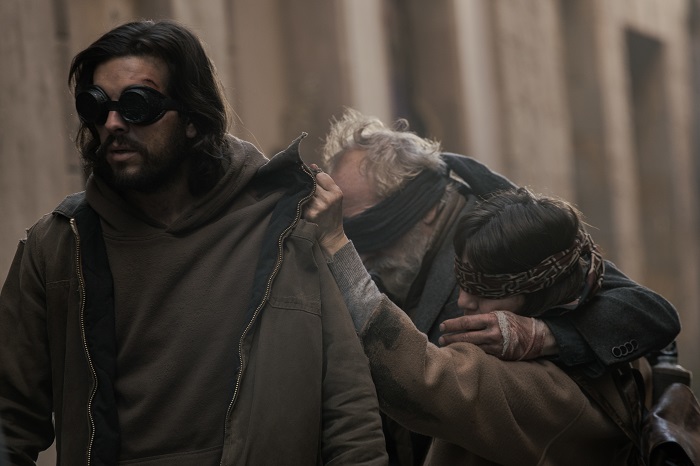
“Bird Box Barcelona” does indeed spin off of the first film which was based on Josh Malerman’s 2014 novel. But it’s certainly no clone of its 2018 predecessor. The Pastors do a good job of giving their film its own identity, taking the same concept and building on it in a number of interesting ways. It does require at least some degree of investment in the Bird Box world. But don’t worry – mine was minimal at first. And by the end I found myself pleasantly (and unexpectedly) intrigued.

Image Courtesy of Netflix

There’s no doubt that the 2018 film was helped by having a Hollywood A-lister like Sandra Bullock attached. “Bird Box Barcelona” may not have that kind of celebrity draw, but Goya Award winner Mario Casas (“Cross the Line”) makes for an impressive lead. Not only does he maneuver his surprisingly layered character through the story’s literal urban hellscape, but he also takes him on an emotionally scarring journey soaked in themes of grief, parenthood, and lost humanity. It’s a subtly rich performance from Casas, even in the final act where his character arc loses some of its steam.

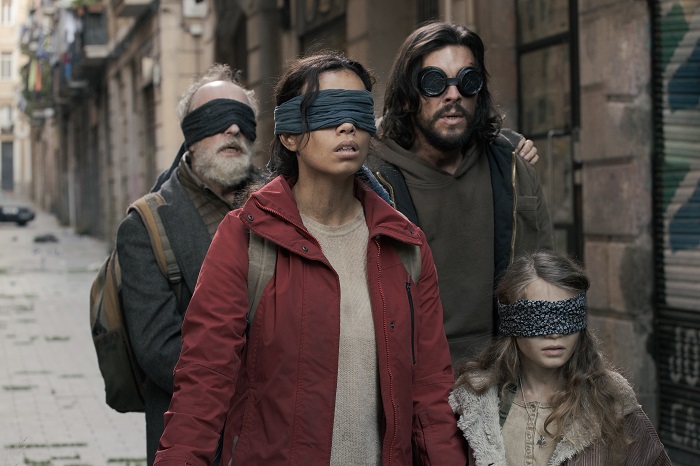
Cases plays Sebastián who we first meet well after the mysterious entities from the first film have plunged earth into dystopian chaos. If you remember, the entities (which the audience are never shown) possess the unexplained ability to make people violently kill themselves just by looking at them. So what few survivors remain are forced to blindfold themselves whenever they’re exposed to the outdoors. This is the world Sebastián and his young daughter Anna (Alejandra Howard) must navigate when we first meet them.

The Pastors do intermittently take us back a few months to when the chaos began, revealing Sebastián’s story through some truly terrifying flashbacks. We see where he was when reports of mass suicides began filling the airwaves. We see him trying to get home to his family as bedlam breaks out across Barcelona. We see what has forced Sebastián and his daughter to scavenge for their survival, not only evading the murderous creatures but the dangerous and equally deadly humans as well.

Image Courtesy of Netflix

But it’s an early first-act twist that sets the movie on an unanticipated trajectory. I won’t dare spoil it as it becomes the crux of story. But it’s an unforeseen jolt that tosses any expectations you may have had out the window. It also opens the door for the Pastors to do some fresh world-building – adding some new pages to the mythology and laying down the groundwork for what looks to be some pretty clear franchise ambitions.

As the story unfolds, Sebastián encounters a number of other survivors throughout the ravaged Barcelona. Some appear friendly such as Claire (Georgina Campbell), a doctor with some keen maternal instincts, and Sofia (Naila Schuberth), a young girl who was separated from her mother. Others appear quite menacing, including Padre Esteban (Leonardo Sbaraglia) and the cult-like group who some claim can look upon the entities and remain unharmed. They all help fill out the world and have their own roles to play in getting the story to the finish line.

After the credits roll there are still some pretty obvious questions yet to be answered: Exactly what are these entities? What do they look like? Where did they come from? Why are they doing what they’re doing? It’s not necessarily a bad thing. The Pastors utilize these mysteries to the fullest, adding in a few new ones of their own. Yet by the end we get the sense that answers are on the way. In true franchise fashion we’ll have to wait until the next movie to find out. But credit to the Pastors, they have me onboard and I’m certainly willing to dive back into this world they have shrewdly expanded. “Bird Box Barcelona” premieres today on Netflix.

VERDICT – 4 STARS

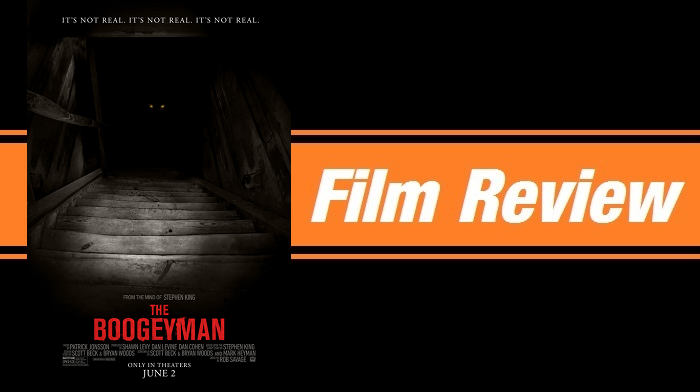
REVIEW: “The Boogeyman” (2023)

(CLICK HERE to read my full review in the Arkansas Democrat-Gazette)

Based on the 1973 short story of the same name by Stephen King, “The Boogeyman” comes from director Rob Savage and the screenwriting trio of Scott Beck and Bryan Woods (the duo who penned “The Quiet Place”) and Mark Heyman. While they’re definitely not reinventing the wheel here, there’s a certain well-made old-school chiller quality to this new horror entry. And it offers up some good counter programming for those not interested in the latest superhero Spider-Man multiverse extravaganza that grabbed most of the attention last weekend.

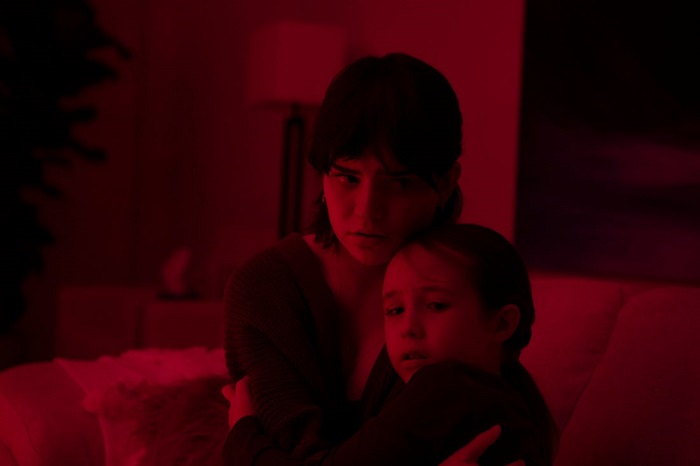
Grief and loss continue to be among the most prominent themes in movies today. They certainly play a big part in “The Boogeyman”. High schooler Sadie (Sophie Thatcher) and her kid sister Sawyer (Vivien Lyra Blair) are struggling to adjust following the recent death of their mother. Suffocating under his own sorrow, their grieving father Will (Chris Messina) has locked up his feelings and refused to talk about the accident that took his wife’s life. Understandably it has put a strain on his relationship with his daughters.

Image Courtesy of 20th Century Studios

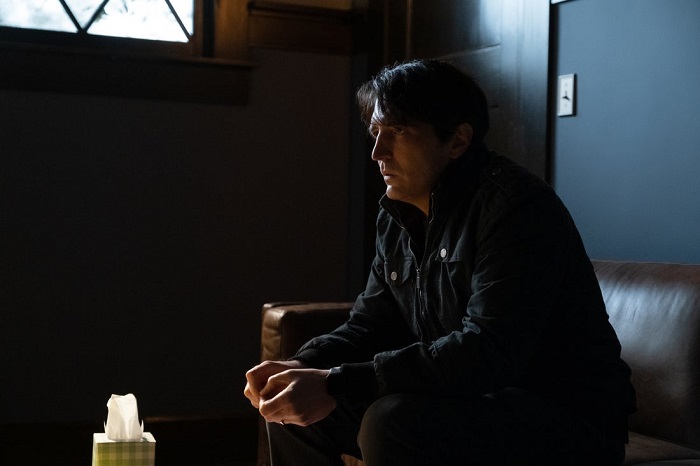
As the girls prepare for their first day back at school in a month, Sadie has an especially tough time (it’s all the more understandable once we meet her pathetic excuse for “friends”). Meanwhile Will, a therapist working from home, has continued to see patients. After getting the girls to school he returns to his office and is surprised by a troubled man named Lester Billings (David Dastmalchian) who is desperate to speak to him.

Will sits Lester down and puts on his therapist cap. The conversation that follows is arguably the film’s creepiest sequence. Lester explains he’s suspected of murdering his three young children but denies it. Instead he hands Will a crude drawing of a sinister looking monster he clams is responsible. “It’s the thing that comes for your kids when you’re not paying attention,” he says in a strangely pointed manner.

I won’t spoil where things go from there, but Will and Lester’s meeting doesn’t end on a good note. Even worse, soon the monster pays their home a visit. Of course it only comes out at night and it begins by terrorizing young Sawyer (don’t ask me why). Blair was a hit playing young Princess Leia in Disney’s “Obi-Wan Kenobi” series and she’s really good here.

The same can be said for Thatcher playing the older sister forced to take on an almost parental role. Sadie doesn’t buy Sawyer’s claims at first. But soon she too comes face-to-face with the malevolent creature. And with her father in such a disconnected state, she takes it upon herself to protect her kid sister and find out why the monster has chose their family to terrorize.

There are a lot of heavy themes being explored and the numerous metaphors are impossible to miss. That’s especially true during the big ending where it’s hard to tell if the filmmakers are even trying to hide their overarching message. Still the metaphors and message are effective. Unfortunately they also make things predictable. Perhaps it’s the inescapable result of seeing so many horror movies plow similar ground, but once you get a grip on what the filmmakers are after it’s pretty easy to tell where they are heading.

Image Courtesy of 20th Century Studios

As for the horror stuff, we get some some good atmosphere, a few well-executed scares, and a cool creature design. At the same time Savage leans a little too much on the genre’s more well-worn tropes. Loud bangs, creepy voices, creaking doors, noises in the walls – it’s all there. He does some interesting things with light and shadows, but even that starts to feel too familiar.

When considered together it’s these nagging issues that eventually cause the movie to sputter despite the best efforts of those in front of and behind the camera. For the most part it still accomplishes what it sets out to do. But the overall impression that “we’ve seen all this before” stymies much of the suspense and leaves the film feeling like pretty standard horror movie fare. Well-intended and mildly successful, but standard nonetheless. “The Boogeyman” is in theaters now.”

VERDICT – 2.5 STARS

REVIEW: “Blood & Gold” (2023)

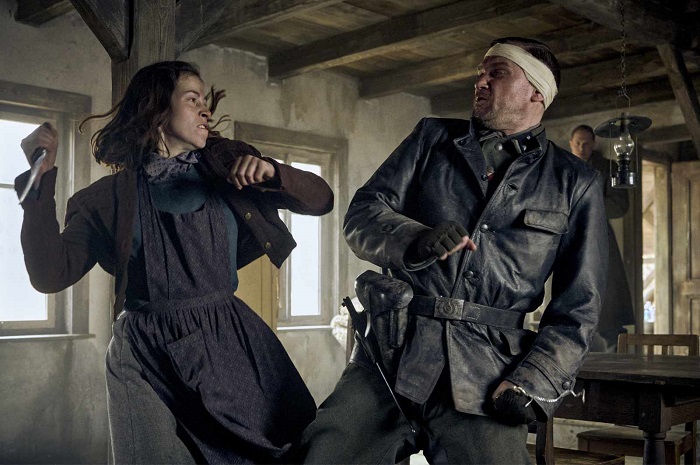
With his new film “Blood & Gold” director Peter Thorwath walks the same path as features like Quentin Tarantino’s “Inglourious Basterds” and even “Sisu” from earlier this year. He’s made a gritty, gory, no-holds-bar war movie that fully embraces its genre influences. Yet Thorwath (who also directed 2021’s “Blood Red Sky”) also shows he has a knack for characters. And there are many that help spin this twisted, violent, and at times darkly funny war-torn tale.

Greed is one of most lethal killers in “Blood & Gold” which is set in Germany during the waning days of World War II. Following some brief opening script that would have made Sergio Leone and Ennio Morricone proud, we get a tone-setting first scene. In it we see a Germany SS unit led by the ruthless and disfigured Lieutenant Colonel Von Starnfeld (Alexander Scheer) chasing after a deserter named Heinrich (Robert Maaser). They eventually catch him and hang him from a nearby tree.

But as soon as the Nazi’s are out of sight a young woman named Elsa (a really good Marie Hacke) appears and frees the seriously injured Heinrich. She takes him to her small country farm where she and her Down syndrome brother Paule (Simon Rupp) nurse the soldier back to health.

Image Courtesy of Netflix

We learn Elsa has no love for the Nazis who killed her father and who would happily kill her brother simply because of his condition. A disillusioned Heinrich is fed up with the war. His pregnant wife and son were killed in a bombing raid, but his young daughter Lottchen survived and was taken in by some neighbors. Getting home to her is all he cares about.

Meanwhile Von Starnfeld and his unit roll into the village of Sonnenberg where they believe a stash of gold bars has been hidden in the rubble of a house once belonging to a Jewish resident named Johannes Löwenstein. The town’s sniveling mayor and Nazi panderer (Stephan Grossmann) welcomes the soldiers into his village. But he quickly learns his uninvited guests aren’t concerned with his hospitality.

Von Starnfeld claims the local inn as his headquarters and forces the townspeople to start sifting through what remains of the Löwenstein house. He then orders his brutal second-in-command, Sergeant Dörfler (Florian Schmidtke) to take some soldiers and steal provisions from neighboring farms. That brings them to Elsa’s doorstep where a violent encounter sets the main story in motion.

Image Courtesy of Netflix

Screenwriter Stefan Barth tosses several more characters into the mix. Most are townsfolk, many with their owns secrets, loyalties, and interests. They all fit nicely into what turns out to be a crazy web of war-scarred anger and unfettered greed. Barth’s script is sharp, shrewdly witty, and hard to predict. He pulls the rug out from under us more than once while delivering a rousing payoff that is a stealthy mix of comically violent and emotionally satisfying.

We also get some fantastic action scenes that range from intense shootouts to ferociously choreographed fight sequences. Thorwath has a good grasp of shooting and framing action. But what’s most fun is watching the different ways he uses it. Some scenes simply emphasize the sheer ferocity of war. Other scenes are straightforward genre movie joy.

With “Blood & Gold” you have a good story, good characters, and good action rolled up into something genre fans should have a blast with. All three can be thrilling, emotional, or sometimes all-out bonkers which is one of the movie‘a biggest strengths. “Blood & Gold” happily wears its influences on its sleeve yet it has its own distinct energy and flavor. And it comes in a tightly structured fast-moving 100-minute package. Yet another good international grab for Netflix.

VERDICT – 4 STARS

REVIEW: “BlackBerry” (2023)

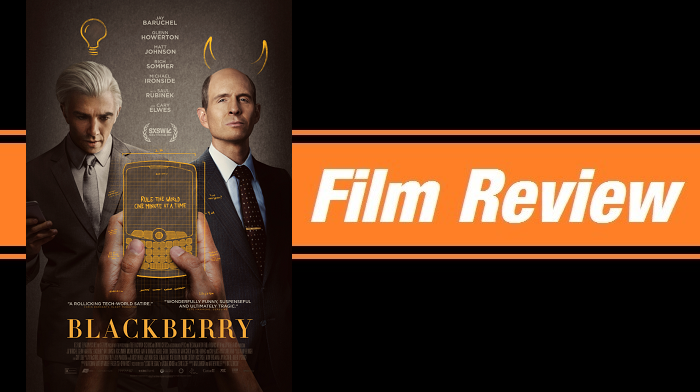
Here’s one of those cases where a film’s title really does say it all. The straightforwardly named “BlackBerry” from Canadian director Matt Johnson is a biographical dramedy based on the fascinating true story of the BlackBerry brand of smartphones. If you remember, the BlackBerry grew enormously popular during the 2000s and was often seen in the hands of such celebrities as Paris Hilton, Kim Kardashian, and President Barack Obama.

The highly innovative BlackBerry line was perhaps best known for its unique physical keypad and the super satisfying clicks that accompanied each press (many found it so addictive they dubbed the device “Crackberry”). I never had one but I freely admit to being a little jealous of those I knew who did. But like much in the tech industry, BlackBerry eventually fell to the next big thing. In their case it was the introductions of Apple’s IPhone and Google’s Android.

“BlackBerry” pulls quite a bit from the true story of the company’s rise and fall. It’s loosely adapted from Jacquie McNish and Sean Silcoff’s book “Losing the Signal: The Untold Story Behind the Extraordinary Rise and Spectacular Fall of BlackBerry”. But what Johnson gives us is more of a mockumentary-styled satire of a tech industry on the eve of one of the biggest tech booms in history. It’s a funny yet insightful cautionary tale that hones in on the people at its center more than the product that would make them billionaires.

Image Courtesy of IFC Films

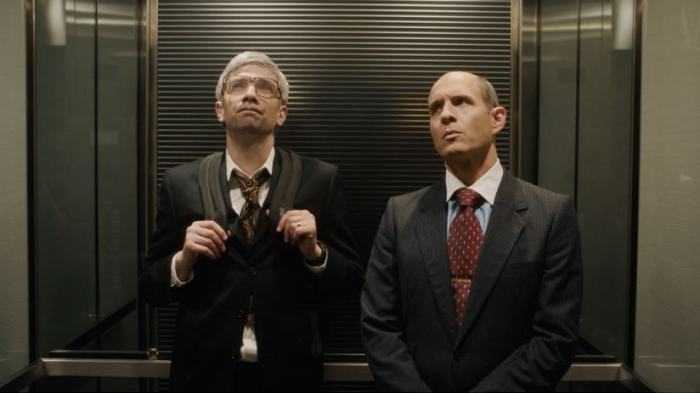
Co-written by Johnson and Matthew Miller, the story kicks off in 1996. In a role tailor-made for his awkward charm, Jay Baruchel plays Mike Lazaridis who back in 1984 co-founded Research In Motion with his longtime best friend Douglas Fregin (played by Johnson himself). In the movie their small Waterloo, Ontario based company consists of an easygoing pack of 14 fellow computer engineering nerds who spend as much time throwing LAN parties and watching movies as they do soldering circuit boards and writing code.

Elsewhere the temperamental and overly ambitious market strategist Jim Balsillie (a blustery Glenn Howerton) gets axed from his company for aggressively disobeying his boss (briefly played by the always good Martin Donovan). Smelling a potential fortune (and out of desperation), Jim bulls his way into a partnership with Mike. He puts down $20,000 and agrees to use his industry connections to market their exciting new product, the PocketLink (“a pager, a cell phone, and an e-mail machine all in one,” Doug proudly states). All Jim wants in return is fifty percent of their company and to be named CEO. Ouch.

They come to an agreement with Mike and Jim serving as co-CEOs. Mike will oversee product development while Jim hits the road to lure in potential investors. Of course as history informs us the PocketLink evolves into the BlackBerry and soon Research in Motion emerges as a market leader in wireless mobile devices.

As the popularity of their product grows so does the financial pressure. Mike, Doug, and their team scramble to innovate and keep up with the demand. But in true “The Social Network” style, success inevitably puts a strain on their relationship. It’s a friction you sense coming a mile away yet we still root for the pair as they struggle to maintain their friendship.

Image Courtesy of IFC Films

Meanwhile the shrewd and unscrupulous Jim is out in the field doing whatever it takes to grow and protect his investment. We see him illegally backdating stock options in order to lure away engineers from rivals Microsoft and Google. He’s also staving off a potential hostile takeover by PalmPilot head Carl Yankowski (a joyously despicable Cary Elwes). And all while he’s secretly trying to purchase his own NHL hockey franchise – a move driven by his own underhanded motivations.

It’s easy for us to see the writing on the wall and it doesn’t take long to tell that things aren’t going to end well. But Johnson keeps us invested. He moves things along at a crisp pace and the crackling dialogue has a Sorkin-esque edge as it chronicles the whirlwind corporate successes and missteps. Yet Johnson keeps things distinctly character-focused and never loses sight of the humanity at his story’s core. And all while being effortlessly funny in a subdued sharply witty way.

It’s also easy to fall in with Johnson’s verité filmmaking. From the frequently moving handheld cams to the strategic zooms which add as much to the humor as they do the drama. It’s a tricky directorial style that can often backfire. But here it actually works really well. And that’s true of “BlackBerry” as a whole – it works really well. It may lack the polish of similar 2023 corporate underdog movies like “Tetris” and “Air”, but Matt Johnson along with his game cast nail it where it counts.

VERDICT – 4 STARS

REVIEW: “Boston Strangler” (2023)

A taut journalism procedural meets a dark crime drama in the Ridley Scott produced “Boston Strangler”, a new film inspired by a true account of the two woman who broke the story of the eponymous murders of 13 women in the Boston area between 1962 and 1964. Written and directed by Matt Ruskin, the movie chronicles the search for truth through the eyes of investigative reporters Loretta McLaughlin and Jean Cole. The results are pretty riveting.

Aside from its rather on-the-nose title, “Boston Strangler” surprises in a number of ways. Its narrative is very straightforward, bypassing needless setup and avoiding the urge to pad the story with distracting drama. And while Ruskin decides against showing the horrific acts of violence in brutal detail, the movie still possesses a dark and gritty Fincher-like feel thanks to Ben Kutchins’ moody cinematography and Paul Leonard-Morgan’s simple yet ominous score.

Image Courtesy of 20th Century Studios

Keira Knightley plays Loretta McLaughlin, a wife and mother of three who works for Boston’s Record-American newspaper. Like most of the other women, she’s shackled to the Lifestyle section, churning out puff-pieces and kitchen product reviews. She aspires to work at the male-dominated crime desk, but she has a hard time convincing her editor, Jack Maclaine (Chris Cooper). That is until she begins connecting a series of unsolved murders that have understandably rattled the city.

Jack pairs Loretta with Jean Cole (Carrie Coon), a seasoned undercover reporter and one of the only women at the Record-American to break through the newsroom sexism. The two ratchet up their investigation, finding links between the murders and first dubbing the killer “The Boston Strangler”. But their news stories are met with skepticism. Some dismiss the assigning of two women to a high-profile crime case as nothing more than a circulation stunt. Meanwhile their articles spark the ire of the Boston PD by revealing the police’s mishandling of the cases.

As the number of murders increases, Loretta and Jean start questioning some of their original theories. Loretta begins squeezing information from a close-to-the-vest police detective (Alessandro Nivola). Jean uses her clout to dig deeper into what the police department may be hiding. Soon a prime suspect emerges – Albert DeSalvo (David Dastmalchian) who eventually confesses. But is the case really so cut and dried? Loretta and Jean aren’t so sure.

Ruskin’s script takes a methodical step-by-step approach to its story, intensely centering on Loretta and Jean’s search for the truth. But its linear focus means we barely get to know the two reporters outside of their jobs. We do get a few scenes with Loretta and her family, and we see the toll her work is taking on her relationship with her husband James (Morgan Spector). But aside from that and a couple of brief bar scenes, not much time is spent fleshing out the two leads.

Image Courtesy of 20th Century Studios

But that’s ok considering how well the true crime and journalism elements fall into place. Ruskin pieces together a compelling and finely paced story that unfolds in several unexpected ways. And the ways he authentically weaves the sexism of 1960s America into his movie is both clever and revealing. He makes a clear-eyed point without sidetracking the central narrative.

The movie is helped even more by some strong performances, particularly from Knightley and Coon. Both are perfectly calibrated for the film’s tone. Knightley shrewdly conveys Loretta’s dogged determination while Coon portrays Jean as a woman with toughness and grit. Together they’re an intriguing duo with a beguiling workplace chemistry and a willingness to go heads-up with the pseudo-macho norms of their day. They’re key ingredients that both energize and humanize this already gripping thriller. “Boston Strangler” premieres March 17, 2023 on Hulu.

VERDICT – 4 STARS

REVIEW: “Blood” (2023)

The new horror thriller “Blood” from director Brad Anderson and screenwriter Will Honley puts a wicked new spin on the “a mother will do anything to save her child“ idea. It’s a patient movie that puts a lot of effort into exploring the fractured family dynamic at the center of its story. But it also delivers the frights, mostly in the final act when “Blood” really begins to burrow under our skin.

A very good Michelle Monaghan plays Jess, a recently divorced mother of two who’s in the middle of a nasty child custody battle with her ex-husband Patrick (Skeet Ulrich) who had an affair (and a baby) with their nanny. But we learn Jess had her own problems, namely a serious drug addiction that put a strain on her relationship with Patrick, their daughter Tyler (Skylar Morgan Jones), and their younger son Owen (Finlay Wojtak-Hissong).

Image Courtesy of Vertical Entertainment

But Jess has been clean for 15 months and is looking to rebuild her relationship with Tyler and Owen. She and the kids move into an old farmhouse that belonged to her family much to the chagrin of a frustrated Patrick. The movie spends a lot of time building up the family tension. It shows both Jess and Patrick as flawed, imperfect people, but they’re not monsters. Both love their children very much and want what’s best for them. But divorce can bring out a nasty side in people, especially when emotions are RAW and children are at the center.

One afternoon Tyler, Owen, and the family dog Pippen set out to go fishing. They follow an old trail through the woods only to discover the lake has dried up. In the blackened muddy bed stands a withered cragged old tree that weirdly grabs Pippen’s attention. Later that evening Pippen runs out of the house and back down the trail. When he finally returns days later he has clearly changed (the glowing eyes are a dead giveaway). Pippen viciously attacks Owen, biting him on the neck and forcing Jess to kill the dog.

At the hospital, Owen’s condition deteriorates. But then Jess walks in on her son slurping from a blood pack as his vitals almost immediately improve. Clearly something unusual is going on. When his blood pressure plummets again, Jess (who’s a nurse at the hospital) swipes a bag of plasma from storage and slips it to Owen. He instantly gets better. Jess knows she can’t keep Owen in the hospital so she takes him home to the farm. But when her blood supply runs low, she gets desperate and starts crossing moral lines in an effort to keep her son alive.

Image Courtesy of Vertical Entertainment

Things get more complicated as Jess tries to hide it all from Patrick, and a bit more twisted as Owen’s craving for blood intensifies. It eventually sends the story down some darkly interesting paths. And there’s a hard to miss yet thoughtful metaphorical punch that can really be felt the further the story goes. Not all the character choices make sense, and certain mysteries are just left mysteries. These issues leave you wondering about what could have been if the filmmakers had dug a little deeper in certain places.

Still, the story holds together just fine, with a good chunk of its focus going towards its characters rather than any genre obligations. It’s much more thriller than horror (you won’t find a single jump scare) so adjust your expectations accordingly. But that doesn’t mean the movie doesn’t provide some scares. It just goes about them a little differently. Its pieces may not always fit snugly together, but its human drama and eerie chills proves to be an enjoyable mix. “Blood” is now showing in select theaters and hits VOD on January 31st.

VERDICT – 3.5 STARS