
REVIEW: “Bardo, False Chronicle of a Handful of Truths” (2022)

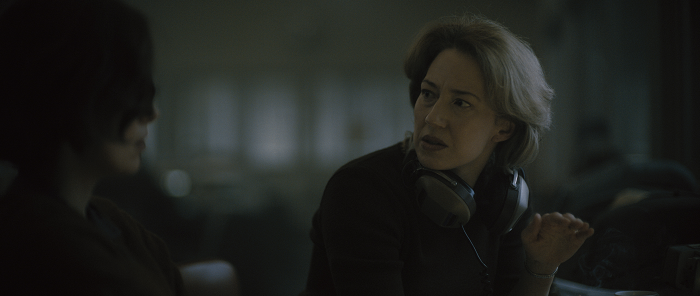
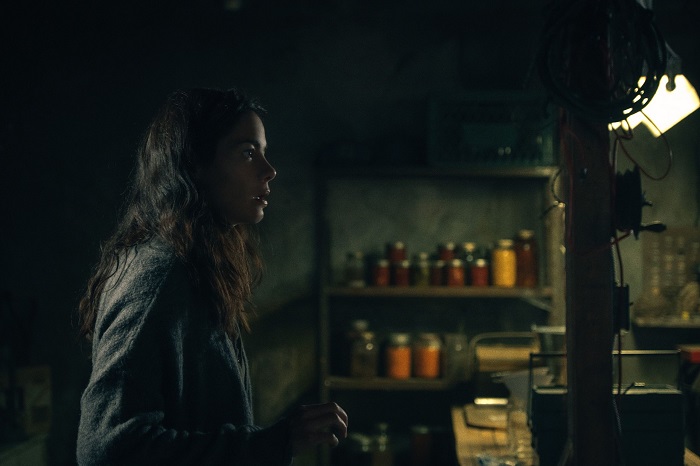
It seems we’re in an interesting phase where seasoned directors are using their platforms to reflect back on their pasts. Alfonso Cuarón did it with “Roma”. Last year, Kenneth Branagh did it with “Belfast”. Already this year, James Gray has done it with “Armageddon Time” and Spielberg with “The Fabelmans”. With “Bardo, False Chronicle of a Handful of Truths”, two-time Oscar winning director Alejandro González Iñárritu takes his shot, but not in any conventional sense.

Iñárritu has made a movie that demands we get into his headspace. If you can’t, odds are you’ll probably struggle with his latest film. For that reason I can see general audiences bowing out before the halfway mark. But for those who can get in sync with it, “Bardo” has a lot to offer. Of the above mentioned movies, it’s most like “Roma”, with its deeply intimate self-reflection and its cutting observations of the Mexican homeland. But what sets it apart are Iñárritu’s Fellini-like flourishes which can come across as pretentious and indulgent. But that actually plays directly into what the filmmaker is after.

With “Bardo”, Iñárritu gives us what can best be described as a narcissistic exercise in self-deconstruction. The film is undeniably self-regarding as Iñárritu makes himself a centerpiece. But there’s more going on here than some vainglorious self-promotion. Iñárritu takes a scalpel to his image and his success; his hubris and his insecurities, dissecting them the best way he knows how – cinematically. Yes, it’s a narcissistic work. But what better way for an auteur to probe and scrutinize the path they’ve traveled and the person they’ve become?

Image Courtesy of Netflix

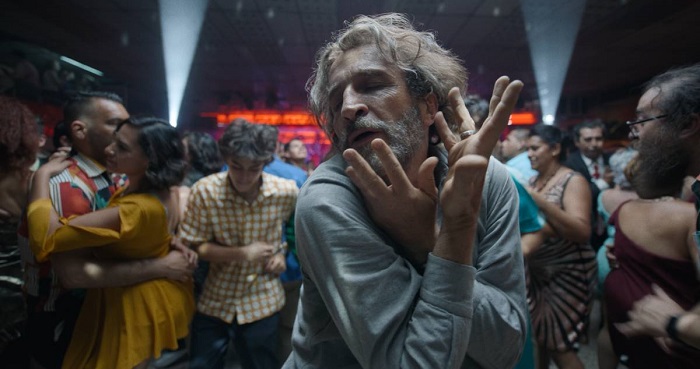
As with “Roma”, Mexico itself is an ever-present interest as Iñárritu seeks to reconnect with his homeland through his lead character and alter ego, Silverio (a magnetic Daniel Giménez Cacho). With the help of cinematographer Darius Khondji and Oscar-winning production designer Eugenio Caballero, Iñárritu envisions Mexico in a number of ways both real and surreal. It could be a scene of people collapsing at a crowded Mexico City intersection as Silverio helplessly looks on. Or an unsettling shot of him climbing a mountain of dead bodies in order to speak to Spanish conquistador Hernán Cortés who awaits at the top. There’s no shortage of alluring imagery.

Iñárritu’s story (which he co-wrote with Nicolás Giacobone) is just as immersive and incisive as the visuals. Its fractured free-flowing structure can be disorientating, and some segments make little sense on their own. But they’re individually compelling (a testament to Iñárritu’s vision) and hold our attention until everything is braided together in an emotionally satisfying final 15 minutes. In a way it does resemble a memory play, except here the people and places we see are dug out of Silverio’s unreliable memory and displayed through dreamlike recreations in his mind. Some feel painfully real while others have a Dali-like surreality. Some are deadly serious while others are utterly preposterous.

Silverio Gama is an acclaimed Mexican-born journalist and documentarian who left his home country for Los Angeles 15 years ago. Now he’s been named the recipient of a major award from the American Society of Journalists. Needing to prepare an acceptance speech, Silverio and his family travel to Mexico where he hopes to reconnect with his birth nation. But rather than find inspiration, he finds himself caught in an existential web. Soon he’s wrestling with everything from his own identity and mortality to his perception of Mexico itself, past and present. And as we’re thrust deeper inside of Silverio’s head, we’re quickly reminded that memories can’t be trusted. They tend to change as we change and are often shaped by emotion rather than truth.

Image Courtesy of Netflix

Regardless of how bonkers some scenes get, there’s always a deeper emotional tenor. For example, one of the earliest scenes takes place in a hospital operating room where Silverio’s wife Lucía (Griselda Sicilian) gives birth to their first child. I won’t spoil it, but something so utterly absurd happens that you can’t help but laugh. Yet the sheer weight of the moment has an effect that resurfaces many times throughout the story. It’s one of several instances of black comedy being fused with consequential drama.

“Bardo” can also be glaringly pretentious and self-indulgent, and Iñárritu is 100% aware of it. He’s constantly poking fun at himself and his movie. In one moment of glorious meta subversion, a character sharply critiques the very film we’re watching, relaying every real-life criticism that has been and will be hurled its way. Iñárritu’s self-awareness also shows in more biting scenes. Such as Silverio being chided for his haughtiness and hypocrisy by his wife, his son Lorenzo (Íker Sánchez Solano), and his daughter Camila (Ximena Lamadrid).

I don’t throw out the tag ‘labor of love’ often, but with “Bardo” it fits. In addition to directing, editing, co-writing, and co-producing, Iñárritu clearly sees some of himself in his lead character. In fact, with Cacho’s unruly hair, dark sunglasses and similar build, there are times you’ll swear you’re seeing Iñárritu on the screen. And you can sense the filmmaker’s touch in the searing self-critiques and the playful jabs; in the expressions of heartfelt joy and heart-crushing loss. It’s all conveyed through this near undefinable sensory experience and technical marvel. It’ll challenge you, but the ultimate payoff is worth the effort. “Bardo” is now streaming on Netflix.

VERDICT – 4.5 STARS

REVIEW: “Babylon” (2022)

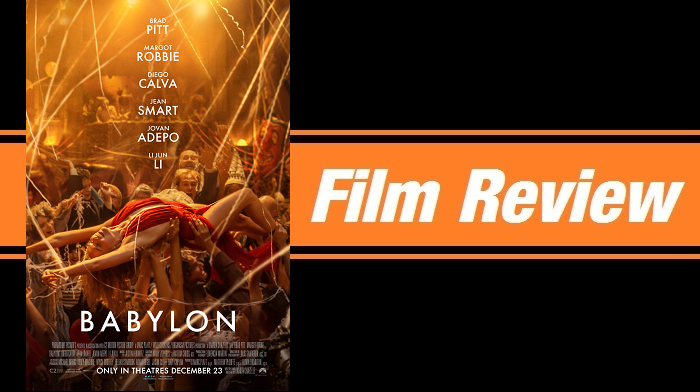
Like three hours of fingernails scraping across a chalkboard but amped up 150 decibels, Damien Chazelle’s “Babylon” is a grating exercise that beats you down with its relentless self-indulgence. It’s a movie smitten with its own sense of grandeur and apparently pledged to the belief that the best way to depict unbridled decadence is to drown its audience in unbridled decadence. It’s a choice that wastes so much time relishing the excess, and not nearly enough on its characters and their stories.

After three straight bangers, “Babylon” is such a disappointing next movie from writer-director Chazelle. Here he’s sold himself on a coked-up ‘more-is-more’ vision that often plays like a smug and shameless vanity project. Other times it feels as if it just needs someone to step in, pull the reins, and tell Chazelle “No”. But as it is, “Babylon” seems beholden to its brash, gleefully vulgar, full-throttled approach, and the movie suffers for it.

I want to believe there’s a good Old Hollywood story buried somewhere among Chazelle’s numbing self-satisfying chaos. But even at an exhausting three hours (plus some), there aren’t enough pieces in “Babylon” to be certain. It certainly has the cast, the costumes, and the production design to recreate the era. But so much of the film’s attention is given to its own rowdy irreverent style that it fumbles its chance to tell a clear-eyed behind-the-scenes Hollywood story.

Image Courtesy of Paramount Pictures

“Babylon” sets out to chronicle the rise to stardom and eventual fall of a handful of characters in the late 1920s as Hollywood began its transition from silent films to talkies. It’s a good premise with plenty of potential. But rather than really digging into his characters, Chazelle revels in their self-destruction. So much so, that most of his later attempts at empathy ring hollow. And that’s emblematic of the larger tonal issues that plague the film, especially in the second half. Chazelle’s sudden turns towards the more serious can come across as half-hearted and clash with nearly everything else he gives us.

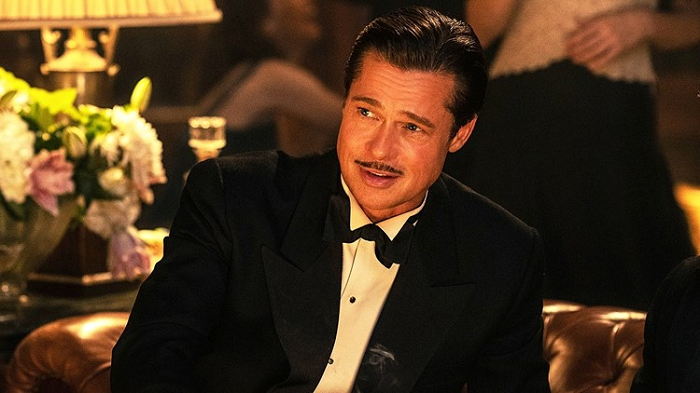
A cranked up Margot Robbie plays Nellie LaRoy, a self-christened star from New Jersey who just needs to get her foot in Hollywood’s door. Brad Pitt plays Jack Conrad, an established but aging silent movie star at a critical point in his career. Diego Calva plays Manny Torres, a studio film assistant who has always dreamed of working in the movies. Chazelle uses these three characters (and a few undercooked others) in his attempt to tell a story of a shifting industry and society. But while the three performances are up to par, the movie is far more interested in using them for its showier self-interests rather than giving any of their characters enough depth for us to care.

Nellie is a careening ball of self-destructive energy who hardly ever tones it down enough for us to get to know her. She’s little more than a hedonistic showpiece for Chazelle’s camera, constantly dialed up past 10, and often more of a caricature than a real person. Jack is the closest we get to a fully fleshed out character. But even with him, most of the details are either confined to two or three brief scenes or left out altogether. And then there’s Manny who should be our connection to the story but who is mostly relegated to standing off to the side. Oh, and he’s in love with Nellie for reasons I still haven’t quite figured out.

Image Courtesy of Paramount Pictures

As it turns out, the most interesting people we meet are two supporting characters. Jean Smart gets a bit part playing a tabloid Hollywood columnist named Elinor St. John who always seems to know more than she lets on. And Jovan Adepo plays Sidney Palmer, a Black jazz trumpeter who has the most grounded point-of-view of anyone in the film. But again, these are small roles and we only get tidbits of their stories. They’re great pieces that hint at what “Babylon” could have went for.

As “Babylon” hurtles forward, we’re treated to some great music and a number of elaborately staged set pieces. We’re even teased with some late scenes that hint at a slightly deeper interest in the characters. But whenever you think the movie has reeled itself in, we get more amped up nonsense. Take a long and draining final act sequence with Tobey Maguire (looking like death warmed-over). It’s one of many examples of Chazelle’s overconfidence in his instincts.

Fittingly I suppose, the film’s ending is as phony as anything I’ve seen in years. It’s meant to suddenly evoke some feelings in those who truly love movies. But it takes more than the flickering light of a theater projector and leeching off of a classic like “Singin’ in the Rain”, especially after everything Chazelle has thrown at us by that point. I didn’t feel any new love for cinema. I hadn’t learned anything about the history of Hollywood. I didn’t better appreciate the magic of moviemaking. Frankly, I was just thankful it was over. “Babylon” hits theaters December 23rd.

VERDICT – 1.5 STARS

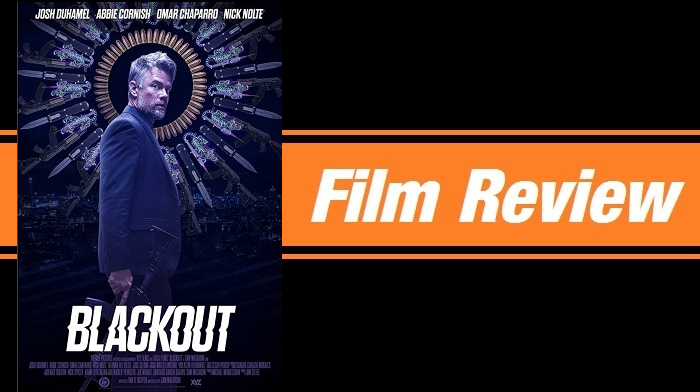
REVIEW: “Blackout” (2022)

Here’s another movie tapping into the well-worn ‘hero with amnesia’ premise. You know the ones – the protagonist wakes up unable to remember who they are. Soon they’re shooting it out with a bunch of goons who want to kill them, all while trying to piece back together their memory. This latest spin on the story isn’t much of a spin at all. But it does star the ever likable Josh Duhamel, so there’s that.

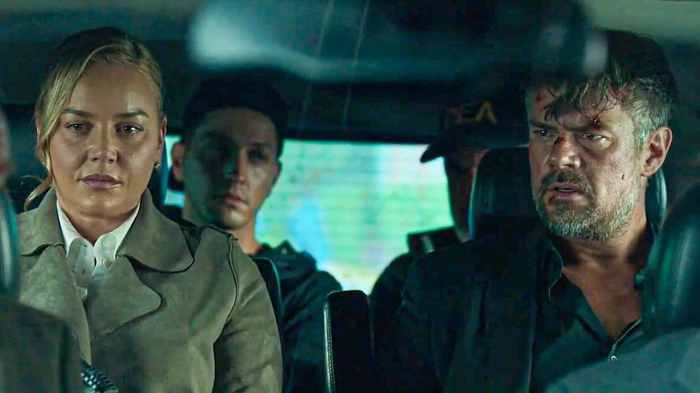
Sharing the same title with as least 30 other movies (according to IMDB), “Blackout” tells a story that ends up being as uninspired as its name. Duhamel plays John Cain, who wakes up in a hospital bed following a serious car accident. It just so happens that Cain has lost his memory. He has no idea who he is or how he got there. By his side is Anna (an incredibly dry Abbie Cornish) saying she’s his wife. Later he’s visited by Eddie (Omar Chaparro) claiming to be his best friend. But why can’t he remember either of them.

Image Courtesy of Netflix

It turns out Cain possesses a briefcase full of something the drug cartels are desperate to get their hands on. The problem is he has no recollection of the briefcase or of what’s inside it. But as his memory slowly starts returning, he finds himself questioning the information different people are feeding him. What are lies? What’s the truth? Even more, if Eddie is Cain’s friend why is he suddenly trying to kill our woozy protagonist? Soon we have a full-scale shoot-em-up as the cartel locks down hospital, and Cain tries to escape while sorting out who he can ultimately trust.

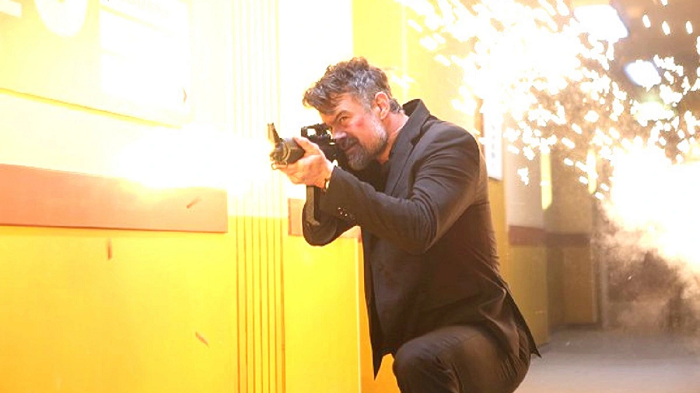
Directed by Sam Macaroni and written by Van B. Nguyen, “Blackout” bops along fairly briskly after getting its setup out of the way. The mostly single setting is a compelling choice and Macaroni has a good eye for action. The fistfights and shoot-outs don’t always make sense and some are just plain silly. But they’re stylishly shot, and Duhamel has the physicality to pull them off.

Image Courtesy of Netflix

Unfortunately Nguyen’s script isn’t as reliable. First off, she’s bound by a pretty tired premise and doesn’t really offer anything new to the old formula. As for the suspense, Nguyen tries to keep us guessing by spoon-feeding just enough information. But there really aren’t many surprises, and everything plays out in a way most people will have figured out well before the not-so-big reveal. It’s also hampered by some pretty hokey dialogue, especially once Nick Nolte shows up. He plays DEA Agent Ethan McCoy, an old friend of Cain’s trying to help him from the outside. It’s great seeing Nolte on screen again. But the 81-year-old screen veteran struggles, and isn’t helped by some really hammy lines that frankly no one could sell.

So “Blackout” ends up being a pretty generic action-thriller that has some decent shootouts and a couple of good fight scenes. There’s just not enough under the hood to make this thing go. It’s simply too by-the-books and even the charming Josh Duhamel can’t liven it up or give it the kick it needs. It’s a shame because I still believe Duhamel can carry bigger movies and handle meatier roles if only given the chance. Sadly, “Blackout” won’t do anything to enhance those opportunities. “Blackout” is now streaming on Netflix.

VERDICT – 2 STARS

REVIEW: “Broker” (2022)

Anytime I see Hirokazu Kore-eda’s name attached to a project you can bet I’ll be watching. The 60-year-old Japanese auteur’s last film was 2019’s “The Truth”, a terrific drama not near enough people talked about. It was Kore-eda’s first movie set outside of his native Japan and not in his native tongue. His latest, “Broker”, sees him once again venturing outside his home country, this time to South Korea. Yet it remains a Hirokazu Kore-eda film through and through.

In “Broker” (written and directed by Kore-eda), the story revolves around a band of outcasts brought together through an unusual series of circumstances and who have all kinds of odds stacked against them. As you would expect from a Kore-eda film, we once again see him plowing that fertile ground of family, both the conventional and (more so in this case) the unconventional kinds. And, as he so often does, Kore-eda tells his story with a heartfelt humanistic touch, ushering his characters (and us) across some morally thorny ground, yet always finding ways to earn our empathy.

Image Courtesy of NEON

Another way you know you are watching a Kore-eda film is by the richness of his visuals. “Broker” is no exception. You can always sense the trust Kore-eda has in his actors by the way he shoots them. So often the camera will sit still, strategically framing a shot in a way that both captures our eye and let’s the performances carry a good portion of the load. And usually when there is movement, it will be slow and steady pans that stay intently focused on the characters. Then you have the incredible detail squeezed into nearly every frame, whether he’s shooting a wider area like a neighborhood street or a small intimate space like a single room. There’s always something compelling to take in.

As for the story, Kore-eda begins with some important table-setting. On a dark and rainy night, a young mother leaves her infant child on the cold concrete in front of Busan Family Church and then scurries off. Watching from a nearby car are two police detectives, Soo-jin (Bae Doona) and Lee (Lee Joo-young). Lee follows the young mother while Soo-jin picks up the well-wrapped child and places it in the church’s “baby box” (it’s like a drop box for infants). Soo-jin then hurries back to her car to avoid being noticed.

Inside, Dong-soo (Gang Dong-won), a part-time employee at the church, retrieves the baby boy from the box and gives him to Ha Sang-hyeon (Song Kang-ho). They erase the security camera footage and any evidence that the child was dropped off. Sang-hyeon then takes the child to his ragtag laundromat which is really just a front for their equally ragtag two-man child trafficking operation. They defend their practice by claiming they’re saving children from the inevitability of growing up in an orphanage. Instead, they find the babies a home, allowing potential parents to bypass the country’s broken adoption process. Of course they do expect a “modest payment” for their services. So as the title intimates, they are brokers, but of a more sordid kind.

But what they didn’t expect was for the mother, Moon Sun-ah (Lee Ji-eun) to show up the next day looking for her son. Before long, she has joined Sang-hyeon and Dong-soo on a long road-trip to meet a couple who are interested in buying her child. Meanwhile the two detectives follow the oddball trio plus one baby, watching from a distance with hopes of arresting them in the act.

Image Courtesy of NEON

It certainly makes for an offbeat scenario – one that could easily veer off into into several directions, either super-serious or farcical. But in the hands of Kore-eda, the film never loses its plausibility despite how crazy the circumstances get. And while fairly serious, the story makes time for more light-hearted moments and even dashes of black comedy. Meanwhile the characters, as morally suspect as they may be, earn and maintain our empathy. Kore-eda guides us past their flaws and urges us to see them in a different light.

There are times when Kore-eda drives close to melodrama, but he never lets his film cross over the line. He keeps things grounded and character-focused, making it easy for us to relate despite the on-screen actions we’re witnessing. At the same time, Kore-eda also poses some thoughtful questions through his characters as they’re forced to face difficult choices, no-win scenarios, and unavoidable consequences. Just more pieces that enhance this technically, narratively, and emotionally savvy journey. Altogether “Broker” is a beautifully composed and constructed character study wrapped in Kore-eda’s signature warmth and grace. “Broker” hits select theaters on December 26th.

VERDICT – 4.5 STARS

REVIEW: “Bones and All” (2022)

(CLICK HERE to read my full review in the Arkansas Democrat-Gazette)

What if I told you there was a new teen romance hitting theaters? You probably wouldn’t think much about it. What if I told you it starred current darling Timothée Chalamet? A large number of you probably just perked up. What if I told you it was a cannibal love story? I’m guessing many of you instantly checked out while others are left understandably scratching your heads.

But for the intrigued, the twisted, and the Chalamet faithful, I present to you “Bones and All”, the latest film from Italian auteur Luca Guadagnino. “Bones and All” is a genre fusion that starts incredibly strong, but meanders a bit in the middle before coming unglued in the final 15 minutes. It’s an undeniably enigmatic movie that occasionally plays like cheap YA love story. Other times it resembles a poor man’s “Badlands”. At one point the words “Natural Born Cannibals” came to mind (and not necessarily in a good way).

Yet when Guadagnino is hitting his marks, you can’t help but be pulled into the morally murky muck of his grisly yet at times unexpectedly endearing story. There are scenes where the movie seems to be at odds with itself. Yet it’s fascinating to watch as Guadagnino somehow successfully juggles the sweet, the gruesome, and the trashy. He also pieces together a couple of the most unsettling sequences of the year – ones energized by two brief but absolutely chilling supporting turns.

Image Courtesy of Metro-Goldwyn-Mayer

“Bones and All” tries to be a road trip movie, a romance, a horror film, and a coming-of-age drama. Not all of its genre pieces fit, yet there’s still much to admire, and Guadagnino isn’t the kind of filmmaker who simply rehashes things we’ve seen before. That said, I kept wondering to myself, what’s the point? It’s not romantic enough to say much about love. Outside of the two mentioned scenes, it’s not scary enough to move the horror needle. And our main characters are too withdrawn to convey much about humanity. Yes, there are some readings that range from pointlessly vague to on-the-nose. But none that pack a real punch.

But again there’s still an undeniable draw to what Guadagnino is doing, and it feels original despite noticeably pulling from several influences. And even when it starts to wander in the second half, there are enough little surprises along the way to keep the film afloat. It’s also helped by its lead, Taylor Russell, who blends nicely into Guadagnino’s canvas. Her quiet, earnest presence fits well with the film’s mellow pacing.

Set in the late 1980s, the story spreads across an imagined middle America: one where two young lost souls can openly drive from state-to-state in a stolen blue pickup, occasionally satiating their shared taste for human flesh along the way, without having to worry about cops, the FBI, or anything other than creepy fellow “eaters”. Taylor plays 18-year-old Maren who is abandoned by her heartbroken father (André Holland) after she chomps down on the finger of a classmate, revealing her appetite for human flesh. He leaves her with her birth certificate, $50 cash, and a cassette tape explaining her situation.

Image Courtesy of Metro-Goldwyn-Mayer

All alone, Maren sets out to find her mother who left home years earlier. Why she left was a mystery, but Maren has some clues as to where she may be. While at a bus stop, she’s approached by a creepy and alarmingly soft-spoken Mark Rylance, with his brimmed hat topped with a feather, a fishing vest, and a long braided ponytail. He introduces himself as a fellow eater named Sully who smelled Maren from across town. What follows is the film’s best and most unsettling scene, as Sully gives Maren a lesson on who they are. “Whatever you and I got,” he says, “it’s gotta be fed.”

It’s hard to figure out the purpose of Rylance’s character other than to explain the eaters and get under our skin. But he does both well. So much so than even Maren skips out on him and hops a bus for Minnesota. During a stop, she meets a drifter named Lee (Chalamet), fresh off of munching on a redneck (yep, he too is an eater). Lee is a bit of a vagabond – scrawny, tattered jeans, a dirty orange-highlighted crop of hair. The two hit it off and set out to find Maren’s mother.

An inevitable relationship blooms, but it’s a hard one to read. Some have called it sensual, sexy, and simmering. But frankly neither character sells that kind of romantic interest. If anything, they’re two outcasts who find an unexpected kinship in each other. That’s enough to hold our interest. But again, the movie starts to drift in the final third and ends with a time-jump scenario that’s too hard to swallow. It’s a confounding yet strangely fitting finish to what is an eerily alluring yet equally confounding movie. “Bones and All” opens Wednesday,

VERDICT – 3 STARS

REVIEW: “Black Panther: Wakanda Forever” (2022)

If the Marvel Cinematic Universe ever needed a jolt it’s now. While the box office and streaming juggernaut is still widely popular and hugely profitable, its current phase (Phase IV for those keeping up) is a far cry from the propulsive and cohesive MCU of old that culminated in “The Avengers: Endgame”. Since then, the MCU has been branching off into so many directions and have forgotten about coherence and continuity (yes, I know Kevin Feige and company have a blueprint they’re following, but that doesn’t change how these movies and streaming shows feel).

Quite frankly, the MCU needs a kick in the pants; a boost of adrenaline to get it out of this current malaise where everything feels so lightweight, segmented, and directionless. Earlier this year Sam Raimi tried with the deliciously chaotic and gonzo “Doctor Strange and the Multiverse of Madness”. But predictably it was met with some push-back (it was too dark. it was too violent, it was too “out there”). The dreadful “Thor: Love and Thunder” only exacerbated the MCU’s problems. And now we have the long-awaited “Black Panther: Wakanda Forever”, a movie full of unenviable challenges. Could it be a cinematic return to form for the MCU, or would its emotional baggage be too much to overcome?

For some people, all they really needed was for “Wakanda Forever” to handle Chadwick Boseman‘s passing well. If the movie did that, it would earn enough goodwill that the rest wouldn’t really matter. In a way that’s understandable. The loss of Boseman hit hard and is still felt by many. Director Ryan Coogler had to deal with it, both in reality and within the context of the “Black Panther” character. That’s no easy task. But Coogler does his best, creating something that’s a memorial to both T’Challa and Chadwick Boseman himself. He also provides a cathartic release for audiences and the cast alike. Something that’s needed before he or we can move forward.

Image Courtesy of Marvel Studios

“Wakanda Forever” begins by immediately tackling the T’Challa issue. Rather than using CGI to recreate the character or framing his death through a some big action encounter, Coogler and co-writer Joe Robert Cole attribute it to an “undisclosed illness”. It’s undeniably vague and the lack of detail is pretty hard to look past. Still, I didn’t mind how Coogler chose to handle it under the circumstances. It hits pretty hard, especially when we’re reintroduced to the Wakandans as they try to cope with the loss of their king and protector.

The story quickly shifts to one year later as T’Challa’s mother, Queen Ramonda (an excellent Angela Bassett) works to lead the wounded and mourning Wakanda. Meanwhile, her daughter, the tech savvy Princess Shuri (Letitia Wright), is burdened with guilt, feeling she should have been able to use her know-how to save her brother. As they try to navigate this difficult time individually and collectively, Wakanda finds itself a hot topic on the global stage. Various nations are pressuring Ramonda to share their vibranium, the strongest metal in the world which Wakanda kept hidden until the events of the previous film. And with word of Black Panther’s death getting around, some are trying to take it by force.

With a new vibranium-detecting machine in their possession, the US government locate a potential vibranium deposit on the ocean floor. A mining expedition is sent out, but during their operation the entire team is attacked and killed by blue-skinned warriors led by Namor (Tenoch Huerta Mejia), the king of an underwater civilization who, like Wakanda, hides from the outside world and also possesses and protects vibranium.

The brainiacs at the CIA wrongly conclude it was the Wakandans who sabotaged their mission. Meanwhile an angry Namor blames Wakanda for drawing the outsiders to their vibranium in the first place. He approaches Ramonda and Shuri to voice his displeasure and inform them of his plan to find and kill the inventor of the vibranium-detecting machine, an MIT student named Riri Williams (Dominique Thorne). He gives them a choice. They can either join him against the surface world, or he and his warriors will attack Wakanda.

Needless to say the story has a lot going on. While the loss of T’Challa looms over the entire movie, there are also introductions of new characters and new worlds, global politics and at-home tension. It ends up being a little too much as the movie feels needlessly overstuffed even at 160 minutes. Much of it comes from the insistence on franchise service. Take the Riri Williams (aka Ironheart) inclusion. She’s a decent enough character and Thorne’s performance is fine. But here she’s little more than a plot device, and here mainly to promote her upcoming Disney+ streaming series.

Image Courtesy of Marvel Studios

The biggest new addition is Namor, a classic comics character with a lot of potential within the MCU. In many ways he’s Coogler’s Killmonger 2.0 – an antagonist with a fairly similar backstory rooted in pain and oppression. Both Namor and Huerta Mejia’s performance start a little soft. But he toughens up later and really embraces the villain role. He’s particularly strong in the action scenes, proving Namor to be a formidable foe.

But the movie can’t fully shake its nagging issues. Some of photography is dark and murky, specifically in Namor’s Mayan-inspired underwater home Talokan (DC and Aquaman had dibs on Atlantis). Also, at times the blue skin of Namor’s warriors doesn’t always look convincing. And while I loved going back to Wakanda, here it’s missing a lot of the detail that made the 2018 film so transporting. It doesn’t quite feel like the same place. Storywise, there’s several strangely rash decisions and knee-jerk reactions. And after some good tense buildup, the ending feels a bit too tidy.

Some of these are small gripes on their own, but they add up. Still Coogler and company deserve credit for facing some really big challenges head-on. And while the heartache is intense, Coogler does more than ride a wave of sentiment and emotion. There are some storytelling issues, the film starts to drag in the middle, and it definitely misses Chadwick Boseman’s quiet dignity and gravitas. But I loved the thorny politics that play out within and between the two vibranium empowered nations. Plus, the introduction of Namor teases some pretty exciting things. And considering how light and breezy the recent MCU has felt, it’s nice and refreshing to get something more serious-minded. “Black Panther: Wakanda Forever” is in theaters now.

VERDICT – 3.5 STARS