

At the risk of once again dating myself, I miss the glory days of 1980s Sword and Sorcery movies. I grew up losing myself in the fantastical worlds created in movie like “Conan the Barbarian” (1982), “Clash of the Titans” (1981), “Beastmaster” (1982), “Krull” (1983), “Red Sonja” (1985), and “Dragonslayer” (1981). While fantasy adventures have continued in things like “The Lord of the Rings” and “Dungeons & Dragons: Honor Among Thieves”, the 80s Sword and Sorcery films had a spirit all their own.
Enter “Deathstalker”, a 2025 release that is an 80s styled Sword and Sorcery movie through and through. It’s passionately written and directed by Steven Kostanski, the man behind 2020’s genre explosion “PG: Psycho Goreman”. Now if you’re at all familiar with “PG” you’ll have a feel for the style of filmmaking you’ll see in “Deathstalker”. It’s almost playfully violent and unashamedly gory. But better than that, it’s a practical effects-driven feature that never lets its modest budget lessen its huge ambition.

“Deathstalker” is technically a remake of the 1983 Roger Corman produced movie of the same name. Kostanski is faithful to the original film in presentation, narrative style, and tone, but he tells a much different story. While scavenging a fresh, corpse-littered battlefield in the war-torn kingdom of Abraxion, a former soldier in the Queen’s army known as Deathstalker (actor, stuntman, and martial artist Daniel Bernhardt) recovers a gold amulet. His plans are to sell it for a tidy profit. But those plans quickly fall apart.
Deathstalker learns the amulet is cursed and magically bound to whoever possesses it. Unable to rid himself of the cursed relic, he sets out on a journey to find someone who can. Along the way he’s joined by a quirky sorcerer named Doodad (physically captured by Laurie Field and voiced by Patton Oswalt) and later an impulsive thief named Brisbayne (Christina Orjalo).
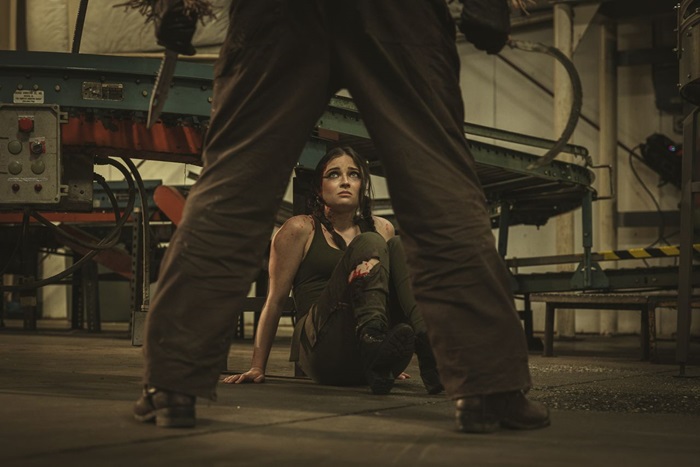
But there are others who want the amulet for their own nefarious purposes, namely a powerful necromancer named Nekromemnon (Nicholas Rice). He intends to unleash the amulet’s power to destroy the world and then rebuild it as he sees fit. So Nekromemnon sends out a host of assassins to kill Deathstalker and bring the amulet to him. And that sets up the bulk of the movie as Kostanski straightforwardly steers us from one action-packed and blood-drenched sequence to another.
Overall the story is fun, routinely silly, and proudly in-tune with the movies that inspired it. Admittedly the mythology is a little muddled and there is a tad too much exposition. But the cheeky sense of humor ensures it’s never taken too seriously. And the world-building is fittingly fantastical and full of imagination. It features many interesting locations that are populated by such creatures as two-headed trolls, witches, pig soldiers, swamp monsters, the reanimated dead, and so on.
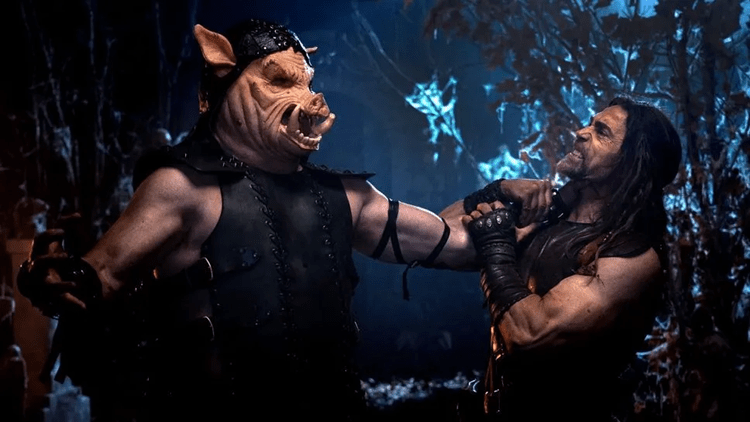
But the most fun is found in the movie’s special effects. You could almost consider “Deathstalker” to be a celebration of the practical effects era. Kostanski and his team put aside the prominent digital approach of today. Instead they go a more handcrafted route, using an amazing combination of stop-motion animation, richly detailed makeup and costumes, latex masks, prosthetics, bodysuits, and an assortment of sets and props. As with the movies from the genre’s heyday, the effects are sometimes obvious. But artistry can shine brightest in the imperfections. And there’s something refreshing about seeing a creative vision without the slick polish of CGI.
“Deathstalker” turns back the clock to an era when bringing your imagination to life required more than computer programs and green screens. It takes us back to a bygone era of Sword and Sorcery adventures, telling a ridiculously entertaining story and creating an inspired world of wonder despite its budget limitations. It does it all with a sincere passion but also an ever-present sense of self-awareness. Those two ingredients are essential in making “Deathstalker” a glorious throwback experience.
VERDICT – 4 STARS















 Keith & the Movies