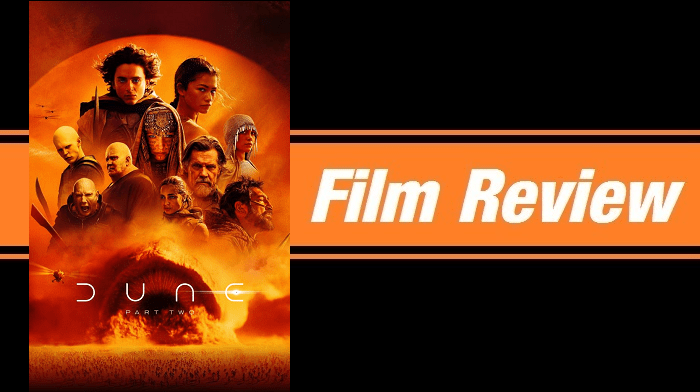
REVIEW: “Dune: Part Two” (2024)

Upon hearing that Denis Villeneuve was making “Dune”, I remember thinking there was no better director to take on Frank Herbert’s science-fiction classic. That sentiment was proven right with the release of Villeneuve’s 2021 feature – the jaw-dropping first chapter of his masterful big screen epic. After a brief delay following last year’s Hollywood labor disputes, “Dune: Part Two” is finally here and sees Villeneuve reuniting with the first film’s incredible cast and talent behind the camera.

Villeneuve’s first venture was an immersive and breathtaking introduction to Herbert’s universe, captured through the passionate lens of a visionary filmmaker. Part Two picks up the story right where its predecessor left off and then expands on it through intensive world-building and character work. A few brilliantly cast new faces are added, seamlessly fitting into the rich and complex world. Then there are the many returning faces – a star-studded ensemble who once again bring their fascinating array of characters to life.

Image Courtesy of Warner Bros. Pictures

Much like the previous film, “Dune: Part Two” offers up a visual feast. The spectacular locations, the thrilling set pieces, and the outstanding costume design are just some of what makes the movie such a stunner. But perhaps more impressive is Villeneuve’s amazing ability to artfully translate Herbert’s dense and complex story to the big screen. Politics, religion, and mythology play significant roles in “Dune” and add intriguing layers to the storytelling. And Villeneuve and his co-writing partner Jon Spaihts don’t shortchange any of those elements.

As a refresher, the “Dune” films are set in the distant future within an empire known as the Imperium. Leading the Imperium is the Padishah Emperor Shaddam IV (played in Part Two by Christopher Walken) who oversees several Great and Minor Houses. Among them is the noble House Atreides and their mortal enemies, House Harkonnen. At the center of the main conflict is Arrakis, a harsh desert planet that is the lone source of the most valuable commodity in the universe, Spice Melange. Through devious plotting and subterfuge, Shaddam uses House Harkonnen to annihilate House Atreides after feeling threatened by the popularity of its beloved leader, Duke Leto. What he didn’t count on was Leto’s son Paul surviving and forming an alliance with the Fremen, the native inhabitants of Arrakis.

Image Courtesy of Warner Bros. Pictures

Part Two picks up with the lone survivors of House Atreides, Paul (Timothée Chalamet) and his pregnant mother, Lady Jessica (Rebecca Ferguson), working to earn the trust of the Fremen people. Many among the Fremen suspect them of being spies. But tribe leader Stilgar (Javier Bardem) defends them, believing Paul to be their prophesied messiah. Meanwhile Paul continues to grow closer to Chani (Zendaya), a Fremen warrior who thinks the prophecy is nonsense but who stands by Paul as he assimilates into her culture.

Paul and the Fremen intensify their guerrilla raids on the Harkonnen spice harvesters which inevitably gets the attention of the ruthless House leader Baron Vladimir Harkonnen (a devilishly sinister Stellan Skarsgård). Out of patience with his nephew Rabban (Dave Bautista) – the overseer of spice production on Arrakis, the Baron replaces him with his younger nephew, the psychotic Feyd-Rautha (Austin Butler). Elsewhere the word of Paul’s survival and rise to power among the Fremen reaches the Emperor who has desperately worked to conceal his involvement in the House Atreides slaughter.

Those are just some of the tensions that grow throughout the absorbing story with its many moving pieces. Part Two has its rousing moments, some romance, and even prickly family drama. But it’s the thematic depth that makes it so intriguing. Take the wicked undercurrent of manipulation and deception that’s felt throughout the film, almost always in the service of power and control. We see it in the hegemonization of cultures through the planting of false religions and in the wielding of political might to maintain power. We even see it the efforts to build an army in the name of the greater good.

Image Courtesy of Warner Bros. Pictures

To no surprise “Dune: Part Two” is a technical achievement, complete with thrilling action, dazzling visual effects, and unmatched artistic vision. DP Greig Fraser captivates with his camera whether shooting the vast sun-scorched dunes of Arrakis or intimate close-ups that peer deep behind the eyes of the characters; whether capturing hypnotic and sometimes unsettling dream sequences or fierce sprawling combat sequences and sandworm surfing. There is never a moment when his images aren’t appealing in one way or another. And it’s all accented by Hans Zimmer’s penetrating score.

“Dune: Part Two” clicks perfectly into place with the first film and builds upon it in a number of scintillating ways. The performances shine from top to bottom (none brighter than Austin Butler’s). And the sheer craft on display, along with the extraordinary storytelling, results in an awe-inspiring and mature science-fiction blockbuster that immediately left me hoping for a Part Three. Will we get one? Rumor has it a script is nearly finished. But as always it will depend on how this one does at the box office. Hopefully it gets the audience it deserves. “Dune: Part Two” opens in theaters today.

VERDICT – 5 STARS

REVIEW: “Dream Scenario” (2023)

I think it’s safe to say that we never know what we’re going to get from Nicolas Cage. And that’s one of the things that makes him such a favorite among moviegoers. Cage is liable to pop up in anything, from gritty crime thrillers to cerebral dramas to bonkers off-the-wall comedies. If you need further proof just look at his latest film, “Dream Scenario” from A24.

Written and directed by Norwegian filmmaker Kristoffer Borgli, “Dream Scenario” is a fascinating exploration of modern media culture, dressed up as a gonzo dark comedy with sinister undertones. Borgli’s story locks onto the fickle nature of fame in our current social media age – a time where a person can be elevated to celebrity status despite no real accomplishments and then tore apart and ruined despite no real offense. It examines how quickly someone can become a viral sensation only to be destroyed just as fast once their 15 minutes of fame is up.

Image Courtesy of A24

Cage is no stranger to taking a character and walking the precariously thin line between playful and unhinged. But here he does it with impressive subtlety. He plays mild-mannered Paul Matthews, a tenured evolutionary biology professor at Osler University. The balding bearded Paul is about as ordinary and unassuming as a man can get, shamefully called “a remarkable nobody” at one point.

Paul lives a relatively quiet life. He’s been happily married to his wife Janet (Julianne Nicholson) for 15 years and together they have two daughters (played by Lily Bird and Jessica Clement). Outside of teaching and his family, Paul likes to think of himself as a writer. He’s hoping to publish his book which he has yet to start writing. And that is Paul in a nutshell. He’s the kind of everyday guy who you would walk by on the street and never notice.

But that anonymity changes after he inexplicably starts showing up in people’s dreams – family members, students, former girlfriends, complete strangers. People begin recognizing him on the street and in restaurants. And much to his chagrin, they all say the same thing. Regardless of what kind of crazy thing is going on in their dream, Paul just pops up, never doing anything, just strolling by and observing. Word gets to scientists who are baffled by the phenomenon and inevitably the media gets wind of it, turning Paul into an instant celebrity.

Suddenly the once ignored middle-aged professor is recognized by everyone and even has a marketing firm (ran by Michael Cera) wanting to represent him. He’s now loved by his enamored students and his daughters see him as a “cool dad”. Paul finds himself excited by the sudden wave of attention. But he quickly learns that fame can have strange and unpredictable consequences, even if you’ve done nothing to deserve them.

Image Courtesy of A24

Borgli takes his story in a pretty dark direction yet maintains a slyly comic tone which surprisingly never clashes. Instead it gels into a movie that can be strangely funny and brutally heartbreaking at the very same time. Borgli isn’t particularly subtle with his messaging but his points are shrewdly woven into his story. Rabid fandom, groupthink, cancel culture, the dark side of celebrity, the perils of instant fame – they’re all topics that resonate within Borgli’s well-executed and highly imaginative metaphysical framework.

We never get an explanation for why Paul is suddenly appearing in the dreams. We’re never told why his noninvasive appearances take a nastier turn. Borgli doesn’t seem interested in the ‘whys’ and ‘hows’ which is both admirable and a bit of a cop-out. And while it goes slightly off the rails in its final act, there are so many intriguing elements to “Dream Scenario” including yet another beguiling Nicolas Cage performance. He embraces every complicated facet of his character, making us laugh with his sheepish comic delivery and breaking our heart with his agonizing insecurity.

VERDICT – 3.5 STARS

REVIEW: “Driving Madeleine” (2024)

Director Christian Carion’s delightful French drama “Driving Madeleine” first screened in 2022 at the Angoulême Francophone Film Festival and a few months later at the Toronto International Film Festival. But it is just now getting an official big screen release here in the States and you won’t have to wait long to see it. And trust me, it’s a movie you will want to make time for.

“Driving Madeleine” is a genuinely sweet and mature gem of a movie. Written by Carion and Cyril Gély, the story is heartwarming and a bonafide tearjerker. I realize that’s a description that can come with some pretty negative connotations. But don’t toss this movie aside. Carion has made a smart and thoughtful film that examines longing, regret, and the intrinsic value of human connection. It explores memories and the preciousness of a life while fully realizing the beauty and tragedy associated with both.

Image Courtesy of Cohen Media Group

Charles Hoffman (Dany Boon) is a down on his luck taxi driver in Paris. Soured and disillusioned, the 46-years-old Charles works twelve hours a day and six days a week to support his wife and daughter who he loves but rarely gets to spend time with. To make matters worse, he’s only one traffic violation away from losing his license which means losing his car which means losing his job.

Charles is dispatched to the other side of Paris for a fare. Once there he picks up 92-year-old Madeleine Keller (a sensational Line Renaud) who is in no hurry to get where she’s going. Her destination sends Charles back across the city but on the way Madeleine asks him to take a couple of detours to important places from her long an eventful life. It annoys him at first, but the more the chatty Madeleine shares the more Charles opens about his own life.

The film is peppered with flashbacks to Madeleine’s past where her younger self is played by a solemn and soulful Alice Isaaz. Through them we learn about the love of her life, an American soldier named Matt (Elie Kaempfen) who went back to the States after World War II. We see her son Mathieu (Hadriel Roure) who she had unexpectedly. We witness her marriage to her violently abusive husband Ray (Jérémie Laheurte) and the consequences that spun from it.

Image Courtesy of Cohen Media Group

There is much more to Madeleine’s story that I’ll leave for you to discover. It all gives shape to what has been a fascinating life. It also affects the troubled Charles, leading him to share snippets of his own life, from his financial woes to his deep sacrificial love for his wife Karine (Julie Delarme) and their daughter Betty (Léonie Carion). As their unorthodox bond slowly forms and grows, it’s pretty easy to get a sense where the story is going. But that does nothing to lessen our connection to the characters or ruin the emotional payoff.

Anchored by two fantastic performances and a sincere story with a warm human center, “Driving Madeleine” turns out to be a surprisingly subtle and (mostly) unsentimental pleasure. You could call it an irresistibly charming heart-warmer and you wouldn’t be wrong. But there’s a darker subtext found mostly in the flashbacks that aren’t afraid to expose and challenge. The film is beautifully shot and Francophiles will love the evocative Paris scenery. But it’s the two central characters and their journey over the course of one day that’ll leave the biggest impression. “Driving Madeleine” opens January 12th in select theaters.

VERDICT – 4 STARS

REVIEW: “Dungeons & Dragons: Honor Among Thieves” (2023)

I won’t pretend to know much about Dungeons & Dragons other than it has been an immensely popular tabletop role-playing game for nearly five decades. That’s pretty much all I know about the game itself. I do know it has spawned several novels, some not-so-great feature films, a Saturday morning cartoon, and a number of video game spin-offs. To say it has impacted popular culture would be an understatement.

Still for me, seeing the name Dungeons & Dragons attached doesn’t exactly grab my attention. That was especially true when the new film “Dungeons & Dragons: Honor Among Thieves” was announced. But this turned out to be one of those cases where the trailers and TV spots slowly won me over. Before long I had gone from “thanks but no thanks” to “show me where to buy my ticket”. So I checked it out. And wouldn’t you know it, “Honor Among Thieves” is one of the bigger surprises of the movie year so far. It’s not without issues, but it makes for a good time.

Directed by Jonathan Goldstein and John Francis Daley, “Honor Among Thieves” is a fantasy action adventure comedy and a needed franchise reboot. And it’s no B-movie cheapie. The film has a reported $151 million budget which thankfully is put to good use – from its wonderful visual effects, exciting locations, fantastic action set pieces, and an immensely fun cast. That’s an overload of adjectives, but in these cases they fit.

Image Courtesy of Paramount Pictures

What drew me most to the trailers was the comedy, and for the most part the movie delivers the humor. Maybe not as much as I had hoped, but it’s there. It’s just goofy enough to not take itself too seriously which is a good thing. And you’ll find some genuinely funny gags scattered all throughout the 134-minute runtime. But what can I say? I was hoping it would be even sillier. But that’s a small quibble for a movie that’s actually a lot of fun.

In the mystical land of Faerûn, a doltish bard named Edgin Darvis (Chris Pine) and an exiled Barbarian named Holga Kilgore (Michelle Rodriguez) are serving time in a remote icy prison for “grand larceny and skullduggery”. During what amounts to their parole hearing, we learn that Edgin’s wife was killed by a Red Wizard leaving him to raise their daughter Kira (Chloe Coleman). He befriended Holga and the two became thieves, along with their friends – a cut-rate sorcerer named Simon (Justice Smith) and a cheeky con-man named Forge (Hugh Grant). The foursome swipe from the wealthy with Edgin using his part of the spoils to help better Kira’s life.

But when one particular risky heist goes bad, Edgin and Holga are trapped while their cohorts escape. Before leaving, Edgin charges Forge with taking care of Kira and keeping her safe until he can return. That was two years ago. Now Edgin and Holga are pleading their case before the prison “parole” board. But before they can hear a verdict, the two bust out of jail and head back home so Edgin can reunite with Kira. But wouldn’t you know it, a lot has changed in two years.

Edgin discovers that Forge has become the Lord of Neverwinter, living lavishly and ruling with the help of the mysterious wizard named Sofina (Daisy Head). Even worse, since taking over as Kira’s guardian, Forge has turned her against Edgin, filling her head full of lies. So Edgin and Holga hatch a plan to rescue Kira, first reuniting with Simon and then adding a shape-shifting tiefling druid named Doric (Sophia Lillis) to their ranks. They’re even joined a dashing paladin named Xenk Yendar (a scene-stealing Regé-Jean Page who unfortunately leaves far too early).

Image Courtesy of Paramount Pictures

Some may be wondering how much they need to know about Dungeons & Dragons in order to get “Honor Among Thieves”. I can say from personal experience – not much. The story (penned by Goldstein, Daley, and Michael Gilio) is pretty straightforward and easy to follow. I’m sure there are numerous nods and winks scattered throughout that fans of the game with pick up on. But they’re nothing that the uninitiated (like me) would see as egregious.

The performances are all spot-on starting with Chris Pine whose charisma allows him to be brazenly silly but also believably warm-hearted. Page is a lot of fun, right up until he vanishes. And Rodriguez, who’s no stranger to tough-girl roles, really shines. Then of course there’s Hugh Grant, so perfectly cast as the film’s roguish yet delightfully goofy antagonist. There’s even one particularly great cameo that everyone should enjoy.

Admittedly, while I liked “Honor Among Thieves”, I wasn’t as into its overall story as I wanted to be. That said, much of the enjoyment comes from simply hanging out with this ragtag group as they bop along to fantastical locales, encounter creatures of all kinds, and learn to work together in the process. Along the way we’re treated to some good laughs, some exciting action, and some fun camaraderie. It makes this a considerably more entertaining experience than I first expected. And it’s one worth catching on the big screen – where all its visual flourishes and flavor really stands out. “Dungeons & Dragons: Honor Among Thieves” is in theaters now.

VERDICT – 3.5 STARS

RETRO REVIEW: “Death Wish” (1974)

Few movies in the 1970s caused a stir quite like “Death Wish”. Upon its release, the 1974 neo-noir action-thriller was heavily criticized for its alleged support and glorification of vigilantism. Many critics shellacked the film, calling it “immoral”, “exploitative”, and “despicable”. But the film resonated with audiences and sparked an intense debate over how to deal with the rising crime rates of the time. As years went by, some opinions of “Death Wish” softened, and it would become a cult classic.

Based on a 1972 novel by Brian Garfield, “Death Wish” took a hard look at a side of New York City that was quickly becoming a reality for many residents. Garfield’s story was adapted by screenwriter Wendell Mayes (“The Poseidon Adventure”) who didn’t go as deep into the reasons behind the spiking violent crime. Instead his story focused more on its horrific effects, specifically on one man who only finds solace in doling out retribution on inner city criminals.

Sidney Lumet was originally set to direct but had to drop out to shoot “Serpico”, opening the door for Michael Winner. Jack Lemmon, Henry Fonda, Steve McQueen, Clint Eastwood, Lee Marvin, and even Elvis Presley were considered for the part of Paul Kersey, but it eventually went to Charles Bronson. Known more for his tough-guy roles, Bronson originally felt he was miscast. But Winner convinced the actor to sign on, and he turned out to be a good fit.

Image Courtesy of Paramount Pictures

Unlike the many half-baked sequels that would follow, the first “Death Wish” was more than just a genre movie. It may be tempting to dismiss it as an exploitation film, but Winner and Mayes had more on their minds. Without question it’s provocative and taps into the urban paranoia of the day. But there’s more to it than just an insular promotion of vigilantism. Again, unlike the sequels, you’re not to meant to feel comfortable with what your seeing.

Bronson’s Paul Kersey begins in a much different place than where he ends. He’s a successful architect at a big land development firm. He’s an unashamed bleeding heart liberal. He was a conscientious objector during the Vietnam War. He’s happily married to his wife Joanna (Hope Lange) and they have a recently married twenty-something daughter Carol (Kathleen Tolan). Again, he’s not the prototypical Charles Bronson character.

Winner starts the film with a stark yet effective contrast. The opening scene sees Paul and Joanna in Hawaii enjoying a quiet romantic afternoon on a beautiful sun-soaked beach. Almost immediately we switch to them arriving back home to a dark and grimy New York City, the gritty cinematography from Arthur J. Ornitz emphasizing the dramatic differences in the locations. It’s a tone-setting transition that Winner will come back to more than once.

But then Paul’s life is changed forever. One afternoon Joanna and Carol are followed home from the grocery store by three hoodlums (on a fun side note, a 21-year-old Jeff Goldblum is credited as Freak #1. It was his big screen debut). The thugs bust into the Kersey’s apartment, beat Joanna and violently rape Carol. Paul is notified by his son-in-law Jack (Steven Keats) and rushes to the hospital only to find Joanna has died from her injuries. And Carol’s trauma has left her in a catatonic state.

Image Courtesy of Paramount Pictures

After his wife’s funeral, Paul tries to resume his daily routine, but he struggles to cope with his loss. The police’s inability to make an arrest only makes things worse. So Paul takes his despair to the streets, roaming unsafe neighborhoods at night, and putting himself in dangerous situations (hence the film’s title). But when he’s attacked by a mugger, Paul shoots him dead with a gun given to him by a client. He promptly runs home in a panic.

But there’s a satisfying sense of revenge that leads Paul to go out again and again and again. And as the bodies mount, the police start making connections. Meanwhile, word of a vigilante spreads through newspapers, magazines, and billboards. Through it all several compelling themes are explored, from the traumatic effects of violent crime to society’s insatiable appetite for violence.

As the story intensifies, Winner challenges us by presenting a moral quandary that has no clean, clear-cut answer. Bronson gives a solid portrayal of a man who doesn’t enjoy killing, but who has lost his faith in justice. So he has taken it on as his duty while unwittingly losing his humanity in the process. It’s both fascinating and uncomfortable, as a story like this should be. Not everything clicks, especially in the final act. But it’s still a well-made thriller that’s worth more than a mere surface level reading.

VERDICT – 4 STARS

REVIEW: “Devil’s Peak” (2023)

Based on the novel “Where All Light Tends to Go” by David Joy, “Devil’s Peak” is a modest crime thriller set in poverty-stricken, drug-infested rural Appalachia. It’s not the first movie to examine this troubled yet compelling region in the Eastern United States, but director Ben Young and screenwriter Robert Knott have some interesting pieces to work with. Unfortunately the material is plagued with overly simple story beats, thinly sketched characters, and an inescapable air of familiarity.

The story takes place in Jackson County, North Carolina and the roles are filled by a solid ensemble. Hopper Penn plays Jacob McNeely, the son of a hardcore drug dealer named Charlie (Billy Bob Thornton) who has had the impoverished local community by the throat for years. Jacob runs an auto body shop which is really a front for the father’s drug ring. We learn Charlie has had his son selling crystal meth since he was nine-years-old. It’s the family business.

But Jacob has a decency inside that sets him apart from his father. It comes out in his affection for his troubled mother and Charlie’s ex-wife Virgie (Robin Wright). We also see it in his love for his girlfriend Maggie (Katelyn Nacon) who is about to go to college in Wilmington. She’s the daughter of a crooked politician (Brian d’Arcy James) who’s not too keen on his daughter’s choice of a boyfriend. Jackie Earle Haley chips in as the local sheriff named Dwight while Emma Booth plays Charlie’s live-in girlfriend Josephine.

Much of “Devil’s Peak” focuses on the dysfunctional family tension between Jacob, Charlie, and Virgie. To no surprise Thornton, with his shaved head and bushy jet-black goatee, has no trouble playing a vile and irredeemable menace. It’s an effective performance that’s a little cartoonish but fittingly repellent. Wright brings more nuance, playing a junkie trying to overcome the mistakes of her past. Sadly Wright is dealt a bad hand and isn’t given much to work with. Penn isn’t quite as convincing. As Jacob struggles to get out from under his family name, Penn struggles to earn our empathy. His somewhat muted performance isn’t able to muster the excitement or emotion that the character and the movie needs.

“Devil’s Peak” could have taken its characters in a number of interesting directions. Instead it plays it safe, telling a story that follows its one trajectory to the very end. And despite the commitment of the cast, even the characters crumble under the weight of formula. To its credit, Young’s pacing ensures it’s never boring. But with so little under its Southern Gothic exterior, it’s hard to find much to get excited about. “Devil’s Peak” is now available on VOD.

VERDICT – 2 STARS