

For many, the new film “Don’t Worry Darling” went from highly anticipated to widely scorned in a snap, and all it took was a seemingly innocuous FaceTime message between Olivia Wilde and Shia LaBeouf. Navigating the gossipy, social media driven hoopla that followed to get into the actually movie itself may be a chore. But if you get beyond the pre-release tabloid noise you’ll find a saucy psychological thriller with lots going on under its shiny, well-made surface.
Olivia Wilde’s sophomore directorial effort is a nice step-up from her much beloved yet frustratingly banal debut “Booksmart”. Unlike her first film, here it feels like Wilde is doing more than just copying and pasting from other movies. With “Don’t Worry Darling” she swings for the fences. And while she may not hit all of her marks, I love the ambition and the willingness to extend herself in some gutsy new directions. And the results aren’t half bad either.
Wilde’s ingenuity and imagination is seen everywhere, but most notably in her visual approach. She and cinematographer Matthew Libatique give their sun-bathed suburb a utopian glow. Everything about their immaculate 1950s veneer (the palm trees, the landscaping, the homes, etc.) is pristine to the point of artificiality. It’s a perfect representation of the pre-fabricated world these privileged few have made for themselves.
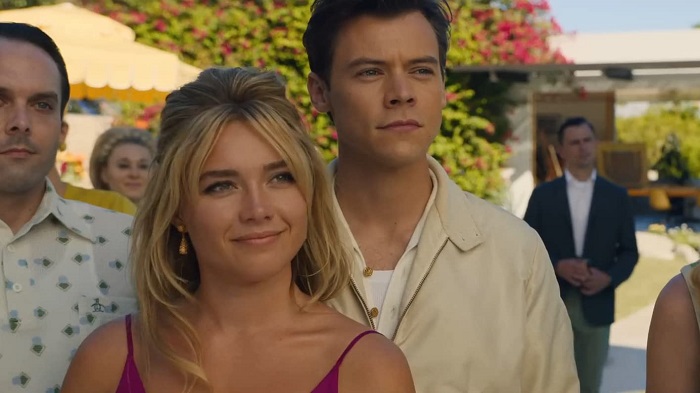
But Wilde’s crafty visual technique goes beyond simply capturing setting. It also brings the neighborhood to life and lets us know that something is off with both the community and its residents. Strategic close-ups, an assortment of effective camera movements, and some really clever framing show off the director’s verve. But it also enhances the storytelling, building up some really good tension and even doing the emotional heavy lifting in a few specific scenes.
It’s hard to watch “Don’t Worry Darling” and not get instant “Stepford Wives” vibes. More than that, the entire film plays like an early season episode of “The Twilight Zone”. Florence Pugh gives a tenacious performance playing Alice, a devoted housewife to her husband Jack (Harry Styles). The couple live in a lush remote suburb in the middle of what looks like the California desert. The men all work for a vaguely defined initiative called The Victory Project (they work with “progressive materials” whatever that is). The women stay at home, cleaning and cooking until their husbands return from their workday.
In this cozy coterie women have all their needs met and are pampered with nice homes, beautiful dresses, and a bustling social life. But make no mistake, this is a community custom-made for men and built on the malignant ideal of old-fashioned subjugation. This only grows clearer as the story progresses. Yet everyone seems onboard, in large part due to their unwavering trust in the charismatic head of The Victory Project, Frank (Chris Pine). His pop-star presence and persuasive speeches of nonsensical mumbo-jumbo is all it takes to sell his misleading vision to his starry-eyed residents.
But Alice is noticeably different than the other ladies on her block. She’s intuitive and strong-willed. And she’s not the kind to sit idly by and ignore her suspicions. So when she begins noticing some cracks in the community’s idyllic facade, she investigates. And that’s a no-no in a place with such little regard for a woman’s agency. Soon Alice is looking for answers to questions she’s not supposed to be asking which draws the attention of a concerned Frank. And it leads to friction in her marriage as Jack must decide if his loyalties lie with his wife or his privileged lifestyle.
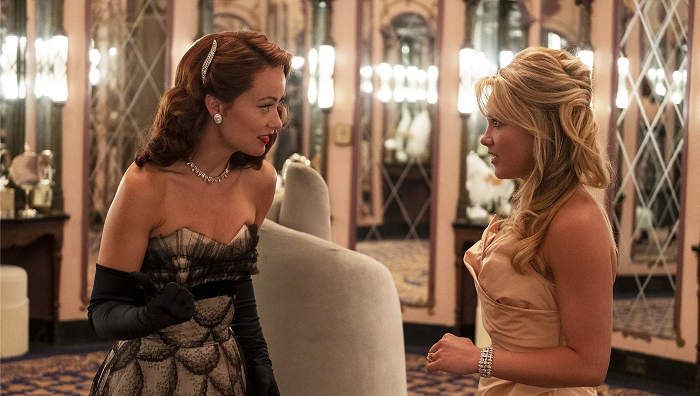
From that synopsis alone you probably have a good sense of some of the themes Wilde and screenwriter Katie Silberman are exploring. But “Don’t Worry Darling” is surprisingly rich and some of its more clever themes don’t become clear until late in the film. That’s when we get the big final-act twist that may lose points for originality, but that does pose some thoughtful questions (I’ll leave them for you to discover).
The cast is a lot of fun and includes Wilde herself playing Alice’s next-door neighbor and best friend, Gemma Chan who doesn’t get much to do, but who has one absolutely brilliant dinner table moment, and an underused Nick Kroll. Pine is mysterious and alluring. And despite what’s been said, Harry Styles is perfectly serviceable as Jack. But it always comes back to Pugh whose fierce yet grounded performance anchors the movie. She’s such an extraordinary actress who possesses the instincts of a seasoned screen veteran despite being only 26-years-old. And it’s those instincts that keep things in check when the movie veers too far off track.
It’s unfortunate that the overblown behind-the-scenes drama has overshadowed “Don’t Worry Darling”. And you can’t help but wonder how much it has influenced those deciding whether to buy a ticket. It’s a shame because Olivia Wilde takes some impressive strides forward as a director, and Florence Pugh shows yet again why she’s one of the most exciting young actresses working today. The film has its flaws. But if you tune out the noise and give it a shot, I think you’ll find there’s a lot to like. “Don’t Worry Darling” is out now in theaters.
VERDICT – 3.5 STARS











 Keith & the Movies