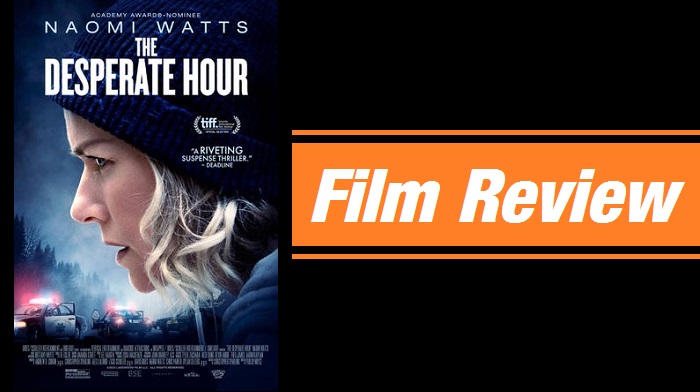
Naomi Watts plays a traumatized mother caught in a hopeless situation in “The Desperate Hour”, an appropriately titled new thriller from director Phillip Noyce. Written by Christopher Sparling, the story takes a well-intentioned look at an extremely sensitive subject but ends up undermining itself with some painfully bad second-half choices.
“The Desperate Hour” is very much a tale of two very different halves. The first half is absolutely terrific, offering a riveting setup and leaning on Watts’ incredible talent to pull us in and connect us emotionally. I was completely absorbed and invested. But then the second half comes along and takes an ill-advised turn. You can see it happening, and I found myself saying out loud “Please, don’t go there!” But it does go there, all for the sake of the genre expectations, and both the movie and the subject matter suffer as a result.
Image Courtesy of Roadside Attractions
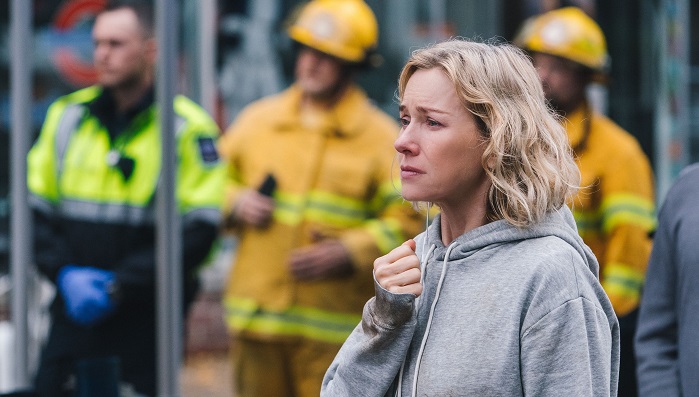
Watts does practically all of the heavy lifting, and for much of the movie she’s the only person we actually see. She plays Amy Carr, a widowed mother of two still working through her grief. It has been one year since her husband Peter was killed in a car accident. Feeling especially down, Amy takes a personal day off from work. She gets her young daughter Emily (Sierra Maltby) on the bus, but her troubled teenage son Noah (Colton Gobbo) won’t get out of bed. Amy hasn’t been able to connect with her son since his father died. Discouraged, she leaves Noah in bed and goes out for a jog.
Other than the final ten minutes, the rest of the movie is spent alone with Amy and her iPhone. She jogs for what seems like ten miles deep into the beautiful forest outside of town. For a while there’s no solitude as she gets calls from her mom, her job, her best friend, etc. She puts her phone on Do Not Disturb for some needed quiet time, but just as she’s alone with her thoughts an alert comes across her screen. There is an active shooter situation at the school and the entire town is on lockdown.
Deep in the forest and with no vehicle, Amy frantically makes calls to anyone she can for help. A 911 dispatcher, an autobody repairman, her daughter’s elementary teacher, and a co-worker are among the many voices she connects with over the phone. But she can’t find a ride, she begins losing her GPS signal, Noah won’t answer her calls, and the cops aren’t sharing any information. It all works as a truly emotional and nerve-shredding setup.
Image Courtesy of Roadside Attractions
But then the movie takes an ill-advised turn which leads to a series of bad creative choices that squash much of what the film had accomplished early on. Amy becomes a super-sleuth and the sheer number of conveniences needed to make the final act happen stretches the bounds of believability. But the biggest misstep is in how it uses the delicate subject of a school shooting as a plot device. I won’t spoil how, and to be fair that isn’t the movie’s intent. But by the end that’s exactly how it feels.
“The Desperate Hour” is one of the more frustrating movies I’ve seen over the last few years. For a while I was so intensely invested in the story and Watts’ performance really grabbed me. But then, as if falling in line with some kind of genre playbook, Sparling’s script veers off into some yucky territory. And the decision to explore grief through the tragedy of others doesn’t land well at all. Especially a tragedy that’s so real and devastating as a school shooting. Again, it should be said that Noyce and Sparling are going for something much different. But that doesn’t change how the movie ultimately feels. “The Desperate Hour” is out now in select theaters and on VOD.
I’ve been hungry for a good old-fashioned whodunnit for a while now. So what better time for Kenneth Branagh to serve up his much-delayed Agatha Christie adaptation “Death on the Nile”. Branagh directs, produces and stars in this period mystery that’s based on Christie’s popular 1937 novel. And it’s the second installment in Branagh’s film series centered around renowned Belgian detective Hercule Poirot (the first being 2017’s “Murder on the Orient Express”). I love that this cinematic universe is a thing.
Branagh returns as super-sleuth extraordinaire Hercule Poirot and he brings along another star-studded cast. This one includes Gal Gadot, Annette Benning, Russell Brand, Armie Hammer, Ali Fazal, Letitia Wright, Emma Mackey, Tom Bateman, Sophie Okonedo, Rose Leslie, and more. The story is handled by returning screenwriter Michael Green and it takes us from war-torn Belgium to a buzzing London to ancient Egypt where the over 4,000 mile Nile River snakes through its vast desert sands.
Branagh opens his film up with a backstory we never knew we needed – the origin of Poirot’s extravagant signature mustache. OK, so I’m being a little facetious. There’s a little more to the exquisitely shot prologue than that. Set in 1917 on a war-scarred Belgian battlefield, young Poirot’s keen sense of deduction saves his company. But he can’t save his captain who is killed by an explosion that leaves the future detective’s face horribly scarred. Later in a medical hospital, a lovely young nurse named Katherine (Susannah Fielding) pays him a visit. The two clearly have a connection, but he fears she’ll leave after seeing his face. “You’ll grow a mustache,” she says with a tender, heartfelt smile.
Image Courtesy of 20th Century Studios
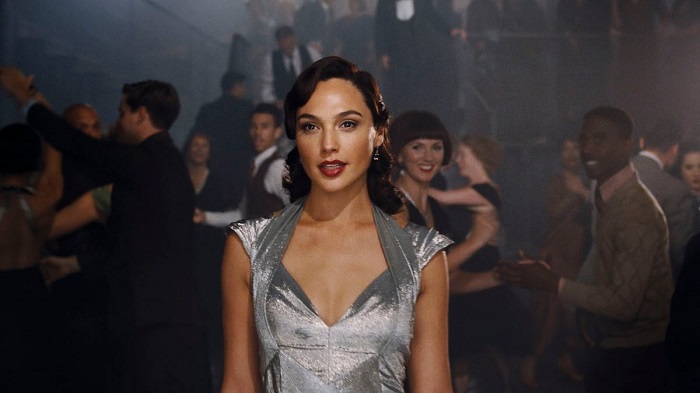
Bop ahead to 1937 London where the mustachioed Poirot sits in a night club soaking in the soulful tunes of jazz singer Salome Otterbourne (Okonedo). His bright blue eyes scope out the patrons, noticing every detail and logging them in his mind. Lighting up the dance floor is the dashing Simon Doyle (Armie Hammer) and his beautiful fiancé, Jacqueline de Bellefort (Emma Mackey). Minutes later, in walks Linnet Ridgeway (played with an ever-present sizzle by Gal Gadot), a wealthy heiress and Jacqueline’s close friend. Remember those names.
Six weeks later, Poirot is vacationing in Egypt, admiring the Great Sphinx of Giza from the shores of the River Nile. There he unexpectedly bumps into an old friend, Bouc (Tom Bateman) who’s in the area with his artist mother Euphemia (Annette Bening) to attend a wedding party at a posh 5-Star hotel. Poirot agrees to join them and several handpicked special guests at the obscenely lavish event where he meets the recently married couple of honor – Simon Doyle and ….. Linnet Ridgeway, NOT Jacqueline de Bellefort.
But as you might imagine, the embittered, scorned and slightly unhinged Jacqueline is not out of the picture. In fact, she’s been shadowing the newlyweds around the globe, popping up at every stop to stir up trouble. When she shows up at their shindig in Egypt, Simon and Linnet rent out a luxury riverboat, the SS Karnak, for them and their handful of guests. Linnet convinces Poirot to come as well, secretly sharing her distrust for her privileged party. “When you have money no one is ever really your friend,” she explains. “I don’t feel safe with any of them.”
The swanky vessel chugs up the Nile, eventually dropping anchor in front of the famed Abu Simbel shrine. The massive monument to King Ramesses II forms a picturesque background for the knotty story that unfolds. One that involves deception, betrayal, and course murder. With one dead body, Poirot sets out to find the killer before more meet the same fate. And you couldn’t ask for a better collection of suspects: the former classmate, the old flame, the accountant, the singer, the painter, the doctor, the maid, the godmother, and so on.
One of the trickiest parts of a movie like this is defining the suspects. You have to root out some kind of believable motive in each of them while also giving us reasons to believe them innocent. It also has to put us in a similar mindset as Poirot. We need to become detectives – watching, listening and soaking up the details. It then needs to bring it all to a satisfying conclusion. One that connects the pieces and makes sense. While I was left with a couple of minor questions, “Death on the Nile” mostly accomplishes all of the above. I was engaged throughout.
Image Courtesy of 20th Century Studios
The ensemble cast is in fine form with a few notable standouts. Branagh is terrific in the lead, capturing Poirot’s steely professional ego but also his more closely guarded sensitivity. There’s an unexpectedly warm subtext found in Poirot’s hidden fascination with love and its many textures. It’s born out of his own personal sense of loss and adds an extra layer to the character which Branagh handles in just the right key.
I mentioned Gadot’s sizzle. We also get a wonderfully understated and nearly unrecognizable Russell Brand playing (I love this name) Linus Windlesham, Linnet’s former beau. Rose Leslie is really good as Linnet’s maid/gopher. I also like the sultry confidence and style Sophie Okonedo brings to Salome. Of course the distracting ickiness associated with Hammer’s casting is hard to avoid, but it wore off over time as the character took the place of the disgraced actor. Still, it’s an obstacle.
In a way, “Death on the Nile” feels like a relic from a bygone era which I found to be one of its most alluring traits. Branagh whole-heartedly embraces the style of the classic whodunnits which I loved but will certainly impact some of the critical reaction. I also loved the look of the film from how Branagh and his DP Haris Zamabarloukos shoot the characters to the outstanding use of the Egyptian setting. It may not have the most seamless conclusion, but it’s a satisfying one. And watching Branagh’s Poirot once again crack another case left me with a grin on my face and hope for a third adventure. “Death on the Nile” is out now in theaters.
The French period drama “Delicious” is (pardon the corniness) a mouthwatering mix of character, country, and cuisine. Written and directed by Éric Besnard and featuring some of the most exquisite cinematography you’ll see, “Delicious” pulls from real history to help tell its largely fictional but utterly compelling story of France’s very first restaurant. At the time, Inns and lodges provided small meals for weary travelers, but the idea of a walk-in restaurant as we know it today didn’t yet exist.
The film is set in 1789 with France on the eve of a Revolution. It’s a time of growing unrest as commoners scrounge for food across the famine stricken countryside. Meanwhile France’s nobility fill their bellies with lavish, meticulously prepared gourmet meals, even using their gastronomical overindulgence as a symbol of power and to flaunt their status.
The film opens with one such extravagant meal being prepared. The camera and the sound design vividly captures the energy and bustle of chef Pierre Manceron’s kitchen. Pierre (a terrific Grégory Gadebois) is the personal chef to the haughty Duke of Chamfort (a wonderfully pompous Benjamin Laverhne). He and his team of cooks rush to put the finishing touches on a lavish dinner he’s preparing for the Duke and his blue-blooded guests.
After the meal Pierre is summoned to the dining area for “comments”. What follows is a scene that highlights both the absurdity as well as the hypocrisy of the aristocracy. At first Pierre is showered with compliments from the table. But then one particularly grumpy friar takes a shot at his lovingly manicured appetizer. “That is your only false note,” he grumbles. It immediately sets off a barrage of insults and ridicule from the very people who were just singing his praises. An embarrassed Duke demands his humiliated chef apologizes. When Pierre refuses, he is promptly fired.
With his Rousseau-quoting son Benjamin (Lorenzo Lefèbvre) in tow, a dejected Pierre retreats to a ramshackle old inn once ran by his late father. There he’s content with letting his dream die. “I’ve lost the taste for cooking,” laments the defeated master chef. Instead he fixes up and reopens the inn, providing a rest place for travelers to stop, stretch their legs, and feed their horses. And for those hungry, there’s no Duck à l’Orange, Braised Pork, or Boeuf Bourguignon. Nope, it’s lukewarm broth over a piece of bread. Bon appétit!
Soon after, a mysterious woman named Louise (Isabelle Carré) arrives on a passing stagecoach asking to be Pierre’s apprentice. “Sorry, I don’t cook anymore,” he grumbles. When she refuses to leave he tries discouraging her with his chauvinistic barbs. “Cuisine is a man’s affair,” he chides. “Women don’t understand it.” Yet Louise stays and over time not only earns Pierre’s trust, but inspires him to look beyond his own self-pity and vainglorious goals.
“Delicious” avoids any dewy-eyed and mawkish trappings by throwing us a few curveballs in its final act. They don’t exactly feel in tune with the rest of the story, but the twists (mild as they are) allow the film more time to dig into the widening gap between the haves and the have-nots. Food proves to be a good tool to do it. Where the Duke and his ilk arrogantly believe that “common people” aren’t capable of properly appreciating cuisine, Pierre and Louise set out to create a place where everyone, regardless of status, can enjoy the happiness and comfort of good dining.
Through it all DP Jean-Marie Dreujou’s breathtaking images go well beyond the sumptuous dishes. The rolling hills, the grassy meadows, the autumn colors – they are all shot with a painterly beauty and would make for a stunning coffee table book. And there are several visual tricks that really impress. Such as one scene where the camera sits outside of Pierre’s inn and we watch a seasonal transition sped up for affect. That sequence is a pure delight, as are several other memorable visual moments.
History says that the first restaurant was actually Le Grande Taverne des Londres which opened in Paris several years before “Delicious” takes place. While the movie creates its own fictionalized origin story, it feels so much a part of that era that you would never question its authenticity. There are some other touches that really enhance the story. For example, there’s a genuine warmth in watching Manceron and Louise inevitably grow closer. And with the French Revolution knocking on the door, having young Benjamin as the voice of the people reminds us that change is on the way. It will come at a sobering cost, but change is coming nonetheless. “Delicious” is now available in select theaters and on VOD.
It’s true that filmmaker Adam McKay has a pretty devoted following. His six(ish) hit-or-miss comedy collaborations with Will Ferrell earned him a pretty enthusiastic fan base. Then in 2015 he tried something a little different with the intriguing but exhausting “The Big Short”. He followed it with the bloated and insufferable “Vice”, a movie that showed what can happen when indulgences run wild.
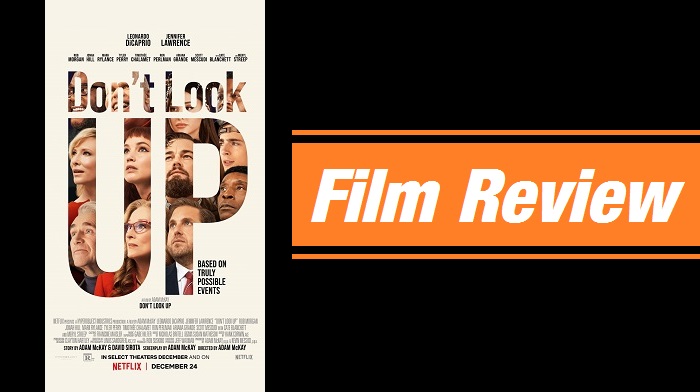
I tend to approach any new McKay film with tempered expectations and a fair amount of caution. That’s precisely what I did with “Don’t Look Up”, his new star-studded affair first announced in 2019 by Paramount Pictures and then acquired by Netflix. It’s another big grab for the streaming leader and a movie with obvious awards season ambitions.
As it turns out, “Don’t Look Up” is a welcomed surprise and a considerable step up from McKay’s last film. It’s a cynical and biting satire in the grandest sense of the word. The film takes aim at everything from our culture, to our politics, to the basic way we interact with each other. Nothing is safe or sacred. Cable news, social media, big tech, the entertainment industry – all find themselves in McKay’s crosshairs.
It’s also really funny. In contrast to “Vice”, which was too full of itself and left McKay resembling the political left’s comic version of Dinesh D’Souza (but with a bigger budget and a great cast), “Don’t Look Up” is a craftier blend of McKay’s early silliness and later message-driven storytelling. The result is a laugh-out-loud, gag-a-minute romp full of well-placed jabs at nearly every hot button issue of our day (and several lukewarm ones as well). There’s so much crammed into this movie, and it’s a miracle that (for the most part) McKay manages to hold it all together.
Image Courtesy of Netflix
While he has never been one to hide his own political slant, here McKay actually takes a broader look at the world, finding that there’s plenty of scrutiny to go around. His film confronts modern society’s division, arrogance, self-righteousness and backwards thinking, revealing what could happen if we continue to let those things ferment. In essence, his movie is saying our world is full of dumb people, many of them in positions of power and influence. And it’s a condition that permeates both sides of the political aisle and every social class.
Of course McKay examines all of the above through his own bluntly comical lens, highlighting the absurdity of our positions, obsessions, and reactions often to a chorus of laughter. And while his script deserves a lot of credit, he’s helped by an all-star cast who seem completely in-sync with McKay’s wacky rhythm.
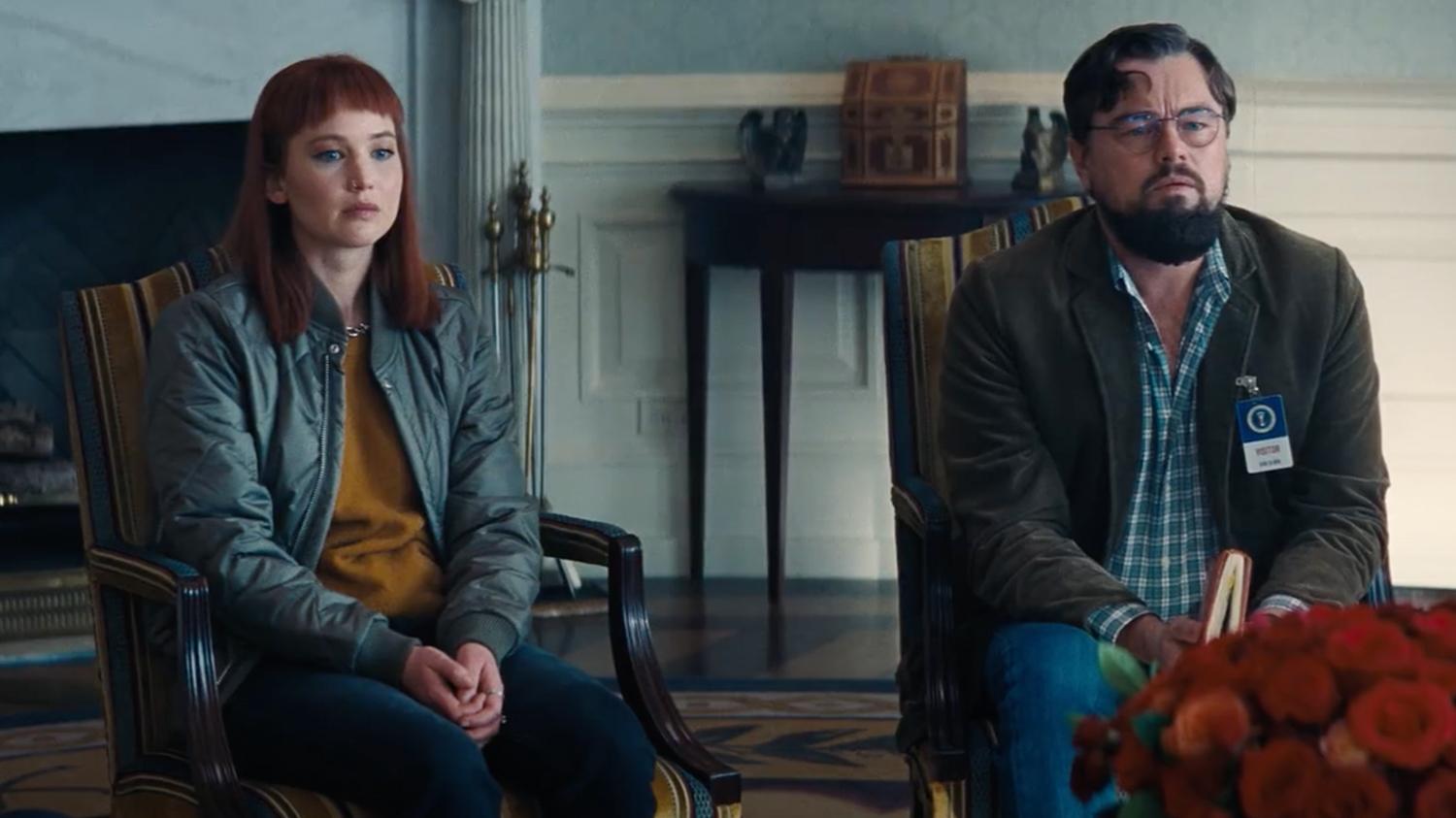
At the top is Leonardo DiCaprio and Jennifer Lawrence, two good-looking Hollywood stars garnished with hideous mops in an effort to make them look more like the rest of us (I’ve read both were drawn by the movie’s themes, but I’m sure the $55 million Netflix paid them didn’t hurt). Leo plays Dr. Randall Mindy, an intensely antsy small-fry astronomer who leads a team of Michigan State grad students. Lawrence plays Dr Kate Dibiasky, Randall’s manic research partner and a Ph.D. candidate who makes the big discovery that sets the movie in motion.
It turns out that a nearly ten-kilometer-wide comet is barreling towards Earth. After crunching the numbers Kate and Randall determine that the “planet killer” should arrive in six months resulting in an extinction level event. The duo contacts Dr. Clayton “Teddy” Oglethorpe (played by the always superb Rob Morgan), an esteemed scientist who helps them get an audience with the President of the United States, Janie Orlean (Meryl Streep).
Image Courtesy of Netflix
The comedy really kicks into gear when the three scientists arrive at the White House. There’s a hilarious Oval Office scene where Randall, Kate, and Teddy attempt to warn the President and her oblivious administration. They quickly learn that optics, poll numbers, and the upcoming mid-terms carry more weight than the looming Armageddon. This is also where we get a good taste of Jonah Hill’s Jason Orlean, the President’s spoiled son and her Chief of Staff. Normally Hill is an actor I can only take in small doses. But here his pinpoint improv-heavy delivery offers some of the film’s biggest laughs.
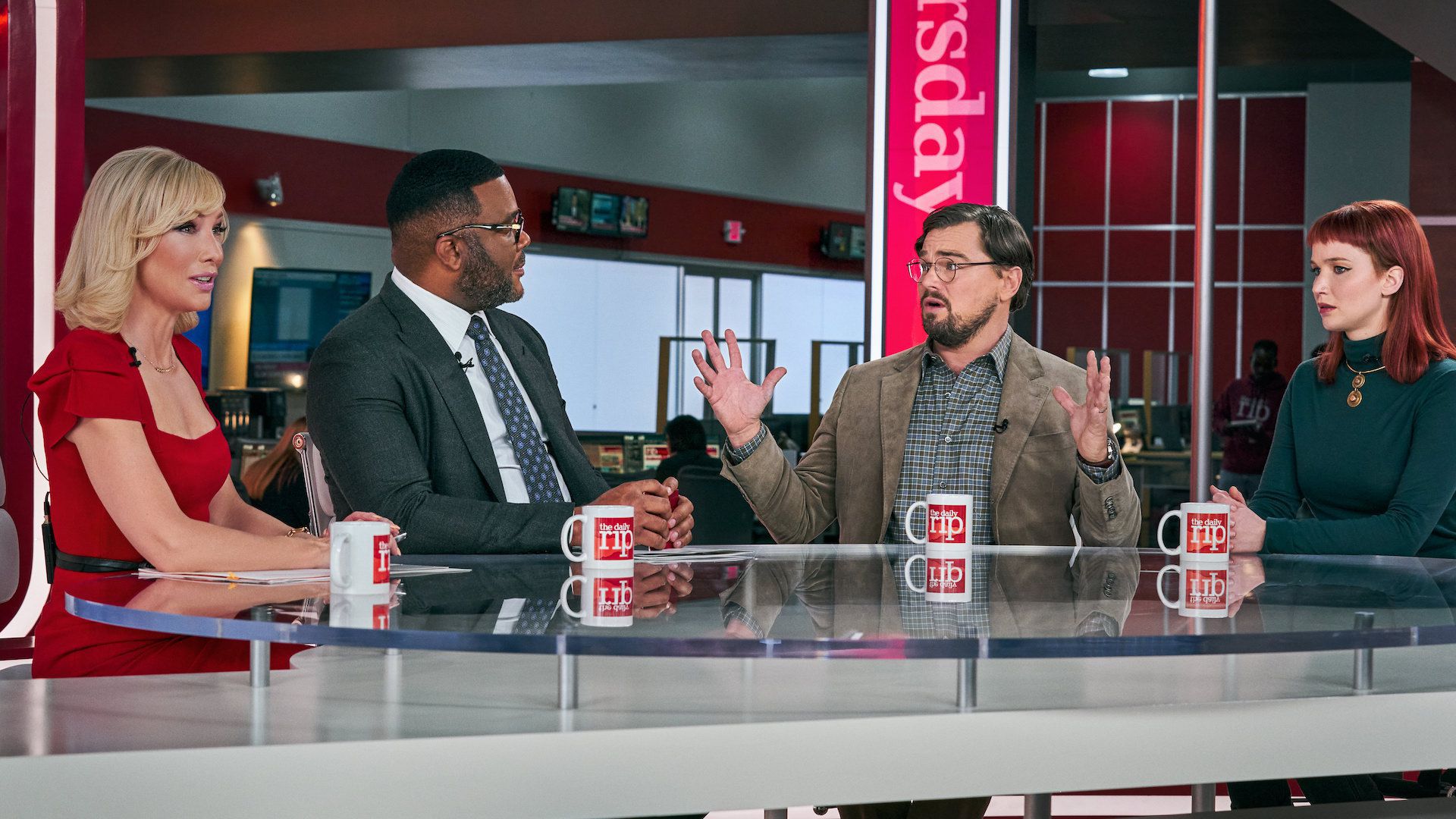
Adding to the fun is Cate Blanchett and Tyler Perry as two incredibly pompous cable news hosts (both are great). Ron Pearlman gets one of the funniest monologues I’ve heard in years. Timothée Chalamet pops up and gets some good lines as a skater-boy named Yule. And with his snowy white hair, pearly uppers, and cosmetically smoothed skin, Mark Rylance is hysterical as the celebrity CEO of a huge tech company.
The movie makes an unexpected pivot at around the two-hour mark. The humor mostly evaporates and the story takes a more serious turn. In one sense it loses some steam as it veers away from its biggest strengths. It’s also where the movie’s running time becomes noticeable (it clocks in at a whopping 145 minutes). But the shift in tone isn’t without purpose. McKay wants to ensure that we don’t miss the point of his movie. He wants us to stop, think, and feel. For the most part he succeeds.
The humor in “Don’t Look Up” ranges from subtle to ridiculous, and there are a number of fun callbacks to movies like “Network”, “Dr. Strangelove“, and even (gulp) “Armageddon”. Yet there’s more to glean from this waggish doomsday comedy. It’s an indictment of our tech dependent society. It’s an on-the-nose allegory for climate change. But most effectively, it’s a stinging examination of a divided nation and its inability to communicate. It’s an urgent issue that demands consideration. McKay just lets us laugh while we do so.
Production designer turned director David Hackl helms the new film “Dangerous”, a kooky action thriller that starts with some real promise. But the story (written by Chris Borrelli) quickly comes unglued and ventures into territory too silly to take seriously. It takes an appealing cast and gives them unappealing characters, leaving them with the unenviable task of moving the audience to actually care about what we’re seeing. Sadly, we never do.
Scott Eastwood plays Dylan Forrester, a former Navy SEAL on parole for murder. He’s also a sociopath who pops lithium like TicTacs and frequently calls his lush of a therapist Dr. Alderwood (Mel Gibson) to talk him through his unwholesome urges. Eastwood borrows his legendary father’s cold and terse screen delivery to portray a character unable to feel emotion or have empathy. And while his meds keep his impulses (mostly) under control, Dylan’s non-existent social skills stick out like a sore thumb during any conversation.
The story is one that hinges on a number of contrivances. It gets underway after Dylan learns his brother Sean, who was opening a bed-and-breakfast on Guardian Island off the coast of Washington, has died. Supposedly it was the result of an accident on some scaffolding, but an unwelcome visitor to Dylan’s apartment says otherwise. So he breaks parole and heads to his brother’s place to pay his respects.
Image Courtesy of Lionsgate
Dylan arrives at his Sean’s wake and is immediately greeted by his estranged mother Linda (Brenda Bazinet), a toxic one-note curmudgeon who’s quick to share her disdain for her living son while praising her saintly dead one. A cautious but more hospitable Susan (Leanne Lapp), Sean’s wife, breaks the ice by welcoming Dylan as does her son Freddy (Atlee Smallman). Also at the wake is Sean’s old college buddy Massey (Brendan Fletcher) and the scowling super-serious Sheriff McCoy (Tyrese Gibson in a glorified cameo).
But if family tension wasn’t enough, a well-armed mercenary named Cole (Kevin Durand) and his generic goon squad arrives on the island and lays siege on Sean’s B&B. There’s something in the house that he wants, but no one seems to know what it is. Meanwhile FBI Special Agent Shaughnessy (played by a seemingly uninterested Famke Janssen) tracks the parole-hopping Dylan to Guardian Island. It all leads to a predictable showdown where the gunplay (much like the eventual revelations) is as underwhelming as it is uninspired.
Eastwood does what he can with a role that more or less demands a cold detached performance. Mel Gibson steals a handful of scenes while Durand hams it up as the film’s bland baddie. Janssen seems as bored as we are and Tyrese Gibson isn’t on screen long enough to leave an impression. In other words, a nice cast gets lost in a movie that feature more cliches than thrills. I do think there’s a way to turn this fairly conventional idea into something fun and entertaining. But what we get with “Dangerous” ends up being the exact opposite. “Dangerous” is now available on VOD.
It’s hard not to be excited for a Denis Villeneuve movie. The French Canadian director, screenwriter, and producer has such a compelling filmography. I was introduced to Villeneuve via his 2010 Oscar nominated drama “Incendies”. But it’s his terrific run since then that has turned me into a bonafide fan. I enjoyed both “Prisoners” and “Enemy”. His 2015 border thriller “Sicario” may be my favorite film of his to date. “Arrival” was my #1 movie of 2016 while 2017’s “Blade Runner 2049” was a gutsy and heady sequel to a 1982 sci-fi classic.
It almost feels like a natural progression for Villeneuve’s next film to be his biggest and most audacious project to date. “Dune” is certainly that. This massive sprawling science-fiction epic is the first film in a two-part adaptation of Frank Herbert’s 1965 cult novel of the same name. Packing a hefty budget and a star-studded cast, “Dune” is a herculean undertaking brimming with ambition and made with the unquenchable passion of a filmmaker who has called this his “longstanding dream“.
There are a number of ways that a project of this size and scope could have gone awry. But Villenueve is a savvy filmmaker with a dedicated vision. I’ve seen “Dune” multiple times now, and I can honestly say that I’m struggling to find a single bad filmmaking decision anywhere in his movie. Bold statement, I know.
Image Courtesy of Warner Bros.
I suppose you could pick on the exposition in the first half, the film’s overall deliberate pacing, or the ending which is more of a stop than an actually finish. But easy defenses could be made for each of those “issues”. The exposition is hardly intrusive and actually feels warranted. Villeneuve’s patience proves to be a real asset, giving the story and the characters the room they need to breathe. It also provides Villeneuve the space to show off the film’s biggest strength – the extraordinary world-building (more on that later). And the ending is simply a byproduct of the right decision to make this a two-parter.
Without question, it was the right choice to break this up into two movies. This film literally starts with the “Part One” tag and ends around the halfway mark of the “Dune” story. As mentioned above, this benefits the film greatly because it allows the right amount of time for us to be immersed into this striking and complex world. And it allows Villeneuve (who co-wrote the script with Jon Spaihts and Eric Roth) to acquaint us the many political, ecological, and societal intricacies that help give the story depth.
Set in the very distant future of 10191, “Dune” tells the story of young Paul (Timothée Chalamet), the gifted son of Duke Leto (Oscar Isaac), the leader of the powerful House Atreides. They live and rule on the planet Caladan where Paul, next in line to lead, is trained in combat by close friend and House Atreides warrior Duncan (Jason Momoa) and Leto’s top aide Gurney (Josh Brolin). His mother Jessica (Rebecca Ferguson), an acolyte of a mysterious sisterhood called the Bene Gesserit, teaches him the secrets of a mysterious inner power he possesses, a power that’s causing haunting dreams of a troubling future.
Meanwhile on the harsh desert planet of Arrakis, the brutal House Harkonnen, ran by the chillingly vile and grotesque Baron Vladimir Harkonnen (Stellan Skarsgård), have become obscenely rich controlling the planet’s production of a priceless mineral called Spice. The Harkonnens callously harvest the coveted natural resource, avoiding massive sandworms and persecuting the resilient indigenous clan known as the Fremen. Their leader is Stilgar (a solemn and reticent Javier Bardem) and also among their ranks is Chani (Zendaya), a young woman who has been appearing in Paul’s dreams.
Image Courtesy of Warner Bros.
After an imperial decree orders the Harkonnen off of Arrakis, the emperor grants stewardship of the planet to House Atreides. Suspicious of the mandate but loyal to the call, Leto accepts with hopes of forming an alliance with the native Fremen. That proves to be easier said than done. After 80 years of oppression, the Fremen are leery of any new offworlders. And can the Harkonnens be trusted to leave behind all the wealth and power found in the sands of Arrakis?
Ultimately the film very much belongs to Paul, a young man trying to find himself while being pulled in every direction. As Leto’s heir, everyone expects him to be next in line to lead House Atreides. Jessica’s sect (led by a wonderfully creepy Charlotte Rampling) hopes Paul is “the one” which they intend to use for their own cryptic purposes. And the Fremen, having heard of this messiah-like deliverer, wonder if Paul might be the fulfillment of that prophecy.
As Villeneuve patiently and methodically lays out his story, we’re struck by the surprising amount of narrative depth. Not only is “Dune” thematically rich, it’s filled with connected backstory. But to the screenwriting trio’s credit, they often (and smartly) allude to the lore rather than bury us in it. Yet there are still many layers to their story, and it’s impossible to narrow the film down to one single category. Of course it’s science fiction, but it’s also a coming-of-age story, a war movie, an anti-war movie, a sociopolitical parable. Another testament to the film’s richness.
But without question the movie’s biggest strength remains its world building. From the imaginative costumes to the jaw-dropping production design, Villeneuve and his talented team of creators have made a stunningly tactile world and every frame gives us something worthy to consume. Whether it’s the lush overcast Atreides homeworld with its vast waters and craggy coastlines or the stark yet gorgeous oceans of sand on Arrakis that look like golden brown meringue through DP Greig Fraser’s camera.
Image Courtesy of Warner Bros.
Interestingly, the technology of “Dune” leans more primitive than futuristic which helps the world feel rooted in our reality. There are no fancy LED panels and very little high-tech gadgetry. Even the structures convey this, often resembling old ruins rather than state-of-the-art facilities. The ships are massive and breathtaking spectacles yet designed with a cold austere simplicity. The machinery has a rusty industrial look and even the incredibly cool ornithopters (which resemble giant dragonflies) are a believable evolution of our standard helicopters.
To the performances, I admit to being a bit of a Chalamet skeptic. I’ve never thought he was a “bad” actor, just not up to the gushing hype that follows everything he does. Here he earns the praise he’s been getting. Chalamet brings a boyish petulance to Paul in the film’s early scenes, but over time convincingly turns his vulnerability to maturity. Isaac is fittingly stoic. Momoa is full of charisma. Brolin is stern and abrasive. Ferguson deftly manages the emotionally meatiest role. Skarsgård is devilishly menacing. Sharon Duncan-Brewster is mysterious yet exciting. Zendaya does fine with the few scenes she’s given.
I honestly didn’t know what to expect from “Dune”. I’ve never read Herbert’s book and I don’t remember a thing about David Lynch’s 1984 film. Perhaps that’s why “Dune” 2021 blew me away. From its opening shot to the final fade, I found myself enraptured and transported. Villeneuve’s captivating direction, Hans Zimmer’s brooding exotic score (one of his very best), the exquisite sound design, the visual feast that screams to be seen on the biggest screen possible. Together it all makes for a smart, evocative, and rousing experience that reminded me at every turn of why I love cinema. And this is just Part One of the story.