REVIEW: “The Electric State” (2025)

You can be certain that some will go into “The Electric State” with their knives already sharpened. Afterall, it’s a $320 million streaming blockbuster from Netflix which makes it an easy target. But this latest small screen creation (that would look amazing on the big screen) is nowhere near the trainwreck it has been tagged as. But it also doesn’t live up to its status as one of the most expensive movies ever made.

With “The Electric State”, the directing duo of Anthony and Joe Russo continue to find their post-Marvel footing, reteaming with frequent collaborators, screenwriters Christopher Markus and Stephen McFeely. This time they’re adapting Simon Stålenhag’s dystopian sci-fi graphic novel of the same name after acquiring the rights back in 2017. They’ve brought this massive undertaking together with a hefty backing from Netflix who apparently handed the brothers a blank check.

From the very start you’ll notice “The Electric State” sports a star-studded ensemble providing both live-action performances and voicework. The featured talent includes Millie Bobby Brown, Chris Pratt, Ke Huy Quan, Stanley Tucci, Giancarlo Espositio, Woody Harrelson, Anthony Mackie, Colman Domingo, Jenny Slate, Brian Cox, Alan Tudyk, Woody Norman, and Jason Alexander among others. Just listing the names gives you a good sense of where a lot of the money went.

Image Courtesy of Netflix

As for its storytelling, “The Electric State” struggles to find its own voice. So much of its story follows a familiar and well-traveled trajectory. We feel three steps ahead of it the entire way. There’s also no nuance in the handling of its themes. They’re mostly plastered on the surface rather than thoughtfully explored through the characters and their journeys. So that leaves the movie leaning heavily on its star power and impressive visuals.

Its 90’s set story takes place in the aftermath of a war between humans and robots. We learn humans had made robots the backbone of the world’s workforce, shaping them to do whatever labor mankind desired. Eventually the robots, led by the noble Mr. Peanut (voiced by Harrelson), began pushing for freedom and equality. But a paranoid humanity resisted which led to a global war.

After much fighting, the humans finally gained the upper-hand with the invention of the neurocaster by a wealthy CEO, Ethan Skate (Tucci). While the technology empowered mankind to win the war, Slate turned it into a virtual reality network that connected the entire world. Soon humans became obsessed with neurocasters, losing themselves in the VR worlds it created. Meanwhile robots have been banished, either disassembled or sent off to the reservation styled Exclusion Zone.

It’s within this world that we meet Michelle (Brown), a ward of the state ever since she lost her parents and was separated from her brilliant but anxious kid brother, Christopher (Woody Norman). Late one evening Michelle is shocked when a small robot in the form of Christopher’s favorite cartoon character, Kid Cosmo (voiced by Alan Tudyk) sneaks into her room. Within the robot is a part of her brother’s consciousness (at least I think) who tells Michelle he desperately needs her help.

Image Courtesy of Netflix

So Michelle sets out for the west coast to find, rescue, and reunite with her brother, guided by an illegal robot who draws all kinds of unwanted attention. But she finds help in an unexpected place – a smuggler named Keats (Chris Pratt in a hideously bad mop) and his robot sidekick, Herman (voiced by Anthony Mackie). They agree to escort Michelle and her Cosmo-bot across the war-torn wasteland of the Midwest towards Seattle. But of course there are plenty of dangers along the way from rogue robots to Ethan Skate, the nefarious CEO who we quickly learn is the movie’s big baddie.

To its credit, “The Electric State” looks amazing thanks in large part to cinematography Stephen F. Windon and the VFX team led by supervisor Matthew Butler. There is an incredible amount of detail put into the world from the retrofuturistic cities to the rust and grime of old battlefields. There are also tons of cool and amusing robot designs. Similarly, the action scenes are well choreographed and shot, incorporating both style and humor into the sequences.

If only the story had more weight. If only it made us feel something for the characters. If only it made the stakes seem as high as we’re told they are. If only its themes of tech dependency, family, and human connection were more seriously treated. Instead we’re left with stunning visuals, a slew of needle drops, and a great cast (some of whom are woefully underused). That was enough to hold my attention and keep me mildly entertained. But it also left me frustrated. The Russos have created a fascinating world that feels like it’s still waiting to be discovered. And no matter how hard I tried, I never felt a connection to it.

VERDICT – 2.5 STARS

REVIEW: “Everyone is Going to Die” (2025)

With a blaring title like “Everyone is Going to Die” you may think you know what you’re in for. But to writer-director Craig Tuohy’s credit, his feature film debut has more on its mind than you might expect. But having big ideas means little if you’re not able to execute them. And unfortunately some of the film’s bigger issues lie with the execution.

The trailer presents the film as a sinister mix of “The Strangers” and Michael Haneke’s “Funny Games”. But it doesn’t have the terror of “The Strangers” or the disturbing edge of “Funny Games”. Instead “Everyone is Going to Die” is a home invasion thriller that’s so intensely invested in being a patriarchal critique that it forgets such things as building suspense, story coherence, and sticking its ending.

Image Courtesy of Saban Films

But Tuohy does impress in some areas including making the most of an obviously small budget. And you can see the framework of a potentially terrifying and thematically provocative movie. But not all of its narrative pieces fit together and there are a few too many details missing from the story. And once the film’s intent becomes obvious, it clumsily tries to make its point through head-scratching sequences that amount to little more than shock value.

The film opens with a wealthy land developer, Daniel (Brad Moore) cleaning up his remote ultramodern home after a hedonistic night of partying with his latest girlfriend, Lydia (Tamsin Dean). From the outset it’s clear that Daniel is a slug and the movie goes all-in defining him as such. So much so that later attempts at revealing the depths of depravity lose their punch. He’s a self-centered jerk, a crooked businessman, and a rotten father. But nothing trumps the damage he has done to the women in his life.

Daniel finishes cleaning up just in time for the arrival of his troubled 16-year-old daughter Imogen (Gledisa Arthur) who has reluctantly agreed to spend the weekend with her father to celebrate her birthday. Daniel attempts to reconnect with Imogen but it’s obvious he has no clue what she likes or dislikes. He’s even more oblivious to the deeper emotional issues she’s struggling with.

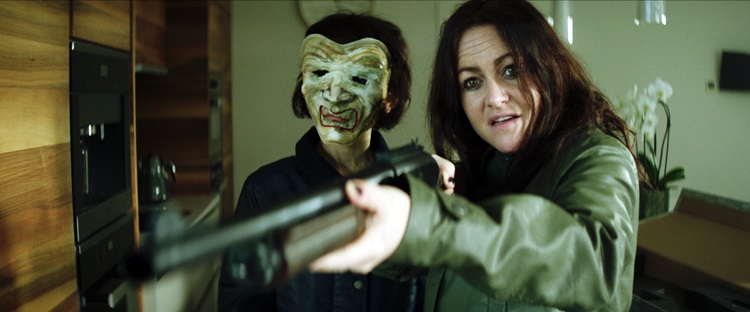
Their not-so-enjoyable father-daughter reunion is suddenly interrupted when their home is invaded by two women sporting hideous masks and a shotgun. The women, listed as Comedy (Jaime Winstone) and Tragedy (Chiara D’Anna), take Daniel and Imogen hostage but aren’t immediately upfront with their reasons. At first it comes across as a straight robbery. But it’s quickly made evident that the women have serious man issues, and specifically with Daniel.

Image Courtesy of Saban Films

The entire movie plays out inside the house which (as in so many other current movies in the horror and thriller genre) is yet another posh estate sitting in the middle of nowhere, conveniently away from any neighbors or law enforcement. It features the two mysterious women humiliating the aggressively vile Daniel in front his daughter by exposing his many vices. But not all of their tactics make sense. And the movie’s opinion of them is cloudy at best, with the script constantly undercutting any feelings we’re supposed to have for them.

One area where the movie excels is in the performances. Moore is too restricted by his character to offer much for us to latch onto. But Arthur, Winstone, and D’Anna each offer compelling takes on the women they play. But even they have a tough time adding substance to this barely 80-minute story. Again, its problems all come down to the diluted script which wants to say something profound but that has a really hard time saying it. Releases in select theaters and on VOD February 21st.

VERDICT – 2 STARS

REVIEW: “Emilia Pérez” (2024)

Jacques Audiard’s “Emilia Pérez” is one of the most confounding movies of 2024. Positioned by some as a strong awards contender, this contradictory and clumsy musical crime “comedy” manages to be as bewildering as it is audacious. Very few of Audiard’s big swings connect at all, and his attempts at finding a human heartbeat often come across as soapy and artificial. And that only scratches the surface of the movie’s panoply of head-scratching issues.

“Emilia Pérez” is a film that attempts to do a number of things but doesn’t do any of them particularly well. It’s a musical with no sense of rhythm; a thriller that lacks suspense; a comedy without a sense of humor; and a melodrama with no emotional spark. The performances are solid, especially from Zoe Saldaña who has always deserved more attention than she receives. But finding reasons to care about these characters shouldn’t be as hard as it is.

Image Courtesy of Netflix

Saldaña plays Rita Mora Castro, an overworked and underappreciated Mexico City lawyer who receives a mysterious call from a potential client wanting to meet her. Now everything about the meeting should have set off alarms – late at night, down a side road near a newsstand. But Rita goes and is promptly hooded and thrown into a van. She’s driven out to the middle of nowhere and sat down across the table from a notorious cartel leader named Juan “Manitas” Del Monte (Karla Sofía Gascón).

Their meeting doesn’t go where Rita or the audience would expect. Manitas is looking to have a secret sex change procedure and wants to hire Rita to covertly oversee the planning. Seizing the offer to become insanely rich, Rita accepts her task of finding a willing doctor abroad, helping Manitas stage a believable death, and relocating Manitas’ wife Jessi (Selena Gomez) and their two children to Switzerland. Soon Manitas is at a Tel Aviv clinic ran by Dr. Wasserman (Mark Ivanir).

Four years pass and Rita is enjoying a comfortable life in London. But her life changes again after she has a surprise encounter with Emilia Pérez, formerly Manitas. Emilia is desperate for a family reunion and once again hires Rita to make it happen. Rita is tasked with bringing Jessi and the kids back to Mexico City. Once there, they will live with Emilia who will be posing as Manitas’ distant cousin. It doesn’t take a Rhodes Scholar to figure out that Emilia’s ruse can only last so long. And where it ends up going only deflates the movie more.

Image Courtesy of Netflix

After reading everything up to this point you may have forgotten that “Emilia Pérez” is indeed a musical. No worries, you’ll probably forget after seeing it as well. That’s because none of the songs will stick in your memory aside from the more absurd ones. Even worse, the songs feel forced or tacked on rather than a meaningful part of the film’s identity. And while they are strangely (yet mercifully) brisk, enduring them can be chore.

As “Emilia Pérez” played out, I kept asking myself a number of questions. What’s the overall point of it all? What am I to make of its murky messaging? How am I supposed to feel about these characters, especially Emilia? And is that the best ending Audiard could come up with? Ultimately I came to the conclusion that I didn’t really care. And that’s my biggest problem with “Emilia Pérez”. Despite its admirable ambition and a terrific Zoe Saldaña performance, the film left me in a state of indifference. And that’s the last place you want to be with a movie like this.

VERDICT – 2 STARS

REVIEW: “The Exorcism” (2024)

Believe it or not, “The Exorcism” isn’t connected to last year’s “The Pope’s Exorcist”. Without question there are some striking similarities. Both are supernatural horror movies about demon possession and both star Oscar winner Russell Crowe. But it doesn’t take long watching “The Exorcism” to recognize it is doing some dramatically different things. And while I had a blast with “The Pope’s Exorcist”, this film takes a slightly different approach to the demonic possession subgenre. The results are mixed at best.

Crowe plays Tony Miller, a once revered movie star whose self-destructive behavior derailed his career and his life. After his wife was diagnosed with cancer, Tony spiraled into a world of drugs and alcohol. It ruined his relationship with his family, especially his daughter Lee (Ryan Simpkins). But now one year out of rehab, Tony is looking to put his life back together, starting by healing his fragile relationship with Lee, who just moved back home after being suspended from school.

Image Courtesy of Vertical

Tony’s luck seems to take a turn after he’s invited to audition for the lead role in an upcoming Exorcist-esque remake following the mysterious death of the previously cast actor. He gets the part mainly because the film’s pitiless director (a satisfyingly despicable Adam Goldberg) sees Tony’s real-life struggles as inspiration for the character. He’s able to get Lee on an associate producer and the father and daughter begin to bond.

But only a few days into filming, the cast and crew start noticing disturbing changes in Tony’s behavior. Lee begins to wonder if the role is affecting her father too deeply and causing old personal demons to resurface. Or is there something more sinister and malevolent at work? Anyone who has watched a horror movie or two will instantly know the answer. You’ll recognize all the marks and see all of the signs.

Image Courtesy of Vertical

And that gets to the main weakness of the film. None of the horror elements generate any real scares. Some are a little eerie and Crowe does all he can to creep us out. But most of its tricks we’ve seen before – demonic voices, unnatural body contortions, unexplained cuts and gashes, and so on. It’s all there. To its credit, the movie set setting does offer a slightly new perspective, incorporating a lot of fun behind-the-scenes looks at filmmaking into its story. But the meat of the movie tastes pretty familiar.

“The Exorcism” ultimately comes to a lackluster final act that does nothing with the initially promising premise. The use of possession as a metaphor for addiction is interesting and early on you get the feeling that the filmmakers have something unexpected up their sleeves. But the conventional and glaringly unremarkable finish is deflating. Meanwhile the lightly breaded characters languish in a surprisingly low-stakes affair that could have been so much more. “The Exorcism” is in theaters now.

VERDICT – 2 STARS

REVIEW: “Ezra” (2024)

Director Tony Goldwyn thoughtfully weaves together a touching story of love and acceptance in “Ezra”, an earnest and personal dramedy written by Tony Spiridakis who was inspired by his own experience raising an autistic son. After years of pouring his heart into his script, Spiridakis shared a final draft with Goldwyn who asked to direct. Soon after, the two close friends were premiering “Ezra” at last year’s Toronto International Film Festival. And now it’s getting a full theater release.

Anchored by a superb cast, “Ezra” sees Bobby Cannavale playing Max Brandel, an impulsive stand-up comic struggling to raise his autistic son, Ezra (newcomer William A. Fitzgerald) with his overprotective ex-wife, Jenna (Rose Byrne). Both love their son dearly, but each have different ideas about what’s best for him. Making matters worse, Ezra has been kicked out of three different public schools, and his current school is threatening to expel him following another outburst.

Image Courtesy of Bleecker Street

The tensions between Max and Jenna intensify after it’s recommended that Ezra be sent to a special needs school and put on the antipsychotic drug Risperdal. The loving yet exasperated Jenna is open to the idea while Max wants no part of it. Following some unfortunate circumstances, Ezra is sent to the school leading Max to make a rash decision that he believes is in the best interest of his son. He loads up Ezra and heads across country without telling Jenna.

As you can probably tell from that brief synopsis, the story is as much (if not more) about the people around Ezra than it is Ezra himself. That may frustrate some viewers, but Goldwyn maintains a good balance and is careful that Ezra never becomes just another plot device. The casting of 15-year-old Fitzgerald was a key move. On the Autism Spectrum himself, Fitzgerald adds an authenticity and a vibrancy that the film desperately needs.

Image Courtesy of Bleecker Street

The performances are top-to-bottom terrific especially from Cannavale and Byrne. Both play very different roles, but complement each other nicely. Then you have the supporting cast starting with Robert De Niro as Max’s critical and unsupportive father. Whoopi Goldberg plays Max’s manager who’s always looking out for him. Goldwyn himself is really good playing Jenna’s new husband Bruce who tries to stay neutral in a difficult situation. Rainn Wilson pops up as a fellow comedian while the always great Vera Farmiga plays Max’s old friend Grace.

“Ezra” strays a little too far in the final act, losing a bit of the above-mentioned authenticity through a handful of plot contrivances and some swings at levity that don’t quite connect. But Spiridakis’ personal experiences can be felt through his movie’s sincerity. And I appreciate his willingness to buck what many would say a movie about the neurodiversity “should be”. Those on the Spectrum, as well as the people around them, have a broad array of experiences that help define who they are. Neither Spiridakis or Goldwyn handcuff their characters to expectations or formulas. They respect them and their experiences, treating them with an emotional openness and honesty that makes it easy to look past the film’s shortcomings. “Ezra” is in theaters now.

VERDICT – 3 STARS

REVIEW: “Eileen” (2023)

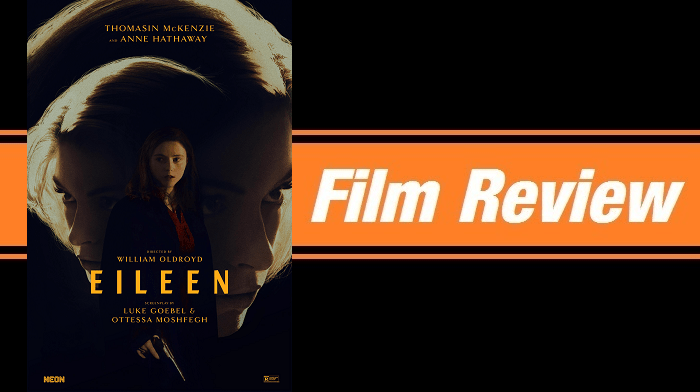
Director William Oldroyd’s “Eileen” is an equally captivating and frustrating psychological thriller based on Ottessa Moshfegh’s 2015 novel of the same name. It features the spellbinding duo of Thomason McKenzie and Ann Hathaway. It’s accented by the brilliant visual work from cinematographer Ari Wegner. And it features an alluring premise that mixes in an array of genres.

Unfortunately “Eileen” is held down by a sometimes clumsy and opaque screenplay. Adapted for the screen by Moshfegh and her husband Luke Goebel, the story starts a little messy but quickly evolves into something delightfully enigmatic and beguiling. Yet the script can’t deliver a satisfying payoff. The final act is riddled with holes in its logic. And there’s a good chance that anyone who has seen an episode of two of “Law and Order” will be picking the ending apart.

Image Courtesy of NEON

Set in the 1960s, McKenzie plays Eileen Dunlop, a mousy young secretary who works at a Massachusetts prison for boys. From the very start it’s obvious there’s something slightly “off” with her. But beyond that, she’s also a victim of her circumstances. She’s lonely and with no friends to speak of. She lives with her drunk and sickly ex-cop father (Shea Whigham) whose passive-aggressive cruelty is enough to mess with anyone’s mind. And she’s stuck in a go-nowhere job with no signs of opportunity.

But things change after the prison hires Dr. Rebecca St. John (Hathaway) to be their new psychologist. Rebecca is confident, beautiful, and vivacious and Eileen is instantly captivated. The more Eileen observes Rebecca the more infatuated she becomes. Soon she’s mimicking her new coworker – taking up smoking and coffee, dressing up as elegant as she can with nothing but her late mother’s clothes. And as a rather thinly sketched friendship forms between them, Eileen’s interest turns into full-on obsession.

At its best, “Eileen” is a sly and devious thriller with dashes of dark humor and even a tinge of Hitchcock. The off-kilter chemistry between McKenzie and Hathaway keeps us wondering what Oldroyd is going for. It makes for a good mystery, but he keeps the characters at an arm’s length. We never feel close enough to them to get a good sense of their feelings or (more importantly for a movie like this) their motivations.

Image Courtesy of NEON

The bigger issue comes in the final 30 minutes. The story takes a dramatic turn that’s meant to be both a surprising reveal and (I think) a shocking twist. Unfortunately it doesn’t make much sense. Our two main characters make several head-scratching decisions and their actions defy good sense. The ending is cloaked in ambiguity but not necessarily the good kind. Instead it leaves the movie in a far-fetched place. Oldroyd definitely goes for the jolt. What he delivers is more of a nudge.

“Eileen” has its strengths starting with the dazzling performances from McKenzie and Hathaway. The story itself is full of intriguing parts waiting to be pieced together. And the film is exquisitely shot, routinely impressing with its clever framing and evocative use of lighting and shadows. But in the end “Eileen” doesn’t seem sure of what it wants to be. Or maybe it wants to be several things. Either way, this diverting yet messy feature has a hard time sticking its landing. “Eileen” hits theaters December 8th.

VERDICT – 2.5 STARS