REVIEW: “Founders Day” (2024)

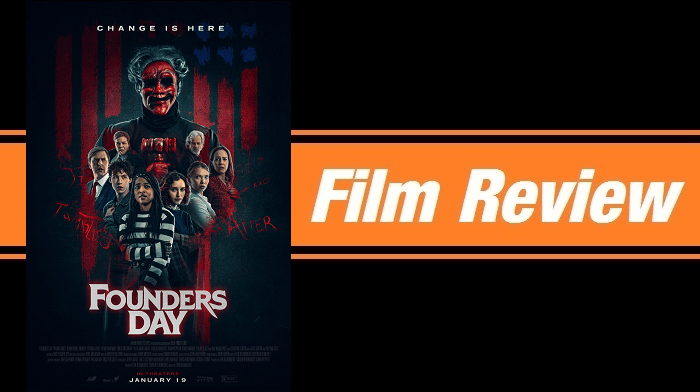
Director, co-writer, co-producer, co-editor, and co-star Erik Bloomquist is the man behind “Founders Day”, a new feature that can best be described as a political slasher film that plays a little like a whodunit but is at its best as a black comedy. It doesn’t all come together particularly well, but there are some good ideas scattered throughout and fans should find enough to carry them over till the next slasher comes down the pipe.

Bloomquist sets his film in the small town of Fairwood that’s in the middle of a heated mayoral race between incumbent Blair Gladwell (Amy Hargreaves) and challenger Harold Faulkner (Jayce Bartok). The two candidates seem to be lightly modeled after Hillary Clinton and Donald Trump (at least at first) which lends to some pretty good early laughs. Both are glaringly obvious phonies who have put winning above everything else including their community and their families.

Image Courtesy of Dark Sky Films

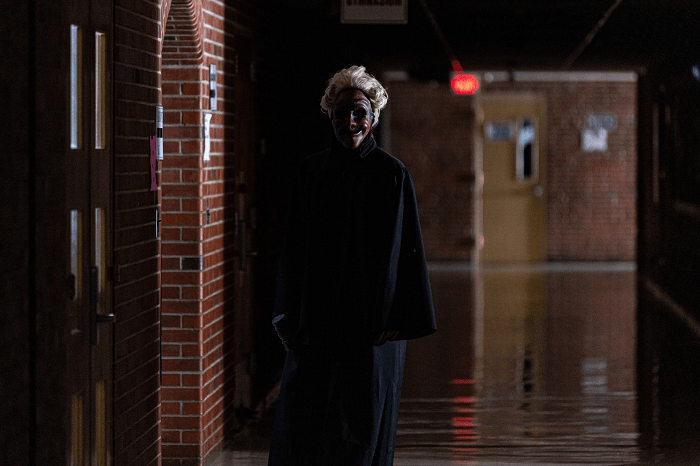
But Fairwood is rocked after Faulkner’s daughter, Melissa (Olivia Nikkanen) is brutally killed and thrown off a bridge by a preposterous looking killer who wears a ghoulish red mask, a white founding father’s wig, and a long black judge’s robe. The murderer’s weapon of choice – a wooden gavel with a protracting blade in the handle. From there (as you can probably guess), the killer sets out on their own blood-soaked campaign of carnage, terrorizing the little town and sending the people into a panic.

Among the things Bloomquist and his co-writing brother Carson do well is create a diverting assortment of characters. Inevitably some are just fodder for the killer to beat or butcher. Others are there to fill our pool of suspects. No one has much depth, but they all help convey the feeling of a small town community. Aside from the politicians, there’s also the police commissioner, a loyal deputy, an ambitious campaign manager, the local bartender, a beloved high school teacher, and a loving father and daughter (who seem to be the only Black people in town).

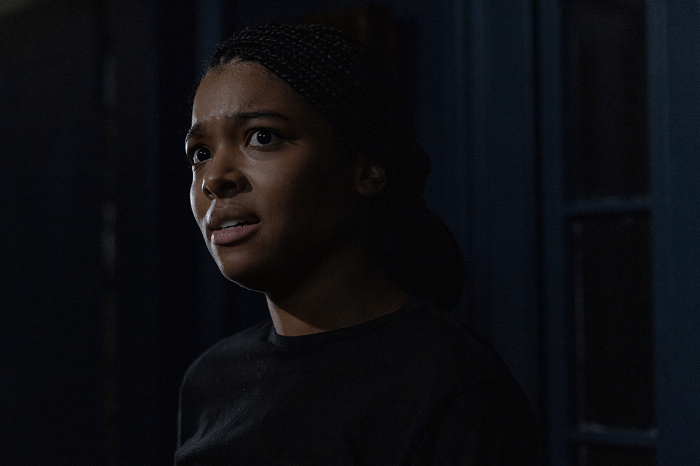
And of course there are the fresh batch of teenagers ready to be carved. Among them are the kids of the two candidates, both of whom are forced to take back seats to their parents’ ambitions. There is the Faulkner’s other kid, Adam (Devin Druid) and there is Mayor Gladwell’s daughter Lilly (Emilia McCarthy). Then there’s Allison (Naomi Grace) who was with Melissa the night she was murdered and the lone eyewitness. As for the other teens, there is a psycho couple (Dylan Slade and Kate Edmonds) and the town bad boy (Tyler James White).

Image Courtesy of Dark Sky Films

Along the way we get some utterly disposable teen drama that never registers and feels more like filler than anything else. But it doesn’t take the Bloomquists long to crank up the kills. They start rather tame but get gnarlier as the story progresses. As for the story, it’s pretty outrageous and culminates in an ending that’s too hard to swallow to have the effect it wants. Yet admittedly it’s kinda fun keeping up with the characters as Bloomquist moves them around from suspect to victim.

While it’s certainly a horror movie, “Founders Day” isn’t the slightest bit scary. But as fans of the slasher sub-genre know, it not necessarily the frights that people enjoy about them. It’s the gruesome kills, guessing the killer’s identity, seeing who survives, etc. “Founders Day” has all of that plus some unexpectedly funny touches of its own. But that’s as close as the movie gets to originality. If you’re looking for anything remotely fresh you won’t find it here. Otherwise, there’s enough bloody fun to satisfy the genre faithful.

VERDICT – 2.5 STARS

REVIEW: “Freud’s Last Session” (2023)

They had me at Anthony Hopkins. That’s all it took to grab my interest. Throw in that he’s playing Sigmund Freud opposite of Matthew Goode as C.S. Lewis and I’m utterly captivated by the possibilities. It has been said that revered neurologist and psychoanalyst Sigmund Freud met with a young, unnamed Oxford don shortly before his death. Was it C.S. Lewis? We will never know. The new film “Freud’s Last Session” poses the question “What if?”.

Based on the stage play of the same name by Mark St. Germain, “Freud’s Last Session” sees director Matthew Brown pondering a fictional meeting between the two intellectual minds. It couldn’t be better cast, with both Hopkins and Goode slipping right into the skins of their characters and creating a sparkling chemistry. When the two are together the film makes for a mesmerizing study. Unfortunately there are a few too many well-meaning distractions that keep it from fully forming into the brilliant two-hander it could have been.

Image Courtesy of Sony Pictures Classics

On September 3, 1939, only two days after Adolph Hitler’s German forces invaded Poland, a sickly Sigmund Freud sits in his London flat awaiting a special visitor. He has invited Oxford professor and Christian apologist C.S. Lewis to pay him a visit. Freud has taken issue with Lewis’ latest book, The Pilgrim’s Regress and is surprised that the young author agreed to come discuss his work. As Lewis makes his way to Freud’s home we get a glimpse of a London in chaos, as Hitler’s actions have put them on the precipice of a Second World War. That inevitability looms over much of the movie.

After some light greetings, Freud and Lewis begin to feel each other out, philosophizing about current events and sharing stories from their childhoods. Written by Brown and St. Germain, the story uses these early conversations and a few brief and well incorporated flashbacks to explore the two men’s backstories. We learn of Lewis’ time in the war and the PTSD that came from it. We hear Freud lamenting his beloved Vienna which he was forced to flee after the Nazi occupation.

But soon their discussions turns to debate as they get to the reasons for their meeting. The pair begin by challenging each other’s dramatically different worldviews, eventually arriving at their key point of disagreement – the existence of God. Freud denies God exists; Lewis begs to differ. The conversations that spring from it are fascinating. Brown and St. Germain put Lewis and Freud on equal footing, highlighting the strengths of their cases as well as their flaws as human beings. Those two elements factor into their positions in a number of intriguing ways.

Image Courtesy of Sony Pictures Classics

Much less effective is the side story involving Freud’s daughter, Anna (Liv Lisa Fries). It’s an element of the story that never comes together as the movie hopes and intends. And it’s too thinly sketched to be anything more than an unneeded diversion. Unfortunately Anna’s scenes devour too much of the running time and they repeatedly pull us away from the much more interesting Freud vs. Lewis parley.

Over time the distractions grow frustrating and they ultimately hinder “Freud’s Last Session” from being the thought-provoking drama it almost is. Much of what we get is truly great material and the performances from Hopkins and Goode are exceptional. The interactions between their characters range from funny to heartbreaking to profound. Brown never takes sides and shows respect to both men, allowing them to make their cases and defend their positions. That’s when the movie is at its very best. “Freud’s Last Session” is out now in select theaters.

VERDICT – 3.5 STARS

REVIEW: “Fallen Leaves” (2023)

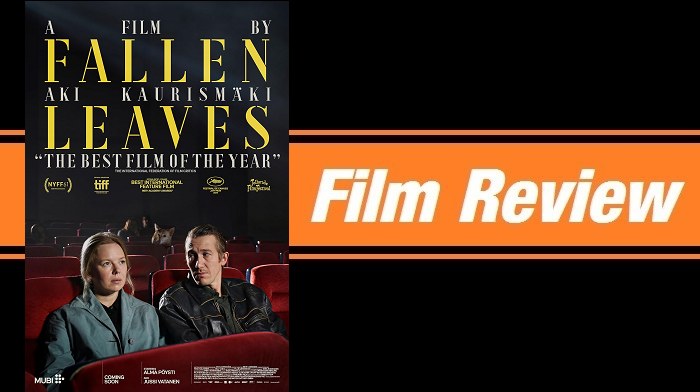
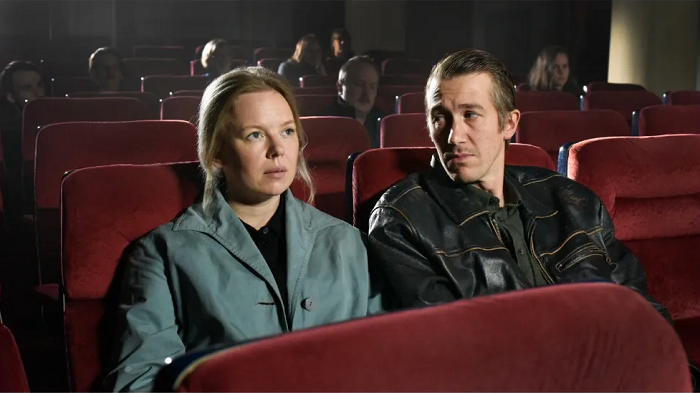
Finnish writer-director Aki Kaurismäki returns to the big screen for the first time since 2017 with his poignant working class tragicomedy, “Fallen Leaves”. It’s said to be a continuation of his Proletariat Trilogy which consisted of 1986’s “Shadow of Paradise”, 1988’s “Ariel”, and 1990’s “The Match Factory Girl”. Kaurismäki’s latest sees him once again melding deadpan drama, pinpoint humor, and warm humanism into something refreshingly classical and true to his form.

The imprints of Kaurismäki’s longtime influences (Yasujirō Ozu, Robert Bresson, Jean-Pierre Melville, etc.) are clearly seen in “Fallen Leaves”. He’s once again working within a familiar socioeconomic sphere – one frequently explored by contemporaries like the Dardenne brothers. And as you watch it’s easy to see why he’s often sited as an influence for filmmakers such as Jim Jarmusch and Wes Anderson. Yet despite all of these notable connections, Kaurismäki’s minimalistic and slightly enigmatic style remains distinctly his own.

Image Courtesy of Mubi

The auteur once again sets his story in Helsinki which he intentionally portrays as unromantically as possible. More intriguing is the mystery of the time period. News broadcasts reporting on the war between Russia and the Ukraine makes it feel very modern day. A calendar on a wall seems to indicate it’s set in the near future. But old corded phones, vintage tube radios, and even some clothing styles are evocations of times past.

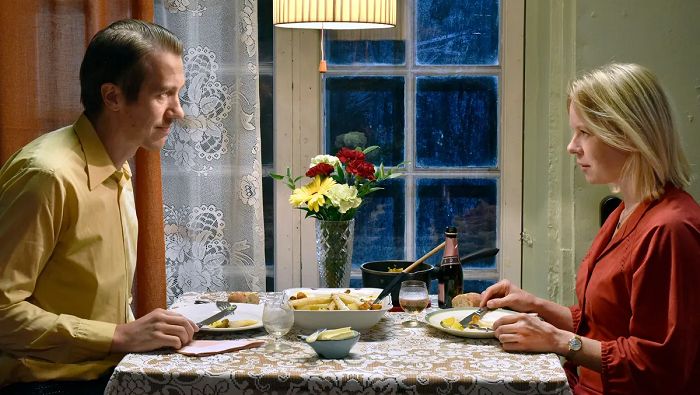
Kaurismäki plants our feet in a well-defined blue-collar sector of Helsinki. There we’re introduced to two people, both caught in the gears of a grinding, soul-crushing system that offers little empathy and no lifelines. Kaurismäki’s camera, often still and observing, gives us a good sense of the city’s harsh realities yet finds humor in the most unexpected moments. Even more, there is a surprising sweetness which plays out even as the cruelty of fate attempts to undermine it.

Ansa (Alma Pöysti) stocks shelves at a grocery store but is fired after taking an expired sandwich that’s about to be tossed in the dumpster. She gets a job washing dishes at a pub but loses it after the owner is busted for dealing drugs. So she ends up on a factory floor, barely making enough to get by in the tiny one-room apartment she inherited from her family.

Holappa (Jussi Vatanen) is a construction worker stuck in a low-paying job, but one that allows him to live in a worksite trailer with his friend, Hannes (a terrific Janne Hyytiäinen playing a self-deluded ladies man and karaoke virtuoso). But Holappa compounds his already difficult circumstances with his heavy drinking, which is both a cause and a result of his reoccurring depression.

Image Courtesy of Mubi

Ansa and Holappa eventually cross paths and a relationship soon forms between the awkwardly quiet pair. It starts as a cup of coffee and progresses to a movie (our deadpan daters go see Jarmusch’s zombie comedy “The Dead Don’t Die” to which Ansa seriously but hilariously utters “I’ve never laughed so much.”). But a few unfortunate blunders, such as not sharing their names and losing phone numbers, threaten to derail this budding romance. Yet again it seems as if fate is working against them.

Along with the delightfully dry humor, delicate emotions, and bittersweet romance, there’s also a subtle but steady undercurrent of critique from a filmmaker who has often spoke up for the disaffected and marginalized in his native Finland. As with Kaurismäki’s other films, his perspective is clear but never overbearing or intrusive. And when combined with his wry and often melancholic tenor, it conveys a clear message within an otherwise placid and transcendent love story.

VERDICT – 4.5 STARS

REVIEW: “Ferrari” (2023)

Among the more exciting announcements regarding the 2023 movie year was that Michael Mann was returning to the director’s chair after over eight years away. The 80-year-old filmmaker, producer, and author has been behind some of my favorite movies including “Thief”, “The Last of the Mohicans”, “Heat”, “The Insider”, and “Collateral”. Now he’s back with a new film that’s significantly different from any of those highly-acclaimed gems.

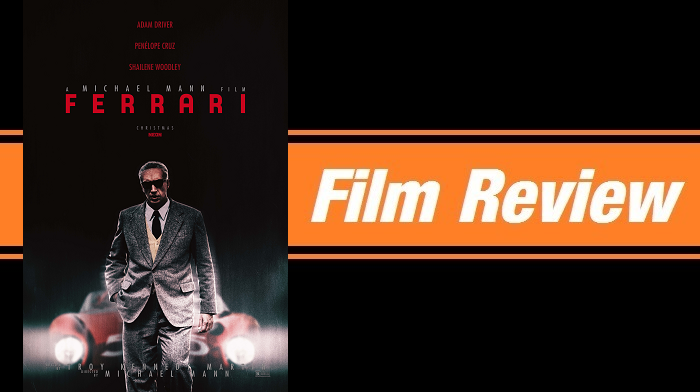
As its name makes obvious, “Ferrari” is a biographical drama about Enzo Ferrari, the founder of the luxury sports car manufacturer that bears his name. The film is based on a 1991 biography by journalist Brock Yates. Mann and the late screenwriter Troy Kennedy Martin wisely narrow their focus to a certain turbulent time in Enzo’s life – one marked by unbridled ambition, dark secrets, and tragedy. It’s more of a snapshot bio than a cradle-to-grave account which ends up serving this particular story perfectly.

The film is set during an eventful three months in 1957. Ten years earlier, racer turned automaker Enzo Ferrari (played by a terrific Adam Driver) and his wife Laura (an equally great Penélope Cruz) launched their car business in post-World War II Italy. But sales of his high-end sports cars are down and the business it is under the threat of bankruptcy. Enzo needs to sell more cars, but to do so requires the help of outside investors.

Image Courtesy of NEON

But just as much of the story (if not more) revolves around Enzo and Laura’s crumbling relationship. We see that their once loving marriage has soured, even turning volatile following the devastating death of their son Dino only one year earlier. Both are still mourning. But they’ve drifted too far apart to be of any comfort to each other. Instead their loss only fuels the growing animosity between them.

To make matters worse, Enzo has a side dish, Lina (played by Shailene Woodley whose on-again, off-again accent is both puzzling and kinda funny). Enzo keeps his mistress comfortably tucked away in a country chateau with their young son and eventual Ferrari heir, Piero. Laura knows of her husband’s dalliances and has even come to accept them (though with growing animus). But Enzo has kept his second family hidden, that is until Laura gets a whiff of his secret life. Does she use the revelation as leverage or does she poor out her vengeance and crush him?

Enzo is a person of contradiction and complexity which Mann impressively uncoils through his business life as much as his personal life. Though things are secretly imploding at home, the public sees Enzo as a national treasure – “a jewel in the crowd of Italy”. He’s a celebrity magnate who makes world-renowned cars that many admire but few can afford. Yet it’s not notoriety or esteem that drives him. It’s racing, and that’s what he determines to use to save his namesake company.

Enzo puts together a crack team of drivers that includes Spaniard Alfonso de Portago (Gabriel Leone), Englishman Peter Collins (Jack O’Connell), and fellow Italian Piero Taruffi (Patrick Dempsey in a wily bit of casting). He enters them into the prestigious Mille Miglia, a treacherous 992-mile open-road endurance race across Italy. Win the Mille Miglia and he’s sure to gain the attention of potential investors.

Image Courtesy of NEON

That builds to the film’s exhilarating final act where Mann’s technical knowhow shines. The racing of the Mille Miglia is as beautiful as it is thrilling with Mann and DP Erik Messerschmidt masterfully incorporating weaving cameras, intense closeups, and gorgeous wide shots to capture a palpable sense of speed and danger. It’s a spectacular display of craftsmanship that will have you holding your breath in anticipation one minute and gasping in horror the next.

To no surprise Adam Driver gives a rich and charismatic turn that sheds a revealing light on a man of many layers. With his combed-back silver hair, finely tailored suits, and stylish black sunglasses, Driver brings gravitas to the part. But it’s the way he conveys what’s lingering just under the surface that makes the performance so compelling. And Penélope Cruz matches him scene for scene. Her Laura is a torrent of emotions, understandably hurt and rightly angry. But she’s also smart and savvy – characteristics that are often hidden under her pain but that eventually burst through in a big way.

Those familiar with the 1957 Mille Miglia race will have a good idea of where the movie goes. But beyond that Mann and Martin surprise us with a unexpectedly heartfelt finish that puts a bittersweet cap on what is largely a heady, well-written drama. Mann has been trying to make this film for over two decades and you can feel his passion. You can also see the creative freedom that allowed him to take an unconventional and at times bold look at such a complicated and fascinating figure.

VERDICT – 4.5 STARS

REVIEW: “Five Nights at Freddy’s” (2023)

Though many do, I have no real investment in the popular video game series ”Five Nights at Freddy’s”. I’m familiar with the game and even gave it a shot. But it didn’t stick with me. That being said, the series (created by independent game developer Scott Cawthon) has quite the following and frankly it’s easy to see why. ”Five Nights at Freddy’s” had a neat premise which has translated into a successful multimedia franchise.

A big screen adaptation has been in the works for some time but ran into numerous delays for (of all things) script issues. And as it turns out the film’s biggest issue is indeed its script. Written by the trio of Cawthon, Seth Cuddeback, and director Emma Tammi, ”Five Nights at Freddy’s” (the movie) is a classic case of getting so carried away with other things that you shortchange what people are coming to see. More specifically, it gets bogged down in bland uninteresting drama rather than delivering the wacky animatronic horror it advertises.

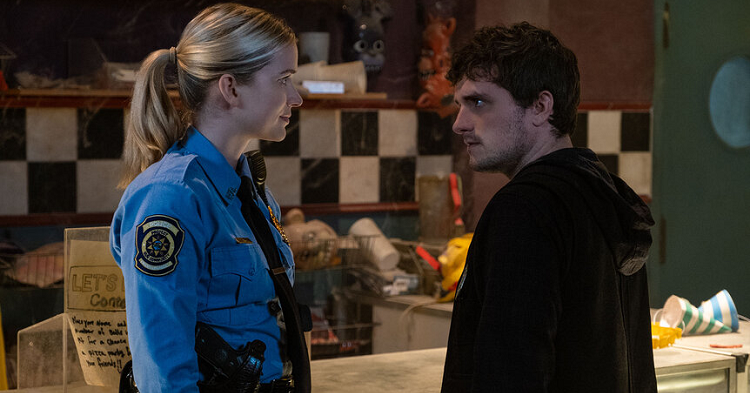
Josh Hutcherson has the unenviable task of playing Mike Schmidt (not the ballplayer), a down on his luck mall cop who can’t catch a break. He can’t lock down a good job and he’s struggling to support his kid sister Abby (Piper Rubio), especially with his vulture of an Aunt (Mary Stuart Masterson) breathing down his neck. Things only get worse after he’s fired from the mall. Suddenly he finds himself in a desperate situation.

Image Courtesy of Universal Pictures

Just when all hope seems lost, Mike’s career counselor (Matthew Lillard) tells him about a job opening. It’s for a nighttime security guard position at Freddy Fazbear’s Pizza Place. Once huge in the 1980s, Freddy’s has been shut down for years. But the sentimental owner can’t bring himself to have it demolished. The job description sounds pretty simple. “Just keep your eyes on the monitors and keep people out. Piece of cake.”

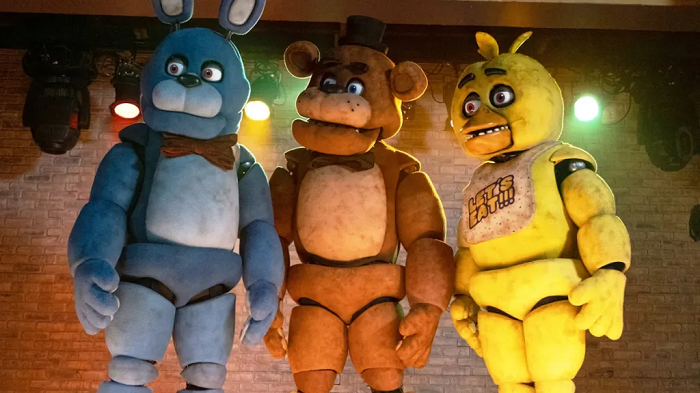
Despite the bad hours and even worse pay, Mike takes the job. And as you can probably guess, the job isn’t as simple as it sounds. You see, at night the Pizzeria’s old animatronic mascot Freddy the Bear and his robotic friends (a rabbit named Bonnie, a chicken named Chica, and a fox named Foxy) come to life and roam the premises. And they don’t take kindly to trespassers, even those paid to watch over the place.

So as you can see, it’s a pretty silly concept. But it’s just the kind of material that would make for some fun, outrageous, and completely self-aware B-movie schlock. Unfortunately the filmmakers lead the movie down a much different (and frankly ill-advised) path. They try so hard to be something else by spending an unfortunate amount of time on Mike’s family struggles. We even get this weird quasi-supernatural detective angle where Mike keeps revisiting the same childhood dream in hopes of finding clues to help solve his brother’s kidnapping from years earlier.

Image Courtesy of Universal Pictures

One thing the movie gets right is the atmosphere. From the crackle of neon lights to the dust-covered remnants of the once popular family eatery, the movie’s attention to detail makes Freddy’s a genuinely spooky place at night. And fans of the game will find all sorts of cool nods and Easter eggs scattered throughout it. This is by far the film’s biggest strength which is why it’s so frustrating that we spend so much time away from there.

Another gripe had to do with the film’s rating. Without question the movie’s PG-13 rating is going to help it at the box office. But I can’t help but think about how much gonzo gory fun could have been had if Tammi was allowed to really go for it. Instead we get the camera constantly turning away just as someone is about to get their’s. Again, it’s a choice that should make the film more money. But oh what could have been.

Yet if I were to guess, I’d bet franchise fans are going to find a lot to enjoy in “Five Nights at Freddy’s”. The story behind what’s going on in the pizzeria is preposterous and doesn’t always make sense. But the setting is both creepy and nostalgic (for anyone who grew up loving Showbiz Pizza) and the animatronic antagonists are hilariously effective. I’m guessing it will be a little tougher for those with no connection to its video game inspiration. They’ll (understandably) want more than a good setting. And unfortunately “Freddy’s” doesn’t have much more to offer. “Five Nights at Freddy’s” is in theaters now.

VERDICT – 2 STARS

REVIEW: “Flora and Son” (2023)

The pointedly titled “Flora and Son” couldn’t be more straightforward. This confounding musical dramedy is every bit about a single mother named Flora and her rebellious 14-year-old son Max. Or is it? Set and filmed in Dublin, the story follows the pair’s strained relationship and shows how music unexpectedly ends up being the balm that heals their deep emotional wounds. It sounds sweet. But there are moments when the movie is anything but.

“Flora and Son” is the latest from writer-director John Carney. It’s his long awaited follow-up to the terrific “Sing Street”. The film builds itself around a heartfelt premise and it’s driven by a brilliant performance from Eve Hewson. It’s a movie that certainly has its funny exchanges and touching moments. But no matter how hard Carney tries, his latest effort is never as emotionally satisfying or infectiously charming as his 2016 gem.

Image Courtesy of Apple TV+

Interestingly, it’s almost like “Flora and Son” is ashamed of what it actually is. You can see it working hard to not be viewed as a feel-good crowdpleaser by tossing in loads of salty language and by creating characters who teeter between sympathetic and insufferable. On the surface that might sound like a petty gripe. But it’s a problem that goes beyond mere movie optics. It impacts how we respond to the story and even the characters themselves.

Take Flora, played by an effortlessly great Hewson. It’s clear she’s intended to be a sympathetic and funny character. But too often Carney goes for cheap laughs by writing her as needlessly crude as possible. And while her son Max (played by a somewhat monotone Orén Kinlan) is ungrateful and disrespectful, Flora is routinely hateful and verbally abusive. Although I’m not sure that’s how the movie wants us to see her – it’s hard to tell.

As for the story, it’s about music mending the toxic relationship between a mother and son. After Max has yet another run-in with the law, the police encourage Flora to find her son a hobby – something to keep him from blowing his last chance to stay out of juvie. While walking home Flora finds an old beat-up acoustic guitar which she gives to Max. But after he shows no interest, she picks it up. And with the help of online guitar sessions from a washed-up musician from Los Angeles named Jeff (a terrific Joseph Gordon-Levitt), Flora finds unexpected joy in making music with her hunky new teacher.

Flora’s newfound interest in music opens her eyes to Max’s desire to be a rapper and DJ. The inevitable come-together moment that follows is a little too tidy and Carney passes on some emotional complexities that would have given him the chance to explore some interesting ground. Still Hewson earns our investment, especially in her scenes with Gordon-Levitt. I just wish the rest of the movie worked as well as their scenes do.

Image Courtesy of Apple TV+

Perhaps it’s unfair to keep bringing up “Sing Street”, but one of its biggest strengths was the original music from Carney and Gary Clark. The two collaborate again although none of these original songs leave much of an impression. Hewson and Gordon-Levitt have a good musical moment together yet it’s nothing as catchy as some of the tunes Carney and Clark have created in the past.

Perhaps most frustrating is how the mother-son relationship (which should be the heart of the movie) often gets back-burnered for Flora’s cutesy online coquetry with Jeff. They end up feeling like two competing storylines rather than combining into something more organic and cohesive. That’s a shame. Overall, “Flora and Son” left me longing for the movie it almost was. “Flora and Son” is streaming now on Apple TV+.

VERDICT – 2 STARS