
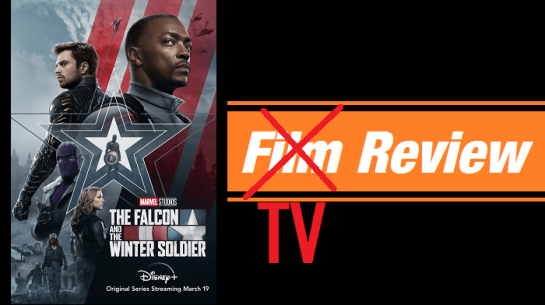
Just so you know where I’m coming from, Captain America has always been my favorite Marvel superhero and not just during his run in the Marvel Cinematic Universe. Long before Marvel Studios started raking in billions of dollars at the box office, I was enthusiastically following Captain America’s comic book adventures, both as the head of the Avengers and out on his own. So naturally a series set in his world and featuring characters inextricably linked to him is going to appeal to me and a number of other enthusiastic fans.
The recently wrapped Disney+ series “The Falcon and the Winter Soldier” is another solid MCU entry but one (much like “WandaVision”) with its own unique set of issues. On the plus side, the series pulls both characters and storylines from Cap’s lengthy comics history and brings back some familiar faces from his three movies (among the best of the MCU). And with a hefty $150 million budget and the full backing of Marvel Studios, the series has a legitimate big screen look and feel to it. On the negative side, there are kinks in the storytelling due to its episodic constraints and some erratic pacing that showrunner Malcolm Spellman never quite irons out.
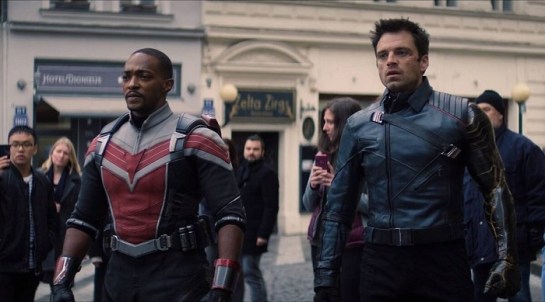
Image Courtesy of Marvel Studios
One of the biggest strengths of the six-episode series is that it finally brings some much-needed depth to two of Captain America’s most essential characters. James “Bucky” Barnes, aka the Winter Soldier (Sebastian Stan), did have a big part in the Cap films but wasn’t much of a factor in “Infinity War” of “Endgame”. Sam Wilson, aka the Falcon, (Anthony Mackie) got even less screen time and was a character in desperate need of some attention. This series not only opens Sam up, but (much like Wanda in “WandaVision”) moves him to a pretty prominent position within the greater MCU.
The series opens with an interesting mix of blockbuster quality action scenes and intimate character building. Both are welcomed features even if they don’t exactly gel together that well. The first episode dives into Sam’s backstory while highlighting his struggle with self-assurance. It ends with the introduction of John Walker (Wyatt Russell), the new government sanctioned Captain America and a character most Cap comic fans will recognize. Then we get the puzzling second episode, a messy blend of action, character introductions, some heavy-handed social commentary, and attempts at humor that seem out of place. It does end with a bang with Daniel Brühl’s return as Baron Helmut Zemo.

Image Courtesy of Marvel Studios
This launches the series into the type of show most of us were waiting for. Zemo forced to help Bucky and Sam; the reemergence (yea!!!) of Sharon Carter (Emily VanCamp); a mysterious crime lord known as the Power Broker; John Walker slowly losing his grip. There’s also a terrorist group called the Flag Smashers led by Karli Morgenthau (Erin Kellyman). You get the sense that we’re supposed to have some level of sympathy for them, but it’s hard when they’re willfully bombing buildings and killing civilians. There are several other unexpected surprises, but through it all the story stays focused on Sam and his journey towards believing in himself and accepting the path in front of him.
There are quieter moments where the series steps away from terrorist attacks, infighting, and globetrotting. Such as when we meet Isaiah Bradley (Carl Lumbly). His introduction is botched in episode two, but we see him later in a complicated yet powerful scene. In it, the reasonably embittered Isaiah shares his dark past with Sam, lamenting that there will never be a black Captain America while also declaring that no self-respecting black man would ever want to carry the shield. Inspired by the 2003 seven-issue limited series “Truth: Red, White & Black”, it’s a heartbreaking picture of someone so pained by the wounds of injustice that he can’t see the possibility of a better tomorrow.
Despite its structural and tonal issues, there is still a myriad of cool and compelling moving parts. So many that you start to wonder if Spellman can bring it all to a fitting conclusion. Well yes and no. The final episode is best defined as serviceable, one with some genuine high points but also some head-scratching missteps which in a way epitomizes the series as a whole. This is clearly Sam’s episode and he is given plenty of moments to shine. It’s really nice to see. Mackie has reached the point where he is in-tune with every facet of his character, but even he can’t save every scene. A glaring example is Sam’s well-intended yet painfully contrived monologue that runs nearly five minutes. It’s so overwritten and woefully on-the-nose.

Image Courtesy of Marvel Studios
It’s also a bummer that Bucky eventually falls by the wayside and becomes much more of a supporting character by the last episode. I get this is ultimately Sam’s show, but with his name literally stamped in the title you would expect there to be a little more to Bucky’s story. Yet it’s almost as if Spellman either lost interest or lost ideas. In fact Sam and Bucky barely have any meaningful scenes together in the finale. Back on the positive side, the final episode does give key players like Sharon, John Walker, and even Zemo chances to leave some important marks on the MCU
“The Falcon and the Winter Soldier” may not have the most seamless story or the smoothest storytelling. It may be a tad too ambitious for its small six-episode frame. It may lack nuance with a lot of its messaging. At the same time it’s hard not to appreciate most of what it’s going for – the buddy movie vibe, the eye-popping action, the wonderful array of supporting characters, its deep social conscience, its darker edge, and a beguiling Daniel Brühl. I still don’t think Marvel Studios has fully figured out episodic television, but you wouldn’t know it by the numbers. All six episodes are now streaming on Disney+.
VERDICT – 3.5 STARS











 Keith & the Movies