REVIEW: “The Greatest Beer Run Ever” (2022)

After four years, director Peter Farrelly returns to the big screen for the first time since winning the Best Picture Oscar for 2018’s “Green Book”. While it might not have been Best Picture material (whatever that even means), “Green Book” was an earnest, big-hearted crowdpleaser that infuriated many who took the film (and awards shows in general) too seriously. It had its flaws, but it also had its charm.

Farrelly’s follow-up, “The Greatest Beer Run Ever” features some of the same ticks that both helped and hurt “Green Book”. It’s sincere, mainstream, feel-good entertainment. But it also keeps so much on the surface, rarely (if ever) digging into the themes it introduces. The movie has a good message, several of them in fact. But the screenplay (co-written by Farrelly, Brian Currie, and Pete Jones) bluntly conveys them rather than explore them which is sure to push away those looking for something deeper.

Based on an inconceivable true account, “The Greatest Beer Run Ever” tells the story of John “Chickie” Donohue (played by a mustachioed Zac Efron, packing his signature goofiness and charm). Set in 1967, Chickie Donohue is a thick-headed merchant marine who still lives with his parents in Inwood, a tight-knit neighborhood in northern Manhattan.
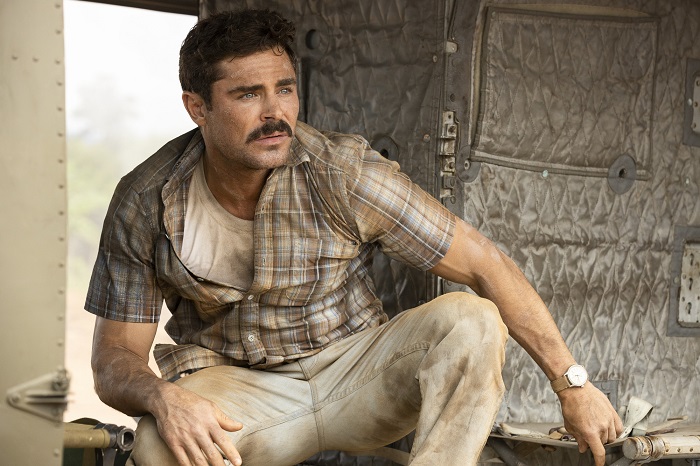
Image Courtesy of Apple TV+

While many local boys are off fighting in Vietnam, Chickie and his gaggle of drinking buddies spend most of their time hanging out at a bar owned and ran by the Colonel (a fantastic Bill Murray). Collectively, the group sits around declaring their unwavering support of the war even though they can’t really articulate what America is fighting for (certainly it’s something to do with those dang “Commies”). But with eight kids from their neighborhood already killed in action and a ninth just declared MIA, their blind allegiance is a tough sell.

On the other side is Chickie’s sister Christine (Ruby Ashbourne Serkis) who’s heavily involved in war protests which he believes dishonors the troops. So Chickie and his pals from the pub hatch a wild-haired idea – one rooted in mind-boggling naivete. Wouldn’t it be great if someone from back home went to Vietnam and surprised the neighborhood boys still fighting with an ice-cold beer? What better way (in their minds) to support the troops? And who better to carry out such a cockamamie plan than Chickie?

While Chickie’s appreciation for the troops is sincere, he’s just as much about showing he’s not a flake. None of his friends or his family expect he’ll REALLY go over to Vietnam. After all, he has a reputation for not going through with his ideas. Convicted over his inaction and determined to prove that everyone’s wrong about him, Chickie stuffs a bottomless duffel bag with cans of Pabst Blue Ribbon and hops a cargo ship bound for Vietnam. Two months and 10,000 nautical miles later he arrives in Vietnam and begins his improbable beer run across a war-torn country.

After firmly establishing Chickie’s ignorance of the world around him, Farrelly spends the rest of the film opening the eyes of our well-meaning yet gullible dope. Much of what he learns comes from the assortment of people he encounters. There’s Arthur Coates (Russell Crowe), a cynical but realistic war correspondent for Look Magazine. There’s “Oklahoma” (Kevin K. Tran), a local traffic cop he befriends in Saigon. And there’s the hysterical Lieutenant Habershaw (Matt Cook) who’s convinced Chickie is an undercover CIA agent.
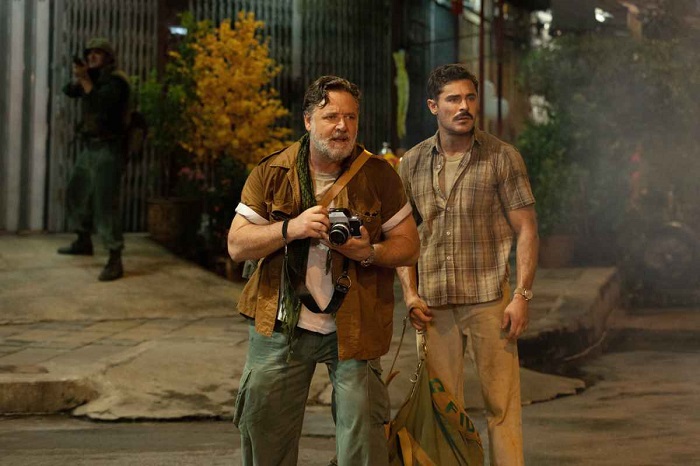
Image Courtesy of Apple TV+

But Chickie’s biggest reality checks comes through his unexpected face-to-faces with war itself. Such as when he dupes his way to the front-line to see his buddy Duggan (Jake Picking). Or when he gets caught up in the Tet Offensive. These scenes stretch the bounds of plausibility, yet they offer several sobering moments for Chickie and us. It all comes down to how much you buy into both Chickie and his outlandish odyssey. Efron’s multilayered performance is convincing even when the storytelling isn’t. And while it’s hard to buy some of the liberties Farrelly and company take, Efron ensures we never doubt Chickie or his motivations.

There’s one hilariously delivered line of dialogue that perfectly sums up Chickie’s crazy venture, “It may be idiotic”, says one character, “but it’s a noble gesture.” The movie agrees. Farrelly makes no attempt to hide the absurdity of Chickie’s idea or the crazy way he pulls it off. But it does recognize Chickie’s heart and his transformation from a naive and credulous lunkhead to an informed and contrite lunkhead. Ultimately that worked for me.

At times Farrelly’s pacing feels too rushed, and the tone-hopping can be distracting. Also, his attempt at connecting the fractured country then to our current climate of divisiveness doesn’t quite land. Still, I love the intent and the optimism behind its overarching message. Efron continues to grow on me as an actor, there are a few good laughs, and several of the more sobering moments have the desired emotional impact. It’s probably too much to juggle in one movie, but Farrelly keeps it all together and makes an utterly preposterous true story resonate in ways I wasn’t expecting. “The Greatest Beer Run Ever” opens tomorrow (Sept. 30th) in select theaters and streams on Apple TV+.

VERDICT – 3.5 STARS

REVIEW: “Goodnight Mommy” (2022)

In the opening scene of the new film “Goodnight Mommy” we see a father (Peter Hermann) drop off his twin sons Elias and Lukas (Cameron and Nicholas Crovetti) at their mother’s middle-of-nowhere modernist home. We pick up on several things in these early moments. It’s clear the mother and father are separated. It’s equally clear that the boys haven’t seen their mother in a while. So as the dad drives away, Elias and Lukas scamper inside to find their ‘mommy’. What they discover is alarming to say the least.

The brothers find their mother (Naomi Watts) and are surprised to see her entire face covered in bandages. She explains it’s the result of a recent cosmetic surgery and that she just needs time to heal. The three sit down and their mother lays down a few house rules. Some are pretty normal (no running or shouting in the house, stay out of her office, etc.). But some will automatically set off alarms for any well-versed horror/thriller fan (keep the blinds closed, sunlight is bad, stay out of the barn, etc.).

Directed by Matt Sobel and written by Kyle Warren, “Goodnight Mommy” is a remake of a 2014 Austrian film of the same name. I haven’t seen the original, but many have praised it as dark, disquieting psychological horror. Obviously I can’t compare the two, but this new “Goodnight Mommy” didn’t quite grab me that way. It’s not that it’s a bad film. In fact it wastes no time building up some pretty good suspense. And it’s helped by Watts who (to no surprise) delivers a solid performance despite a script that does her no favors.

Image Courtesy of Amazon Studios

As the tender Elias and the more rambunctious Lukas spend more time with their mother, they start to notice unusual behavior. She’s colder and more distant. She’s quick tempered and snaps at the boys for the smallest things. But things only get worse, and soon Elias and Lukas come to a startling conclusion. They convinced that the woman under the heavy gauze is not their mother.

That’s a really good setup with loads of potential. And there are plenty of ways to squeeze some good tension out the premise. But unfortunately things start to deflate in the second half as the movie struggles to keep its early momentum. Even worse, the story’s big twist becomes obvious well before it’s revealed. And that turns out to be a killer, zapping the movie of any tension and suspense. And with the exception of one lone delightfully terrifying scene, finding anything resembling a fright or a thrill proves to be a chore.

Again, I haven’t seen the original “Goodnight Mommy”, but this English-language update plays like a more sanitized version – one that lacks the guts to really take this story to darker and more unsettling places. In fairness, by the end it makes sense why things aren’t quite as twisted and deranged as they could’ve been. But that doesn’t change the experience of watching the film, especially the second half which desperately needs a kick. “Goodnight Mommy” is now streaming on Amazon Prime Video.

VERDICT – 2 STARS

REVIEW: “Gigi & Nate” (2022)

(CLICK HERE for my full review in the Arkansas Democrat-Gazette)

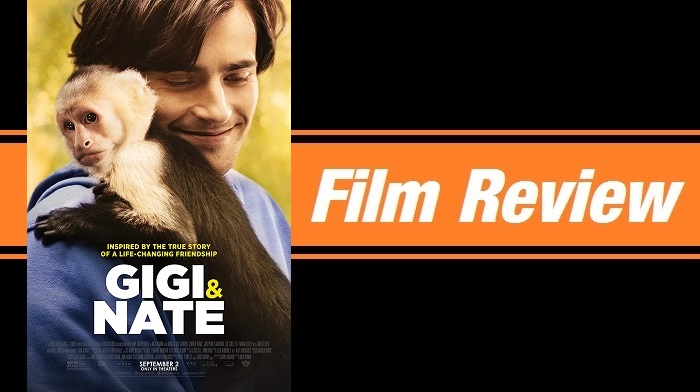
The new feel-good drama “Gigi & Tate” taps into that well-worn but tried-and-true ‘a boy and his dog’ formula. Except this time it’s a boy and his capuchin monkey. Directed by Nick Hamm from a script by David Hudgins, “Gigi & Nate” tells the touching true story of an unexpected friendship and shows how it saved a young man’s life and brought a hurting family together following a devastating tragedy.

Charlie Rowe plays 18-year-old Nate Gibson who we first meet only a couple of weeks before he’s to head off for college. He has big plans and a bright future ahead. That is until his life is forever changed. Nate contracts bacterial meningitis after cliff diving. Nate is med-flighted to a hospital in Nashville, Tennessee where his parents, Claire (Marcia Gay Harden) and Dan (Jim Belushi) and his two sisters, Katy (Josephine Langford) and Annabelle (Hannah Riley) are given some heart-shattering news.

Image Courtesy of Roadside Attractions

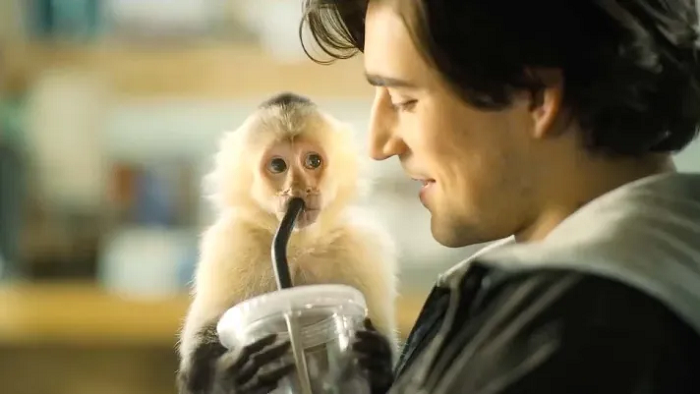
The movie leaps ahead four years where we learn Nate is a quadriplegic. Confined to a wheelchair and spiraling into depression, he finds solace in a capuchin monkey named Gigi. She was rescued from an abusive petting zoo in California and nurtured and trained to be a service animal. After some initial hesitation (by both Gigi and some of his family) Nate and the pint-sized primate bond. They develop a tender relationship that not only helps Nate and his outlook on life, but helps bring a splintering family back together.

But these days it seems like we always have to have an antagonist. Here we get it in the form of an absurdly one-note animal rights activist named Chloe Gaines (Welker White). She heads a group called Americans for Animal Protection, and she immediately puts Nate and Gigi in her legal crosshairs. The second half of the movie gets bogged down in their room-temperature conflict that includes a laughably phony protest sequence outside the Gibson’s home and some tensionless courtroom drama.

The clunky storytelling doesn’t exactly help things. The movie tends to skimp on details, often bypassing opportunities for some good character building. For example, there’s an early scene where we seen Nate in such a bad state of mind that he attempts to take his own life. But less than a minute later we see him at a service animal training facility, smiling and eager to meet Gigi for the first time. There’s not a single scene devoted to showing how Nate went from completely broken and suicidal to optimistic and excited. It turns out to be a reoccurring frustration.

While it’s hard not to take note of the Gibson family’s wealth, Hamm and Hudgins do a good job of helping us see the people beyond the privilege. The filmmakers put in the effort to connect us with this tight-knit family as they each try to cope with Nate’s condition in their own ways. As with other story elements, sometimes the movie breezes past opportunities to make this family dynamic even richer. But as a whole, we get a good sense of who these people are and of their efforts to recover individually and collectively.

Image Courtesy of Roadside Attractions

And then there’s Gigi. She’s brought to life by blending the work from a real capuchin monkey named Allie with digital effects. Of course we get a few saccharine scenes of animal cuteness meant to melt our hearts. But as a whole, the filmmakers use Gigi smartly and to great effect. She plays a pivotal part, not just in realizing the story, but in opening up a number of themes the movie is interested in. She too ends up undercut by some of the second-half sloppiness. But as animal portrayals go, Gigi is used well and has an undeniably heartwarming presence.

I can’t say enough about the movie’s message of hope and triumph. I love what it says about coping with tragedy and overcoming adversity. Yet while “Gigi & Nate” is full of compelling themes and scenes that are tender and earnest, it’s hampered by some nagging frustrations that make it hard to focus on the more meaningful moments. The corny villain angle, the jolts in the pacing, some wobbly performances – they pulled me out of a movie that really hinges on our emotional investment. “Gigi & Nate” is out now in theaters.

VERDICT – 2 STARS

REVIEW: “The Good Boss” (2022)

(CLICK HERE to read my full review in the Arkansas Democrat-Gazette)

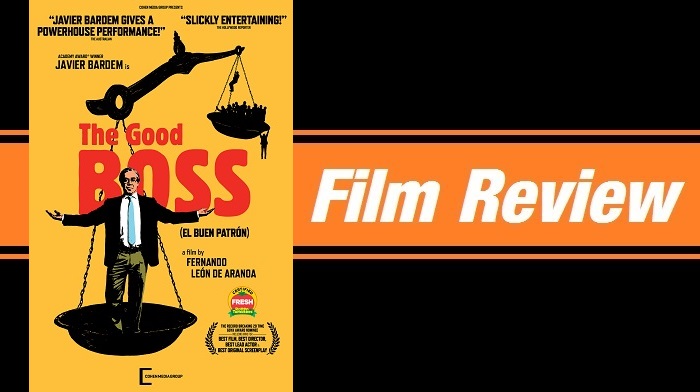
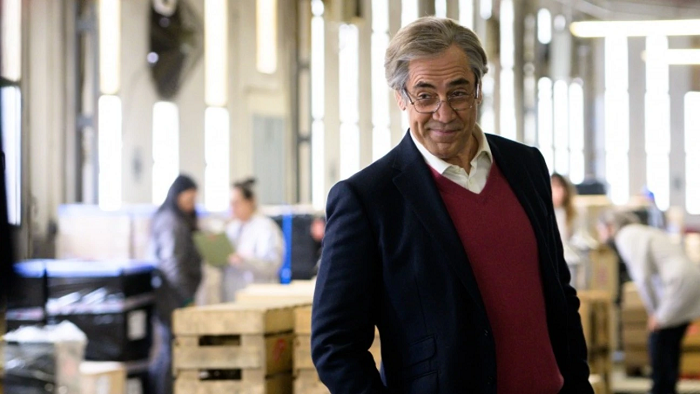
Writer-director Fernando León de Aranoa’s biting anti-corporate satire “The Good Boss” is the kind of movie that can have you snickering one minute and squirming the next. It’s a dark workplace comedy with a subtle edge; one driven by a tour de force performance from Javier Bardem, whose smooth-talking charisma-rich presence turns megalomania, duplicity, and self-serving passive-aggression into a captivating image you can’t turn away from. It’s some of the 53-year-old Oscar winner’s best work.

While Bardem is undeniably magnetic, just as key to the movie’s success is de Aranoa’s cracking script. With its many side characters and smorgasbord of sub-plots, there are so many ways this could have turned messy. But de Aranoa has such a firm and confident control of the material. It’s nicely paced; it has a near perfect balance of storytelling and character development; and the subtle shots of humor often come from the most hilariously unexpected places. Most importantly, the story maintains a remarkably tight cohesion throughout. Not easy for a movie with this many moving parts.

Image Courtesy of Bright Iris Film Co.

The story revolves around Julio Blanco (Bardem), the titular head of Blanco Scales. It’s a mid-sized company he inherited from his father that makes and sells weight scales of every shape and size (the richness of that reoccurring metaphor is impossible to miss). Along with his wife Adela (a really good Sonia Almarcha) who runs her own fashion boutique, the two are a working couple who never had children. Instead, Blanco claims his employees as his “children” to the point of frequently involving himself in their personal lives.

In reality, Blanco uses his “One Big Family” spiel as a tool to manipulate and control his workforce. Some see through his fatherly ruse and have learned how to manage it. Others fall victim. Take Jose (Óscar de la Fuente), a disgruntled former employee (and perpetual thorn in Blanco’s side) who sets up camp on a splotch of public land near the factory’s main entrance to protest being laid off. Or the string of young female interns who Blanco is quick to bring onboard and even quicker to replace once he’s had his way with them. So the irony in the movie’s title is pretty glaring.

Blanco’s company is one of three finalists for a prestigious industry award which he desperately wants to win. Winning would secure some much-needed subsidies, but deep down it’s all about the glory. Ever the narcissist, Blanco craves the adulation, and he even has a trophy wall which the film routinely cuts back to, highlighting the empty space that he has already prepared. And with the awards committee set to make a surprise visit, Blanco wants to make sure everything at the factory is in top form. Of course that proves to be easier said than done.

The bulk of the film follows Blanco’s attempts at managing his employees and their range of problems (many of which he is directly or indirectly responsible for) before the awards committee shows up. Days serve as chapters, starting on a Sunday, and the story moves throughout the week chronicling the growing workplace and personal drama.

Image Courtesy of Bright Iris Film Co.

Along the way we’re introduced to a fun array of surprisingly layered supporting characters. There’s Blanco’s oldest friend and the company’s Head of Production Miralles (Manolo Solo), his handyman and jack-of-all-trades Fortuna (Celso Bugallo), his dutiful second in command Rubio (Rafa Castejón), his factory’s front gate security guard Román (Fernando Albizu), an ambitious floor worker Khaled (Tarik Rmili), and a young marketing intern, Liliana (Almudena Amor) who proves to be more than some new flavor of the month. The more Blanco meddles in their lives the more complicated things get and his paternal charade quickly starts to crumble.

That may not sound like the most compelling story, but don’t be fooled. Even at two hours, “The Good Boss” keeps you locked in thanks to its whip-smart script and a powerhouse Javier Bardem lead performance. Again, this is some of his best work, and he takes this rich character and embodies him to the fullest. And Fernando León de Aranoa clearly knows what he has in Bardem and gives the actor the material he needs to vividly bring Blanco to life. De Aranoa does the rest, using his know-how to wrangle everything else together to fill out a story that never loses its wit or it’s bite. “The Good Boss” opens in select theaters August 26th.

VERDICT – 4.5 STARS

REVIEW: “Gold” (2022)

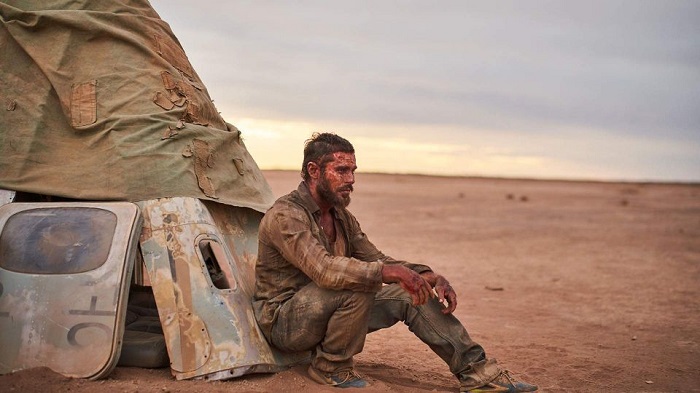
In the opening scene of “Gold”, director Anthony Hayes wastes no time immersing us in his harsh dystopian setting. A drifter (played with remarkable restraint by Zac Efron) sits in a railway boxcar as it slowly moves across the dry parched outback. The man, with his face caked in grime and his clothes covered in dust, hops off the train at a barren depot made mostly of rusted tin and tarp. He’s there to meet another man who is to drive him to a mysterious place called “the compound”. This opening sequence (and really the entire movie) does such a good job drawing you into its world that you can almost taste the grit in your mouth.

Co-written by Hayes and Polly Smyth, this Australian thriller moves at a visceral slow-boil, relying as much of the visual language of DP Ross Giardina’s camera than a driving narrative. Set “Some time. Some place. Not far from now…”, the striking cinematography conveys a not-too-distant future that’s both stunning to behold and undeniably forbidding. And Hayes’ uncompromising dedication to realizing his gritty and minimalist vision makes for an experience that’s hard to shake.

Image Courtesy of Hulu

Perhaps it’s unjust of me, but Efron is an actor that I never expect much from. While there has been a hint or two of his talent, he’s wasted a lot of time on forgettable dramas, corny rom-coms, and lame raunchy comedies. But he proves me wrong in “Gold”, delivering what I feel is the best performance of his career. Efron shows an intense commitment both physically and dramatically and the above-mentioned restraint allows him to show off a side of his talent that I didn’t know he had.

Efron’s drifter is a bit of a mystery. He’s clearly had a tough run as evident by deep scar across his face and a noticeable limp. We learn that he’s from “back west” and is heading to the compound for what he understands to be an opportunity to work and make some money. When he’s picked up at the depot by his driver (played by Hayes himself) the two head off across the grueling landscape. As they drive, their conversations shed a little light on the world’s crumbing society. But Hayes leaves most of that to our imagination and instead hones in on these two men who make a life-changing discovery.

While stopped in the middle of nowhere, the two men stumble across a massive deposit of gold. Unable to dig it out of the ground or pull it out with the truck, they put together a plan to claim their fortune. The driver will take the truck to a village some two days away and get an excavator. The drifter will stay behind and guard their treasure from any potential passerbys. Of course that will require surviving the scorching sun, the harsh land, and packs wild dogs with minimal food and water.

Image Courtesy of Hulu

With the driver gone, we spend all of our time with the drifter as his story turns from fortune to all-out survival. The layers of detail Hayes brings makes the drifter’s worsening circumstances feel remarkably real. Filming near the Flinders Ranges in the South Australian outback creates an authentic setting that is a sparse and arid spread of sand, bushes, and deadwood. Then there are the details Hayes commits to his lead character. Whether it’s his face covered in flies or the various stages of sunburn realized through the incredible work of makeup artist Beth Halsted. Efron’s performance is equally crucial to making it all feel painfully genuine.

As “Gold” unfolds it evolves into a story of greed and the dissolution of humanity. It’s also a man-versus-nature movie but with a slight “The Treasure of the Sierra Madre” vibe. All of these themes and influences come together in a taut, focused, and surprisingly potent thriller. It also features a terrific Zac Efron performance that gives long-time naysayers like me a chance to rethink our past feelings on the 34-year-old actor. “Gold” is streaming now on Hulu.

VERDICT – 4 STARS

REVIEW: “The Gray Man” (2022)

Among the biggest (and most expensive) Netflix movies of 2022 is “The Gray Man”. The big-budgeted star-studded action whopper from the Russo brothers sports a hefty $200 million budget. With Ryan Gosling, Chris Evans, and Ana de Armas highlighting its star power, “The Gray Man” is a major investment for the streaming platform which has suffered its share of losses recently. Netflix needs this blockbuster to work, and for what it’s going for, it actually does.

Anthony and Joe Russo became pretty high-profile filmmakers thanks to the Marvel Cinematic Universe. To their credit, they were behind four of the MCU’s very best films; each were massive box office successes. Since moving away from superheroes, the brothers have taken aim at making films for streaming platforms. It’s an interesting choice that they’ve been quick to defend (see Joe’s recent bizarre slamming of those who hold the theater experience in high regard).

The Russos’ first post-MCU venture was the not-so-great Tom Holland film “Cherry”. Now they give it another whirl with “The Gray Man”, a movie co-written by their frequent MCU collaborators, Christopher Markus and Stephen McFeely. The film is based on author Mark Greaney’s 2009 debut novel about a former CIA operative who suddenly finds himself targeted by his own government.

Image Courtesy of Netflix

The movie opens in 2003 at a Florida state prison where inmate Court Gentry (Gosling) is visited by federal agent Donald Fitzroy (Billy Bob Thornton). After a few pleasantries, Fitzroy tells Court that he’s there on behalf of the government to commute his sentence. Of course there is one pretty significant condition. Court must join the covert CIA Sierra program where he’ll be trained to kill bad guys. “And since you’ve already killed one it shouldn’t be too difficult,” Fitzroy reasons. As you can probably guess, Court agrees.

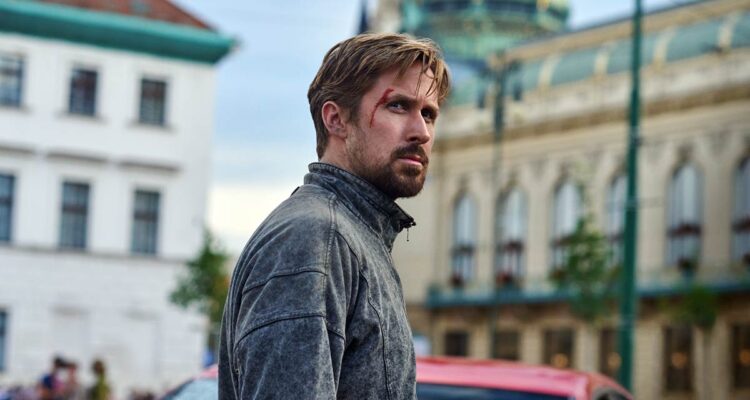
Jump ahead 18 years. Court (aka Sierra Six) is a seasoned Sierra operative and working a mission in Bangkok with field agent Dani Miranda (de Armas). Things take a turn after he discovers their target is a fellow government assassin designated Sierra Four (Callan Mulvey). In his dying words, Four warns Six that the shifty CIA Chief Denny Carmichael (Regé-Jean Page) is crooked and intent on erasing anyone who can prove it. He gives Six a memory drive with incriminating evidence against Carmichael and a number of other high-ranking feds.

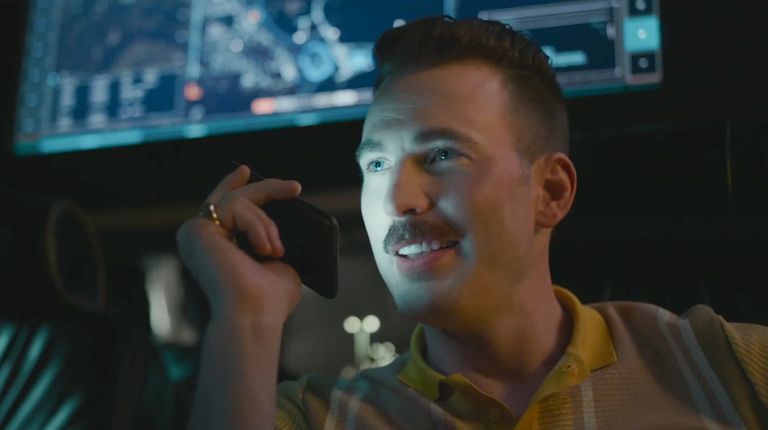
Realizing he’s probably next on his government’s kill list, Six skips his extraction and goes off the grid. He contacts his old handler Fitzroy who was pushed into early retirement by Carmichael. Fitzroy reaches out to some old friends to help Six escape. In the meantime, Carmichael grows more nervous and impatient. He calls on Lloyd Hansen (Evans, dressed as if he’s been plucked out of a 1960’s sit-com), a sociopathic contract killer known for his brutal and unhinged methods.

As you can imagine, the injection of Lloyd into the equation leads to violence and chaos. He immediately goes after Fitzroy for leverage, even kidnapping his niece Claire (Julia Butters – the chatty scene-stealer from Tarantino’s “Once Upon a Time in Hollywood…”) to help lure Six out. Lloyd then puts out a huge bounty on Six’s head and sends it out to hit teams and safe houses around the globe. Sounds like a full-proof approach. But Six proves to be a lot harder to kill than the egotistical Lloyd expected.

Despite Joe Russo’s strange attempt at devaluing the theater experience, there’s no denying that “The Gray Man” would have popped on the big screen. The globetrotting to locations like Vienna, London, Hong Kong, Berlin, and Croatia among others is fun, and the energetic camera of DP Stephen F. Windon gives us plenty of cool shots to enjoy. But the action scenes are the film’s bread-and-butter and the Russos, Windon, the visuals effects team, and the sound designers give us some real bangers that scream for the largest screen possible. The best is an over-the-top yet insanely fun action sequence through the streets of Prague. It’s a blast.

Another plus is how “The Gray Man” handles its villains. Carmichael isn’t another narcissist obsessed with world domination or a lunatic set on global destruction. Instead, he represents something more chilling – the secret lengths our own government protectors might go to hide their abuse of the public’s trust. Murdering police officers, gunning down innocent civilians, dispatching a government-sanctioned psychopath – all acceptable in their efforts to cover their dirty tracks. Granted, the movie isn’t out to make a particularly profound point about it. But it’s a welcomed change from the normal antagonists who populate these kinds of films.

Image Courtesy of Netflix

Performance wise, the movie features some pretty good ones. Gosling ratchets down on the emotionless poker-faced persona he has developed over a handful of other grittier action movies but let’s a little humor slip through now and then. And he certainly has the physical chops. Ana de Armas is given a lot more to do here than in her recent James Bond adventure and she makes the most of it. She slips into the background a little too much, but whenever she re-emerges it’s usually with a bang. And I enjoyed seeing Thornton back on screen. He’s a great presence, as is Alfre Woodard who’s terrific in the few moments she’s given.

On the villain side, Page is just the kind of detestable baddie the film needs. He’s never over-the-top and he has this kind of self-serving callousness that makes you hate his guts. Chris Evans gets the film’s showiest role. Outside of Captain America, there’s not a lot on Evans’ resume to get excited about. That said, there is one character type he has always excelled at – the brash, smart-mouthed wise-cracker. It was his signature in films like “The Fantastic Four”, “The Losers”, and even “Knives Out”. Here Evans hams it up in a variation of that role. But there’s a key reason the performance works so well. Rather than let Lloyd turn into a clown, the Russos know when to dial back the silliness and let Evans take the character down some more sinister paths. Without that restraint, Lloyd could have become an annoyance. Instead he’s a formidable antagonist.

The biggest knock on the film is that the story’s entire framework is undeniably simple and familiar. Even with the slightly different flavor of villains, “The Gray Man” is too by-the-books. Rather than take some narrative big swings, the story is content with keeping it conventional. But for those hungry for fast-paced grand-scaled action, the Russos have you covered. The energy is high and the set pieces are massive. Add to it a charisma-rich cast and you have a popcorn movie that may not reinvent the wheel storywise, but that delivers just the kind of fun adrenaline jolt action lovers crave. “The Gray Man” premieres tomorrow (July 22nd) on Netflix.

VERDICT – 3.5 STARS