

Barry Jenkins became a household name with his 2016 Best Picture winner “Moonlight”. Despite the film’s universal acclaim, I could never get in sync with its storytelling rhythm and felt it dropped off significantly in its second half. That’s certainly not the case with his follow-up feature “If Beale Street Could Talk”.
Adapted by Jenkins from James Baldwin’s 1974 novel, “Beale Street” has a very distinct voice. It’s a movie filled with longing and not just between two lovers. There is also an ever-present longing for hope, peace, equality, justice. This longing is in every frame of Jenkins’ soulful film and you see it burning in the eyes of nearly every character we encounter.

Jenkins begins his film by introducing us to Tish who is 19 and Fonny who is 22. Their opening gaze makes it clear that these inseparable childhood friends have fallen in love. They are two black kids in early 1970s Harlem with plenty of societal hurdles and a deck stacked against them. But in this early moment their love is all they see. In a very poignant way their simple yet central romance is the catalyst for everything else the film has to say.
The young couple’s world is turned upside down when Fonny is arrested for a crime he didn’t commit. He is sent to prison while Tish discovers she is pregnant with their child. Jenkins elegantly maneuvers back-and-forth on his timeline, braiding together their challenges during Fonny’s incarceration with touching looks back at their lives as a couple subtly framed as memories more so than flashbacks.
Jenkins shows off an impressive knack for drawing a ton out of his characters, not just through his dialogue but even more so from his camera. Take relative newcomer KiKi Layne who plays Tish. She brings a heartbreaking innocence and vulnerability to her character. Layne’s earnest portrayal conveys an inherent goodness in Tish which Jenkins wisely locks in on. He does the same for Stephan James as Fonny. He’s gentlemanly and sincere; so full of life and love yet slowly being drained of hope with each passing day behind bars.
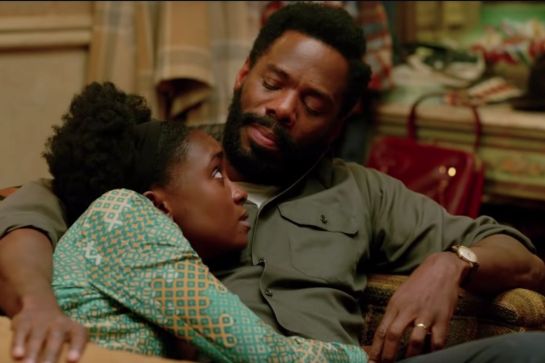
Then there is the stellar supporting cast led by Regina King who is winning every award she’s nominated for. She plays Tish’s mother Sharon, a realist but also a loving encourager determined to help Fonny despite there being no easy road to justice. Colman Domingo is superb as Tish’s father, also a realist and equally compassionate, yet forced to help the kids in his own unique ways. Both performances offer up some of the year’s best supporting work.
I should also mention Brian Tyree Henry who appears in a key sequence midway through. He plays Fonny’s old friend Daniel who just got out of prison for a crime he also didn’t commit. In a bit of on-the-nose foreshadowing, Daniel shares his experience with Fonny almost like a prophet warning us of what’s to come. Obviousness aside, Jenkins allows their conversation to play out, probably a hair too long, but still in the way it needed to. And within the framework of their conversation, every word they express feels authentic and honest.
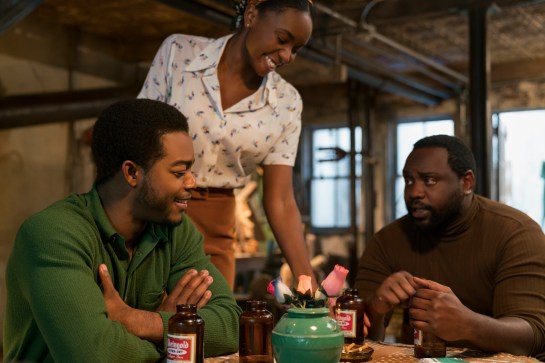
Perhaps the most magnetizing sequence sees Tish and her parents inviting Fonny’s family over to break the news of her pregnancy. It’s tense and contentious from the start eventually bringing out thoughts of “Who’s Afraid of Virginia Woolf?”. The scene is almost undone by Fonny’s belligerent and over-the-top mother (possibly Jenkins’ attempt at channeling Baldwin’s negative perception of religion). Still, you find yourself glued to every character and every exchange.
Barry Jenkins clearly has something to say about racial injustice, not just of the past but also how it still resonates today. It forms an ominous cloud that hangs over his entire film. But at its deepest core “Beale Street” isn’t a loud, angry social lecture. It’s an aching love story lusciously shot by Jenkins favorite James Laxton and accompanied by one of the year’s best scores from Nicholas Britell. The tragedy is in how this love is forever effected by a cold, prejudicial system. Tish’s burdened father once says “These are our children, and we gotta set them free.” This becomes our longing as well.
VERDICT – 4.5 STARS








 When watching Bryan Fogel’s now Oscar-nominated “Icarus” I couldn’t help but think of Morgan Sperlock’s “Super Size Me” but with performance-enhancing drugs replacing McDonalds. At least that’s how it starts. But the further it goes Fogel’s documentary (originally meant to show the effects of PEDs) inadvertently becomes an stunning exposé on how the recent Russian doping scandal was brought to light.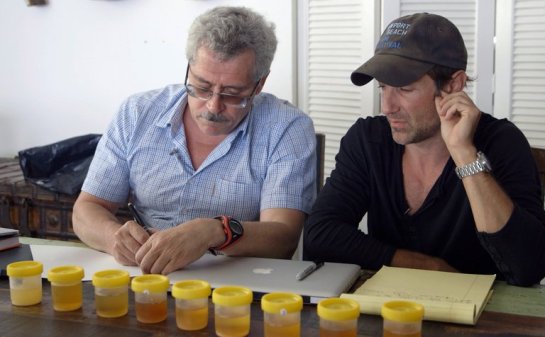








 Keith & the Movies