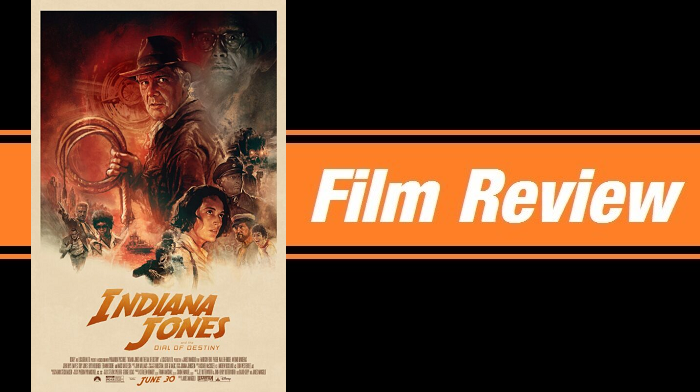
REVIEW: “Indiana Jones and the Dial of Destiny” (2023)

Let me be perfectly honest and open – I have a soft spot for the Indiana Jones franchise that’s a mile wide and a mile long. It’s one of the biggest reasons that I loved the first three movies and genuinely disliked the fourth one. My childhood is marked by endless memories of the series’ titular archaeologist and college professor. Whether I was seeing the original three movies in the theaters or taking my replica whip and my grandfather’s wide-brimmed fedora and making up my own adventures, Indiana Jones has been indelibly etched into my personal history.

So there was no way I was going to miss seeing “Indiana Jones and the Dial of Destiny”, the fifth and final feature film adventure for this adored character. At the same time, I entered it with hopes that we would be seeing a fitting and heartfelt farewell for Indy and one that more closely resembled the first three films than the Crystal Skull debacle. It certainly had the potential. And with a budget nearing $300 million, it was clear Disney and Lucafilm weren’t taking any shortcuts.

This latest Indy adventure instantly had a lot going for it. It starts with Harrison Ford who returns to play what is arguably the 80-year-old screen legend’s most beloved character (although I know some Han Solo fans who might disagree). The film also benefits from having the great Mads Mikkelsen as its chief antagonist. He’s not handed the most well-rounded villain here. But Mikkelsen is always a treat.

Image Courtesy of Walt Disney Pictures

“Indy 5” is also helped by the addition of James Mangold, a smart and savvy director who clearly has a love for the franchise. He makes a few missteps and miscalculations, but for the most part Mangold is able to capture the spirit of Indiana Jones. His film is fun, action-packed, laced with humor, and with just the right amount of nostalgia to give us die-hard fans the warm and fuzzies.

But “The Dial of Destiny” isn’t without its problems. To its credit, it’s considerably better than Crystal Skull which admittedly isn’t the highest bar. But it doesn’t have the spark of the three earlier (and far superior) movies. There are flickers here and there, but it can’t maintain that playful energy of the better films. One reason is because it’s simply too long. Mangold and his three fellow screenwriters (Jez Butterworth, John-Henry Butterworth, and David Koepp) draw things out way longer than they need to and the occasional lulls are hard to miss.

There are also the issues of comedy and chemistry. The Indy movies have always had a sense of humor, much of it situational and almost always with pitch-perfect timing. The humor is definitely present in this one. But the jokes aren’t nearly as effective or even memorable.

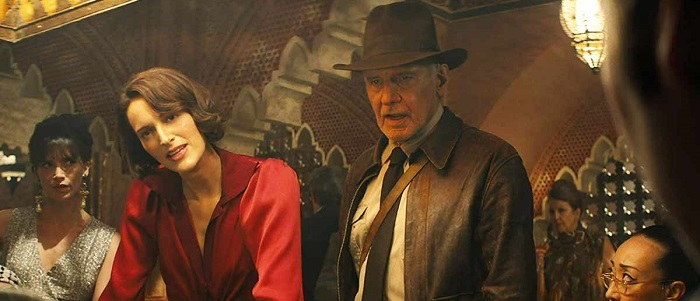
Then there’s the chemistry. Among the many things the three earliest films had in common was a sparkling chemistry. In “Raiders” it was between Indy and Marion. In “Temple of Doom” is was between Indy and Short Round. In “Last Crusade” it was between Indy and his father. Sadly “Dial of Destiny” has nothing comparable. Phoebe Waller-Bridge is a nice addition playing Indy’s goddaughter, Helena Shaw. She and Ford share several good scenes and they play off each other fairly well. But there’s nothing that really stands out between them. I know that may sound like a small thing, but it’s noticeable.

Yet “Dial of Destiny” still connects in the places where it counts most. First off, the story is full of Indiana Jones signatures that fans should love. The awkward situations Indy finds himself in; the hilariously loud sound whenever he punches someone; the way his hat always finds its way back to him; how he continues to find ways to be a thorn in the Nazis’ side. And then there are the many references to classic franchise characters and past movie moments. Sure, there’s a bit of fan service involved. But it works.

Image Courtesy of Walt Disney Pictures

As for the story, the bulk of it is set in 1969 and follows a tired and melancholy Indy. He’s all alone after separating from his wife Marion and he’s left will little to do since recently retiring from teaching. But his dull and lonely life gets a jolt when his goddaughter Helena shows up inquiring about the Antikythera, also known as Archimedes’s Dial. It’s an ancient orrery split into three pieces and her late father lost his mind trying to unlock its secrets.

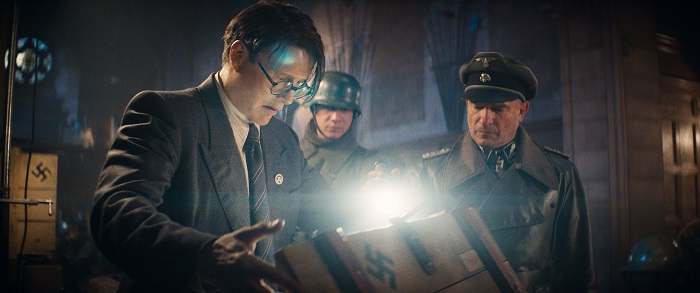
Indy has one piece of the dial and Helena wants it. But so does Nazi astrophysicist Jürgen Voller (Mikkelsen). Indy, Helena, and her sidekick Terry (Ethann Isidore) find themselves racing around the globe to find the remaining two pieces before Voller and his henchmen can get them and use the dial for their own nefarious purposes. It all culminates in a truly wacky yet undeniably fun final act spin before beautifully sticking the landing with a truly terrific final scene.

It may not capture every facet of a classic Indiana Jones adventure, but “Dial of Destiny” has so much that fans should enjoy. The action is mostly thrilling (despite some occasionally wonky CGI), John Williams’s final film score is as sweeping and epic as ever, and Harrison Ford simply IS Indiana Jones through and through. So resist the urge to over-analyze and embrace what you love about the previous films. If you do you’ll find a satisfying final chapter that lets the franchise end on a significantly better note. “Indiana Jones and the Dial of Destiny” is in theaters now.

VERDICT – 3.5 STARS

REVIEW: “Inside” (2023)

(CLICK HERE to read my full review in the Arkansas Democrat-Gazette)

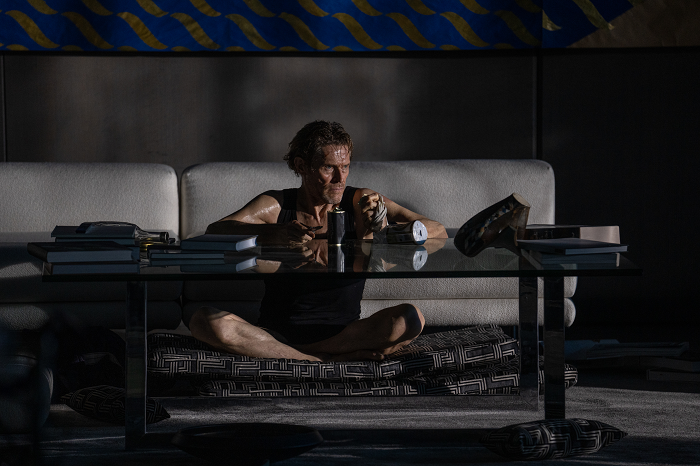
I’ve always been impressed with Willem Dafoe’s broad range and versatility. With “Inside”, the seasoned and routinely compelling actor takes center stage in a high-concept genre confection from first time feature film director Vasilis Katsoupis. Penned by Ben Hopkins, working from a story by Katsoupis, “Inside” is a movie that sits somewhere between a stark survival thriller and a twisted exercise of the mind. And it sees Dafoe doing something he’s no stranger to – running his character through a mental and emotional wringer.

While you could call it a pandemic-era parallel or a genre lover’s cocktail, “Inside” has a lot more on its mind. It touches on isolation, anxiety, and the need for human connection. But at its core, the film explores the idea of art and its inseparable bond to the human will. It subtly (and occasionally not so subtly) poses thoughtful questions surrounding the purpose of art, keeping its answers vague enough for us to wrestle with.

Interestingly, the movie’s themes aren’t simply laid bare. It takes effort and plenty of observation to get what Katsoupis is going for. Clues are left like bread crumbs, scattered about and easy to miss if you aren’t paying attention. That may sound like a lot of work, but it invigorates the movie and keeps it from being just another solo survival experience.

Image Courtesy of Focus Features

Katsoupis wastes no time cranking up his story. Dafoe plays Nemo, a name that’s never revealed until the end credits. He’s an art thief who we first meet as he’s breaking into a lavish ultra-modern Manhattan penthouse belonging to a mysterious (and insanely wealthy) collector who is away in Kazakhstan. Nemo is aided by a voice on his two-way radio who first walks him through deactivating the security system. From there he’s told he has seven minutes to swipe a series of prized Egon Schiele paintings, most notably a self-portrait valued at a cool $3 million, and then make his escape.

Nemo nabs several expensive pieces but is surprised to find the self-portrait missing. With time running out, he’s forced to cut and run. But suddenly the security system malfunctions, sealing him behind locked doors, reinforced walls, and panes of unbreakable glass. His handler promptly abandons him, leaving Nemo to fend for himself. At first he frantically looks for a way to break out before the cops arrive. But it quickly becomes evident that no one is coming, and he is indeed trapped, left to his own faculties.

For the next little bit Katsoupis hones in on Nemo’s search for a way out of his posh impenetrable prison. He starts by chipping away at a gaudy ornate wooden door with his pocket knife. He attempts to bust out the giant windows overlooking the city. He tries to make a call but the phone is dead, and he can’t get online because there’s no internet service. It doesn’t take long before the realization of his situation sets in.

Image Courtesy of Focus Features

From there, Nemo’s ingenuity shifts away from escaping and towards survival. The dichotomy is almost surreal. There he sits in an ultra modern home surrounded by priceless works of art. In fact, you could say the penthouse itself is an art piece. But for Nemo it quickly becomes a hellish cell. Suddenly the heat turns on, sending temperatures climbing to over 100 degrees. Even worse, there’s no running water, and the refrigerator and cabinets are mostly bare.

As days rapidly pass, everything becomes expendable in the interest of staying alive and holding onto his sanity. And that includes the art, whether it’s using an expensive statuette to wedge a door open or busting a framed painting to use the wood and canvas. Yet even in Nemo’s dire circumstances, the movie shows the deeper values of art. For instance, as the freedom of the New York City skyline sits beyond panes of unbreakable glass like a cruel tease, art proves to be a soothing balm. Whether Nemo is sketching on shreds of paper or creating his own mural, we see his inherent urge to create and express.

It feels like a disservice to say much more as “Inside” is all about submerging us into the experience of its central character. It may sound dark and dour, and frankly it kinda is. There are brief moments of levity (such as “Macarena” by Los Del Río playing whenever the refrigerator door is left open too long). But through Katsoupis’ lens the feeling of confinement and being cut off from the outside world is palpable. And Dafoe’s physical and psychological transformation makes it all the more harrowing. His character may be a tad too opaque, but he’s fascinating nonetheless. Much like this reasonably demanding and slyly absorbing movie. “Inside” is out now in theaters.

VERDICT – 4 STARS

REVIEW: “I Came By” (2022)

Just a few days ago Netflix stealth dropped a chilling new potboiler called “I Came By”. Co-written and directed by Babak Anvari, this crafty yet overly ambitious thriller has a hard time finding the balance between social politics and straightforward genre filmmaking. Yet it still scratches at some meaty themes, and the genre thriller elements are a lot of fun. And it’s nice seeing a movie break from convention, even if its pieces don’t always fit.

Anvari takes an interesting approach to storytelling, ending his film in a dramatically different place than he begins it. He changes perspective several times, shifting between three different protagonists throughput the course of the movie. This infuses the movie’s fairly familiar premise with some unexpected layers. And there are more than a few surprises that keep the story simmering.

Image Courtesy of Netflix

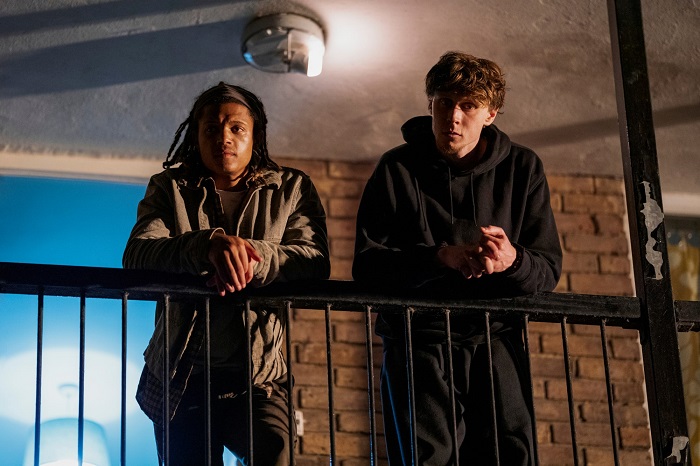
Best friends Toby (George MacKay) and Jay (Percelle Ascott) have gained notoriety as what newspapers call “renegade graffiti vandals”. The masked duo targets wealthy and affluent Londoners, break into their swanky homes, and adorn their walls with their signature graffiti tagline, “I Came By”. Driven by their angst-filled convictions, Toby and Jay are products of a radical underground youth culture who are fed up with the establishment’s ways.

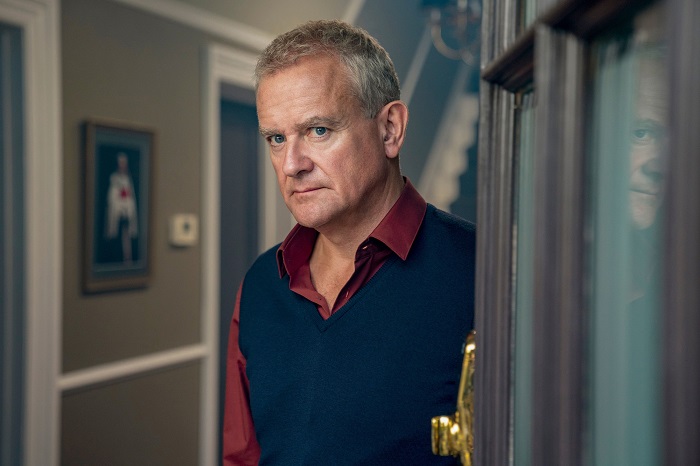
But their crusade against the rich hits a speed bump after Ray learns he and his wife Naz (Varada Sethu) are going to have a baby. He bows out of their cause, determined to settle down and be the best father he can be. A frustrated Toby chooses to carry on without his partner in crime, taking aim at a new mark – a recently resigned high court activist judge named Hector Blake played by a deliciously sinister Hugh Bonneville. This is a truly twisted turn from the man who plays the kindly Mr. Brown from the “Paddington” movies.

Image Courtesy of Netflix

Saying much more would be doing a disservice as this truly is a movie built around subverting your expectations. So the less you know the better. But it’s safe to say the movie’s change of perspective is key. It starts with Toby but soon shifts to his single mother Lizzie (Kelly Macdonald). She has a hard time connecting with her embittered son, and their turbulent relationship is rooted in some deep-seated pain. Macdonald is excellent, and while I wish Anvari would have dug deeper into her character, Macdonald does a good job making us care. Later, the movie shifts to Jay’s perspective which offers a much different take on the unfolding events.

But it’s Bonneville who makes the movie and takes it to some unsettling places. The film is at its very best when it lets him loose to uncoil the secret side of his otherwise esteemed character. It makes for some gnarly genre entertainment. Yes, shots at capitalism, greed, and corruption are certainly taken. But they don’t quite resonate the way the movie wants. They’re interesting additions that show the film has some things on its mind. But they don’t go far enough to leave an impression. Instead, it’s the thriller elements that energize the movie. Anvari shows himself to be a savvy filmmaker with enough tricks up his sleeve to keep us guessing. And that’s a big part of the fun. “I Came By” is now streaming on Netflix.

VERDICT – 3 STARS

REVIEW: “The Invitation” (2022)

I happen to be a big fan of movie trailers. When done right there are a few better ways to get moviegoers excited about an upcoming film. Of course there are several ways a movie trailer can go wrong. One of the biggest (and sadly most prevalent) ways is by revealing too much. It’s something that can be incredibly frustrating and has driven many to simply skip trailers altogether. I mean who can blame them when the studios are spoiling key chunks of their movie in what amounts to a two-minute advertisement?

I felt that frustration after seeing the trailer for “The Invitation”. Not only did it more or less give away the entire story, but it revealed what looked to be the movie’s big twist. I was hoping that wouldn’t be the case when I sat down to watch this gothic supernatural horror film. But it kinda is. From start to finish the story plays out just as we see in the trailer with practically no shocks or surprises. Yet “The Invitation” is a surprisingly easy watch in large part thanks to a nice lead performance from Nathalie Emmanuel.

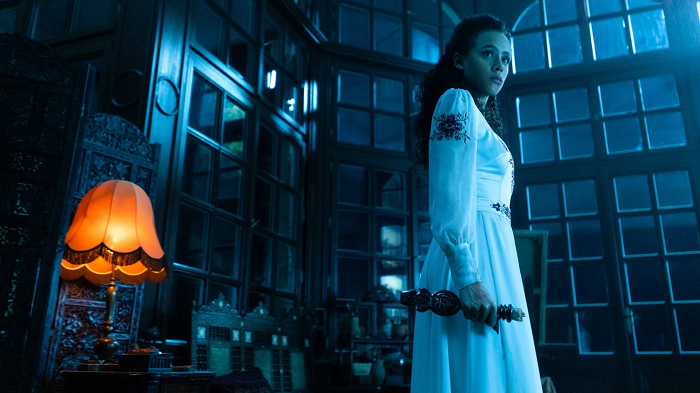
Evie Jackson (Emmanuel) works for a New York City caterer where she serves hors d’oeuvres to their snooty upscale clientele. Evie is bright and talented but has been stuck at her go-nowhere job, unable to get a leg up in her career. Personally things have been even worse. Her father died several years back and she’s still mourning the recent loss of her mother to cancer. With no siblings, aunts, uncles, or cousins, Evie can’t help but feel all alone.

But that changes after she’s tries a mail-in ancestry kit called ‘Find Yourself’. It’s one of those deals where you send in a DNA sample, the company traces your family history, and contacts you with the results. Evie is surprised to learn that she has a second-cousin in London named Oliver Alexander (Hugh Skinner) and it just so happens that he’s going to be in New York City in the upcoming days. So the two connect and arrange a meet-up for coffee. The enthusiastic Oliver tells her all about her wealthy family in England and invites her to another cousin’s upcoming wedding where she can meet her newfound kin.

With practically no hesitation (gulp), Evie accepts the all-expenses-paid offer and jets off to England. Oliver picks her up at the airport and whisks her away to New Carfax, a posh abbey remotely nestled in the British countryside. The manor itself is custom-made for a horror movie. It has an extravagant yet alluring storybook exterior. But inside is cold Gothic architecture with dimly lit hallways, drafty bedrooms, and jagged bars on the windows to keep out those pesky carnivorous birds (or so Evie is told). Think of it as a beige-colored Highclere Castle on the outside and a home fitting of Barnabas Collins inside.

Image Courtesy of Sony Pictures

Despite the numerous red flags that would send most people rushing back to the States, Evie sticks around, eventually falling for the charms of Walter Deville (Thomas Doherty), the suave and dapper lord of the manor. A romance blooms and everything seems to be falling into place for our protagonist. But we know better (even if our clueless heroine doesn’t). Even if you haven’t watch the trailer, it’s glaringly obvious that something is not quite right at New Carfax. It takes a while to get there, but once the reveal comes things get batty and we’re treated to bloody finish that ranges from fairly entertaining to utterly ridiculous.

Directed by Jessica M. Thompson and written by Blair Butler, “The Invitation” does a good job creating an atmosphere fitting for what’s to come. It also builds its own compelling mythology that centers around four filthy-rich families and a centuries-old pact. And though frustratingly oblivious to the clear signs in front of her, Emmanuel manages to make Evie a character we actually root for, especially when put up against the smug aristocracy.

But there are too many areas where the movie flounders. Many of them are in the handling of its themes. There are constant on-the-nose references to how “white” Evie’s new family looks and acts – a dull-edged attempt at racial commentary that never quite goes anywhere. Slightly more effective yet still lacking the needed bite are the film’s messages on class and patriarchy. They’re more natural to the story, but even they fail to resonate in the way the movie wants them to.

I can see where some may take issue with the movie’s slow pace. Others will be disappointed in its lack of scares. I wouldn’t be surprised to hear audiences vocally chiding the protagonist as she repeatedly breaks some of the basic cardinal rules of horror movies. It’s such a shame because there are some good ingredients here. But every time when I would get onboard with what the movie was doing, it would go off and do something that would leave me shaking my head. Take the final 15 minutes of so. It was just bonkers enough to get me smiling but then ends with a hokey final scene that left my face firmly planted in my palm. Like I said, such a shame. “The Invitation” is now playing in theaters.

VERDICT – 2.5 STARS

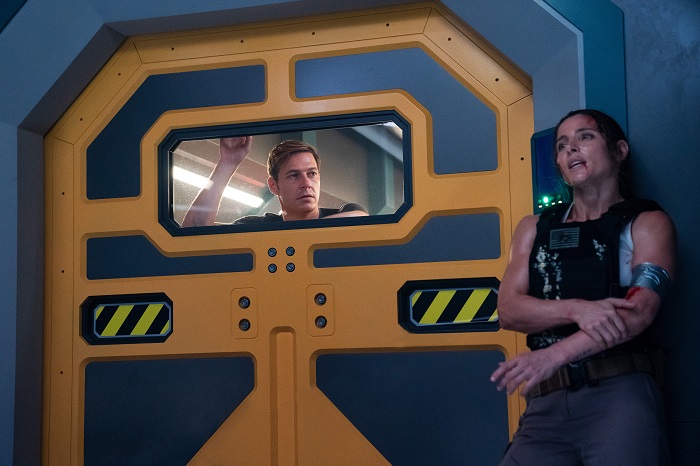
REVIEW: “Interceptor” (2022)

“Interceptor” is one of those action movies where you sorta know what you’re going to get before seeing it. There’s just enough in the trailer to (despite your better judgement) give you hope. And since movies like this can be a lot of fun, you go in optimistic. But then you see it and you remember why you were hesitant to begin with. It may be a movie you want to root for, but it’s just too silly and trite to get behind.

Directed by Matthew Reilly and produced by Chris Hemsworth (who also has a brief tone-shattering cameo that milks his likable goof persona dry), “Interceptor” starts off on the wrong foot. The ridiculous setup goes something like this: The US has only two early warning stations that can detect and shoot down nuclear missiles (we’re doomed). They’re called Interceptor bases. One is at the icy Fort Greely in Alaska. The other is a seaborne platform called SBX-1. Text tells us that SBX-1 is 1500 miles northwest of Hawaii but its exact location is “classified” (because, you know, audiences might tip off the Russians and we don’t want that).

Image Courtesy of Netflix

A generic terrorist group takes command of 16 (!!!) Russian nuclear missile installations with the intent of destroying 16 U.S. cities. But they’ll need to knock out America’s defense systems. First they wipe out Fort Greely. That leaves SBX-1 as the lone deterrent. But wouldn’t you know it, the terrorists have infiltrated the platform. Posing as janitors, the semi-ruthless Alexander Kessel (Luke Bracey) and his blank-slate henchmen have plans of taking over SBX-1.

But he didn’t count on Captain JJ Collins (Elsa Pataky of the “Fast & Furious” series). Transferred to the undesirable SBX-1 following a sexual assault cover-up by the military, JJ is promptly welcomed to her post in “the middle of nowhere” by Kessel and his mercs who attempt to gain entry into the control room. But JJ fights them off, sealing herself and the antsy Corporal Shah (Mayen Mehta) inside. In one of the more hilarious details, JJ radios for help but is informed that reinforcements to one of America’s most crucial defense stations is 90 minutes away.

Surrounded by an endless horizon of ocean and no help in sight, our hero must “hold the room” and fend off the terrorists until backup arrives. Along the way we’re fed a steady diet of silly one-liners and cringy dialogue (“We’re the only thing standing between America and Armageddon.”). The characters don’t fare much better. Pataky has a good action presence and has the physicality for some really good fight sequences. But too often she’s handcuffed by some truly awful lines. To her credit she does keep the film watchable, but putting the whole thing on her back is too much to ask.

Image Courtesy of Netflix

The villains are dealt far worse hands. Bracey tries to deliver charisma and danger but he’s only slightly menacing. Again, it’s the script that hangs him out to dry. He’s handed such an uninteresting antagonist who probably seemed better on paper than on screen. Both Kessel and his cause are hard to buy into and eventually spills over into absurdity. And at times you can’t tell if the filmmakers are on his side or against him.

Yet, “Interceptor” somehow manages to hold your attention. Lots of it has to do with Pataky who earns our sympathies. Not so much for the terrorist threat her character faces, but for the task she’s given of making a really sub-par script entertaining. It’s an impossible undertaking yet she gives it her all. And because of her effort and the countless number of unintentional laughs, the film isn’t the unbearable experience it easily could have been. “Interceptor” premieres June 3rd on Netflix.

VERDICT – 2 STARS

REVIEW: “The Innocents” (2022)

CLICK HERE for my full review in the Arkansas Democrat-Gazette

Fresh off his Best Screenplay Oscar nomination for “The Worst Person in the World”, Norwegian filmmaker Eskil Vogt goes in a much different direction with his new movie “The Innocents”. This subtle yet relentlessly eerie supernatural thriller first premiered at Cannes in 2021. Now it’s set for its release this weekend and I promise you, this one will rattle you in ways you won’t be expecting.

Vogt uses a richly detailed but thoroughly unsettling vision to explore the notion of childhood innocence and burgeoning moral conscience. While he handles the subjects with a great deal of restraint, Vogt also manages to shake us to our core. Part of it is due to his ability to infuse a near unbearable level of dread into certain sequences. He’s also not afraid to shock his audience, using violence in a way reminiscent of Michael Haneke. Not simply for the sake of doing it, but with a precise intention in mind. It gives his movie a real bite.

Pretty much the entire story takes place in and around a large Norwegian apartment complex. Our avatar is nine-year-old Ida who’s played by the incredibly expressive Rakel Lenora Fløttum. Ida has just moved to the apartments with her parents (Ellen Dorrit Pedersen and Morten Svartveit) and her autistic older sister Anna (Alva Brynsmo Ramstad). Vogt builds a compelling family dynamic centered around Ida’s relationship with the mostly nonverbal Anna. Jealous of all the attention her sister requires from their parents, a resentful Ida will often pinch Anna when no one’s looking and sometimes does much worse.

Image Courtesy of IFC Midnight

While Ida’s cruelty is troubling, Vogt doesn’t cast her in a one-dimensional light. There’s more to her character and it really begins to come out once she makes two new friends, a troubled boy named Ben (Sam Ashraf) and the kindhearted Aisha (Mina Yasmin Bremseth Asheim). The two come from significantly different single-parent homes. Aisha’s mother (Kadra Yusuf) loves her dearly but struggles financially to make ends meet. Ben’s mom (Lisa Tønne) is abusive and neglectful, often leaving her young son to fend for himself.

The supernatural element is introduced after Ben reveals his telekinetic powers to Ida. It starts innocently enough with him snapping twigs and flinging pebbles with his mind. Neither seem shocked by his power. Both treat it with the same childlike amusement as they do Ida’s double-jointed elbow trick. They laugh it off the way kids often do with any cool little discovery. But some of their other antics go beyond simple kiddie mischief, and reveal a darker side to Ben that even Ida finds unsettling.

Aisha adds another variable to the story. Along with being sweet and compassionate, she also possesses psychic abilities that allow her to speak with people via their minds. It’s through Aisha that we learn Anna also has untapped supernatural powers of her own. I won’t spoil where things eventually go, but the interactions between the four children fester into something disturbing and deadly. And while the main story turns chilling and occasionally brutal, a powerful subtext examining class and minority status simmers under the film’s surface. It’s something that could’ve been explored deeper, but at the same time it’s there and relevant.

Image Courtesy of IFC Midnight

There are several interesting storytelling choices that are surprisingly effective. For example, we get no lengthy backstory explaining how these children acquired their powers or how widespread the phenomenon may be. It’s sounds like a significant omission, but by keeping us captive in their small confined world, such detail isn’t needed. Also, you may wonder about the adults. They’re present but they mostly exist on the periphery. They nicely serve the young characters, and their influences (both good and bad) can be felt in their children.

I also like how Vogt uses several clever methods to keep us always seeing things from the children’s perspective. One of my favorites is his visual approach. DP Sturla Brandth Grøvlen’s camera often puts an emphasis on the height of the children’s surroundings. Shots of the massive high-rise apartment building, the near bottomless stairwell in their complex, the towering trees in the nearby forest where they play – they all contribute to capturing the world the way these four young people see it. It may sound like a small detail, but it’s an artistic touch that proves impactful.

Led by four outstanding child performances and an unflinching vision from writer-director Eskil Vogt, “The Innocents” uses elements from the horror genre to challenge the traditional way we often depict childhood, both in the movies and in reality. It can be hard to watch (take heed cat lovers), and its patient and unvarnished style may let down those looking for a more conventional genre film. But that’s a key thing I loved about it. Vogt’s clear-eyed treatment allows him to focus on what matters most – his characters. And it’s their stories, as tragic and as uneasy as they may be, that makes this a hard movie to shake. “The Innocents” opens today in select theaters and on VOD.

VERDICT – 4 STARS