

My how plans can change. Need an example? Look no further than “The Invisible Man”. The film was originally set to star Johnny Depp and be part of Universal’s Dark Universe. The idea was to have an interconnected cinematic universe (ala the MCU) reviving many of the classic Universal monsters. The first film of the series was “The Mummy” which opened to bad reviews and less than stellar box office numbers. As a result The Dark Universe was canned and replaced with a stand-alone movie model.
The new vision for “The Invisible Man” saw Depp out, a new writer in, and horror producer Jason Blum putting it all together. It follows Blum’s successful formula of taking a micro-budget and putting out a movie that is guaranteed to make money. Not all of his films land and rarely do they turn out to be great. But the vast majority turn profit and always seem to find an audience.
Well surprise, “The Invisible Man” is pretty great, not because of Blum’s formula or even H.G. Wells’ fantastic source material. Instead it’s writer-director Leigh Whannell’s slow methodical pacing. It’s the stellar lead performance from Elisabeth Moss. It’s the film’s strikingly effective metaphor for domestic abuse, women not being believed, and having the courage to fight back. It all makes for a surprisingly potent concoction.
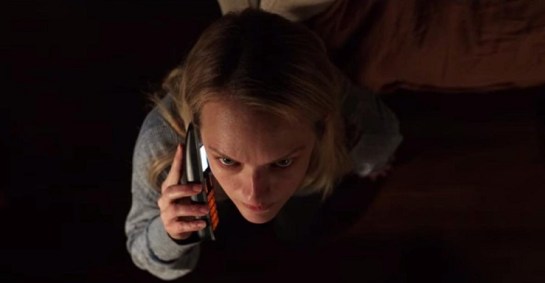
Photo: Universal Pictures
Whannell takes elements of the horror genre and mixes it with a dash of science-fiction, all while maintaining a cutting modern-day resonance. The movie starts with quite the kick and instantly lays the groundwork for its central conceit. Cecilia (Moss) flees from her controlling, abusive husband/boyfriend Adrian (Oliver Jackson-Cohen). He’s an uber-wealthy tech entrepreneur known as a genius in the field of “optics” (whatever that is). Remember that last bit, it’ll come back into play later.
Cecilia hides out at the home of her police officer friend James (Aldis Hodge) and his college-bound daughter Sydney (Storm Reid). But she still lives in terror, fearing that the narcissistic sociopath Adrian will find her. That is until her sister Emily (Harriet Dyer) informs her that Adrian has committed suicide. Cecilia also learns that Adrian left her $5 million which his estate will pay in hefty monthly installments. She’s finally free…right?
Well, remember the movie’s title? Cecilia begins noticing strange happenings, small things at first that soon turn more terrifying and violent. She’s convinced Adrian has found a way to make himself invisible and has come back to torture her physically and emotionally. But even those closest to her aren’t buying it and they begin questioning Cecilia’s state of mind. It’s a sinister twist on gaslighting and stalking, but this time the victim fights back.

Photo: Universal Pictures
The pacing is vital to the overall effect. Whannell doesn’t stuff his film with “boo” moments. Instead he clearly enjoys creating atmosphere and building tension. Much of it comes through his camera, whether its settled into a static shot or oscillating around a room. Whannell’s clever use of negative space has us eyeing every corner of the frame looking for any visual evidence that someone is there. It adds to the simmering but steadily growing sense of dread which runs side-by-side with Cecilia’s unraveling psyche until the lid finally blows off in the final act. That’s not to say there aren’t a handful of bigger scares along the way. They’re mostly shocking jolts that legitimately catch you off-guard but are actually meaningful and revealing.
It’s well shot, well paced and features an ominous, dread-soaked score by Benjamin Wallfisch. But it all sinks without Elisabeth Moss who is an absolute force. She is intensely committed both physically and psychologically, nimbly bouncing back-and-forth between defeated and determined, vulnerable and vehement depending on what the scene needs. Interestingly, the movie never details the abuse Cecilia has endured in the past. It’s not necessary. Moss deftly conveys all the information we need to believe and understand her character. She’s terrific.
Whether it’s being an edge-of-your-seat horror thriller or a stinging allegory of domestic violence and the quest of women to be heard, “The Invisible Man” hits all of its targets. It’s a remake that actually brings something new to the table and has something rather timely to say. And much like Lupita N’yongo in last year’s “Us”, Moss shouldn’t be overlooked simply because of genre. She gives a top-notch performance full of conviction and (along with Whannell) propels what could have been an easy to overlook film. Instead “The Invisible Man” is the best of the young movie year so far.
VERDICT – 4.5 STARS










 Keith & the Movies