True appreciators of 1970s blaxploitation will find a lot to love about the low-budget but highly entertaining “Jade”. Writer-director James Bamford makes no attempt to hide his inspiration, treating us to a buffet of blades, bullets, and bodies that decades ago would have felt right at home on New York City’s notorious 42nd Street.
As with some of the movies that inspired it, “Jade” has its shortcomings. The story is lightweight at best, some characters are paper-thin, and at times the movie finds itself wandering in an effort to make it to the next big action scene. Yet fans of the pulpy throwback subgenre will eat up the steady diet of cool split-screens, gratuitous slow motion, fun Mexican standoffs, and glorious gun fu action.
Image Courtesy of Well Go USA
Martial artist and stunt performer Shaina West gets a starring role as the film’s titular lead Jade, a young woman burdened by grief and guilt following the unfortunate death of her brother by her own hand. It’s a seemingly significant bit of backstory that never gets fully explained to us. The closest thing to family she has left is her late brother’s pregnant girlfriend, Layla (Katherine McNamara) who is still struggling to forgive Jade for what happened.
What story there is kicks off after Jade ends up with a mysterious hard drive that’s wanted by a crooked businessman named Tork (played by Mickey Rourke who phones in his performance in what is a very Mickey Rourke type of role). Also hungry for the drive is an Interpol agent named Reese (Mark Dacascos) who happens to be Jade’s former mentor and a close friend of the late parents.
But figuring out who to trust isn’t easy for Jade, especially when shooting and slicing her way through waves of thick-skulled baddies, all with really bad intentions. And that’s basically the story in a nutshell. The hard drive turns out to be nothing more than a MacGuffin. We only get a few mild twists. And there are only a couple of scenes that could qualify as reveals. Mostly it’s Jade moving from one ferocious and stylish action sequence to the next.
Image Courtesy of Well Go USA
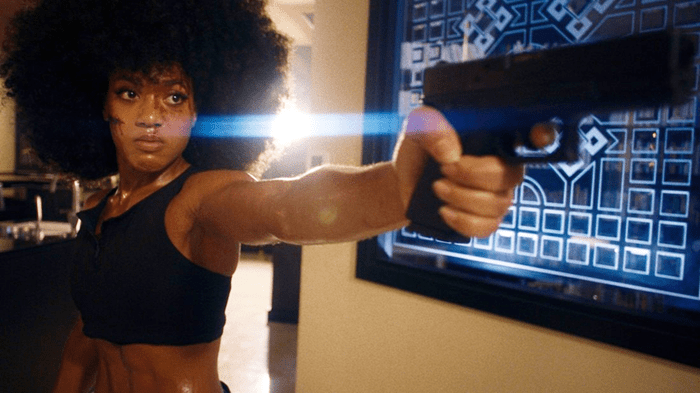
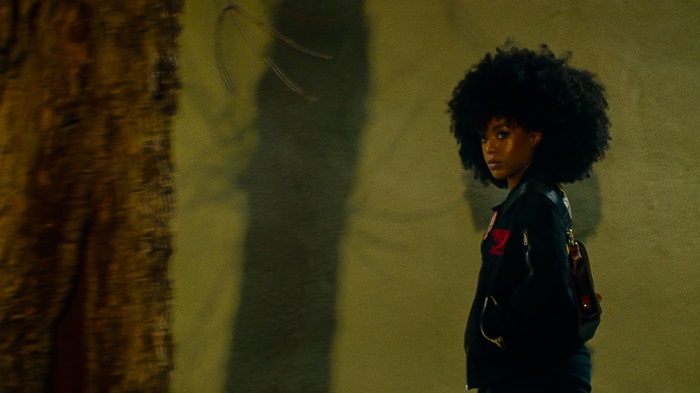
Those looking for a meatier script may be tempted to write the movie off. But “Jade” has much more to offer, mainly from the electric Shaina West. She’s a physical and charismatic force of nature, dishing out bloody retribution with a twinkle in her eye and a glorious full volume afro that’s as big as her body count. Memories of Tamara Dobson’s Cleopatra Jones and Pam Grier’s Foxy Brown immediately come to mind as Bamford gives West one action highlight after another.
“Jade” is a cool, straightforward, and unabashedly violent throwback to the exploitation era of the 1970s. It’s full of razor-sharp quips, hilarious genre nods, and enough shooting, kicking, and slicing to satisfy the cravings of any fan who truly gets what Bamford and company are going for. It’s light on story and the characters are mostly archetypes. But there’s a good chance you’ll be having too much fun with everything else to bother noticing. “Jade” releases on digital February 18th.
It goes without saying, but few have had better big screen careers than the legendary Clint Eastwood. In addition to appearing in over 60 movies, the 94-year-old cinema icon has directed and/or produced a total of 44 features. He has even composed a total of seven film scores. On top of all that, he has received eleven Academy Award nominations and has had four Oscar night wins.
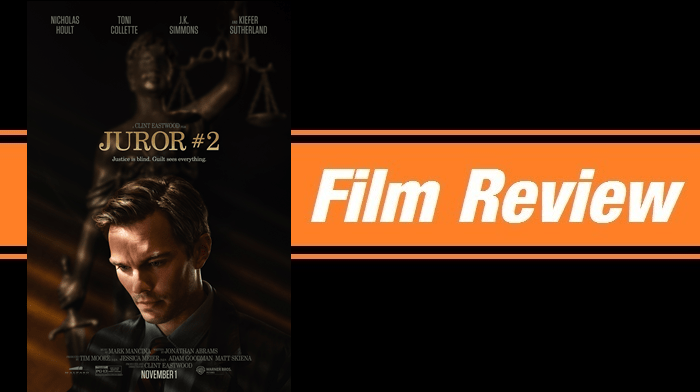
And that brings us to “Juror #2”, a feature that many are reporting could be the final film in Eastwood’s brilliant seven decade-long career. Eastwood himself hasn’t personally said anything about retiring, But if he does choose to step away, it’s hard to imagine a better movie for the legend’s potential swan song. Now if only it could get the big screen rollout it deserves.
“Juror #2” is every bit a gripping courtroom drama. But it resonates most as a thought-provoking morality play that uses the American legal system as a conduit for its incisive study of guilt and justice. The film is strengthened by its propulsive and character-focused script from Jonathan Abrams and a strikingly nuanced lead performance from Nicholas Hoult who continues his phenomenal career-defining year. But it’s Eastwood’s signature tight and efficient storytelling that makes the movie hit on all cylinders.
Image Courtesy of Warner Bros. Pictures
In “Juror #2” Eastwood taps into his career-long fascination with moral quandaries within modern social constructs. Here he wastes no time getting started by introducing us to Justin Kemp (Hoult), a journalist living in Savannah, Georgia with his wife Ally (Zoey Deutch). The two are nervously navigating the third trimester of Ally’s high-risk pregnancy when Justin receives a summons to report for jury duty. His hopes are that the pregnancy will be reason enough for him to be relieved. No such luck.
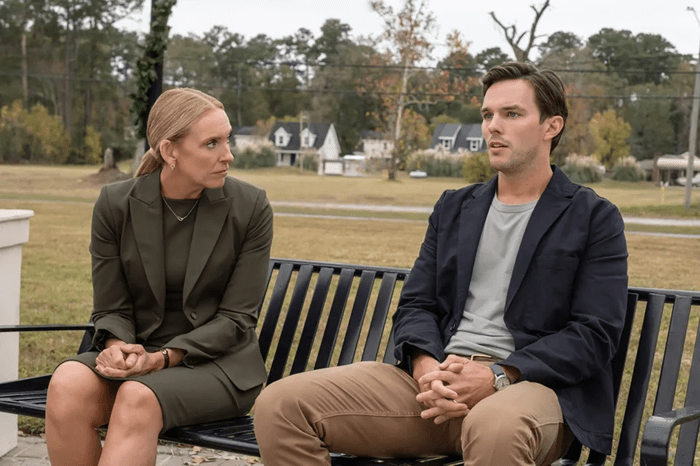
Justin is on the jury for a local murder case involving the death of a young woman named Kendall Carter (Francesca Eastwood). Her body was discovered near a bridge in a rocky creek bed. The accused killer is her boyfriend, James Michael Sythe (Gabriel Basso). The case is being prosecuted by Assistant District Attorney Faith Killebrew (Toni Collette) who is on the home stretch of her campaign to succeed her boss as the new DA. Faith believes she has all she needs to convict Sythe including eyewitness testimony, the medical examiner’s opinion, and Sythe’s own violent history.
But Sythe’s attorney, public defender Eric Resnick (Chris Messina), believes there is ample reason for reasonable doubt. Aside from the defendant passionately proclaiming his innocence, there is no murder weapon. And the defense contends that the eyewitness accounts don’t hold up under scrutiny. This sets up and fuels the two sides of the courtroom segment of Eastwood’s story.
But the big twist lies with Justin. As he listens to the prosecution and defense plea their cases he realizes he may have an unexpected connection to the murder. Justin’s sudden moral dilemma spills over into the deliberations as he becomes Sythe’s most ardent defender out of the twelve jurors. The tension steadily ratchets up as Eastwood and Abrams drip-feeds us more and more information. Over time the revelations help paint a clearer picture, yet there’s enough vagueness to keep things suspenseful.
Image Courtesy of Warner Bros. Pictures
There’s so much to admire about Eastwood’s sure-handed direction. It’s seen in his approach to the story that brings to mind such classics as Kurosawa’s “Rashomon” and Lumet’s “12 Angry Men”. We see it in how he opens up his themes with scalpel-sharp precision. And it shows in his confident use of Yves Bélanger’s sturdy classical cinematography.
But it’s perhaps clearest seen in Eastwood’s handling of his actors. Not only does the cast get good material, they also get space to explore and create. Hoult is especially good, conveying the weight of guilt in the light of uncertainty. Collette is outstanding in a role she takes in some unexpected directions. J. K. Simmons is his normal rock-solid self playing a skeptical juror with a unique insight. And Kiefer Sutherland gets a small but welcomed part as Justin’s mentor.
“Juror #2” hinges on a twist that could have easily turned into a cheap gimmick. But Clint Eastwood is not the kind of filmmaker to allow that to happen. His film has a lot more meat on its bones. Its themes are potent, the stakes get higher, and actions have far-reaching consequences. At the same time it entertains like an old-fashioned, well-oiled genre film. If this is Eastwood’s final film (and the selfish side of me really hopes it isn’t), what a way to wrap a truly remarkable career.
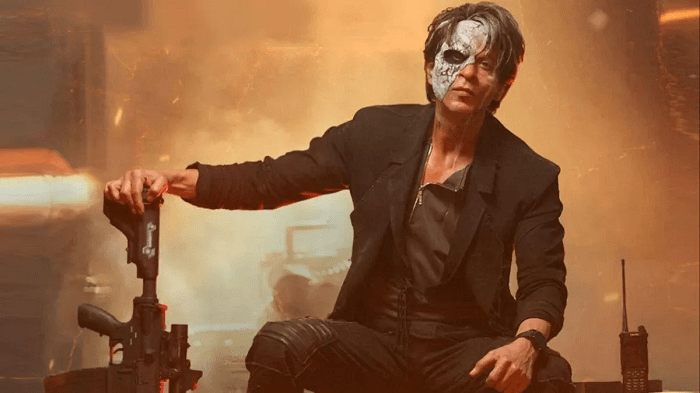
Director and co-writer Atlee makes his Hindi film debut with Jawan, a high-energy big-budget action thriller starring fan favorite Shah Rukh Khan. The film was a box office smash, emerging as the highest grossing Indian film of the year (topping King Khan’s other big 2023 hit “Pathaan”). Atlee’s ambitious first feature is a wildly entertaining blend of violence, romance, and music, all built around the endless charisma of one of Bollywood’s biggest stars.
“Jawan” proudly embraces many of the trademarks of Indian action cinema including outrageous plot twists, lavishly produced musical numbers, and of course the thrilling stylized set pieces. The story itself features as many wild narrative flourishes as eye-popping action. It shrewdly interweaves both past and present day storylines, evolving its characters along the way. Not everything clicks into place as it should and certain elements of the story feel rushed. Yet Atlee keeps us hooked for the entire 170 minutes.
SRK gets to stretch himself in all kinds of directions starting in the film’s opening scene. A man (Khan) is shown floating in the river high in the mountains near the Indian border. Bloodied, wounded and near death, the man is found by a young woman who takes him back to her village. As the villagers are nursing him back to health, soldiers from a brutal military regime attack the village and begin slaughtering the people. The man suddenly rises up and slays the invaders, saving the people like a mythical hero.
Jump ahead thirty years where a strikingly similar man has hijacked a metro train in Mumbai with the assistance of his six highly skilled female accomplices. He threatens to kill the passengers if a hefty ransom isn’t paid. Government agent Narmada Rai (an excellent Nayanthara) is called in to negotiate. Kalee Gaikwad (Vijay Sethupathi), a notorious arms dealer, learns that his daughter is aboard the train and agrees to pay the ransom.
“Jawan” has so many twists and turns that I hesitate to say much more about the story. Suffice it to say Shah Rukh Khan is given a “multifaceted” role that he tackles with his signature charm and panache. Nayanthara is fabulous in a supporting turn that lets her flex her emotional intensity and physicality. As for Sethupathi, it takes time, but he eventually evolves into a solid villain – devious, cold-hearted, and fueled by his own self interests.
The action is spectacular and ranges from entertainingly cartoonish to absolutely jaw-dropping. The sequences can amaze you with their insane creativity and sometimes jolt you with their bursts of brutality. Outstanding cinematography (G. K. Vishnu), editing (Ruben), and stunt choreography (Anal Arasu) help Atlee put his wild and stylish vision to screen.
Narratively the movie is fun and diverting, but it does ask a lot of its audience. It challenges our ability to suspend disbelief and needs us to go along with some pretty far-fetched ideas. But to be honest that’s a big part of the fun. “Jawan” is such a wild ride, playfully blending genres while also making serious statements on government corruption, greed, class discrimination, and healthcare scandals among other things. It has a little bit of something for everyone, and Atlee’s ability to corral it all together is pretty impressive.
Who knew that a little movie about a hitman avenging his dog’s death would evolve into the most popular action franchise going? Of course that’s an overly simplified synopsis of 2014’s “John Wick”, a movie that instantly won people over (yours truly included) with its ferocious style, exciting yet proudly tongue-in-cheek story, and the incandescent charms of its lead actor, Keanu Reeves. Great reviews from critics and strong word of mouth from audiences catapulted the film to unexpected heights.
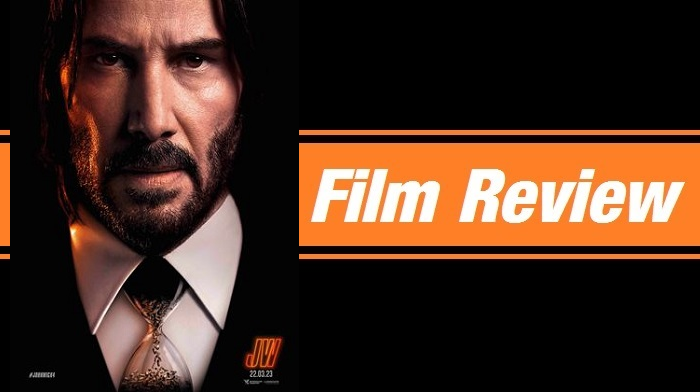
2017’s “John Wick: Chapter 2” stepped up the world-building while 2019’s “John Wick: Chapter 3 – Parabellum” gave some fan favorite side characters more time in the limelight. Now Reeves is back for a fourth installment. “John Wick: Chapter 4” is the biggest, wildest, and certainly the most ambitious film of the franchise. It travels to more locations, introduces a slew of cool new characters, and features even bigger and more mind-blowing set pieces. “Chapter 4” takes much of what fans have loved about the previous three films and amplifies them. The results are nothing short of terrific.
Unfortunately there is a cloud of sadness that hangs over the release of “John Wick: Chapter 4”. Esteemed actor Lance Reddick, who has appeared in all four films playing Charon, the faithful concierge at the New York Continental Hotel, unexpectedly passed away on March 17th at the age of 60. It was a crushing loss for the franchise and the entertainment world. Reddick’s passing adds an extra level of emotion to a film that already has a surprising amount of feeling baked into it.
Image Courtesy of Lionsgate
Fans of the franchise should know exactly what to expect from “Chapter 4”. Stuntman turned director Chad Stahelski returns after helming the first three films and orchestrates yet another stylish ballet of relentless heart-pumping action. Yet more than any of its predecessors, “Chapter 4” is almost poetic in its presentation, mixing together meticulously choreographed movements, pulse-pounding music, and some of the most incredible stunt-work I’ve seen in a while.
To say the affable 58-year-old Reeves has made the title character his own would be a massive understatement. His fourth venture as the almost mythical Baba Yaga is his most challenging yet (it’s said Reeves did 90% of his own stunts!!!). As mentioned, everything is bigger including the running time (2 hours and 49 minutes) and the budget ($100 million). Yet despite its waves of violence and the massive body count (140 by one pretty reliable count), in many ways “Chapter 4” may be the most intimate and personal John Wick film since part one.
Picking up where the previous movie left off, the story (penned by Shay Hatten and Michael Finch) sees John Wick in New York City preparing to enact his revenge on the formidable High Table – the powerful and mostly faceless faction of crime lords that rules the underworld. He’s helped by The Bowery King (Laurence Fishburne), a loyal and reliable provider of useful information, weapons, and finely tailored Kevlar suits.
John’s first order of business is to head to Morocco where he assassinates The Elder (George Georgiou), the one person who sits above the High Table. As a result, Winston Scott (Ian McShane), John’s friend and the manager of the New York Continental Hotel is summoned by Marquis Vincent de Gramont (Bill Skarsgård), a high-ranking member of the High Table. In response to failing to kill John in the previous movie, the Marquis revokes Winston’s status as hotel manager and then doles out some even harsher punishment.
De Gramont then hires a blind yet deadly hitman named Caine (Donnie Yen). He’s retired and wants no part in killing his old friend John Wick. But he’s forced to take the contract after the Marquis threatens to kill his daughter. Meanwhile John is holed up in the Osaka Continental which is managed by his trusted friend Shimazu Koji (the always great Hiroyuki Sanada) and Koji’s daughter/concierge Akira (Rina Sawayama). Soon Caine arrives, accompanied by de Gramont’s right-hand muscle Chidi (Marko Zaror) and an army of High Table assassins. It leads to the first of several hyper-kinetic showdowns.
Image Courtesy of Lionsgate
Among the many joys of watching a John Wick film is relishing the incredible world-building and the colorful array of side characters. “Chapter 4” delivers both in spades. Stahelski takes us around the world, shooting on location in places like New York, Paris, Tokyo, and Berlin. At each stop we’re thrust deeper into the franchise’s vibrant (and often violent) underworld network. In addition to Koji, Akira, and Caine, we’re also introduced to other fascinating players such as The Harbinger (Clancy Brown), a high-ranking representative of the High Table, a crime boss in Germany named Killa (Scott Adkins), and a mysterious “Tracker” who adopts the name Mr. Nobody (Shamier Anderson).
If there was ever a movie that showed the need of Oscar categories for stunt-work and choreography, it’s “John Wick: Chapter 4”. Whether throwing down in a famed Berlin nightclub or on a never-ending outdoor staircase in Montmartre; in a neon-bathed hotel in Osaka or on a busy roundabout circling the iconic Arc de Triomphe, Jeremy Marinas” graceful yet intense fight choreographer stuns and the work from stunt coordinators Scott Rogers and Stephen Dunlevy will routinely have your jaw on the floor. And it’s all emphasized by Dan Laustsen’s gloriously precise cinematography.
“John Wick: Chapter 4” is a full-on action extravaganza and an unforgettable cinematic experience. It’s an adrenaline-fueled spectacle but with a beating heart. It’s also one of the best action movies of the last decade-plus. Keanu Reeves, with his quiet charisma and amazing physicality, once again has us rooting for his tragically heartbroken yet intensely lethal former hitman who remains trapped between his insatiable thirst for revenge and his longing for some semblance of peace. John Wick has evolved into a legendary character – one who I’ll follow to his grave. “John Wick: Chapter 4” is now showing in theaters.
In recent years there’s been a noticeable maturation of “faith-based” movies. It’s been visible in both the quality of the filmmaking and the depth of storytelling. Not only are their characters becoming more rooted in the real world, but they’re demonstrating a more lived-in faith. And filmmakers are finding that they can still convey their faith-centered messages without pounding their pulpit or speaking to their audience in platitudes. Obviously these welcomed shifts don’t guarantee great movies. But they do help these films to be seen and judged by a more equal standard.
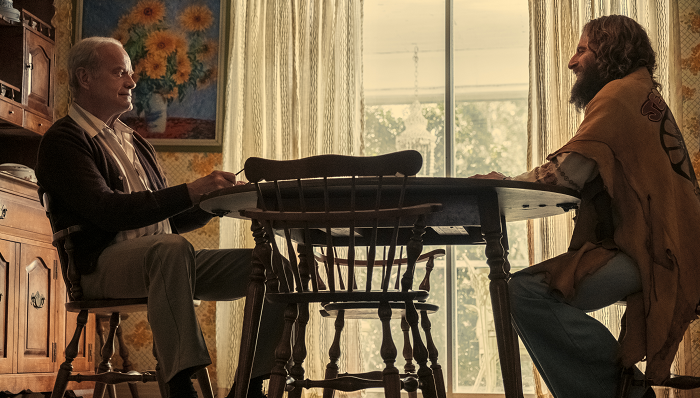
The latest example is “Jesus Revolution” from co-directors Jon Erwin and Brent McCorkle. Based on Greg Laurie and Ellen Vaughn’s book of the same name, the movie tells of the Jesus Movement and its growth in Southern California during the early 1970s. The Jesus Movement was a Christian counterculture revolution that emerged in the late 1960s and exploded across the country in the early 1970s. Born out of the burgeoning hippie sub-culture, the movement wasn’t just restricted to disillusioned flower children. Young people from around the country left their traditional church settings and joined fellow “Jesus Freaks” in the many communes along the West Coast.
Image Courtesy of Lionsgate
Some within the Christian ranks have celebrated the Jesus Movement as the last great “spiritual awakening”. Many have praised its use the culture to draw young people; how its anti-establishment roots helped redefine church services; and how it gave birth to today’s lucrative contemporary Christian music industry. Critics saw it as more of a cultural movement than a biblical one. And they noted its emphasis on signs and experience over doctrine and theology. There’s certainly no doubting which side the movie lands on.
“Jesus Revolution” is taken from megachurch pastor and producer Greg Laurie’s early experiences as a member of the Jesus Movement. It’s a well made, well directed, and well acted mixture of biographical, coming of age, and faith-based elements. The “based on a true revolution” story (written by Erwin and Jon Gunn) covers a lot of ground and does so by focusing on three key characters: Greg Laurie (played by Joel Courtney), Chuck Smith (Kelsey Grammer), and Lonnie Frisbee (Jonathan Roumie).
The film opens in 1968, a time when you couldn’t turn on your radio or television without hearing about the growing peace-and-love hippie movement bursting out of San Francisco’s Haight-Ashbury district and across Southern California. It’s here that we meet a young Greg Laurie who lives in Newport Beach with his hard-drinking and hard-living mother (Kimberly Williams-Paisley). Greg gets a good taste of hippie culture after meeting and falling for a spirited and beautiful girl named Cathe (a terrific Anna Grace Barlow).
Meanwhile, Pastor Chuck Smith has watched his Costa Mesa church’s numbers dwindle down to a faithful few. His first inclination is to blame the culture, specifically the shaggy-haired, barefoot, drugged-out hippies who are all over the news. But when Chuck meets a traveling hippie street-preacher named Lonnie Frisbee, he’s immediately captivated by what he hears. He invites Lonnie and some of his Jesus-loving friends to his church. Of course it initially upsets Chuck’s congregation who the movie paints as a bunch of old starched and stuffy squares. But soon the church is drawing hippie youth from all around, including Greg and Cathe.
Image Courtesy of Lionsgate
The movie’s blinding affection for the Jesus Movement ultimately shapes how it’s portrayed. The filmmakers don’t offer any real critique and there’s certainly not much interest in a biblical assessment. It even comes through in their treatment of the real-life characters, most notably Lonnie Frisbee. He was undoubtedly a central figure in the Jesus Movement but also a complicated one. The movie touches on some of his later missteps but dodges the more controversial parts of his life.
But despite its obvious lean, “Jesus Revolution” still makes for an diverting look at a more recent slice of America’s spiritual and cultural history. The impressive production value, costume design, and needle-drops create a vibrant and authentic late 60s and early 70s atmosphere (although I did chuckle at a character in 1968 singing along with a song that actually came out in 1970). And there are moments that inspire, both spiritually and socially. There’s a good chance it’ll speak to those whose faith needs recharged or to those who simply need a reminder that people from different camps can come together in meaningful ways. Now there’s a message that we certainly need today. “Jesus Revolution” is out now in theaters.
Hot on the heels of the mega-hit “Top Gun: Maverick”, “Jurassic World: Dominion” is the next big blockbuster on the 2022 summer movie calendar. It’s predecessor, “Jurassic World: Fallen Kingdom” was a monumental disappointment, lacking the awe and wonder that made even the lesser Jurassic installments entertaining. And its story devolved into something too absurd, even for a movie based on a modern day dinosaur amusement park.
Still, “Fallen Kingdom” earned well over $1 billion at the box office and a sequel was all but assured. Enter “Dominion” which takes place four years after the events of the previous film. To “Fallen Kingdom’s” credit, it did leave the series in an interesting place. If you remember, dinosaurs were suddenly loose across our country. The fabulous Jeff Goldblum pops up in a cameo (reprising his role as Dr. Ian Malcolm) and tells a U.S. Senate committee that we have entered a neo-Jurassic Age where humans and dinos must co-exist.
Image Courtesy of Universal Pictures
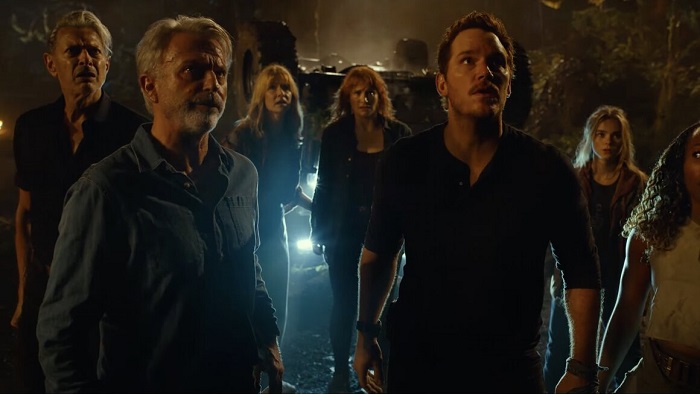
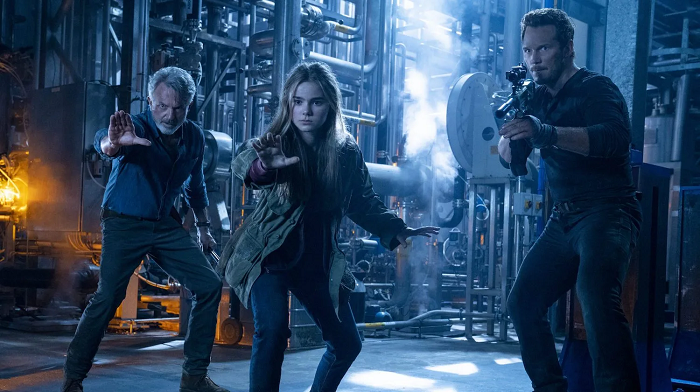
That leads to “Dominion”, an ambitious movie that attempts to bring together the old and the new. Chris Pratt and Bryce Dallas Howard return from the “Jurassic World” movies while Sam Neill, Laura Dern, and Jeff Goldblum are reunited from the “Jurassic Park” films. It’s a cool idea and there are moments of nostalgic glee even for a lukewarm Jurassic fan like me. But “Dominion” is a weird movie that struggles to find a rhythm. There’s entertainment to be found, but you have to wade through some messy parts to find it.
With so many characters, director and co-writer Colin Trevorrow backs himself into a corner. He has to introduce each in a way that gives them stakes in the story. He has to develop them so that they have purpose beyond just refilling their character’s shoes. So we get the film’s first half that is literally and figuratively all over the map. It does set the table for its better second half, but getting there is a bit of a chore.
The most disappointing thing is how “Dominion” never really lives up to its promise. Ian Malcolm’s words in the “Fallen Kingdom” cameo made it sound like “Dominion” was going to give us mankind and dinosaurs fighting to co-exist. Instead the bulk of the movie once again moves to a fairly confined space and again features an overambitious (and in this case utterly mad) scientist who never questions what he’s doing. It fits with original writer Michael Crichton’s sharp critique of genetic tinkering. But it doesn’t expand on Crichton’s idea in the way it advertised.
Image Courtesy of Universal Pictures
The movie sets its two batches of character on different paths before inevitably bringing them together in the final third. Everyone’s favorite (and I’m quite sure only) Velociraptor trainer Owen (Pratt) and former Jurassic World park manager Claire (Howard) are living a secluded life high up in the the mountains. They have adopted young Maisie (Isabella Sermon), the world’s first successful human clone (I had completely forgotten her angle). But when a group of baddies kidnap Maisie, Owen and Claire set out to find her.
Meanwhile, paleobotanist Ellie Sattler (Dern) is secretly studying a destructive swarm of giant prehistoric locusts. She traces their origin to an evil corporation called BioSyn that is headed by the slimy Dr. Lewis Dodgson (Campbell Scott). Ellie wants to link Dodgson to the swarm and convinces her old colleague, paleontologist Alan Grant to help. And it just so happens Ellie has an inside man – mathematician and smooth-talker extraordinaire, Ian Malcolm (Goldblum).
As things play out we do get a cool action sequence in Malta (although the story surrounding it is pretty absurd). That’s where we’re introduced to a new character, Kayla Watts (DeWanda Wise). She’s a pilot-for-hire who out-of-the-blue decides to help Owen and Claire. Kayla adds a little toughness to the story but not much else.
Image Courtesy of Universal Pictures
All roads eventually lead to the BioSyn laboratories and dinosaur reserve where the movie finally picks up a little steam. There, Ellie, Alan, and Ian are reunited and do a little super-sleuthing. That also happens to be where Maisie is being held. You can probably already see how all of the character pieces start coming together. The final act plays much more like a traditional Jurassic Park movie, with our heroes caught in a madman’s domain where dinosaurs are roaming free. Here we get some genuinely fun moments and it’s where the characters feel most like themselves.
Again, “Jurassic World: Dominion” is messy and it takes forever to get its footing. And I can’t help but be disappointed by it shortchanging the who “coexisting” angle. And there are logic questions galore. For example, I’m still trying to figure how the dinosaurs multiplied to such vast numbers and spread all over the globe in only four years. But “Dominion” is a pretty dramatic step up from “Fallen Kingdom”. There is a big variety of dinosaurs for old and new for fans. And we get plenty of scene-stealing lines from the terrific Jeff Goldblum (he’s also part of the funniest laugh-out-loud joke I’ve seen in a movie this year). But these things can’t fully cover the film’s numerous shortcomings. I can appreciate the ambition, but this is a case where Trevorrow and company bit off more than they could chew. “Jurassic World: Dominion” opens today (June 10th) exclusively in theaters.














 Keith & the Movies