
Rian Johnson’s fresh take on the whodunit genre comes in the form of “Knives Out”, a murder mystery/dysfunctional family comedy mashup anchored by one heck of a star-studded cast. Johnson’s first film since his, shall we say “controversial”, venture into the Star Wars universe sees him easing right back into his comfort zone.
First and foremost “Knives Out” is a lot of fun. Not only is Johnson enjoying himself, but the entire cast is clearly having a blast. And how could they not? Johnson creates for them a narrative playground full of whip-smart dialogue, genre nostalgia and with a biting sense of humor. It’s also very confidently made. From the film’s earliest moments it’s obvious Johnson firmly believes in his script, his characters, and the wickedly good ensemble who portrays them.

© 2019 Lionsgate Studios. All rights reserved
As with all good whodunits you’ve got to have a murder, a colorful list of suspects, and a sly detective who always seems to know more than he’s letting on. Here the murder victim is wealthy crime novelist Harlan Thrombey (Christopher Plummer). He’s found in his study with his throat slit the morning after his big 85th birthday party. The police initially rule it a suicide but c’mon, we know it must be….“murder”!
Which leads us to the suspects. Namely the entire Thrombey clan – a mash of rich dysfunctional miscreants who are far more interested in their inheritance than their daddy’s death. Among them is the sharp-tongued eldest daughter Linda (Jamie Lee Curtis) and her Trumpian blowhard husband Richard (Don Johnson). There is the strategically meek and overly-ambitious youngest son Walt (Michael Shannon) who runs his father’s publishing company. Joni (Toni Collette), the widow of Harlan’s oldest son, is a left-wing scam artist who has her own line of “lifestyle” products.
Oh, I can’t forget the grandchildren. Jacob (Jaeden Martell) is a creepy internet troll (perhaps a little thin-skinned jab by Johnson at those who gave him the business over Star Wars). Meg (Katherine Langford) is a pot-smoking liberal arts student. And then the real scene-stealer, Ransom (Chris Evans), a spoiled playboy and the bonafide black sheep of the family. This is about as far removed from Captain America as Evans could get and boy does he nail it.

© 2019 Lionsgate Studios. All rights reserved
And that leaves the detective. Daniel Craig lets loose playing Detective Benoit Blanc (gotta love the name), a renowned private-eye from a dying breed recently featured in a New Yorker article “The Last of the Gentlemen Sleuths“. Fitting. Anonymously hired and dripping with Deep South vernacular, Blanc immediately smells something fishy and from the very beginning suspects foul play. A local police detective (Lakeith Stanfield) doesn’t buy Blanc’s suspicions but he’s willing to watch and listen as the Poirotian gumshoe works his magic.
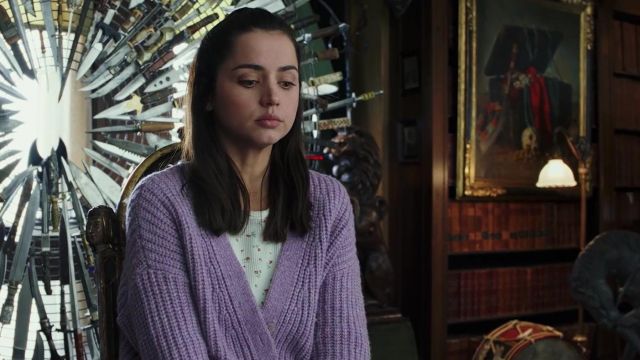
Caught in the middle of all the pomposity, posturing, and pretense is Marta (an absolutely brilliant Ana de Armas). She was Harlan’s personal nurse and now a lamb among a pack of ravenous wolves. “You’re part of the family” she’s repeatedly told yet not one of the Thrombey bunch can even get her nationality right. Marta is the film’s one spark of virtue but even she has her own secrets (and a weird but funny digestive disorder that I’ll let you discover for yourself).
This densely plotted medley of twists and turns, mystery and motives is simply intoxicating to watch. The toxic back-and-forths between these entitled elites and trust fund brats has plenty of satirical bite but it can also be laugh-out-loud hysterical. Even funnier is watching Craig’s Detective Blanc steadily poking the Thrombeys with a stick while never losing his distinctly southern charm. Thankfully there’s Marta, our refuge from the upper-crust madness and the movie’s clear moral high ground.
I can’t go any further without mentioning David Crank’s killer production design. You simply have to see Thrombey manor. It’s stuffed to the gills with period decor, bookshelves galore, weird dioramas and a bizarre assortment of odds-and-ends. There is something to turn your eyes towards in nearly every shot. And I know this is incredibly cliché but I’m going to say it regardless: the house is truly a character in itself.
While Johnson’s script is full of savory dialogue and razor-sharp wit, there’s nothing particularly engaging about the mystery. The clues aren’t substantial enough for even the keenest eye to put together. Instead the real fun is in simply watching the many moving parts run their course. There is a point in the final third where much of the family disappears for a pretty long period of time. It makes sense within the story, but I did find myself missing several of the big personalities.
Quibbles aside, “Knives Out” slaps a fresh coat of paint on the Agatha Christie murder-mystery in a way that could (and should) attract a new kind of audience. It’s a blast of a throwback film that embraces the basic tenets of the whodunit genre and then turns them on their heads. Bull-headed conservatives and self-important liberals who tend to be oversensitive may have their feathers ruffled, but for everyone else “Knives Out” is an electric burst of feisty and high-spirited fun.
VERDICT – 4 STARS








 Keith & the Movies