
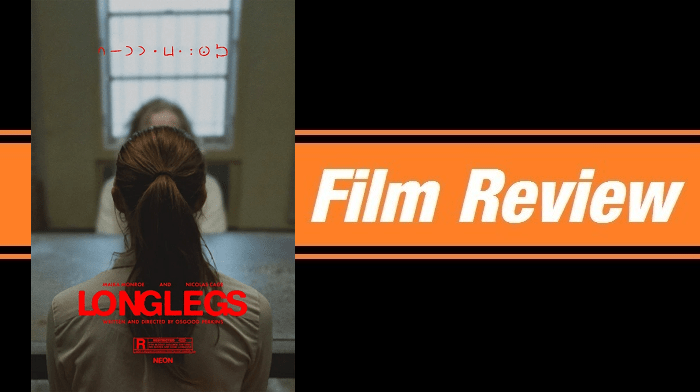
The promotional lead-up to the release of “Longlegs” has been pretty terrific. The creepy and cryptic first teasers, the equally mysterious full trailers, a series of unnerving movie posters, the slow and controlled hints at plot details – it has all worked together perfectly to build some real anticipation. Add in NEON’s stellar pedigree in the world of independent filmmaking and you have one of the most intriguing feature films of the year.
Now here’s the really good news – “Longlegs” absolutely delivers in nearly every way imaginable – as a horror movie, as a deep character study, and as a dark and disturbing crime procedural. It’s written and directed by Osgood Perkins, the son of the late actor and “Psycho” star Anthony Perkins. With “Longlegs” he has made a truly unnerving and visceral experience – one that sustains a chilling atmosphere and a steady sense of dread.

Perkins frames his story in three parts, each transporting us deeper into his bleak, nightmarish world. His approach is very measured and calculated. And while the subject matter is grim and some of the images are gruesome, there’s a level of restraint that leaves just enough to our imaginations. It’s an effective approach that sees Perkins burrowing into our subconsciouses and planting fears that linger for the film’s duration. He doesn’t feed the impulse to show us everything which may frustrate some mainstream audiences. But for those who don’t need to be spoon-fed every detail, “Longlegs” offers one of the most purely unsettling experiences to hit the screen in years.
Set in Oregon during the mid-1990s, a superb Maika Monroe plays Lee Harker, a rookie FBI agent who is assigned to an unsolved serial killer case involving a psychopath known as Longlegs (played by Nicolas Cage at his most demented and unhinged). Lee has an almost psychic intuition which prompted her boss, Agent Carter (Blair Underwood) to bring her onboard. Lee is meek and awkward but surprisingly capable and with good instincts. Think of her as Clarice Starling in demeanor and dress but minus the ambition.
As Lee begins digging deeper into the murders, she makes a number of discoveries involving information such as the dates of the killings and the birthdays of the victims. But they only scratch the surface of something far more insidious. Much like the messages Longlegs leaves at his crime scenes, the film itself plays like a code needing to be cracked. But just know, even when we finally do, not every question is given an answer which only adds to the movie’s sinister essence.

Nicolas Cage (who also serves as a producer) makes brilliant use of his limited screen time, manifesting the kind of terrifying madman that can turn your dreams into nightmares. At times you have to look close just to see Cage underneath the facial prosthetics, pasty white skin, and long stringy gray hair. But he’s there, and his maniacal transformation gets under your skin and makes you squirm. It may not go down as his best performance, but it’s as weird and gonzo as anything Cage has done to date.
As you watch “Longlegs” it’s easy to see the fingerprints of other movies that inspired it. “Zodiac”, “Se7en”, and “The Silence of the Lambs” are just some of the influences that stand out. Still, Perkins has made a movie that is distinctly his own – one that shows off the impeccable talents and confidence of its creator both as a storyteller and a visual artist. From his masterful use of framing, blocking, and aspect ratios to his keen instincts regarding tone, tension-building, and pacing, Perkins has crafted an eerie and riveting chiller that’s also one the best movies of the year. “Longlegs” is in theaters now.
VERDICT – 4.5 STARS









 Keith & the Movies