REVIEW: “Pain Hustlers” (2023)

Taking on America’s devastating opioid crisis is a noble task for any filmmaker. The epidemic began in the late 1990s when the prescription of opioids for pain management began to spike. Since then opioid-involved addictions have been on the rise, leading to an astonishing number of deaths by overdose (it went from 47,600 deaths in 2017 to 80,411 in 2021). So any movie that seeks to bring attention to the crisis should be commended.

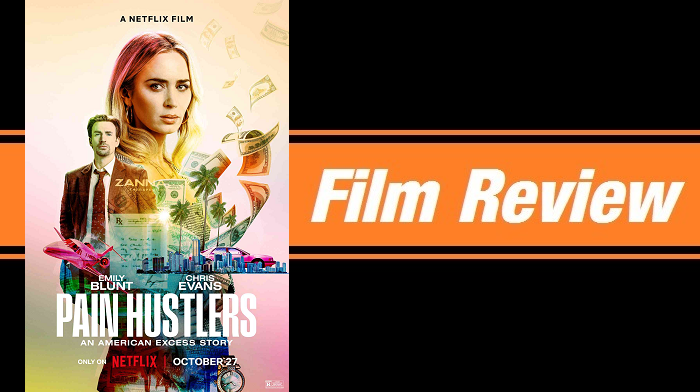
Such is the case with “Pain Hustlers”, a new film from Netflix based on a 2018 New York Times Magazine article of the same name by Evan Hughes and his subsequent book “The Hard Sell”. The film is directed by David Yates (the Harry Potter and Fantastic Beasts films) who works from a script by Wells Tower. The movie takes its aim at the people who fueled the epidemic, namely those in the pharmaceutical world. That includes greedy drug companies, devious middlemen. and crooked doctors – all driven by the seemingly endless flow of wealth at the expense of the sick and suffering.

Unfortunately “Pain Hustlers” isn’t the movie to recommend to those interested in the subject. It opens a number of revealing boxes and shines a pretty candid light on the vile and appalling practices of unscrupulous drug companies and complicit doctors whose rackets made them rich while killing an enormous amount of people in the process. But some misguided choices and a desire to be both clever and funny hinders its ability to tell an otherwise meaningful story. Even its impressive star wattage can’t save it from itself.

Image Courtesy of Netflix

The always great Emily Blunt stars in a role that she makes more compelling than it has any right to be. She plays Liza Drake, a down on her luck single mother working as an exotic dancer just to take care of her teenage daughter Phoebe (Chloe Coleman). Things only get worse after Liza loses her job, her car, and her place to stay. In desperation she calls Pete Brenner (a wildly uneven Chris Evans), a shady pharmaceutical executive she met in her club who once offered her a job making $100,000 per year.

It turns out that Pete works for a nearly bankrupt drug company called Zanna Therapeutics. It’s headed by Doctor Jack Neel (Andy Garcia), the creator of a cancer pain drug called Lonafen. Zanna needs Lonafen on the market but they don’t have the capital to compete with bigger companies who have a stranglehold on their region. So they hire Liza, fully expecting her to fail. But with the company about to go under, who cares?

Liza is given one week to convince one doctor to prescribe Lonafen. And wouldn’t you know it, not only does she succeed, she kickstarts the dying company. With Pete by her side, the two work the corrupt system and after one quarter they go from 0 to 86% market share in the southeast. But you know how stories like this go. It’s only a matter of time before their greed gets the better of them and they push things too far.

Image Courtesy of Netflix

To the film’s credit it does uncover quite a bit about how the scandalous system works. It shows drug company reps frequenting hospitals and pain management clinics, enticing physicians to get onboard with their product. It shows how grifts such as speaker programs whisk doctors away for lavish weekends in exchange for prescribing their drug. And it shows how quickly some doctors will toss aside their ethics once the checks start coming in.

Unfortunately all of that is undermined by the film’s numerous flaws starting with its seismic tonal shifts. It’s clunky desire to be both a slick edgy comedy and a smart eye-opening drama is best encapsulated in Chris Evans’ character and performance. One minute he tries to be serious-minded only to act like he’s doing an amped up scene from “The Wolf of Wall Street” shortly after. The movie sobers up in the last act but by then it’s a little too late.

Adding to its problems, “Pain Hustlers” is overlong and at times frustratingly dull. But perhaps its biggest offense lies in its focus. The movie is so honed in on its disgustingly wealthy profiteers that the true victims (the people who actually died) barely have a voice. In fairness, the movie takes a swing at acknowledging them. But they mostly feel like an afterthought. Altogether those are issues too big to overcome. Blunt deserves credit for carrying the load and making it watchable. But she can only do so much in a film that at times informs, but is too messy to truly spread awareness. “Pain Hustlers” is now streaming on Netflix.

VERDICT – 2 STARS

REVIEW: “Priscilla” (2023)

It was a little over one year ago that director Baz Luhrmann’s “Elvis” hit theaters. The vibrant and stylish biography of music icon Elvis Presley won over both audiences and critics before eventually earning eight Academy Award nominations. How interesting that in such a short time we’re getting another movie set around the life of the “King of Rock and Roll”. But this one comes with a distinctly different focus and is told from a uniquely fresh perspective.

“Priscilla” is based on the 1985 memoir “Elvis and Me” by Priscilla Presley, the wife of the legendary Elvis Presley who also serves as the movie’s executive producer. It’s written and directed by the ever compelling Sofia Coppola and is her first feature since her underappreciated 2020 dramedy “On the Rocks”. Much like the book, Coppola’s film looks entirely through Priscilla’s eyes, showing how she first met Elvis in 1959, their soon after marriage in 1967, and the rollercoaster ride that eventually led to their divorce in 1973.

Image Courtesy of A24

While at times Luhrmann’s film leaned heavily on its style and energy, Coppola takes a much more subdued approach to “Priscilla”. For most of its running time it’s patient and methodical, almost languid as it roots us in Priscilla’s experience. But that’s very much intentional and it does a tremendous job conveying her feelings while caught in the web of their high-profile relationship. Often lonely and isolated; other times smothered and domineered – it’s all sublimely realized through the quietly captivating performance from 25-year-old Cailee Spaeny.

Even more intentional is Coppola’s depiction of Elvis and her aim to stay away from anything that might be considered a reason why Elvis talks, thinks, and acts the way he does. In her movie he just is how he is. As a result Elvis (ably played by Jacob Elordi) is portrayed as an irredeemable monster, occasionally caring when it suits him, but mostly controlling, neglectful, and abusive. The majority of what Coppola shows us has been well-documented as true and snaps at the fabled image of Elvis Presley. But the lack of nuance in the portrayal, though still intensely effective, feels ever so slightly suspicious.

Coppola begins her story in West Germany where a somewhat shy 14-year-old Priscilla Beaulieu is introduced to 24-year-old rock star Elvis Presley. It’s immediately queasy and uncomfortable with words like predatory, grooming, and coercion coming to mind as they play out on the screen. There’s a striking delicacy in the way Coppola presents it, but also a unflinching honesty that forces the audience to reckon with what they’re seeing. And one of Coppola’s greatest tools is Spaeny who conveys youthful innocence with an alarming clarity.

From inexplicably winning her parents’ blessing to being whisked away to Elvis’ Graceland estate in Memphis, the movie follows the troubling pseudo storybook “romance”, with all of its red lights and warning signs, as it slowly erodes into something increasingly constrictive and toxic. Over time Graceland becomes a lavish prison for Priscilla. Her starry-eyed illusion turns to loneliness and melancholy as Elvis runs around with his meatheaded Memphis Mafia or is out West shooting movies and making tabloid headlines with his sexy co-stars. They eventually marry once she turns 21 and only months later they have a daughter, Lisa Marie. But things only get worse.

Image Courtesy of A24

For most of the film Coppola keenly visualizes Priscilla’s crushing circumstances through her deliberate pacing and careful attention to emotional details. It all flows seamlessly until the erratic final third where the film begins jumping from point to point, hitting interesting marks in Elvis and Priscilla’s crumbling relationship but doing little to connect them together in a satisfying way. It’s so strangely at odds with the first two acts and goes by in a blur. But maybe that’s what Coppola is going for. Perhaps that’s the way Priscilla recalls those final months with Elvis – as a blur.

Aside from the strategic depiction of Elvis and the skittish storytelling near the end, “Priscilla” is a captivating experience that provides an inside look at one of the most well known celebrity couples of our time. It features bravura filmmaking and is driven by a bold vision that doesn’t follow the normal biopic model we’ve grown accustomed to. Coppola has more on her mind and watching her bring it to life is riveting, even if she doesn’t hit every mark. (Just a note: in my screening the dialogue, specifically from Elordi, was often mumbled and hard to understand. I’m not sure whether it was Elordi’s performance, the sound mixing, or my theater. Let me know about your experience with the sound). “Priscilla” is in theaters now.

VERDICT – 3.5 STARS

RETRO REVIEW: “Piranha” (1978)

1978’s “Piranha” was one of many low budget B-movies that happily rode the massive success of Steven Spielberg’s “Jaws”. Released only one month after “Jaws 2”, the Joe Dante directed and co-edited “Piranha” did well at the box office despite its mixed reception from critics (the legendary Gene Siskel and Roger Ebert were notoriously brutal in their critiques). Yet over time the film has grown into a genuine cult classic.

“Piranha” is best described as a horror-black comedy with a small dash of satire thrown in for good measure. Dante directs John Sayles’ script with his tongue firmly in cheek. But it’s not so glaringly obvious as to make this a full-blown spoof. There’s just enough seriousness to add some genuine tension to what is a pretty silly story. Better yet, Dante shows a real love for genre filmmaking and there’s some impressive B-movie craftsmanship in this undeniable yet wildly entertaining “Jaws” knockoff.

Image Courtesy of New World Pictures

The movie begins with two teen hikers sneaking into an old abandoned fish hatchery. After slipping through a fence with a big No Trespassing sign the two geniuses decide to go skinny-dipping in a treated pond. Unfortunately for them this isn’t an abandoned hatchery. It’s actually an unmarked secret test site ran by the U.S. military. And in the pond are schools of ravenous genetically-altered piranha who make a quick lunch out of the dimwitted divers.

Soon after, a scatterbrained skiptracer named Maggie McKeown (Heather Menzies) is sent to locate the missing teens who were last seen near Lost River Lake. Her first stop is at the house of the down-on-his-luck and hard-drinking Paul Grogan (Bradford Dillman) who reluctantly agrees to guide her around the area. While investigating the old hatchery they find evidence that the teens had been there. In a hilarious mishap, they attempt to drain the pond to look for bodies but inadvertently let the piranha loose in the nearby river. Oops.

Maggie and Paul are confronted by a skittery scientist named Dr. Robert Hoak (Kevin McCarthy) who warns them of what they’ve unleashed. He tells them about “Operation Razor-Teeth” (I still laugh every time I say it), a government sanctioned secret program that genetically enhanced the piranha, turning them into ferocious man-eating weapons. And now they’re loose in the river heading downstream towards a children’s summer camp and the bustling Lost River Resort.

As our two protagonists race to warn the potential human fish food of what’s coming, we’re treated to several fun nods, especially to Spielberg’s classic. We also get countless funny lines and some even funnier characters (Paul Bartel’s pompous camp counselor Mr. Dumont instantly comes to mind). Then you have these amusing little Dante touches scattered throughout the movie. Like the crudely animated stop-motion lizard creature that’s hiding in Dr. Hoskins lab. We see it in one scene and then never again. It’s weird, but I love that Dante takes those crazy swings.

Image Courtesy of New World Pictures

But what’s most surprising are the unexpected flashes of humanity that often come at the most unexpected times and from the most unexpected people. Several specific scenes showing the real human depth of emotion have stuck with me. I don’t want to oversell it – “Piranha” is still very much a genre film with a keen awareness of what it is. But you may be surprised at its human pulse.

“Piranha” has its flaws, many of which are related to its minimal budget and resources. But that also highlights another of the film’s strengths – Joe Dante’s ability to do much with little, whether its in his storytelling or the special effects (his brilliantly edited piranha attacks are delightfully fierce and at times bloody terrifying). Ultimately Dante is the star and his personality seeps from ever pore of the movie. From his snarky jabs at the military and political apparatuses to silly flourishes that seem to come from out of the blue, Dante’s fingerprints are everywhere.

VERDICT – 3.5 STARS

REVIEW: “The Pod Generation” (2023)

Sophie Barthes returns to the director’s chair with “The Pod Generation”, her first feature film since 2014’s “Madame Bovary”. This kinda wacky, oddly alluring, and slyly funny sci-fi satire sees Emilia Clarke and Chiwetel Ejiofor (both very good) playing a married couple looking to start a family in a dystopian society marked by its dehumanization and artificiality.

In our current day when dependence on technology has never been higher and something as simple as human connection is quickly becoming a foreign concept, “The Pod Generation” makes for a timely movie. The not-so-distant future that Barthes envisions is a world where nature has become a commodity and society has been severed from any tangible connection to it. People rely on artificial intelligence in nearly every facet of their lives. It runs many of their homes, doing everything from fixing their breakfast to measuring their serotonin levels and gauging their “bliss index”. Even human psychiatrists have been replaced by A.I. therapists.

Image Courtesy of Vertical

Nowhere is this unhealthy disconnect more evident than in the area having children. While some still practice the archaic ritual of a natural childbirth, most go to companies that specialize in having your baby for you. They claim to be the answer to the declining birth rate which they blame on inconvenience. “Let us do the heavy lifting while you enjoy your babies.”

Enter Rachel (Clarke), a middle-aged businesswoman working for a large firm who just acquired such a company. It’s called the Womb Center (that’s 1-800-WOMB for those interested in a tour) and it is highly esteemed in its field. For the most part Rachel has bought into the tech-driven world of her day unlike her husband Alvy (Ejiofor), a botanist who spends much of his time growing plants in their apartment and lamenting their world’s detachment from nature.

At the aggressive urging of her boss, Rachel visits the Womb Center and schedules a tour without telling Alvy. They both want to have a child and he’s thinking natural birth. But she’s leaning the other way especially after her boss’ more self-serving recommendation. They ultimately decide to use the Womb Center which ends up taking their marriage in a number of unexpected directions as they face the convenient ups and more concerning downs of having a custom-made baby.

Image Courtesy of Vertical

Barthes has a lot of fun with her concept and her movie turns out to be a lot funnier than I expected. She pulls some good laughs from the sheer absurdity of we see and hear. Yet there is a not-so-subtle warning throughout that is worth listening to. Not everything done in the name of “progress” is for our good especially if we’re trading in the very essence of our humanity. Losing our identities, trying to manufacture happiness, sacrificing our individualism for convenience – just some of the thoughts that came to mind as I watched.

Unfortunately the movie loses its way a bit in the last act and ends without ever really satisfying the interests it raises in us along the way. I appreciated the hint of optimism we get in its final scenes, but was left wondering about the movie’s convictions. Still, Barthes poses a number of thought-provoking questions and has a lot of fun playing around in her cool futuristic sandbox. The movie looks great and the performances from Clarke and Ejiofor are key to centering us in the wacky world their characters inhabit. If only the movie a little more bite. “The Pod Generation” hits theaters August 11th.

VERDICT – 3 STARS

REVIEW: “Prisoner’s Daughter” (2023)

After premiering at last year’s Toronto International Film Festival, director Catherine Hardwicke’s film “Prisoner’s Daughter” is finally getting its proper release. The rather straightforwardly titled drama is written by Mark Bacci who puts together a touching yet routinely formulaic story. Yet he crafts characters who are easy to invest in largely because of the two terrific performances from Kate Beckinsale and Brian Cox.

“Prisoner’s Daughter” is a nice return for Hardwicke whose earlier 2023 film “Mafia Mamma” didn’t exactly hit its marks. Here she explores a number of familiar themes yet they’re ones rooted in real-life circumstances. It explores shattered relationships, forgiveness, and second chances in a way that won’t catch anyone by surprise. Still the sincerity that Hardwicke and her cast bring out of these characters forms the backbone of what is a heartwarming family drama.

Image Courtesy of Vertical

Cox plays Max MacLeary, a well respected inmate in a Las Vegas prison who is diagnosed with terminal pancreatic cancer while serving his sentence. His doctor gives him four maybe five months to live. Elsewhere his estranged daughter Maxine (Beckinsale) struggles to support her whip-smart twelve-year-old son Ezra. She works long hours at several low-paying jobs and still can’t afford her son’s epilepsy medication. To make matters worse, her deadbeat drug-addicted ex Tyler (Tyson Ritter) keeps showing up and causing trouble.

Max is surprised when the prison’s sympathetic warden informs him of an opportunity. He can leave prison and spend his remaining days under house arrest. But there’s one significant catch – his daughter must agree to let him live with her. At first Maxine wants no part of it. She hasn’t spoken to her father in twelve years and the wounds from their turbulent past are still deep. But due to her desperate need of money, she agrees so long as he pays rent and covers his own expenses.

This sets up the family dynamic that sits at the core of the “Prisoner’s Daughter”. Its overall trajectory is pretty obvious and (again) not much about it will catch you by surprise. The only real suspense comes in the last 15 minutes where the film takes a clever yet not especially cathartic turn. Still we remain engaged thanks to Beckinsale and Cox who create and develop an organic and compelling central relationship through performances that feel rooted in the real world.

Image Courtesy of Vertical

There are a few more touches that I enjoyed. For example I always enjoy seeing Ernie Hudson. Here he plays Max’s old friend who mentors and trains young boxers at his downtown gym. I also appreciated how Hardwicke tells her story while (mostly) steering clear of schmaltz.

Overall “Prisoner’s Daughter” may not do enough to set itself apart from the multitude of other redemption and reconciliation movies out there. But it gets by on the heartfelt chemistry of Kate Beckinsale and Brian Cox. They take a fairly routine arc and infuse it with a welcoming emotional heft that keeps us invested even if we have a good idea of where their story is going to end up. “Prisoner’s Daughter” releases in select theaters on June 30th.

VERDICT – 3 STARS

REVIEW: “Peter Pan and Wendy” (2023)

There wasn’t anything that had me itching for a new Peter Pan movie. I’ve never been a big fan of his story and haven’t really connected with the various movie adaptations we’ve gotten over the years. But then I heard David Lowery was directing a new Peter Pan movie and my curiosity kicked in. Suddenly I found myself interested in seeing yet another version of the J. M. Barrie children’s classic.

Lowery is a fascinating director who has strikingly unique movies like “A Ghost Story” and “The Green Knight” to his credit. Yet interestingly this isn’t his first collaboration with Disney. He also made 2016’s charming live-action adaptation “Pete’s Dragon”. With “Peter Pan and Wendy” Lowery sticks pretty close to the source material, updating in a few places while expanding in some others. It’s certainly a well made movie with Lowery once again showing his knack for visual storytelling. Yet I can’t help but ask, did we really need another Peter Pan movie?

Image Courtesy of Walt Disney Pictures

I pose that question because there isn’t a lot in “Peter Pan and Wendy” that we haven’t seen before. There’s clearly passion in Lowery’s direction and in his faithfulness to the source material. He and his co-writer Toby Halbrooks have an obvious affection for Barrie’s original work and for Disney’s 1953 animated film, drawing inspiration from both equally. But even with the dazzling visuals, spot-on performances, and effervescent spirit it all feels a bit too familiar and lacks enough of its own flavor to make it seem necessary.

That said, I can still see long-time fans of Peter Pan really enjoying this most recent adaptation. And there’s enough eye-popping spectacle and wonder for children to enjoy. It follows many of the beats you expect. We meet Wendy Darling (nicely played by Ever Anderson, daughter of Paul W.S. Anderson and Milla Jovovich) on the eve of being sent off to boarding school.Wendy is at the stage in her life where growing up has become a reality and the pains of change are weighing on her. She wants things to stay the way they are.

Then one night Wendy and her two brothers, John (Joshua Pickering) and Michael (Jacobi Jupe) are paid a visit by an adventurous young boy named Peter Pan. Along with his best friend Tinker Bell (Yara Shahidi), a sprightly little fairy who enables him to fly, Peter whisks Wendy, John, and Michael away from their home in London to Neverland, a magical island where you never grow old.

Neverland is gorgeously realized through Lowery’s lens. It a place of lush forests, tall cliffs, sun-soaked hills, and a sparkling sea. It’s a home for fairies, mermaids, a native tribe, and Peter’s gang of fellow children called the Lost Boys (but with girls). Oh, and there are also pirates – a ship full of them led by Peter’s arch-nemesis Captain Hook (played by a fun yet tame Jude Law). As you probably expect, their adventure eventually brings our young heroes face-to-face with Hook and his marauders. Through it all Wendy learns a few good life lessons and gains a new perspective on growing up.

Image Courtesy of Walt Disney Pictures

A few of Lowery’s changes are more noticeable. For example he adds a little more meat to Peter and Hook’s backstory. Tinker Bell feels less involved. And he plays around a bit with the ending. But none of the alterations to the story have much of an impact. They neither help or hurt. And that gets to the movie’s biggest issue. While it looks great, sounds great, and at times plays great, it doesn’t have much of a lasting effect.

Here’s the thing, there are a couple of terrific set pieces but it could’ve used more. It has a few tender moments but not quite enough of them. We get some laughs but not that many. Overall I can’t help but believe that with a few extra touches here and there “Peter Pan and Wendy” could have been truly memorable. As it is I’m guessing only the Peter Pan faithful will hold it dear. It’s hardly a bad movie. David Lowery is too good of a filmmaker for that. And anything he does is worth watching. But it doesn’t fully utilize his talents either. And ultimately that’s what left me feeling a bit indifferent. “Peter Pan and Wendy” is now streaming on Disney+.

VERDICT – 2.5 STARS