REVIEW: “Red Sonja” (2025)

Warrior and swordswoman Red Sonja has a long history in the world of pop culture. The character as most know her was created by Roy Thomas in 1973 and was somewhat inspired by Robert E. Howard’s Red Sonya of Rogatino from 1934. Thomas – the man who brought the classic pulp character Conan the Barbarian to mainstream American comics – often teamed Red Sonja with Conan in his Hyborian Age adventures prior to her receiving her first self-titled dedicated comic series in 1977.

Those who aren’t comic fans may remember Red Sonja from the not-so-great 1985 film starring Brigitte Nielsen. It was a spin-off from Arnold Schwarzenegger’s popular Conan movies but ended up a critical and commercial failure. Nonetheless a reboot was in the works in 2008 and again in 2015, but both attempts crumbled early into their conceptions. By 2021 a script had finally been written, and one year later M. J. Bassett was in line to direct.

Image Courtesy of Samuel Goldwyn Films

Now set for its official release, “Red Sonja” seeks to recapture the once popular sword and sorcery pulp from the 1980s. In many ways it’s very much a throwback action fantasy in line with that decade’s earlier (and notably bloodier) films. At the same time, it has no real connection to the 1985 film and is only vaguely in line with the more recent comics. Instead Bassett takes Red Sonja in a handful of new directions while mostly staying true to the essence of her character.

An inspired Matilda Lutz fully commits to her role as the eponymous central character. Her Red Sonja is a capable warrior who is not without her own vulnerabilities, many of which are traced back to her childhood. A series of flashbacks reveal she was separated from her people as a child after their village was violently ransacked by barbarians. Now, accompanied only by her fiercely loyal horse, Sonja roams the vast Dyrkania forest in search of her lost people, the Arkanians.

After pouring out some well-deserved vengeance on some shameless poachers, Sonja is taken captive by the film’s big baddie, Draygan (Robert Sheehan). He and his entourage are combing the forest for beasts to put in his arena. Sonja is immediately cast into his den of gladiators whose only purpose is to “die exceptionally“. The similarities to Ridley Scott’s “Gladiator” are impossible to deny. Sonja is told she can win her freedom if she wins in the arena. And she can only win in the arena if she wins the crowd (sound familiar?). Meanwhile her courage wins over the other gladiators who determine to fight by her side.

As for Draygan, in many ways he’s a blend of several fantasy villain archetypes. But Bassett and screenwriter Tasha Huo add a few layers of backstory that give him a touch of his own identity. Draygan is a self-ordained emperor who seeks the second half of a sacred tome that he believes prove he is the fulfillment of a mythical prophecy. He’s the epitome of a megalomaniac, using his crude mechanical inventions and army of loyalists to crush anyone in his way. He’s also a coward, hiding behind those very same forces he wields.

Image Courtesy of Samuel Goldwyn Films

To no one’s surprise, the story moves towards an inevitable showdown between Sonja and Draygan. As it does, we’re ushered through a violent world full of ancient gods, mythical creatures, and eye-popping natural beauty. At the same time, you can’t miss the moments of campiness and certain scenes where the film’s budget constraints are made pretty obvious. Still Bassett does a lot with what she’s given, unfolding an immersive story accented by beautiful landscapes, brutal violence, and a rousing heroine at its center.

For many (like me), “Red Sonja” is an entertaining callback to a nearly forgotten time in sword and sorcery cinema. It’s a movie that embraces the wonder (and at times absurdity) of the 1980s films with reverence. Yet it’s littered with lines of humor that keep it from taking itself too seriously. And while it has most of Sonja’s key ingredients including her fierce warrior tenacity, her fire-red hair, and even her signature chain mail bikini, it’s aware enough to poke fun at the old-school exploitation from her past. When all considered, “Red Sonja” is the worthwhile feature length adaptation the character has long deserved.

VERDICT – 3.5 STARS

50 Years Later: “Rollerball” (1975)

It doesn’t seem possible, but Norman Jewison’s “Rollerball” turns 50 this year. The movie doesn’t quite blend with the filmmaker’s more lauded movies such as “In the Heat of the Night”, “Fiddler on the Roof”, “The Thomas Crown Affair”, and “Moonstruck”. But this dystopian science-fiction sports film from 1975 remains a favorite of mine out of Jewison’s rich catalog – a sentiment that was reinforced after a recent rewatch.

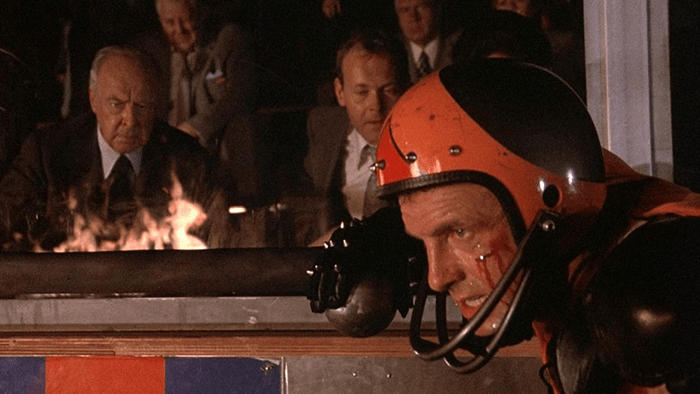
At the center of the movie is a futuristic sport called Rollerball – a violent fusion of roller derby, football, and motorcycles. Bizarrely, audiences at the time were so wild about the “sport” that several potential promoters and investors contacted Jewison in hopes of acquiring its rights. But considering the themes of the movie, it understandably never happened as the idea of an actual Rollerball league was repellent to the director.

The screenplay was penned by William Harrison who was adapting his own Esquire magazine short story titled “Roller Ball Murder”. It’s set in the ‘not too distant future’ of 2018 (which is both amusing and sobering for us in 2025) where our world is ruled by a multi-corporate dictatorship. The earth has been broken up into sectors, each controlled by a powerful global corporation. Together they run society by setting policy, enforcing the laws, and governing the working class in ways that protect their own self-interests.

Image Courtesy of United Artists

Though released in 1975, the movie’s insightful vision has proven surprisingly prophetic. Jewison and Harrison coat their story with a futuristic veneer. But its thematic core speaks to issues that some could argue are coming true right before our eyes. The corporate usurpation of democratic rule, the unwitting surrender of freedoms, and the suppression and control of information – all have a striking relevance today.

One of their biggest means of control is Rollerball, a corporately funded and globally sanctioned sport with a strict social purpose but that’s packaged as mainstream entertainment. Every sector has their own Rollerball team and a fiercely loyal fanbase. The executive board attributes Rollerball with putting an end to wars and curing society’s many ills. In reality the game was designed to “demonstrate the futility of individual effort” and it has had its desired effect

Jonathan E. (a terrific James Caan) is the very best in the sport and has become a star who is beloved all over the world. So much so that even fans of other teams chant his name. But Jonathan’s popularity and celebrity has certain executives concerned. They see his individual stardom as a threat to their control. The corporations believe Jonathan’s fame has made him bigger than the very game they use to keep the world’s population in line.

Jonathan is called to a meeting with Mr. Bartholomew (John Houseman), the chief executive of the Energy Corporation which oversees his sector and his Rollerball team. Bartholomew informs Jonathan that the executive board wants him to retire and they’re willing to give him a lavish retirement package that will set him up for life as well as a big public sendoff in his honor. But Jonathan doesn’t want to abandon his teammates and he doesn’t like the idea of being pushed out with no real explanation.

Image Courtesy of United Artists

The majority of the movie follows Jonathan’s bitter resistance to retirement and the executive board’s growing impatience with his lack of cooperation. We learn that Jonathan hasn’t trusted the corporations since a high-ranking official took his wife Ella (Maud Adams) as his own spouse. And he grows even more disillusioned after discovering how the corporations keeps their tight grip on society.

The film’s thematic depth is often overshadowed by the Rollerball matches themselves. Jewison, along with acclaimed cinematographer Douglas Slocombe and editor Antony Gibbs, film the Rollerball matches with indomitable fury and panache. They take this wild and violent sport and clearly define it for us, not through exposition but through their camera. And it gets more barbaric with each game, especially once the executives start changing the rules in an effort to target Jonathan.

“Rollerball” released as a thrilling future shock yet to this day it maintains a sharp contemporary bite. It’s highlighted with slick production values and brimming with astute social commentary. And its all accented by a touch of violent 70s exploitation. As with any 50-year-old movie, you can pick at things that haven’t aged particularly well. But “Rollerball” remains a fascinating sci-fi opus with the brawn of a pulse-pounding action thriller and the brains of a razor-sharp social critique.

VERDICT – 4.5 STARS

RETRO REVIEW: “Rolling Thunder” (1977)

A young Paul Schrader burst onto the Hollywood scene with his critically acclaimed screenplay for 1976’s “Taxi Driver”. Only one year later, “Rolling Thunder” was released, a gritty yet surprisingly thoughtful revenge thriller that Schrader originally penned in 1973. Schrader’s script was said to be a companion piece to “Taxi Driver” and even included a cameo by Robert De Niro’s Travis Bickle.

Interestingly George Romero was first in line to direct and later Schrader himself was attached. It eventually fell to John Flynn whose previous film was 1973’s “The Outfit”. Heywood Gould was hired for rewrites and a well-rounded cast was put in place. The final product wasn’t as dark and ruthless as Schrader envisioned, yet violence is in the very fabric of the story. But it’s the unexpected focus on the characters that makes “Rolling Thunder” stand out.

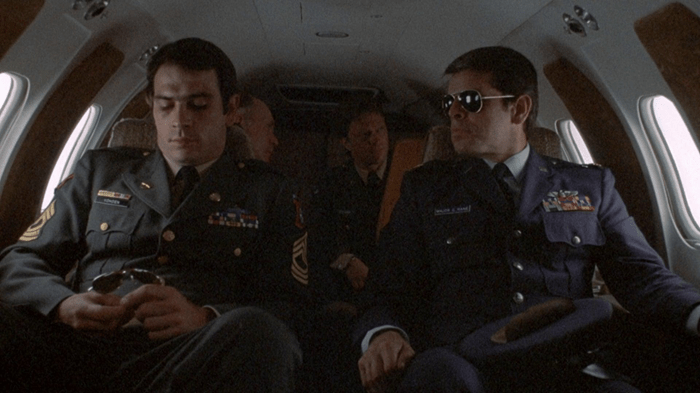
The movie opens in 1973 with Major Charles Rane (William Devane) and Sergeant Johnny Vohden (Tommy Lee Jones) returning home to Texas after spending seven tortuous years in a Hanoi POW camp. As the Vietnam vets arrive at the San Antonio airport, they’re greeted by an excited crowd from their hometowns who welcome them with a red carpet, a high school band, some local politicians, and a briefcase full of silver coins. Charlie and Johnny put on their best face before finally going their separate ways with their families.

Image Courtesy of American International Pictures

Despite his best efforts to readapt to normal life, Charlie’s reunion with his family doesn’t go as he had hoped. His son Mark (Jordan Gerler) was only eighteen months old when his father deployed making Charlie feel like a stranger. But even worse, his wife Janet (Lisa Blake Richards) tells him that she’s been seeing another man – a local sheriff’s deputy named Cliff (Lawrason Driscoll) – and the two are engaged to be married.

And then the movie takes its first violent turn. One afternoon Charlie comes home to find a group of armed thugs led by actor James Best waiting for him. They’re after the silver coins, and when Charlie refuses to give them up, they beat and torture him, going as far as grinding up his hand in a garbage disposal. Janet and Mark unexpectedly arrive and are taken by gunpoint. The thugs eventually get the coins and then violently gun down Charlie and his family.

Most of the story takes place after a wounded Charlie wakes up in the hospital where he spends months in rehab. Not only does he learn that Janet and Mark are dead, but he has also lost his hand which forces him to wear a prosthetic arm. In what feels like an oversight, the movie never gives Charlie that one needed moment to mourn. It’s true that a big point of the story is how Charlie (and by extension combat veterans) keeps many of his emotions pent-up. But we never see the devastation that should come from such loss.

Image Courtesy of American International Pictures

But we do see Charlie’s hunger for revenge which intensifies with the realization that his family’s murderers were never caught. So he decides to take matters into his own hands, and with the help of Vohden and a flirty local barmaid named Linda (Linda Haynes), he sets out to Mexico to pay back the thugs who took everything from him. From there the movie’s revenge-a-matic roots kick into gear and the curbed drama turns towards a violent conclusion.

The performances are mostly strong starting with Devane. David Carradine was among the original choices to play Charlie, but Devane brings everything the role needs. On the outside he’s very cordial and almost business-like with his emotions. But the repression of his character’s scarred psychology is what makes the performance special. Jones is also good, speaking volumes through his pained expressions. And the underrated Haynes adds a jolt of fresh energy and sexual tension. Dabney Coleman even pops up briefly as Charlie’s military psychiatrist.

It’s unfortunate to see “Rolling Thunder” lumped in among the many “Death Wish” clones. There are undeniable similarities, but it’s hardly a fair assessment. The movie is just as much a character study as it is a revenge thriller. Its themes are straightforward but insightful, plowing deep into the post-Vietnam alienation felt by many veterans. At the same time, there’s no denying its exploitation inspiration which pours out in the ultra-violent final 15 minutes. It doesn’t gel seamlessly with everything that came before it, but it does offer the audience a satisfying payoff.

VERDICT – 3.5 STARS

REVIEW: “Red One” (2024)

When done well, a trailer can play a big part in building anticipation for an upcoming movie. It’s equally true that a bad trailer can squash any excitement you may have for the film it’s promoting. Sadly the latter is true for “Red One”, a $250 million Christmas themed action-adventure-comedy that looked significantly cheaper in its trailers. But if anyone could overcome rough first impressions it’s Dwayne Johnson, Chris Evans, and JK Simmons, right?……..right?

Well, not exactly. “Red One” starts off promising and has some original ideas of its own. But most of its potential is quickly smothered out by the overall uninteresting story, uneven dialogue, and an endless parade of unimpressive digital effects that fall well below the quality you would expect from a $250 million movie. Worst of all, “Red One” seems to have an identity crisis. It clearly wants to be a kid-pleaser. But there’s enough profanity and violence to rule out smaller children. And it’s far too silly for adults. So who is it for?

Image Courtesy of Metro-Goldwyn-Mayer Pictures

Director Jake Kasdan (whose movies range from “Sex Tape” to the Jumanji sequels) and screenwriter Chris Morgan (the Fast & Furious franchise) incorporate and expand on well-known Christmas mythology. They also create a lot of their own – too much in fact. Kasdan and Morgan may earn points for imagination, but none of their additions help make “Red One” any more memorable. And no matter how hard they try (and they really try), nothing they do is able to generate the Christmas cheer they’re going for.

Johnson plays Callum Drift, the commander of the North Pole’s security force known as E.L.F. (Enforcement Logistics and Fortification). For decades Callum has served as chief protector and close friend of Santa Clause (Simmons). But he’s grown disillusioned with the state of humanity. When news breaks that for the first time in history there are more people on the Naughty List than the Nice List, Callum decides to retire after Santa’s upcoming Christmas Eve run.

But his retirement plans are put on hold after a black ops squad infiltrates the North Pole’s defenses and kidnaps Santa on the day before Christmas Eve. Callum contacts Zoe Harlow (Lucy Liu), the director of M.O.R.A (Mythological Oversight and Restoration Authority) whose resources lead them to Jack O’Malley (Evans), a dark web bounty hunter and hacker who also happens to be a “Level 4 Naughty Lister” (*gasp*).

After learning Jack inadvertently led the soldiers to Santa, they recruit him to help track down the mysterious person who hired him. After a numbing battle with giant snowmen on an Aruba beach and a Nick Kroll appearance that quite literally goes nowhere, it’s revealed that the culprit behind it all is Grýla, the Christmas witch (Kiernan Shipka). She’s intent on ridding the world of everyone on the Naughty List by imprisoning them in magic snow globes. And she needs Santa’s magic to do it.

Image Courtesy of Metro-Goldwyn-Mayer Pictures

Kasdan and Morgan at least make an effort to inject a heartbeat amid all the big budget dressing. The crude and irresponsible Jack attempts to reconcile with his son. Callum looks to find his Christmas spirit. But none of it comes across as authentic. And that’s the biggest problem with “Red One” as a whole. It all feels like a big studio project plucked right off the assembly line. And no amount of star-power or big screen charisma is able to overcome that.

To be fair, the story does pack a few laughs and there is some decent buddy-movie chemistry between Johnson and Evans. But the film can also wear you down. Look no further than a grueling tavern scene where Callum and Jack duke it out with Krampus (Kristofer Hivju), Santa’s estranged brother and Grýla’s former lover (yep, you read that right). In the end, a lot less of that and more humanity would have made “Red One” a much better movie.

VERDICT – 2 STARS

REVIEW: “Rumours” (2024)

Cate Blanchett continues her eclectic big screen run with “Rumours”, a movie that can’t possibly be categorized in any single genre. Directed by the filmmaking trio of Guy Maddin, Evan Johnson, and Galen Johnson, “Rumours” is a black comedy and a biting political satire set within a story that subtly mixes end-of-the-world science fiction with classic horror. It’s sometimes surreal, other times absurd, and proudly free of any creative constraints.

While all of that is amazing, “Rumours” is as puzzling as it is entertaining. This is a movie that poses more questions than it cares to answer. It throws in some outlandish twists which (probably) have allegorical purposes but I’ve yet to figure them out. And its melding of the real-world with the fantastical can be more confounding than insightful. At the same time, it’s beguiling in all the right ways and ultimately the cause of the chaos we witness takes a back seat to the bungling response from the seven world leaders we spend our time with.

The story takes place during a G7 summit – an annual gathering where leaders from the world’s wealthiest open democracies (Canada, France, Germany, Italy, Japan, England, and the United States) convene to discuss the globe’s biggest issues. For screenwriter Evan Johnson, this was fertile ground to satirize the inefficacy of world leadership especially in times of crisis. And the punchline to his biggest joke comes with the end credits and the realization that these characters haven’t accomplished a thing. And that’s the whole point.

Image Courtesy of Bleecker Street

Maddin and the two Johnsons put together a pitch-perfect cast who seem to be having a ball from the opening moments to the final frame. Chief among them is Cate Blanchett who plays German Chancellor Hilda Ortmann. She’s hosting the G7 Summit at a rural castle in Dankerode, Germany where seven stuffy world power-players come together to discuss an unspecified global crisis.

Joining Hilda is the embattled yet laughably stoic Canadian Prime Minister, Maxime Laplace (Roy Dupuis); the intensely focused British Prime Minister, Cardosa Dewindt (Nikki Amuka-Bird); the overly pragmatic United States President, Edison Walcott (Charles Dance), the chatterbox French President, Sylvain Broulez (Denis Ménochet), the jittery pacifistic Prime Minister of Italy, Antonio Lamorte (Rolando Ravello), and Japan’s Prime Minister, Tatsuro Iwasaki (Takehiro Hira) who the movie seems to forget about until the final 20 minutes.

After a few goofy photo ops, our seven dignitaries settle around a table in a newly built gazebo. There they begin putting together their provisional statement – an illusion of multilateral accomplishment to be shared with the entire world. But things turn upside down after the group discovers they’ve been abandoned. There are no staff members, no security, no cellphone service. To make matters weirder, they find themselves cut off from the castle by zombie-like “bog men” with muddy gelatinous bodies and some pretty twisted habits.

From there we follow our seven petrified leaders as they reveal how poor they are at world crisis management through how horribly they mismanage their own. It becomes evident that these aren’t the sharpest knives in the drawer, and in many ways they are personifications of their individual nations – something Maddin, Johnson, and Johnson have a field day with.

Image Courtesy of Bleecker Street

“Rumours” is littered with funny details including Dance’s intact British accent, the seemingly endless supply of cured meat in Antonio’s pocket, the group’s crazy obsession with finishing their provisional statement despite a looming apocalypse, and a hysterical third act bit involving an AI chatbot.

It also has its share of head-scratching inclusions. For instance, the sudden appearance of Alicia Vikander whose scenario never makes sense. And what’s with the pink squishy brain the size of a Volkswagen Beetle plopped in the middle of the forest? But if you’re seeking answers to the zaniness you’re already on the wrong track.

“Rumours” is a mannered slice of absurdism that can understandably frustrate with its slow build towards nothing. But if you can get onboard with its audacious approach, it’s hard not to enjoy the pomposity, platitudes and pantsuits. And with such a stellar all-star cast in on the joke, it makes the movie’s blunt-force message not just timely, but often laugh-out-loud hilarious. “Rumours” is now available on VOD.

VERDICT – 3.5 STARS

RETRO REVIEW: “Rage” (1972)

George C. Scott stars and makes his big screen directorial debut in “Rage”, a film inspired by true events known as the Dugway Sheep Incident. In the real-life account which took place in 1968, over six thousand sheep were killed on ranches near the U.S. Army’s Dugway Proving Ground in Utah. Dugway was a military facility established in 1942 to test chemical and biological weapons. Many believe a nerve agent escaped Dugway resulting in the sheep deaths. Clear culpability was never established but sweeping changes came in the aftermath.

“Rage” pulls from the true account and creates a gripping thriller built around the growing middle class distrust towards the United States government. It tells a smart, incisive, and cutting story that pulls no punches in its indictment of military and medical collusion and corruption. Meanwhile Scott’s direction is patient yet laser-focused, leaving no doubts about his convictions and keeping us honed in from the movie’s heartfelt start straight through to its violent finish where the film really earns its title.

Image Courtesy of Warner Bros. Pictures

By 1972 Scott had already established himself as a terrific actor. In fact he was just coming off of back-to-back Academy Award nominations for 1970’s “Patton” and 1971’s “The Hospital” (he won for “Patton” but infamously refused to accept it). “Rage” featured yet another of the grounded and organic performance the commanding Scott was known for. In it he plays Dan Logan, a widowed sheep rancher in rural Wyoming.

One afternoon Dan decides to take his 12-year-old son Chris (Nicolas Beauvy) camping near the edge of his property. While setting up their tents they notice a helicopter flying low to the ground. It’s a bit out of place – enough to grab Dan’s attention but not enough to worry him. After a great evening of father-son bonding the two call it a night. But the next morning, Dan wakes up to find Chris unconscious with a nose bleed. Understandably shaken, Dan picks up his boy and makes a mad run to his truck, passing several dead sheep on the way.

At the hospital Chris is put in quarantine while Dan is admitted for testing despite feeling fine. Their longtime family physician and friend, Dr. Caldwell (Richard Basehart) refers them to a young medical specialist named Dr. Holliford (Martin Sheen) who seems to recognize Chris’ symptoms but doesn’t offer many answers. Over time the doctors go from keeping news of Chris’ worsening condition from Dan to straight-up lying about it altogether.

Image Courtesy of Warner Bros. Pictures

The movie doesn’t make any effort to hide the truth behind what’s actually happening. In fact an early scene lays everything out. In it we see military leaders at a nearby base secretly discussing what went wrong during their recent test of a new nerve agent. They assess the potential damage done in the neighboring communities and immediately begin planning damage control. At the same time, they shamelessly see Dan and Chris as guinea pigs and their chance to study the nerve agent’s effects on humans.

The film’s third act sees the proverbial pot boil over as the deceit, misinformation, and posturing push Dan over the edge. It’s here that the movie takes a dramatic turn, but Scott (the director and actor) doesn’t overcook the ending. And he manages to retain our sympathies even as his character crosses one line after another. It’s a good punctuation mark for a movie that is essentially a lacerating critique wrapped inside a smart slow-burning thriller.

VERDICT – 4 STARS