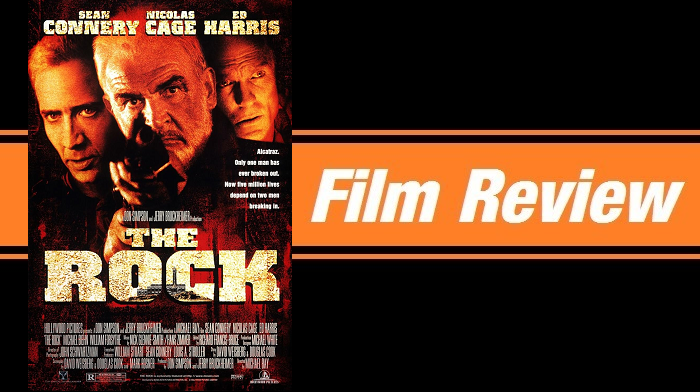
RETRO REVIEW: “The Rock” (1996)

Through the 1980s and 1990s Jerry Bruckheimer solidified himself as one of Hollywood’s biggest producers. Along with his partner Don Simpson, he produced many box office successes such as “Top Gun”, “Beverly Hills Cop”, “Flashdance”, “Crimson Tide”, and “Bad Boys”. Simpson would pass away in 1996, but Bruckheimer’s success only grew. He went on to produce massive hits like ”Pirates of the Caribbean”, “Armageddon”, “National Treasure”, “Black Hawk Down”, and most recently “Top Gun: Maverick”.

Simpson’s troubling lifestyle led to Bruckheimer ending their partnership. But before going their separate ways, the two agreed to finish their final project together. That project was 1996’s “The Rock”, a pure 90s action extravaganza. It was the sophomore effort from a young director named Michael Bay who had previously worked with Bruckheimer and Simpson on his debut feature, “Bad Boys”. “The Rock” was a hit with critics and with audiences with many still considering it to be Bay’s best film.

“The Rock” is fueled by big action scenes and thrilling set pieces. But it’s true bread-and-butter is found in burgeoning action star Nicolas Cage and the ground-shaking charisma of Sean Connery. Cage plays Special Agent Stanley Goodspeed, a biochemist and chemical weapons specialist for the FBI. Rather than field work, Stanley spends his days in a laboratory. Meanwhile at home, he gets news that his girlfriend Carla (Vanessa Marcil) is pregnant. She wants to get married but he’s got cold feet – a side of the story that never feels as relevant as it should.

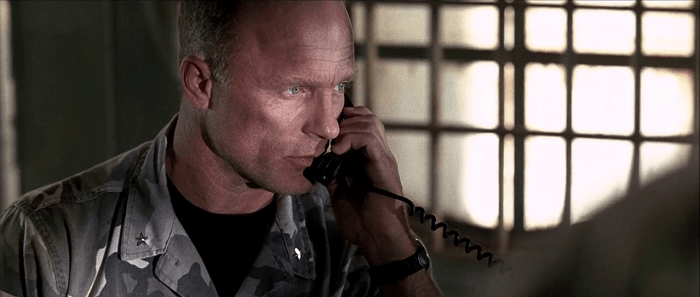
Enter Brigadier General Francis Hummel (Ed Harris). Frustrated with the government’s continued mistreatment of soldiers who died under his command, he and a his disillusioned yet loyal squad of Marines break into a military weapons base and steal fifteen rockets armed with warheads carrying VX poison gas. They then take over the notorious island prison of Alcatraz, once the home of America’s worst criminals; now a tourist spot. Hummel and his men take 81 hostages, set up missile launchers around the island, and aim their rockets at nearby San Francisco.

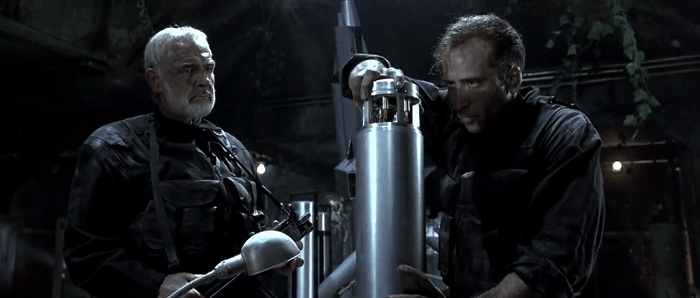
Upon receiving Hummel’s list of demands, the U.S. government and the FBI hatch a plan to stop the rogue general. They will send a Navy SEAL team to infiltrate and retake the island. They call in Stanley to accompany the team in order to deactivate the missiles on site. But how do you secretly infiltrate a prison known as impenetrable and inescapable? For that they’re forced to seek the help of John Mason (a scene-owning Connery), a former British SAS agent and the only person to successfully escape from Alcatraz. He’s been imprisoned for three decades – disavowed by his own government and his identity wiped by the FBI.

His offenses are revealed later, but with a promise of a full pardon, the shrewd and sophisticated Mason agrees to help. So he, a team of highly-trained SEALS, and a nervous, out-of-his-element Stanley set out break into Alcatraz before Hummel carries out his twisted plan. It’s a bonkers premise, yet at the same time it sets up the kind of wildly entertaining action that was a signature of the 1990s and that we (unfortunately) don’t get much of these days.

Aside from Connery, Cage, and Harris, “The Rock” is lined top-to-bottom with fantastic familiar faces. Among them is David Morse, William Forsythe, Michael Biehn, John Spencer, John C. McGinley, Tony Todd, and Bokeem Woodbine among others. They all gel nicely with Bay’s high-energy 1990s bombast. What makes it even better is that it’s a great movie to revisit. It’s still just as fun, wacky, and thrilling as it was in the theater nearly 30 years ago.

VERDICT – 4 STARS

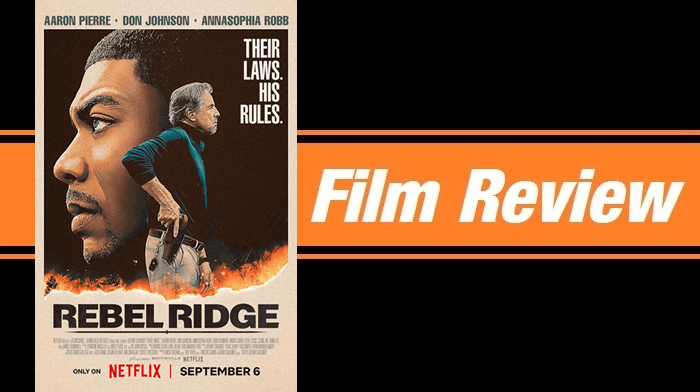
REVIEW: “Rebel Ridge” (2024)

It has taken a while, but the long-awaited new feature from filmmaker Jeremy Saulnier has finally arrived following some lengthy delays due to the COVID-19 pandemic and the departure of lead actor John Boyega. Relative newcomer Aaron Pierce signed on to replace Boyega and filming picked back up in 2022. Now “Rebel Ridge” is set to premiere on Netflix and it offers up yet another compelling rural-flavored thriller from Saulnier.

“Rebel Ridge” marks Saulnier’s fifth feature film and his first since 2018’s “Hold the Dark”. His latest fits snugly with his earlier movies, all of which show off his numerous creative influences. The Coen brothers, Sam Peckinpah, John Carpenter – those are just some of the names that come to mind when watching a Jeremy Saulnier film. At the same time, he brings a gritty aesthetic that make his movies distinctly his own. “Rebel Ridge” is much the same although to a notably lesser degree.

Image Courtesy of Netflix

Saulnier has always liked messy characters and we get plenty of them in “Rebel Ridge”. Pierce plays Terry Richmond, an ex-soldier who finds more than he bargained for in the one-horse rural town of Shelby Springs. Terry has come to town with $36,000 in cash to bail out his cousin Michael (C.J. LeBlanc) who was arrested for a misdemeanor possession charge. Terry hopes to get to town and post bail before Michael is transported to a neighboring prison.

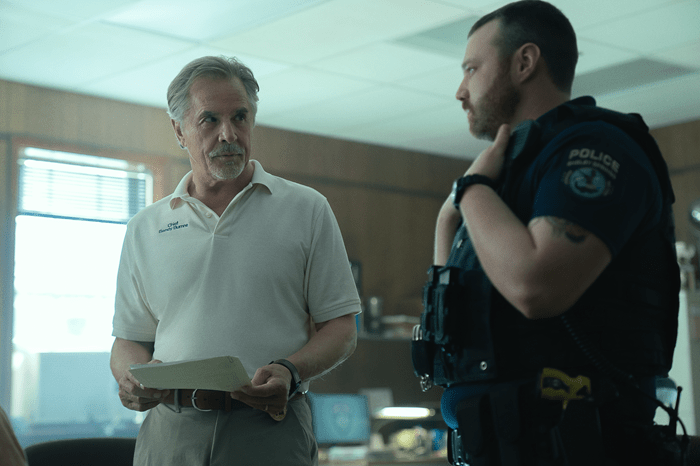
But his plans are turned upside down when he has a run-in with two local cops, Evan Marston (David Denman) and Steve Lann (Emory Cohen). After roughing him up, the officers unlawfully confiscate Terry’s $36,000 under “suspicion” that it’s drug money. Desperate, Terry rides to the Shelby Springs police station seeking help from Chief Sandy Burnne (Don Johnson). But he quickly discovers he and his cousin are victims of a long-running racket extending from the police department to the county court system.

As his story unfolds, Saulnier peels back layer after layer of small town corruption – so much that over time it can be a challenge to follow. There are numerous revelations, misdirections, and plot maneuvers, most coming in the second half. It all works to create a palpable tension that steadily builds towards an inevitable violent showdown. But neither the tension nor the violence is as gritty and raw as in Saulnier’s other films. It’s a tamer movie, yet one that still features his signature style and focus.

Image Courtesy of Netflix

As for the performances, Pierce has the physical presence and necessary intensity, but he’s nearly stoic to a fault. Still, he has the sturdiness his character needs. AnnaSophia Robb is equally solid playing Summer, a Shelby Springs court clerk who agrees to help Terry uncover the truth. Robb ends up having a significant role, and while her thick Southern accent is wobbly in places, she’s still convincing and earns our empathy. Then there’s Don Johnson who’s fun to watch in any movie he pops up in.

“Rebel Ridge” is undeniably Jeremy Saulnier’s movie. He directs, writes, co-produces, and edits a film that may surprise you with how deep in goes into developing its story. Those accustomed to Saulnier’s edgier work in films like “Blue Ruin” and “Green Room” may be surprised by how tame this one is by comparison. Yet it doesn’t take a keen eye to recognize and enjoy his signature techniques and thematic interests. And that’s what will always put me in a seat whenever a Jeremy Saulnier movie hits the screen. “Rebel Ridge” premieres on Netflix September 6th.

VERDICT – 3.5 STARS

REVIEW: “Ride” (2024)

C. Thomas Howell gives a career best performance in “Ride”, a rural family drama with a hint of crime thriller thrown in for good measure. Howell plays John Hawkins, a retired bull riding champion struggling to hold his family together in the face of numerous difficulties. John is a grizzled and world-weary soul who we watch do everything in his power to provide for his loved ones only to see it all crumble under economic hardships and past choices that come back to haunt him.

The driving force behind “Ride” is director, co-writer, co-producer, and co-star Jake Allyn. The film marks Allyn’s directorial debut and is the culmination of a deep emotional journey that saw him pouring more and more of himself into the project as it took form. As a result we get a compelling, poignant, and insightful drama with the kind of tough-minded truthfulness that can only come from the heart.

Image Courtesy of Well Go USA

Allyn co-wrote the script with his best friend Josh Plasse who also plays his kid brother in the film. Their story is set in the small Texas town of Stephenville and focuses on the Hawkins family. Allyn and Plasse build an interesting and complex dynamic that revolves around three generations of bull riders and the forces that pull at their relationships.

John is a former rodeo star in desperate need of money. He and his wife Monica (Annabeth Gish), who is the town sheriff, are drowning in medical bills from cancer treatments for their 11-year-old daughter Virginia (Zia Carlock). A potential life-saving treatment is recommended which gives their family some much-needed hope. But John needs a $40,000 first payment before Virginia can even be admitted into the clinic. John attempts to sell assets and tap into his pension which only adds unneeded stress on his already shaky marriage.

Meanwhile John and Monica’s estranged son, Peter (Allyn) arrives back in town after spending four years in prison. He reconnects with his grandfather Al (Forrie J. Smith) who helps him get settled and encourages him to get back to bull riding. But Peter immediately gets in deep with his former cell mate, a local drug dealer named Tyler (Patrick Murney), which thrusts him back into the drug-addled life that put him behind bars.

Image Courtesy of Well Go USA

We learn that Peter’s crimes damaged his relationship with his parents, leading them to never write or visit him while he was in prison. But with Virginia’s life on the line, both sides are forced to work through their own faults and failures if they are going to have any chance to save her. And that’s where the heart of “Ride” lies – in seeing these flawed people navigate through the mistakes they’ve made while at the same time being crushed by various systems that seem to be working against them.

Allyn does a nice job planting our feet in his world by offering an authentic portrayal of rodeo life and filling it with characters who feel firmly rooted in it. They’re brought to life by a solid ensemble led by an emotionally rich and soulful C. Thomas Howell performance. Allyn uses their story to take some healthy sociopolitical swings, specifically at the U.S. healthcare system. Yet he never veers from its deeply human core. And that’s what makes his movie resonate. “Ride” is available on VOD and home video.

VERDICT – 4 STARS

REVIEW: “Reagan” (2024)

These days there are few things more acidic than modern day politics. To be fair, politics have always been competitive and sometimes contentious. But there was a time when rival parties good duke it out in the hallowed halls of Washington DC and then have drinks together afterwards. I may be wrong, but we seem far removed from that today, especially at the national level.

Ronald Reagan had a way of connecting with people regardless of which side of the political aisle they sat. Like all presidents he had his detractors, but he was able to speak in a way that earned him the moniker The Great Communicator. During Reagan’s presidency people were inspired when he called on Mikhail Gorbachev to tear down the Berlin Wall. People were consoled when he addressed the nation following the Space Shuttle Challenger disaster. And people were collectively shocked when he was nearly assassinated by John Hinckley Jr. It was a different time.

Sean McNamara directs “Reagan”, a long developed biographical drama based on the life of the 40th President of the United States. Written for the screen by Howard Klausner and Jonas McCord, it’s based on Paul Kengor’s 2006 book “The Crusader: Ronald Reagan and the Fall of Communism”. It’s an ambitious project that attempts to cover more ground than it probably should, often resembling a rapid-fire series of dramatized news clips more than a fully fleshed out story. Yet, “Reagan” remains as intriguing as its subject who is portrayed by a thoroughly committed Dennis Quaid.

Image Courtesy of Showbiz Direct

The movie is framed by a conversation between a young Communist politician (Alexey Sparrow) described as the “rising star of Mother Russia” and an aged former KGB agent (Jon Voight) who followed Ronald Reagan’s rise which helped precipitate the Soviet Union’s fall. It’s through their discourse that we are transported back in time to key points in Reagan’s history. They include his small town childhood with his devout mother Nelle (Amanda Righetti) and his alcoholic father Jack (Justin Chatwin), his time as a lifeguard at Lowell Park, doing radio broadcasts, and playing football at Eureka College.

A lot of time is spent on Reagan’s Hollywood years where he made numerous feature films before and after enlisting in the military. But rather than focusing on his movies, McNamara hones in on the Reagan behind the scenes including his marriage to actress Jane Wyman (Mena Suvari) and their eventual divorce, his busy tenure as president of the Screen Actors Guild, and of course his first meeting with his future wife, Nancy Davis (Penelope Ann Miller). Through it all the film attempts to emphasize Reagan’s willingness to tackle problems head-on as well as his growing concern over the spread of Communism. And they factor into the next phase of his life – politics.

From there the movie chronicles Reagan’s rise through the political ranks beginning with his election as California Governor where he served eight years. It covers his loss to Gerald Ford in the 1976 Republican primary and his landslide 1980 victory over incumbent Jimmy Carter to become President of the United States. The filmmakers try to hit most major targets during his presidency: “Reaganomics”, Hinckley’s assassination attempt, the Iran-Contra affair, the Korean Air Lines tragedy, the famous Berlin Wall speech, and his Cold War chess match with Mikhail Gorbachev (Olek Krupa) just to name a few.

On more personal notes, McNamara often takes us back to Reagan’s loving relationship with his mother, stressing the impact she had on his life. We’re shown his mutual admiration and respect with Margaret Thatcher (Lesley-Anne Down), his friendship with Democratic Speaker of the House Tip O’Neill (Dan Lauria), and the endless support he receives from Nancy. It all culminates in the film’s touching finish that addresses his failing health including being diagnosed with Alzheimer’s disease.

Image Courtesy of Showbiz Direct

“Reagan” features an enormous cast, most of who deliver solid performances. But it’s Dennis Quaid who rightly earns the most attention. It takes some time and effort, but he is ultimately convincing with his look, voice, and mannerisms. In an attempt to make him look younger, some early scenes are visually awkward with too much digital gloss. But the story reaches a point where Quaid falls rather seamlessly into Reagan’s skin. It’s here that his performance really elevates.

The film does run into a few common biopic traps. For example its story structure is fairly routine, the writing can be rose-tinted and a little on-the-nose, and it overdramatizes a couple of key scenes. But the movie’s biggest issue is its ambition. It simply tries to cover too much. As a result, several events in Reagan’s life get shortchanged. And it can be hard to follow along as McNamara darts from one significant moment to the next. It’s a bit like watching a CliffsNotes version of Reagan’s life.

Even with its issues, “Reagan” takes us on a fascinating biographical journey through an extraordinary American life. It’s a well-made and well-acted feature that looks at Ronald Reagan through an undoubtedly sympathetic lens yet without ever turning overtly political. Instead its interests are in exploring Reagan’s challenges and achievements, balancing them with the man he was underneath. It offers a compelling perspective on a broad timeline of events. And like Reagan himself, it’s a movie that can speak to anyone who can hear beyond their own political affiliation. “Reagan” opens in theaters August 30th.

VERDICT – 3.5 STARS

REVIEW: “Rebel Moon – Part One: Director’s Cut” (2024)

The genesis of Zack Snyder’s epic space opera “Rebel Moon” dates all the way back to 1997. In the years that followed, Snyder would pitch his idea to LucasFilm as a new Star Wars installment. Later he attempted to turn it into a video game. And even later, he considered developing it as a television series. He would eventually make a deal with Netflix, but it came with an agreement that (so far) has led to some pretty mixed returns.

That agreement was that Snyder would be given the creative freedom to fully realize his vision for “Rebel Moon”. It would come in the form of director’s cuts that would offer longer and R-rated dives into his world and its rich mythology. But in order to get the green light, Snyder had to agree to also make a neutered PG-13 version in hopes of it having a broader blockbuster appeal. The two-part PG-13 cut earned big viewership numbers for Netflix but mostly bad reviews from critics.

To be honest, reading reactions to Zack Snyder movies can be a challenge. Viewers are often broken into two groups – the Snyder loyalists who adore anything he does regardless of its quality and the poorly veiled haters who bristle at the mere mention of his name and are as feral in their disdain for his movies as any doting Snyder fanboy. After weeding out all of the noise, the PG-13 product turned out to be entertaining. But it was clearly just a slice of something bigger and potentially better.

Image Courtesy of Netflix

Part One of Snyder’s director’s cut adds 70 minutes and gets a new title. “Chalice of Blood” essentially covers the same ground as its significantly shorter PG-13 version, but adds new layers to the overarching story, recontextualizes several character arcs, and gives the film a darker edge through its deeper world-building and amped-up brutality. Also, Snyder’s influences are clearer and better utilized. He’s made it known that “Star Wars”, “Seven Samurai”, and “Heavy Metal” magazine were among his many inspirations. Here they’re more obvious yet better realized.

Among the strengths of “Chalice of Blood” is how it sheds much needed light on several characters and their stories. Chief among them is Jimmy (voiced by the great Anthony Hopkins), one of the last remaining members of a race of sentient robotic knights. In the shortened film version, very little about his character made sense. In this cut we see his journey of self-discovery as he searches for a new sense of purpose. We get to witness the evolution of Jimmy leading to him becoming one of the young franchise’s most compelling players.

Another character to benefit from more attention is Aris (Sky Yang), a young soldier with the Imperium who sides with the villagers on Veldt. We’re shown a side of his story that adds much-needed context to the character’s actions. As for the film’s big baddie, the sadistic Admiral Atticus Noble (Ed Skrein), he’s seen as even more cold-blooded in his psychopathic loyalty to the Motherworld. As for the main protagonist, Kora (Sofia Boutella), we get a clearer understanding of the pain that haunts yet drives her. It’s mostly thanks to the flashbacks which are better realized this time around.

Image Courtesy of Netflix

Despite a runtime of 3 hours and 24 minutes, there is still that lingering sense that Snyder is trying to cover too much ground. It still feels as if there is so much more to be told. For example, the motivations for nearly every warrior who joins Kora’s group could still use more explanation. Their backstories are alluded to more than explored, leaving them too thinly sketched. Still, Djimon Hounsou, Bae Doona, and Staz Nair all make compelling heroes even if their individual backgrounds get shortchanged.

And of course the action gets a welcomed makeover via the movie’s bigger and bloodier set pieces. Those prone to push back on Snyder’s distinct style are almost certain to roll their eyes at the elaborate canvases he creates. But his visual flair fits these movies and could even be called refreshing. Take his signature use of slow-motion. At a time when so many action scenes are hacked to the point of being indecipherable, Snyder’s technique is satisfying its own stylishly indulgent way. And this time there are no constraints with the violence. It’s fittingly graphic, sometimes excessive, but often thrilling.

It’s easy to see how the director’s cut of “Rebel Moon” provides a more fully formed expression of Zack Snyder’s ambitious vision. The visuals are more eye-popping, certain scenes have more impact, and the overall stakes are higher. A few nagging problems from the PG-13 cut remains. And things occasionally veer into the gratuitous, whether it’s a gush of digital blood or a superfluous early sex scene. But for the most part Snyder keeps his focus on developing this vibrant and diverse world, this time taking us beyond a mere sample size and offering us something more established and engaging. The “Rebel Moon” director’s cuts are now streaming on Netflix.

VERDICT – 4 STARS

REVIEW: “Rebel Moon – Part Two: The Scargiver”

The first film in Zack Snyder’s original two-part space opera “Rebel Moon” was met with the ever so predictable panning, much of it from those who seem triggered by the mere mention of the director’s name. The movie wasn’t nearly as bad as fashionable sentiment declared and it did a good job setting the next film which Netflix was onboard to release as part of their exclusive deal with the strangely polarizing filmmaker.

But in fairness, “Rebel Moon – Part One” was far from a flawless film in large part due to a particular demand in Netflix’s deal with Snyder. It seems Snyder had always envisioned “Rebel Moon” to be epic in scale and R-rated. Netflix agreed to let him fully realize his vision but demanded that he first release a shortened PG-13 cut of both films. This led to “Part One” feeling shortchanged in some key places including its character development and even the action.

Image Courtesy of Netflix

That problem is even more pronounced in “Rebel Moon – Part Two: The Scargiver”, a movie that eventually gets to the big showdown both films have been building towards but that feels as though large chunks are missing. To no surprise it’s a visual feast and the performances bring these characters to life. But the action, while often beautifully shot, is once again pruned as evident by noticeable camera zooms and awkward cutaways to avoid violence that may push to an R-rating. And then there is the story which (in this version) tries to get by on the bare basics. You can tell there’s much more than what we get.

“Part Two” begins with Kora (Sofia Boutella) and Gunnar (Michiel Huisman) returning to their village with the warriors rounded up in “Part One” who have agreed to help the villagers defend themselves against the oppressive Imperium. Those warriors are a former Imperium general Titus (Djimon Hounsou), a cyborg swordmaster Nemesis (Doona Bae), a prince-turned-blacksmith Tarak (Staz Nair), and a young rebel fighter Millius (Elsie Duffy).

What they didn’t realize is that the ruthless Admiral Atticus Noble (Ed Skrein), who Kora killed in the first film, has been resurrected and is now set to lead his forces on a siege of their village. So Kora and the warriors quickly begin training the inexperienced farmers in order to mount some kind of defense against Noble’s army. The full final hour of the movie is dedicated to the epic battle as it unfolds in the air and on the ground.

But getting to that final hour is a little rocky. That’s because “Part Two” takes too long to get going. The first hour has its moments and Snyder takes the time to give his characters more to do than just fight. But there’s not enough compelling drama and lengthy exposition is no substitute. I hate to beat a dead horse, but it’s another case where it feels like segments are missing. Again, it’s trimmed down to the bare basics with only a handful of scenes that actually feel as though they’re adding anything of value to the characters or the overall story.

Image Courtesy of Netflix

But then the second hour kicks in and Snyder gets down to doing what he does best. The glacial pacing of the first 60 minutes gives way to an action-packed second half that’s full of exciting set pieces and cool combat in spite of its obvious PG-13 edit. Snyder’s creativity really shines as he turns a farmland into war zone and even more so when the fight is taken to Noble’s massive starship hovering in orbit. And the inevitable second round between Kora and Noble is nothing short of jaw-dropping.

“Rebel Moon – Part Two: The Scargiver” directly continues the story of the first film in such a way that it’s hard to see it as its own movie. For many (like me) that’s hardly a dealbreaker. But if you didn’t like “Part One” it’s hard to imagine this one will change your mind. Most of the same limitations remain but to a greater degree. This is especially true with the characters who get the worst end of the PG-13 edit (take Jimmy, a robot knight voiced by the great Anthony Hopkins who is all but forgotten for most of the film). Snyder still nails his strengths. We’ll just have to wait to his director’s cuts to experience his full vision. “Rebel Moon – Part Two: The Scargiver” is now streaming on Netflix.

VERDICT – 3 STARS