
REVIEW: “Thieves Highway” (2025)

It’s been too long since the underrated and undervalued Aaron Eckhart has been in a major big screen movie. People may forget, but Eckhart has a pretty stellar résumé, having worked with such heavy-hitting directors as Oliver Stone, Steven Soderbergh, Ron Howard, John Woo, Brian De Palma, Christopher Nolan, and Clint Eastwood. But while he waits for Hollywood to remember his name, Eckhart continues to work, having starred in a run of straight-to-video action thrillers.

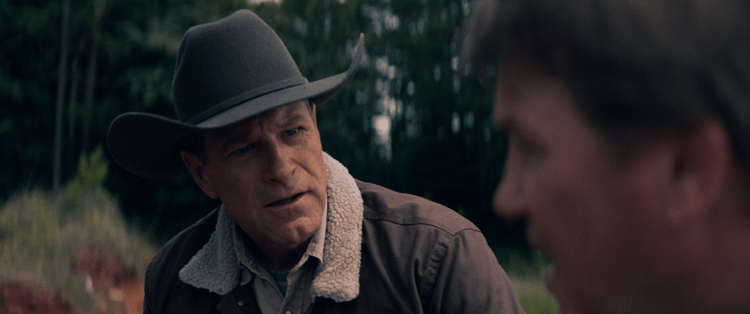
His latest thriller is “Thieves Highway”, a feature strengthened by its interesting setting yet frustratingly hampered by a formulaic plot. Written by Travis Mills, the story is set in rural Oklahoma where a sharp spike in livestock theft has cost ranchers and the industry millions of dollars. Eckhart plays the grizzled Frank Bennett, a “cow cop” with the Oklahoma Department of Agriculture who tracks and apprehends modern day cattle rustlers.

Frank’s job has gotten tougher of late. Not only are the cattle thefts on the rise, but the rustlers have become more ruthless, as evident by Frank’s friend and fellow lawman (Johnny Messner) being left permanently paralyzed after a recent encounter. Yet Frank pushes on, mainly because he has nothing else to fall back on after the death of his wife. But we see a spark when he bumps into an old acquaintance named Sylvia (Brooke Langton). Unfortunately their undercooked meet-cute doesn’t lead to anything we can’t see coming.

Equally predictable is the fate of Frank’s partner, Bill (Lochlyn Munro). After sharing his plans to retire and spend more time with his family, Bill insists on accompanying Frank in confronting a gang of rustlers outside of town. To no surprise, Bill is gunned down while Frank manages to escape. From there, a stranded yet determined Frank looks for a way to catch the criminals who killed his partner. Meanwhile the gang hunts for Frank, led by Jones (Devon Sawa), a deranged sociopath wielding a World War II Thompson submachine gun.

Most of the film sees director Jesse V. Johnson setting up a game of cat and mouse between the outgunned but resourceful Frank and Jones, along with his colorful band of thugs. Frank is left stranded with no vehicle and no cell service. But he finds an unexpected ally in an off-the-grid hermit named Axsel (Tracy “The D.O.C.” Curry). Elsewhere a plucky waitress named Peggy (Lucy Martin) finds herself playing a meaningful role in the chaos.

“Thieves Highway” moves along at a fairly crisp pace while streamlining its storytelling within a lean 87-minute runtime. At the same time, the movie could have fleshed out and filled out more if given an extra fifteen minutes or so. As it is, “Thieves Highway” travels down a fairly predictable path. Johnson and Mills do some fun maneuvering with their characters and Eckhart is a sturdy enough lead. But the storytelling takes too many shortcuts and the overall lack of suspense keeps us one step ahead.

VERDICT – 2.5 STARS

REVIEW: “Train Dreams” (2025)

Throughout his thirty-year career, Joel Edgerton has shown himself to be an incredibly versatile actor. It’s a fact that is highlighted by the sheer array of roles he has taken on, whether in gritty crime films like “Animal Kingdom”, twisted psychological thrillers like “The Gift”, or hushed yet affecting human dramas such as “Loving”. His latest film falls into that latter category. In “Train Dreams”, Edgerton’s performance is quiet and understated yet with deep emotional depth. It’s a tremendous turn.

“Train Dreams” is the sophomore directing effort from Clint Bentley who also wrote the screenplay with his frequent writing partner Greg Kwedar. The two are coming off an Academy Award nomination for “Sing Sing”. Now they’re adapting Denis Johnson’s award-winning work which began as a 2002 short story in The Paris Review before being published as a novella in 2011. The duo bring the heart of Johnson’s story to the screen under Bentley’s assured direction. It results in one of the year’s very best films.

“Train Dreams” is a deeply affecting snapshot of life, with all of its joys and tragedies, as seen through the eyes of one man trying to find his place in a changing world. In one sense it plays like an echo of a bygone era, when the world seemed bigger and taming it came at the expense of men on the margins who tirelessly worked in the background of the rapidly expanding America. It’s also a moving and firmly grounded character study, spanning decades of one such man’s life.

Image Courtesy of Netflix

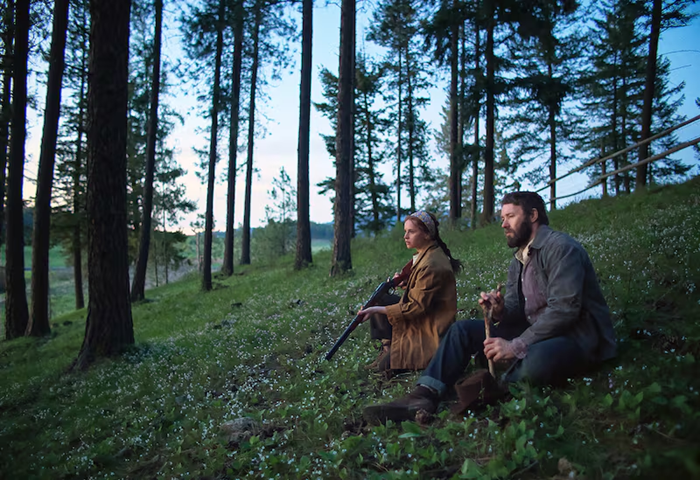
The story opens in the early 20th century during the boom of Western expansion. It follows Robert Grainier (Edgerton), an unremarkable man by the world’s standards who works as a logger in the Pacific Northwest. It’s solitary work done mostly by solitary men – a description that fits Robert well. He’s a hard worker who blends right in with the beautiful yet rugged wilderness. But underneath his burly exterior is a gentle and soft-spoken soul who mostly keeps his thoughts to himself. He’s more of an observer than a talker, yet we learn so much about him through Edgerton’s ability to speak volumes with very few words.

Robert takes a job with a railroad company, building a lengthy trestle bridge over a river gorge. It’s decent money, but it’s a decision he soon regrets. Robert witnesses the senseless killing of a Chinese immigrant co-worker in the name of justice. Despite not having a part, the guilt of not stopping it haunts Robert, prompting him to wrestle with an existential question for the remainder of the movie, “Do the bad things we do follow us in life?” After the job, he leaves the railroad and goes back to logging.

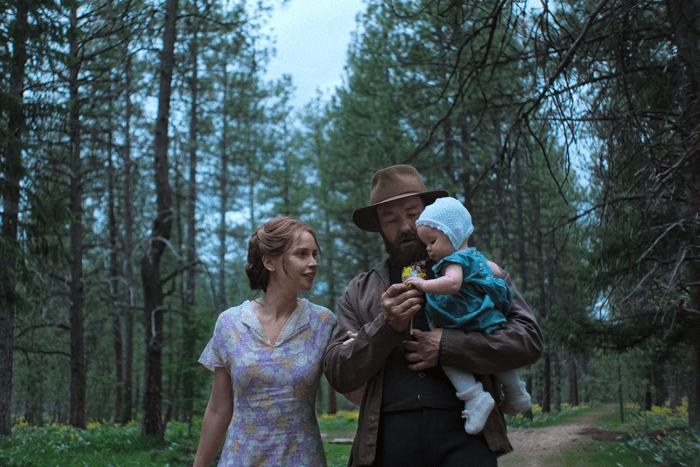
Robert’s solitude is interrupted when he meets and instantly falls for the forthright Gladys (Felicity Jones). In no time, the two end up married. They purchase an acre of land where they build a cabin on the banks of the tranquil Moyie River. Shortly after, they have a baby girl. For Robert, it’s the happiest he has ever been. And for the first time in his life he feels as if he has found his purpose. But just as he would get used to being at home, logging season would roll back around. And the jobs were taking him further and further away from home.

From the elegant opening frames, it’s obvious that Bentley is remarkably in-sync with the story he’s telling and the period he’s recreating. There is a poetic lyricism anchoring his storytelling which patiently progresses with an observant eye and a soul-stirring rhythm. There’s also a fascinating subtlety in Bentley’s handling of things, even later as Robert’s life takes a heart-shattering turn. Bentley maintains a quiet control of his material. And he knows what he has in Edgerton – an actor who can do heavy lifting with a single expression.

Image Courtesy of Netflix

There’s also Bentley’s reliance on visual language to convey feeling while also visualizing this very distinct era. The rapturous cinematography of DP Adolpho Veloso utilizes natural lighting and an assortment of striking lens choices to capture evocative compositions that offer more than simple eye-candy. His Malickian view of nature uses the camera to show how big and vast his world is. Yet the same camera gives us rich moments of heartfelt intimacy. And it’s all complimented by Bryce Dressner’s stirring score.

While Edgerton’s sturdy stoicism and gut-wrenching authenticity firmly centers the story, some fine supporting work proves equally valuable. As Gladys, Jones finds the perfect balance between delicate and determined. A terrific Kerry Condon gets a small yet touching role as a U.S. Forestry Service worker. William H. Macy is an absolute scene-stealer playing Arn Peeples, a talkative old-timer who is good with dynamite and at avoiding hard work. And the story is guided by the mellow narration of Will Patton who also did the original audio reading for Johnson’s book.

“Train Dreams” astonishes, both as an unvarnished slice of American history and a contemplation of our intrinsic bond with nature. But it connects most as the soulful birth-to-death odyssey of one solitary man navigating a life of small triumphs and immense tragedies. Clint Bentley has delivered something so deftly crafted and richly organic while Joel Edgerton does his best work in a career full of dynamic performances. They transport us to an impeccably realized period that is ruggedly textured and lived-in. But it’s the deeply human moments between the superbly etched characters that left me speechless and overwhelmed.

VERDICT – 5 STARS

REVIEW: “Truth & Treason” (2025)

To our great benefit, filmmakers from around the world are still telling inspiring and sobering real-life stories from World War II. The latest is “Truth & Treason” from director Matt Whitaker which tells the touching yet horrifying true story of Helmuth Hübener. At age 17, Hübener was found guilty of high treason by the Nazi courts and sentenced to death. On October 27, 1942, Helmuth Hübener was beheaded by guillotine. His crime – he simply spoke the truth about Hitler’s Nazi regime.

This isn’t the first time Whitaker has shared Hübener’s story. In 2002 he directed a documentary entitled “Truth & Conviction”. Now, with the help of his co-writer Ethan Vincent, Whitaker has turned this moving true story into a narrative feature that takes place roughly over the course of one year. It features a collection of stellar performances and a firm dedication to telling a powerful story with a timeless relevance.

The story is set in 1941 and mostly takes place in Hamburg, Germany. That’s where we meet 16-year-old Helmuth (Ewan Horrocks), a bright and whip-smart young man with a gift for writing. When not hanging out with his three close friends, Karl (Ferdinand McKay), Rudi (Daf Thomas), and Salomon (Nye Occomore), Helmuth is serving in the Hitler Youth as required by Nazi law. He also continues to write which earns him a job as the youngest intern ever hired at Hamburg city hall.

Image Courtesy of Angel

As the world is plunging into war and Germany itself is undergoing radical changes under Adolf Hitler, Helmuth remains oblivious, swallowing the Nazi propaganda as truth and naively going about his life. That is until a series of events unfold that are impossible for the boy to ignore. Soon Helmuth is questioning everything he believed to be true about his country, his church, even his family.

Helmuth’s transformation begins when his big brother Gerhard (Maxim Ays) returns home from the French front having smuggled back a shortwave radio. Despite them being banned by the German authorities, Helmuth listened to the radio faithfully, hearing news broadcasts from the BBC that offered a much different view of Hitler’s aggression.

But Helmuth’s eyes are fully opened when his Jewish friend Salomon is beaten by German soldiers and later taken away in a neighborhood roundup. Being a young man of faith, a troubled Helmuth looks to his church for guidance. But his Bishop (Daniel Betts), who Helmuth has always held in high regard, chooses to stay loyal to the Führer, embracing blind allegiance to an oppressive dictator over the teachings of the One he claims to serve.

Image Courtesy of Angel

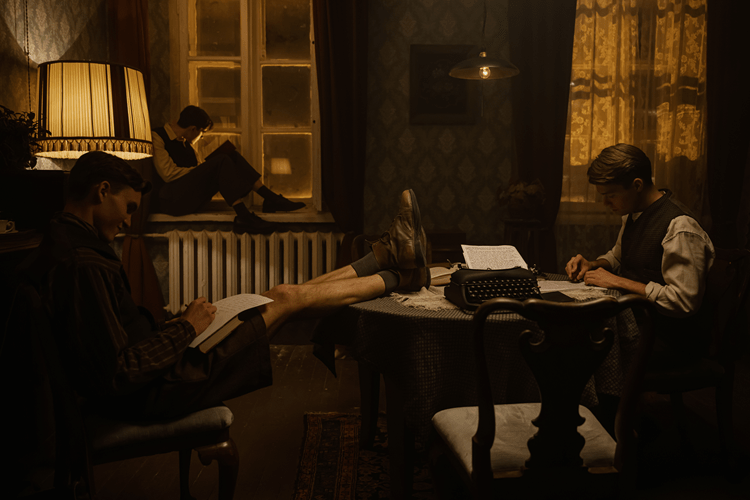
Angry and inspired, Helmuth forms his own resistance, wielding truth as his weapon and using his writing skills to spread it across the city. His secret campaign consists of typing out anti-Nazi leaflets on bright red parchment and planting them around the city under the cover of night. He even recruits Rudi and Karl who join his righteous cause despite the heavy consequences if they’re ever caught.

Helmuth remains the centerpiece of this compelling drama, but Whitaker makes time to view the darkening times through several other characters. We see the corruption of a church through Bishop Zander’s willful ignorance. We see different German perspectives through the conflicted eyes of a Gestapo officer (Rupert Evans). We see the impact on families through Helmuth’s own quiet and unassertive mother (Joanna Christie) and his stern Nazi sympathizing step-father (Sean Mahon). Each add layers to Helmuth’s story while also casting a revealing light on the Nazi rule.

Whitaker uses several visual details and historical references to help paint a clearer picture of Germany under the Führer’s iron fist. Consider the door to Bishop Zander’s church officer with a picture of Jesus Christ on one side and a portrait of Adolph Hitler on the other. Or the locked door protecting an archive of banned literature in the basement of city hall. Touches like these leave quite an impression and help define the times. They’re just some of the many pieces that bring this powerfully urgent and profoundly inspiring drama to life. “Truth & Treason” is a movie not be missed.

VERDICT – 4 STARS

REVIEW: “Tron: Ares” (2025)

After 15 years the Tron series is back on the big screen with “Tron: Ares”. I have to admit, despite being a lover of both science fiction and action, I never fully latched onto the Tron movies. I’ve always admired their premise and strikingly unique visual style. But for whatever reason, neither the 1982 original “Tron” nor 2010’s “Tron: Legacy” pulled me in like other movies from a similar mold.

Next up is “Tron: Ares”, the third installment in this ambitious sci-fi action franchise and a standalone sequel to “Legacy”. It’s directed by Joachim Rønning (“Maleficent: Mistress of Evil”) and written for the screen by Jesse Wigutow. Together they craft a visually bold and refreshing blockbuster that neither looks nor sounds like anything else on the big screen. Its only drawback is a surprisingly basic story that plays like a franchise’s attempt at reintroducing itself.

Image Courtesy of Walt Disney Studios

Since its beginning, the Tron franchise has transported audiences to a spectacular world called The Grid. It’s a visually stunning digital frontier populated by sentient programs who interact like their human counterparts. It was created by programmer and video game designer Kevin Flynn (Jeff Bridges) who is digitized into The Grid during the first movie. In “Legacy”, Flynn’s son Sam (Garrett Hedlund) enters The Grid in search of his father.

That brings us to “Ares”, where The Grid has evolved and is now divided into sectors tied to major tech companies. As a result of the corporate rivalry between ENCOM and Dillinger Systems, the wall separating the digital and physical worlds has rapidly dissolved. Much of this due to Julian Dillinger (Evan Peters), the CEO of Dillinger Systems and the grandson of Ed Dillinger (played by David Warner in the 1982 film). Julian is intent on restoring his grandfather’s legacy at any cost despite the warnings of his concerned mother Elisabeth (Gillian Anderson).

Julian’s latest breakthrough has him able to pull programs from his company’s sector of The Grid into real life (think 3D printing on steroids). State-of-the-art bikes, paragliders, armored vehicles, and his crown jewel, Ares (Jared Leto), a sophisticated and super-advanced AI soldier who is incredibly strong, highly intelligent, and utterly expendable. Julian is anxious to sell his tech to the highest bidder but he has one problem – he can’t keep his programs in the real world for more than 29 minutes.

Enter Eve Kim (Greta Lee), the current CEO of ENCOM who has taken the company’s reins following the death of her sister. Eve is determined to finish what her sister started which includes recovering the Permanence Code created and hidden by Kevin Flynn. The Permanence Code allows digital programs to exist in the real world indefinitely. And Eve knows bad things will happen if Dillinger Systems gets to it first. But Julian has a bigger problem once Ares begins questing his identity and purpose. His desire for independence sets in motion a much bigger conflict than spans both the digital and physical worlds.

Image Courtesy of Walt Disney Studios

Set to a pulse-pounding original soundtrack by Nine Inch Nails and jaw-dropping digital effects custom-made for the big screen, “Tron: Ares” is an exhilarating spectacle that dazzles both audibly and visually. It’s original premise and setting lends to a distinct style that energizes the action and well as the slick aesthetics. The performances also shine led by a spirited Greta Lee. A shrewdly reserved Leto makes Ares a fascinating mystery while Jodie Turner-Smith is fierce as his second in command. Jeff Bridges even returns in a small but welcomed spot.

Surprisingly though, the story is rather simple and underwhelming, with it playing out and finishing in a mostly conventional manner. There are very few highs or lows, and we get no real twists. That said, it does keep the audience constantly moving forward while nicely setting up the movie’s technical strengths – the stunning visuals, the cutting-edge action, and the sinister industrial grind of Trent Reznor and Atticus Ross’ score. A deeper narrative could have catapulted it higher. But even as it is, “Tron: Ares” is an electric experience that (as cliché as it may sound) demands to be seen on the big screen. “Tron: Ares” is in theaters now.

VERDICT – 3.5 STARS

REVIEW: “Tin Soldier” (2025)

Scott Eastwood stars, Jamie Foxx baffles, and Robert De Niro cashes a check in “Tin Soldier”, one of the most confounding features to reach a screen this year. While it’s technically an action thriller, finding a fitting category for it is a challenge. That’s because this confection is all over the map, attempting to be a little bit of everything but ultimately landing nowhere.

It’s hard to believe this ever looked good on paper, but something about “Tin Soldier” drew Eastwood and two Academy Award winners. The film is directed by Brad Furman who is helming his first feature since 2018’s “City of Lies”. He does everything he can to make something at least slightly cohesive. But even at under 80 minutes, his film has a difficult time generating or sustaining any momentum. That’s because the script (written by the trio of Furman, Jess Fuerst, and Pablo Fenjves) fails to develop into anything compelling or narratively functional.

Image Courtesy of Samuel Goldwyn Films

Seventeen years prior, a decorated naval officer named Leon K. Prudhomme (Foxx) founded a PTSD treatment center for veterans. He called it THE PROGRAM. But a secret FBI investigation discovered Prudhomme was actually forming a heavily armed anti-government cult. He reinvented himself as a charismatic (and unintentionally goofy) revolutionary called The Bokushi. And all indications point to his cult stockpiling chemical weapons.

Out of fear that a domestic terror attack is imminent, the FBI begin planning a raid on the Bokushi’s remote mountain compound (think Waco, 1993). But before they do, a covert tactical team organized by Emmanuel Ashburn (De Niro) is secretly organizing an unsanctioned mission to infiltrate the compound and take out the Bokushi before things escalate.

To guide his team, Ashburn approaches Nash Cavanaugh (Eastwood), a disheveled military vet and former member of Prudhomme’s cult. Nash struggles mightily with PTSD, a result of his time at war and in the Bokushi’s outfit. Nash wants no part of Ashburn’s mission. But when he hears his wife Evoli (Nora Arnezeder), who was presumed killed during his escape, may actually be alive, Nash agrees to join the operation with hopes of rescuing his wife.

From there the movie moves forward in the most mechanical way imaginable. It jumps from point to point with very little buildup and even less emotion. Furman makes an effort to break things up, but it mostly comes through instances of awkward narration and jarring flashbacks, none of which add much the story (there’s one unintentionally bonkers flashback of Foxx giving a musical performance that plays like an “In Living Color” sketch). Meanwhile other actors like John Leguizamo and Shamier Anderson do little more than add some familiar faces.

Image Courtesy of Samuel Goldwyn Films

Not that it was ever fully together, but things completely fall apart in the final act where any attempt at an explosive finish gives way to utter absurdity. We get a laughably easy infiltration, a goofy cult ritual, and a hysterically bad monologue. And if that wasn’t enough, the story wraps up with a preposterous showdown in….a gladiator arena.

To its credit, there are a few striking locations, flashes of clever cinematography, and a couple of decent action sequences. But overall, “Tin Soldier” features more bad haircuts than good scenes. And no amount of effort can make this AI-quality creation remotely entertaining or inspired. “Tin Soldier” is in select theaters now and releases on VOD September 30th.

VERDICT – 1 STAR

REVIEW: “The Threesome” (2025)

With the obviousness of its provocative title, “The Threesome” sets out to grab as much early attention as it can get. Once you get beyond that, you have a movie hampered by dueling ambitions. On the one hand it wants to be a millennial romcom. On the other hand it wants to be a mindful and mature relationship drama. Unfortunately it never fully works as either. And things get even shakier as the two ambitions try to coexist.

Connor (Jonah Hauer-King) is head-over-heels for Olivia (Zoey Deutch). The two once had a fling but broke it off and became friends. He’s still crazy about her and wants to give it another shot. She’s not interested, or so she pretends. While at the bar where Olivia works, Connor strikes up a conversation with a young woman named Jenny (Ruby Cruz). His intent is to make Olivia jealous, but the three end up hitting it off.

After spending some time dancing at a nearby club, all three end up at Connor’s place where things quickly heat up. The trio get closer and from there…well, look no further than the movie’s title. All of this happens in the first 15 minutes or so. The rest of the movie deals with the aftermath and the complications that mount at almost absurd rate. And it all begins with the revelation that both Olivia and Jenny are pregnant.

Image Courtesy of Vertical

The story is a rollercoaster of consequences brought on by a near endless parade of bad choices. But that’s not quite the way the movie sees it. Instead, director Chad Hartigan and screenwriter Ethan Ogilby tell their story from an aggressively ‘modern’ perspective. They view nearly everything including dating, relationships, sex, even religion through the same social lens. In fact, it’s so beholden to its point-of-view that it may only appeal to those who hold the same worldview while pushing away those who don’t.

That may not seem like the most fair-minded critique, but in this case it does impact the storytelling. For example, throughout the story the consequences are almost exclusively emotional. That’s not to say there aren’t emotional consequences. But the movie barely looks beyond feelings. And those feelings are often undermined by the tonal hopscotch as the story bounces back-and-forth between comedy and drama.

And then you have the characters. The performances are solid with Deutch impressively balancing the best. Meanwhile Cruz is an absolute revelation. But the characters often live oblivious to reality, making statements like “I thought you were on the pill?” or “But you wore a condom!”. Meanwhile supporting characters manage a few laughs but are mostly cut from the standard romcom cloth. Take Kevin (Josh Segarra), Olivia’s meat-headed side-dish and Greg (Jaboukie Young-White), the conventional gay best friend functioning as comic relief.

“The Threesome” takes several swings at humor while at the same time attempting to be realistic and grounded. It’s a juggling act the movie never quite masters. There’s certainly potential in the story and its unorthodox ‘love’ triangle. But it’s too difficult to get onboard when the story stretches believability to such a degree. And it’s even harder to take seriously when the movie tries to say something weighty. Ultimately, there are just too many frustrations to get past.

VERDICT – 2 STARS