REVIEW: “Tesla” (2020)

TESLAposter

All movie genres have their conventions and biopics are no different. So many biographies are bound by certain self-imposed responsibilities and constraints that often strip them of their own style and flavor. They follow familiar paths, hitting familiar beats, and ultimately reaching familiar results. But as quick as I say that, along comes Michael Almereyda’s “Tesla” to give the biopic ‘genre’ a swift kick in the pants.

Almereyda’s fresh, quirky, and utterly fascinating foray into the life of Nikola Tesla fully embraces the mystery behind the brilliant engineer, inventor, and futurist. With style aplenty and even more audacity, Almereyda kicks aside nearly every biopic convention, crafting a biography based as much on feeling and intimation as strict history. For example Almereyda doesn’t mind showing you a scene only to stop it and tell you it never actually happened. He doesn’t do it as a stunt, but as a way of exploring the enigmatic Tesla from unique points of view.

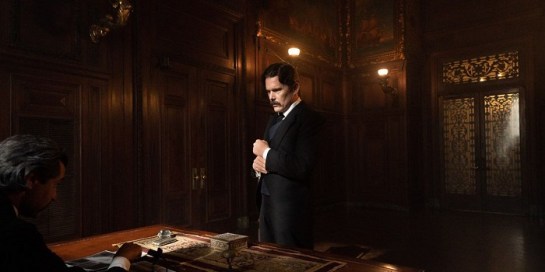
What better fit for the film’s peculiar rhythm than Ethan Hawke. The often underrated actor plays Tesla as a man out of time, someone so forward thinking that he struggles to connect with the present. A man essentially held captive by his own genius. “Sometimes it seems as though all I do is think.” Tesla solemnly explains. “For days and weeks on end. Like my brain is burning. Who can live with that?” Hawke doesn’t give us a starry-eyed dreamer. Instead his Tesla exists in a perpetual state of awkward intensity; so confident in his brilliant theories yet too melancholic and soft-spoken to convince anyone other than himself.
TESLA1

Photo Courtesy of IFC Films

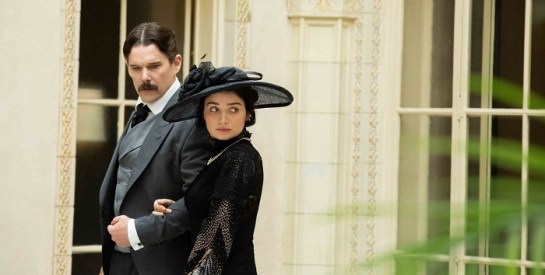
Not afraid to color outside the lines, Almereyda mixes facts with speculation to paint an abstract portrait of a man often overlooked in conversations over what became known as The Current War. Enter Anne Morgan (a really good Eve Hewson), daughter of financier and banking giant J.P. Morgan (played in the film by Donnie Keshawarz). Anne serves as our narrator and semi-historical tour guide through the life of Nikola Tesla. She also brings a shrewd female perspective to the testosterone-rich timeline. Sometimes Anne is sitting at a table with her MacBook sharing Google searches with the audience (yes, MacBook and Google). Other times it’s simple yet cutting voiceover where she shares how things might have played out. “If only Tesla had an enlightened hustler to steer him through the crass commercial world.”

That cynical yet thoughtful line of dialogue is actually a thinly veiled jab at Thomas Edison, played with a delectable balance of smarts and smarm by Kyle MacLachlan. Anne points out that you’ll only find the same four or so photos of Tesla on the web. Yet a quick Google search turns out countless images of Edison. And history bears it out. Edison’s renown has proven timeless. His success led to great wealth and notoriety. Children still learn of his work at an early age. Hotels, schools, bridges, a lake, a mountain, even an asteroid honor his name. Tesla died penniless and alone in a New York City hotel room.

Anne’s laptop, the internet references, even a later scene showing Edison with an iPhone all speak to technologies made possible by Tesla’s contributions. But Almereyda wisely keeps them brief and at a minimum, instead focusing on Tesla the man. From his early days working with Edison to their disagreement over direct current which Edison supported versus Tesla’s preferred alternating current. We watch him join Edison rival George Westinghouse (Jim Gaffigan), selling many of his patents and costing himself millions of dollars down the road. And of course we see Tesla’s move to Colorado to do his own radical experiments away from constant corporate conflicts.
TESLA3

Photo Courtesy of IFC Films

Through it all Tesla is shown to be a man stubbornly loyal to his work. Anne tries to crack through his shell, even using her father’s fortune as a lure. Tesla shows signs of interest but is overwhelmed by Anne’s game of cat-and-mouse. Even a sultry global stage celebrity like Sarah Bernhardt (Rebecca Dayan) can only capture so much of his attention. In one sense Tesla is fascinated by Bernhardt and her aura of fame. But who has time for relationships when there is so much work to do?

Almereyda’s style choices also extend to the film’s look. Several scenes are shot in front of beautiful yet blatantly obvious painted backgrounds as if we were suddenly watching a small stage production. My favorite may be a scene of Tesla walking out in front of a backdrop of Niagara Falls, his hair and raincoat soaked. It’s unmistakably evident that they are not on location, but Almereyda is fine with that, happily drawing attention to its artifice. And it fits the film in its own strange synchronistic way.

It has been fun watching the early reactions to “Tesla”. Some have been taken aback by its weird beats and it’s unorthodox structure. Others have really went for its gutsy risk-taking and avant-garde flavor. Put me down in the latter category. “Tesla” finally gives the Serbian-born visionary the big screen treatment, offering him more than than a brief cameo or a thinly sketched supporting role. It happily embraces the Tesla mystique and tells his story with an ever so sly sense of humor (Just wait until you see a hysterical out-of-the-blue musical number. I’d be a villain if I spoiled it). Thankfully the film’s blending of the past, present, and future is more than a gimmick and Hawke’s stoic, internalized performance is the perfect anchor for this spunky and stylish bio.

VERDICT – 4 STARS

4-stars

REVIEW: “The Truth” (2020)

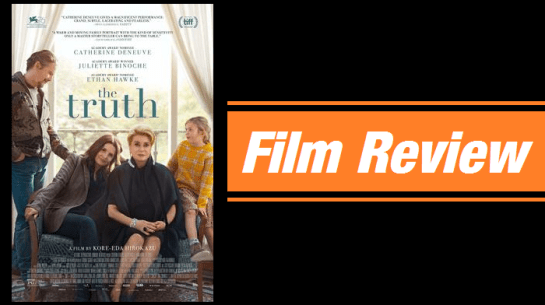
TRUTHposter

When it comes to the new French-Japanese family drama “The Truth”, they had me at Catherine Deneuve, Juliette Binoche, and Ethan Hawke. Toss in that it is written, directed and edited by acclaimed Japanese auteur Hirokazu Kore-eda and you have one of my most eagerly anticipated movies of the year. With such craft in front of and behind the camera, it’s hard not to be drawn to its potential.

“The Truth” marks Kore-eda’s first movie shot outside of his native Japan. It’s also his first film since winning the Palme d’Or at Cannes for his 2018 gem “Shoplifters”. This time he sets his story in the beautiful City of Lights and sports a star-studded cast. But Kore-eda never forsakes his arthouse roots or loses sight of the deep personal focus his films are often known for. You’ll also find him exploring many of his signature themes and fascinations while maintaining the warm, curious, and observant gaze you’ve come to expect from the distinguished filmmaker.

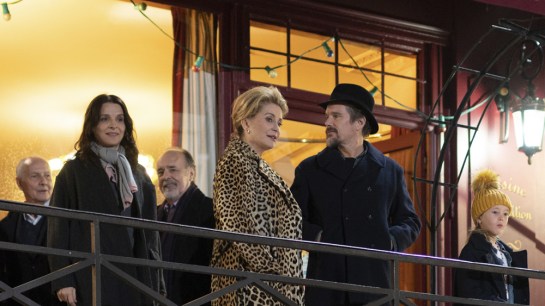
In a delightful bit of meta casting, 2-time César Award-winning French screen legend Catherine Deneuve plays a 2-time César Award-winning French screen legend named Fabienne Dangeville. The film opens with Fabienne giving an awkward interview to promote the upcoming release of her memoirs ironically titled “La Vérité” (or “The Truth”). Fabienne is instantly defined for us – a brash and unapologetic diva who at 70-years-old still feels her star status affords her special consideration. As you would expect Deneuve handles the character masterfully, infusing Fabienne with sincerity and spirit yet with a subtle air of self-imposed misery.

TRUTH1

Photo Courtesy of IFC Films

In less capable hands Fabienne could have easily become a caricature. But neither Kore-eda or Deneuve allow that to happen. Instead we are given a layered and complex character whose star may be fading but who still possesses the allure of celebrity. She can be haughty and unbearable making her ripe for disdain. This becomes especially true once it’s revealed she neglected her family for the sake of her career (and still brazenly defends doing so). But she’s far from one-dimensional and Deneuve’s performance reveals cracks of vulnerability.

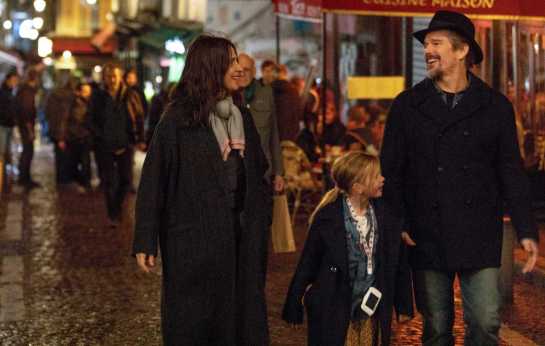
Binoche is a sublime presence playing Fabienne’s long-suffering daughter Lumir. She’s a screenwriter living in New York with her second-tier actor husband Hank (Ethan Hawke) and their precocious daughter Charlotte (Clémentine Grenier). The three arrive in Paris for the launch of Fabienne’s book and immediately old mother-daughter tensions resurface. Things move from a slow simmer to slow boil after Lumir reads her mother’s book and finds it to be far from “The Truth”. When confronted Fabienne coldly responds “I’m an actress. I won’t tell the naked truth.”

From there Kore-eda patiently let’s his story play out. It may seem like the movie is idling along with nothing much happening. But it’s quickly evident that Kore-eda is carefully unpacking his characters through the organic flow of everyday life. By simply watching and listening we learn that everyone is in some way wrestling with the past and they all seem to have something to hide. It neatly fits with Kore-eda’s lingering interest in family dynamics specifically between parent and child.

TRUTH2

Photo Courtesy of IFC Films

Kore-eda is a master of subtlety and observation, but he also has a sly sense of humor. He builds his movie around the production of Fabienne’s new film, a sci-fi arthouse oddity titled “Memories of My Mother”. These amusing scenes get us out Fabienne’s posh but stuffy Parisian estate and onto a movie set where Kore-eda pokes fun at the quirks of filmmaking while relishing the joys of creativity. At the same time the characters are always front-and-center and their stories are steadily moving forward. There’s an glaring analogy between Fabienne’s new movie and her mother-daughter drama back home, but it’s handled with sure-handed smarts.

Kore-eda pulls off a lot with “The Truth” including making a film that is indelibly French through and through. It’s a beguiling chamber piece where every line drips humanity and his characters are the chief focus. It helps to have talents like Deneuve and Binoche whose natural fluency with dialogue is unmatched. Even Ethan Hawke’s Hank, who seems like a flighty tag-along at first, is fully fleshed out and given a surprising amount of depth.

“The Truth” is a treat for those of us who love sitting back and watching great performers act. Binoche is one of our best working talents and Hawke has for years now consistently made interesting choices. But Deneuve is the star (as she should be). She has worked steadily since her debut in 1957, but it has been years since she was given such a meaty role. Her self-referential confidence and complete command of her character shows she hasn’t missed a step. And Hirokazu Kore-eda is not only smart enough to utilize this caliber of on-screen talent, he also writes the kind of engaging material that enables them to shine.

VERDICT – 4.5 STARS

4-5-stars

REVIEW: “The Lovebirds” (2020)

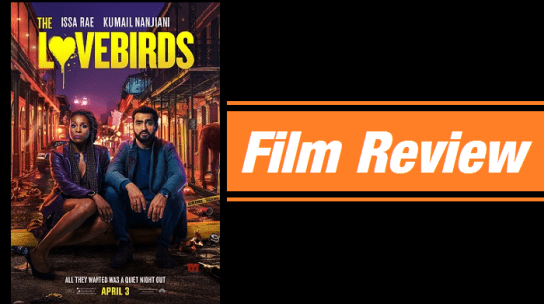
BIRDSposter

One of the earliest big screen casualties of the coronavirus theater closings was “The Lovebirds”. Paramount was in the middle of a pretty hefty promotional campaign when the coronavirus pandemic shut down movie houses and multiplexes around the globe. In a surprise move the film was sold to Netflix and now set to release on their streaming platform tomorrow.

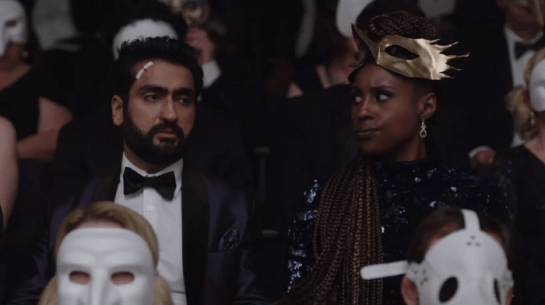
The film is directed by Michael Showalter who earned critical acclaim for his 2017 comedy “The Big Sick”. He follows it up with “The Lovebirds”, a film that reunites him with Kumail Nanjiani and adds rising star Issa Rae. Their movie plays like a slightly edgier “Date Night” (remember that Steve Carell/Tina Fey flick) but without the memorable supporting players. Instead everything here rides on the backs of the two able leads who are forced to carry the load.

BIRDS1

Photo Courtesy of Netflix

Everything starts rosy for Jibran (Nanjiani), an introvert who makes documentaries, and Leilani (Rae), a social go-getter works at an ad agency. They really hit it off on their first date and the lovestruck couple seem destined to be together. Fast-forward four years and the two are still an item but hardly the starry-eyed romantics they once were. They find themselves arguing over the most inconsequential stuff (like whether or not they could win “The Amazing Race”). This couple who once looked like a match made in Heaven now are on the verge of calling it quits.

But something crazy happens on the drive to a dinner party. While arguing (again) Jibran hits a guy on a bike who darts out in front of their car. The man gets up and speeds off, but another man claiming to be cop takes the wheel and runs the cyclist over – literally…over and over. He then takes off leaving Jibran and Leilani to take the heat. Rather than wait for the police, the two panic and run away setting up a night of close calls and off-the-cuff detective work as they try to clear their name.

Nicely set within the not-so touristy parts of New Orleans, “The Lovebirds” bounces Jibran and Leilani around the city dropping them into one ludicrous scenario after another. They start out silly but undeniably amusing such as when they’re abducted and forced to play “Let’s Make a Deal” with a saucy Southern vixen (a really fun Anna Camp). But their predicaments get more ridiculous as we go, topping off with an absurd aristocratic sex cult sequence à la “Eyes Wide Shut”. It’s something that I’m sure looked better on paper than on screen.

BIRDS2

Photo Courtesy of Netflix

And then you have the mystery/conspiracy itself (if you can find enough meat on its bones to even call it that). It’s half-baked and barely held together. It completely fizzles out by the end while the antagonist is as generic and paper-thin as any you’ll ever see. I get that these things are secondary and are only there to offer up moments for Nanjiani and Rae to do their thing. But the stakes seem like an afterthought and if it’s going to be a fundamental part of your story it should at least be mildly convincing.

The movie finds its dual saviors in Nanjiani and Rae. It’s at its strongest when the two charismatic leads are bouncing barbs back-and-forth or bickering over frivolous nonsense in the face of various dangers. Nanjiani is solidly within his comfort zone while Rae continues to open eyes and turn heads. I wouldn’t say they are brimming with romantic chemistry, but as a comedy duo they pair up nicely doing a lot with little and ultimately keeping “The Lovebirds” afloat.

VERDICT – 3 STARS

3-stars

REVIEW: “The Trip to Greece” (2020)

GreecePOSTER

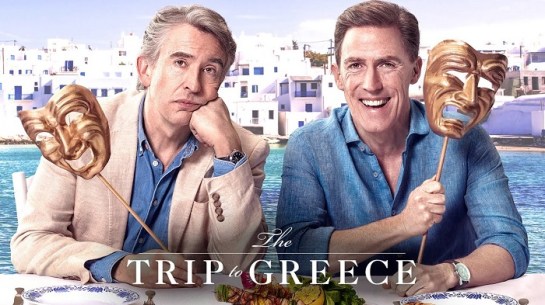
If you aren’t familiar with the “Trip” movies, they actually have an interesting origin. The brainchild of actors Steve Coogan and Rob Brydon along with filmmaker Michael Winterbottom, they began back in 2010 as an improvised six-episode BBC television series. The series was then edited into a well-received feature film. In the years following, the trio would successfully repeat their comedic TV-to-movie formula for trips to Italy and Spain.

The idea has Coogan and Brydon playing fictionalized and slightly exaggerated versions of themselves. Coogan is commissioned to venture out on a culinary road trip reviewing restaurants across various European locations. Everybody he invites to go along turns him down except Brydon. So the two set out on week-long journeys into history, culture and cuisine. But as before, the real draw is the steady diet of banter, drollery, and of course the wildly funny impersonations.

GREECE1

Photo Courtesy of IFC Films

The fourth and final “Trip” series aired earlier this year in the U.K. and this Friday we get its film version “The Trip to Greece”. This time around the pithy, chattering Brits set out to retrace the steps of Odysseus in six days beginning with a brief stop in Turkey. From there it’s across Greece’s beautiful rolling hills and along its stunning sun-soaked coasts, making stops at Ancient Stagira, the Temple of Apollo at Delphi, the Theatre of Epidaurus, the Caves of Diros, among other history-rich landmarks. Each day is wrapped up with a delectable gourmet meal at a five-star local restaurant.

While the film absolutely works as an exquisitely shot travelogue, it’s the easygoing and often hilarious conversations that sets these films apart. Coogan and Brydon have a relaxed, free-wheeling chemistry that shows itself in their off-the-cuff chats about history, mythology, and philosophy. Their good-natured riffing and playful competitiveness lead to some really funny exchanges. And then you have the slew of impersonations from Marlon Brando to Sean Connery (their “Stan Laurel and Tom Hardy” bit may be my personal favorite).

Greece2

Photo Courtesy of IFC Films

But though coated in humor, some of their topics expose a thinly-veiled middle-age melancholy. Certain discussions reveal deeper and more personal reflections – ponderings about life and death, happiness and contentment. It really comes to light in the final act where Winterbottom injects his film with a heavy dose of humanity that quite frankly caught me off guard. It’s culminates in a strong ending which taps into some important but often less recognized themes that have subtly ran throughout the entire series.

“The Trip to Greece” is a fitting and thoroughly satisfying way to end a surprisingly enduring series. It’s a joy to look at whether admiring the gorgeous seas and countryside or enviously drooling over the exquisite dishes. And it’s all threaded together by Coogan and Brydon’s terrific camaraderie. You could make the argument that this is more of the same just in a different country. You wouldn’t be wrong and that should excite fans of the previous movies. Interestingly, this may be the most mature of the four films, but it’s just as funny and entertaining even when the duo’s jokes are flying over my head.

VERDICT – 4 STARS

4-stars

RETRO REVIEW: “Tremors” (1990)

TREMORSposterImagine a movie that opens with Kevin Bacon standing on a ledge and peeing into a vast Nevada canyon. Inspiring, right? Yet it’s an opening that strangely fits “Tremors”, a goofy creature-feature comedy that barely made a dent in the box office back in 1990, but went on to earn a pretty big cult following over the next few years. Enough in fact to spawn at least five direct-to-video sequels and an ill-fated 2003 television series.
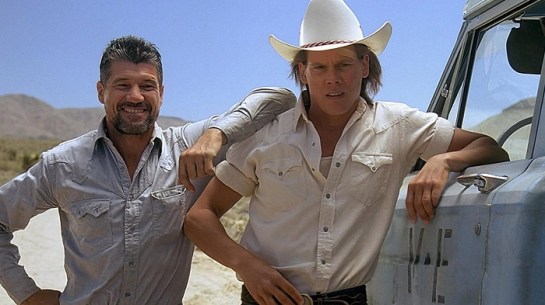

That indelible opening image introduces us to Bacon’s character, Valentine McKee (how’s that for a name). He and his older but not always wiser partner Earl Bassett (Fred Ward) are a couple of redneck “handymen” in the small town of Perfection, population 14. Val and Earl are basically jacks-of-all-trades, doing all sorts of odd-and-in jobs for the motley group of townsfolk. But the pair dreams of brushing off the dust of Perfection to strike it rich in the bigger town of Bixby.

But the boys have their plans interrupted by a pack of giant subterranean slug-like varmints who begin devouring residents and destroying the town. Val and Earl team alongside their fellow local eccentrics fight to fend off the underground beasts. In the process the two guys learn that maybe Perfection isn’t such a bad place after all.

TREMORS1

PHOTO: Universal Pictures

The origin of “Tremors” is as amusing as the movie itself. Writers S.S. Wilson and Brent Maddock came up with the idea while doing safety videos for the United States Navy. They shared their concept of “land sharks” with director Ron Underwood who was doing documentaries for National Geographic. They shopped it around soon getting Universal Pictures to distribute.

A big part of the fun comes from the wacky assortment of supporting characters. Finn Carter plays a grad-student named Rhonda. She’s out in the desert doing seismology studies when the big worms hit. Victor Wong plays Walter, the town’s lone store owner. But the best may be Michael Gross and Reba McEntire. They play Burt and Heather Gummer, a gun-loving couple who just happen to have their own “bunker” filled with firearms and explosives. Gross was just coming off the successful TV show “Family Ties” while Reba was (obviously) a beloved country singer. The two steal nearly every scene they’re in.

TREMORS2

PHOTO: Universal Pictures

“Tremors” builds on its foundation of goofy, often foul-mouthed, banter (how it managed a PG-13 rating is beyond me) and modestly budgeted special effects that fall somewhere between cool and comically bad. But to be honest the effects are part of the film’s strangely infectious charm. The slugs themselves (designed by Tom Woodruff and Alec Gillis) are well conceived and Underwood has a lot of fun easing us and the characters into understanding what makes them tick. Three things are certain: they’re huge, they’re hungry, and they have a weakness (you know, because they always have to have a weakness).

Unashamedly silly and playfully irreverent, “Tremors” is born from plenty of inspiration while still carving out its own offbeat identity. It’s smartly made and you can’t help but see traces of old westerns, slice of 1950s sci-fi, maybe even a bit of satire. While I may not hold it in as high regard as it’s passionate cult following, I do see where their enthusiasm comes from. And after watching this 30-year-old movie again, it’s kinda surprising to see how well this kooky concoction still holds up.

VERDICT – 3.5 STARS

3-5-stars

REVIEW: “Tread” (2020)

TREADposterSometimes reasonable men must do unreasonable things.” Those words were written in 2004 by Marvin Heemeyer and found several days after he went on a bulldozer rampage through a small Colorado town. For obvious reasons the story caught national attention but only for a short time. President Ronald Reagan died the very next day, quickly stealing the headlines. Meanwhile the locals were left trying to make sense out of what had happened.

“Tread” is a fascinating documentary from Paul Solet that examines the lead-up and eventual wave of destruction in Granby, Colorado. The story is constructed through a combination of interviews, reenactments, camcorder footage, and actually audio from cassette recordings Heemeyer left behind. Solet gives plenty of attention to the genesis of Heemeyer’s rage and carefully uncoils the motivations behind the “job” he believed God had asked him do.

Through a sly and absorbing story structure Solet begins by playing with our sympathies. The film makes a compelling case that Heemeyer was a victim of “good ol’ boy” small town politics. In interviews friends portray him as a fun-loving, larger-than-life guy. A friendly, self-made man who loved snowboarding and had a knack for welding and working on engines.

Heemeyer was from South Dakota but stationed in Colorado while serving in the Air Force. He liked it so much that he stayed, buying a home in Granby and a two acre spot of land where he built a muffler shop. He earned the reputation of being a fine citizen and a hard worker. But things soured when Heemeyer’s business was annexed into the sewer district. The local board informed him that he was not only required to connect to the town’s sewer lines, but to pay to run the lines himself. Something that would cost up to $80,000. It set in motion a series of conflicts between Heemeyer and those in power who he felt were trying to squeeze him out.

Tread1

PHOTO: Gravitas Ventures

But then Solet takes an interesting turn and begins considering the disputes from different points of view, particularly from the city officials and businessmen who were involved. They each paint a much different picture of the situations which led to the bad blood. The new perspectives instantly challenge our sympathies. It muddies the waters and the reliability of Heemeyer’s narration is suddenly called into question. The same audio tapes that first put us on his side suddenly become full of self-justification for the horrible act he was preparing for.

Heemeyer purchased a Komatsu D55A bulldozer and for a year worked in secret to turn it into a tank, reinforced with steel and concrete. It was impenetrable and June 4, 2004, Marvin Heemeyer sealed himself in and set out to destroy select targets around Granby. From there Solet’s film takes yet another form. You would think you were suddenly watching a grindhouse thriller except for the real camcorder footage that injects it with reality. Solet keeps us glued to the screen as this unbelievable rampage plays out.

“Tread” is thoroughly compelling filmmaking; a documentary just as interested in the buildup as the notorious headline-making act. It may start slow for some, but even those early moments offer a fuller picture of Marvin Heemeyer and his ultimately beef with Granby, Colorado. And by the time we get to his destructive warpath we practically feel like citizens ourselves.

VERDICT – 4 STARS

4-stars