REVIEW: “Troll” (2022)

Director Roar Uthaug take us on a ridiculously fun ride with “Troll”, his Norwegian monster flick that plucks inspiration from countless creature features and disaster movies. What we get is a cool action-packed spectacle full of crazy set-pieces and top-notch special effects. And while its story has some good build-up, it has the sense to know not to take things too seriously, which makes it more of a rip-roaring hoot than a dark and dour downer.

While it looks amazing (as good if not better than anything from US studios not named “Top Gun: Maverick” or “Avatar: The Way of Water”), Uthaug’s unashamed pastiche doesn’t shirk on the tension-building. And despite how familiar things feel, “Troll” has its share of surprises, starting with its titular creature plucked right out of Scandinavian folklore. And while most of the characters all fit a particular model, it’s easy to overlook thanks to the solid performances and some fun energy between them.
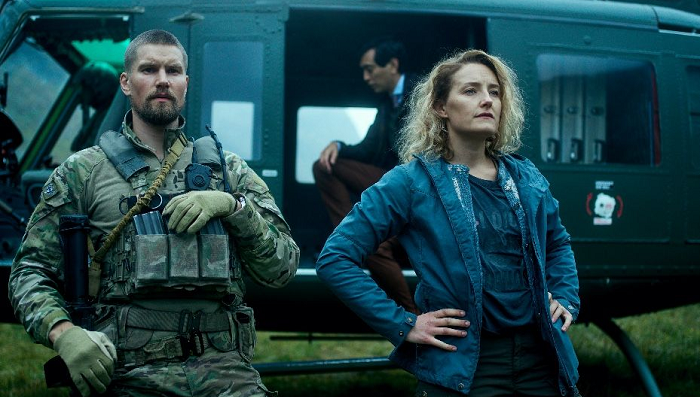
Image Courtesy of Netflix

While blasting a tunnel through a mountain in Dovre, a construction crew inadvertently awakens a creature laying dormant deep within. The creature, a massive stone Troll, bursts out, killing those who have interrupted its sleep. After live video captured by protesters reaches the Norwegian government, Prime Minister Berit Moberg (Anneke von der Lippe) organizes the military and calls in a team of experts to help figure out a course of action.

One of those experts is Nora Tidemann (Ine Marie Wilmann), a paleontologist overseeing a dig along the Atlantic coast in northwestern Norway. Nora knows the area well and was taught the mythology of the mountains, aka The Troll Peaks, by her estranged father Tobias (Gard B. Eidsvold). He believed firmly in the existence of trolls but was discredited and shamed by others in the science community. Ultimately Nora couldn’t get behind her father’s theories leading to them going their separate ways.

Image Courtesy of Netflix

In Oslo most of the “experts” are quick to blame the incident on a pocket of methane. But Nora is quicker to recognize the obvious – a beast the size of a tall building has been let loose and is heading towards the capitol city. After a second incident, the Prime Minister orders the evacuation of Oslo and tasks Nora with investigating deeper, in hopes she can find a way to stop the troll. With the help of Captain Kris Holm (Mads Sjøgård Pettersen) and Moberg’s chief advisor Andreas Isaksan (Kim Falck), Nora sets out to find the only person who may have the answers they need – her father.

“Troll” features a terrific blend of fantasy and modern day while also tapping into the the old-school entertainment of classic monster movies. And while the story might not win any awards for originality, its chock full of cultural references including King Kong, Star Trek, and Call of Duty. They may not add a ton overall, but they’re fun to pick out. That often dismissed and maligned word “fun” defines “Troll” in a nutshell. It’s an eye-popping genre flick that delivers exactly what you expect from it. Nothing more; nothing less. That turned out to be all I needed to have a good time. “Troll” is now streaming on Netflix.

VERDICT – 4 STARS

REVIEW: “Tár” (2022)

Cate Blanchett cements her next Oscar nomination (and quite possible a win) with “Tár”, the latest film from writer-director Todd Field. It’s Field’s first time behind the camera since 2006’s “Little Children”, and he has once again put together a movie that’s getting a lot of awards season buzz. His story follows a fictional conductor and composer named Lydia Tár who’s at the height of her career. But when accusations of misconduct arise, she watches as her life of success and renown begins to unravel.

Blanchett plays Lydia Tár with a fierce confidence that bleeds over into the character. It can be quiet and subtle, or it can be unbridled and consuming. It’s that very confidence that makes Lydia such a fascinating, complicated, and at times loathsome character. It’s a trait that has made her one of the greatest living composers. It has led her to become the Berlin Philharmonic’s first female chief conductor. It’s put her in place to lead the upcoming live performance of Mahler’s Fifth Symphony. It has even enabled her to publish her own biography.

Image Courtesy of Focus Features

But we watch as that same confidence that has afforded Lydia so many opportunities crushes the people who dare to get close to her. It’s seen through a collection of relationships she has, mostly business but occasionally personal. They include people such as her diligent assistant Francesca (Noémie Merlant), her concertmaster and significant other Sharon (Nina Hoss), her assistant conductor, Sebastian (Allan Corduner), the manager of her fellowship program Eliot (Mark Strong), and a young Russian cellist named Olga (Sophie Kauer).

Field uses these relationships for much of the film’s near 160 minute runtime to try and give us a full picture of Lydia Tár. As a character study it mostly works although it does leave some of the supporting players doing little more than servicing Lydia and her story. It’s a shame because the film sports a compelling cast. But rather than building on them, we get several showy, pretension-soaked scenes that can be a lot of fun, but would be even better if Field would have pushed his story a little more off the rails.

But the film’s self-seriousness eventually gets Field into trouble, especially as he breezes by the heavier subject matter (allegations of inappropriate conduct, sexual harassment, suicide, etc.). None of them gets the attention they need. He also skirts around what seems like important details – the accusations themselves, the backlash, the legal hearings, the consequences.

All of that is exacerbated by some frustrating pacing decisions. The first two hours (plus some) of the film moves at such a patient (and at times borderline lethargic) pace. It can be slow yet it’s often observant. But then in the final 30 minutes it’s as if Field checked his watch and said “We need to wrap this up.” He frantically jumps from place to place as he shows Lydia’s house crumbling down on her. It’s an intentional choice that simply doesn’t have the desired effect. Ultimately it leaves the ending feeling terribly rushed and woefully unsatisfying.

Image Courtesy of Focus Features

Whether Lydia is conducting in Berlin or teaching at Julliard, Blanchett munches her scenes with a conviction that’s hard to turn away from. At the same time, in many of these very same scenes you can see the movie working hard to earn its prestige status. Take the film’s opening, Lydia’s ego-stroking interview with The New Yorker‘s Adam Gopnik. It’s an compelling scene, but I found myself more interested in watching what Blanchett was doing than getting an introduction to Lydia Tár. It’s not her fault. It’s just that the scene (like several others) exudes a vanity that almost rivals that of the main character.

“Tár” has a lot to admire even if it doesn’t all coalesce into something truly satisfying. And while it attempts to tackle some pretty hefty issues, its story blurs too many details which does more to obscure any truth than actually reckon with it. So much so that I found it hard to get a grasp the movie’s convictions. For some, Blanchett’s domineering performance will be enough to cover any flaws or at least divert attention away from them. Me, I’m stuck on the fence, appreciating the things that fit with what I hoped the movie would be, and a little frustrated with how things ultimately turned out.

VERDICT – 2.5 STARS

REVIEW: “Till” (2022)

(CHECK OUT my full review in the Arkansas Democrat-Gazette)

The story of Emmit Till is unsettling, unspeakable, and infuriating. Yet out of such a cold-hearted and hate-driven crime came another story – one of unimaginable courage. And while the story of Emmit Till, his murder, and the travesty of justice that followed inescapably brings feelings of heartache and indignation, the story of his mother, Mamie Till-Bradley is one full of inspiration and power.

It was the summer of 1955. Emmit Louis Till was only 14-years-old when he hopped on a train in Chicago bound for Mississippi. There he was to spend a couple of weeks visiting family. A few days into his visit, he and his cousins entered Bryant’s Grocery and Meat Market to buy candy. While inside Emmit, an African-America boy, had an encounter with Carolyn Bryant, the white co-owner of the store. What exactly took place in the store is still disputed, but what followed isn’t. On August 28, 1955 young Emmit Till was kidnapped, tortured, and lynched.

Image Courtesy of United Artists Releasing

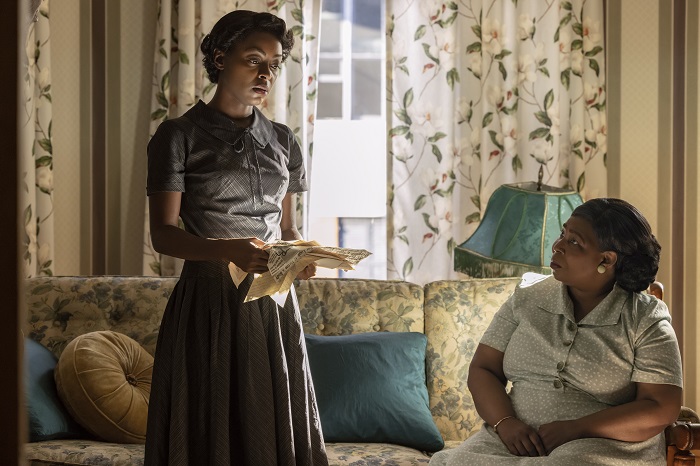
Dramatizing stories like this in movie-form is always tricky. But rather than honing in on the barbaric killing of Emmit Till (and risk unintentionally exploiting it in the process), director Chinonye Chukwu puts her focus on Mamie Till-Bradley. Told mostly from Mamie’s perspective, “Till” spares us the visual horror of Emmit’s murder, but the pain of his death is felt in every single frame and in the emotionally raw and revelatory performance of Danielle Deadwyler whose name should be on every awards season ballot. She invigorates the role of Mamie who makes the agonizing journey from shattered mother to civil rights crusader.

“Till” features much of the same precision seen in Chukwu’s 2019 debut film, the terrific yet woefully underseen “Clemency”. This is a considerably bigger undertaking both in terms of size and scope. But Chukwu manages it well, showing off keen instincts both technically and narratively. The production design and costumes are top-notch, as is her control of the camera, from framing a shot to knowing when to keep it still. Most importantly, Chukwu and her co-writers Michael Reilly and Keith Beauchamp maintain a grounded and crushingly authentic approach to storytelling.

Emmit is played by Jalyn Hall whose big smile and outgoing personality can light up a room. He’s shown to be sweet, full of life, and the apple of his mother’s eye. When we first meet him he’s bubbling with excitement over visiting his cousins down South. But Mamie is uncomfortable with letting her son leave Chicago. She knows the dangers that may await a young boy of color in the Mississippi Delta, warning him, “Be small down there.” Yet despite her visible concern (aka mother’s intuition), Mamie puts her beloved son on the train with his uncle known as Preacher (John Douglas Thompson). Little did she know, that was the last time she would see her son alive.

For African-Americans in the Jim Crowe-era South, you could find yourself in a lot of trouble for simply looking at a white person the wrong way. As the well-meaning and naturally friendly Emmit enters Bryant’s Grocery and Meat Market, Chukwu ensures we sense the weight of what’s about to happen. And as Emmit has his ill-fated exchange with Carolyn Bryant (played by Haley Bennett), Chukwu turns up the tension. It’s palpable, from the time he leaves the store until a few days later, when Carolyn’s husband Roy (Sean Michael Weber) and his pack of goons kidnap Emmit in the dead of the night, savagely beating him beyond recognition, and then killing him. Chukwu’s handling of these scenes are masterful – showing you don’t always have submit your audience to brutality in order for them to feel it’s affects.

Image Courtesy of United Artists Releasing

Back in Chicago, Mamie gets word of Emmit’s kidnapping and is directed to Rayfield Mooty (Kevin Carroll) who uses his connections to get the NAACP involved. But then comes word of Emmit’s fate, and Mamie is left devastated. Rayfield encourages her to speak out and utilize the public’s attention, but Mamie has no interest. She just wants Emmit’s body brought home. But then she sees his brutalized remains and makes a bold decision. Mamie has an open-casket public wake, determined that people actually see what happened to her son. This launches her campaign for justice which leads to a Mississippi court where her son’s killers are put on trial. “There is no testimony like a mother’s.”

Interestingly, “Till” does stumble on a few of the real-life details. Most are small, such as Emmit’s stutter which pops up in one lone scene then suddenly vanishes. Others are puzzling, like the sanitizing of Emmit’s father and his troubling backstory. But they’re hardly deal-breakers, especially in a movie that speaks with such honesty and clarity. Add to it some of the very best ensemble work of the year, impeccable 1950s period design, and storytelling that’s every bit as heart-wrenching as it needs to be. “Till” is out now in theaters October 28th”.

VERDICT – 4 STARS

REVIEW: “Ticket to Paradise” (2022)

Aside from its half-fun and half-cringey trailer, “Ticket to Paradise” advertised a potentially fun throwback romantic comedy built on the backs of two Hollywood A-listers. For some of us, it’s hard not to be drawn to the prospect of George Clooney and Julia Roberts hamming it up again on the big screen. And considering both have dialed back their workload in recent years, it’s nice seeing them again even if this is a pretty by-the-numbers romcom.

Built on Clooney’s charm, Roberts’ effervescence, and their effortlessly fun chemistry together, “Ticket to Paradise” (from director Ol Parker) is the kind of movie that calls back to decades ago when mega-stars frequently took these gigs, often between bigger and better projects. The movies were always light and frothy and they stuck to a pretty strict formula. Eventually these movies ran their course and were even looked down upon as tastes went a little more highbrow.

Image Courtesy of Universal Pictures

Don’t get me wrong. Like many other people, I too grew tired of these uninspired studio products and haven’t exactly been longing for their return. That said, I did feel a slight tingle of nostalgia when “Ticket to Paradise” was announced. I like Clooney and Roberts and seeing them together in one of these romcom concoctions of yesteryear wasn’t the worst thing in the world. And for me personally, sometimes I enjoy stepping away from the heavier stuff and taking in something like this.

Well, I can honestly say that “Ticket to Paradise” didn’t disappoint. Not because it’s something extraordinary, but because it’s exactly the kind of movie you think it is. It’s strongly beholden to the well-known romantic comedy formula, both in its handling of characters and in its storytelling. And it’s a movie where you know exactly how things are going to play out. Nothing will catch you by surprise. You’ll have figured out the ending before the opening credits have finished. But that will hardly bother the audience the film is aiming for.

Clooney plays a Chicago architect named David Cotton. Roberts plays a Los Angeles art dealer named Georgia. The two have been divorced for five years, and in this case time has not healed their wounds. It’s safe to say David and Georgia detest each other. Each blame the other for their split. Each relish the opportunity to degrade their former spouse. Together they’re an undeniably toxic recipe, but Clooney and Roberts, along with co-writers Parker and Daniel Pipski, offer up some pretty hilarious verbal jabs, needles, and takedowns, with both stars playing off each other extremely well.

Image Courtesy of Universal Pictures

The lone bit of joy David and Georgia share is their daughter, Lily (Kaitlyn Dever) who takes a trip to Bali with her best friend, Wren (Billie Lourd) to celebrate their recent graduation from law school. While there, Lily meets and falls in love with a local seaweed farmer named Gede (Maxime Bouttier). Only 37 days later, David and Georgia get emails from Lily informing them that she and Gede are engaged. Convinced Lily is throwing her life away, David and Georgia hop a plane for Bali, reluctantly join forces, and hatch a plan to discourage their daughter from getting hitched. Hijinks ensue.

Parker soaks us in crystal blue waters and lush green forests (courtesy of Queensland, Australia) so we always have something pretty to look at. Meanwhile the story plays out like your typical crowdpleaser, hitting most of the notes and checking most of the boxes. The antics range from cute and amusing to facepalm worthy. But the sheer star wattage of Clooney and Roberts keep the movie afloat. Their individual presences mixed with their smile-inducing chemistry ensure that those going to see “Ticket to Paradise” leave with exactly what they came for. “Ticket to Paradise” is now showing in theaters.

VERDICT – 3 STARS

REVIEW: “Triangle of Sadness” (2022)

The rich and pampered have become a favorite punching bag of filmmakers and studios (it’s hard to miss the baked-in irony of that statement). It makes sense considering the snobbish upper crust elites routinely give us new things to scrutinize and satirize. So you could call them an easy but deserving target. The latest film to take a big swing at the wealthy and privileged is Swedish director Ruben Östlund’s “Triangle of Sadness”.

This satirical black comedy surprised a lot of people by winning the Palme d’Or at this year’s Cannes Film Festival. Early critics scores revealed a more mixed reaction, and understandably so. “Triangle of Sadness” is a peculiar movie – one whose blistering intentions are so clear from scene to scene that there’s no room whatsoever for subtlety or nuance. In fact, its heavy-handedness is so pronounced it drags the movie down on a few occasions. Yet there are other times when the Östlund’s bluntness feels like part of the joke.

Perhaps the most surprising (and perplexing) thing about “Triangle of Sadness” is in seeing how much more Östlund enjoys poking fun at the one-percenters and relishing in their suffering than saying anything new and insightful about them. Yes, there are some pointed cuts at the systems that provided and sustains their wealth, and we get some obvious commentary on class disparities and skewed power dynamics. But this is mostly a all-out basting and humiliation of the rich and powerful.

Image Courtesy of Amazon

But don’t get me wrong, part of the mad genius of Östlund’s batty concoction is in how he takes everything I said above and makes it into something so thoroughly entertaining. “Triangle of Sadness” is a blast, firing off a number of good laughs through both its overt directness and its unbridled absurdity. Östlund’s irreverent style is tailor-made for such a scourging. And though there’s nothing revelatory in his portrayal of the uber-wealthy, he exaggerates his perception in such a way that we’re always given something to chew on.

The closest we get to protagonists are Carl (Harris Dickinson) and Yaya (Charlbi Dean). They’re a young couple in the literal sense, but it’s hard to tell if their relationship is built on true affection or social clout. Carl is your prototypical male model and makes most of his money with his shirt off. Yaya is a social media influencer whose success is based more on followers than revenue. Both live off of their good looks, but it’s hardly a lucrative business. Yet they happily live above their means, in large part thanks to the freebies Yaya gets from companies hungry for free advertising.

One such freebie is a luxury cruise on a $250 million yacht. Carl and Yaya join an assemblage of obscenely rich high-society types that includes a Russian fertilizer magnate (Zlatko Burić) and his self-deluded wife (Sunnyi Melles), an elderly British couple (Oliver Ford Davies, Amanda Walker) who made their fortune on hand grenades, a disabled German woman (Iris Berben) who continually shouts “In Den Wolken” (which means “in the clouds”), and a forlorn mobile app creator (Henrik Dorsin) among others.

The very makeup of the ship could be a reflection of class structures around the world. The privileged out-of-touch cruisers soak up the amenities of the lavish upper deck where mostly white servers pamper them in anticipation of huge tips. Meanwhile the predominantly non-white service members stay in cramped cabins below. They’re considered part of the service crew, but not allowed to be seen topside. Like many things, it isn’t the slightest bit subtle, but nor is it trying to be.

Image Courtesy of Neon

While the first half focuses on the privilege the rich enjoy, the second half explores what happens when they have it taken away. But connecting those two halves is what’s sure to be considered the film’s signature scene – a posh Captain’s Dinner that goes horribly wrong. Let’s just say it involves spewing vomit, overflowing toilets, turbulent seas, and the ship’s stone-drunk captain (a hysterical Woody Harrelson). It sends the story careening into its third act as a select number from the boat find themselves stranded on a deserted island. Once there, class status is tossed, gender roles are reversed, weaknesses are exposed. But being good-looking still has its benefits.

Unfortunately Östlund doesn’t see his story through to the end. Instead he takes an easy out, giving us an ambiguous ending that doesn’t offer any real conclusion. It’s the old “you determine for yourself” finish which often works nicely. But in a movie like this, where everything is so straightforward and Östlund is basically shooting fish in a barrel, it really needs to end with a punch.

Still, Östlund gives us plenty to absorb as he runs his filthy rich subjects through the wringer. Some scenes are savagely funny while others are simply savage. More importantly, we’re always engaged. And his satire, though glaringly blunt and without an ounce of subtlety, has bite. “Triangle” is a wild and wildly original film, and it’s hard not to be drawn to it, flaws and all. And though Östlund may whiff on a few of his crazy swings, most of them connect with bludgeoning force. So much so that we may feel a little guilty about laughing at these people’s suffering. Not much, but maybe a little. “Triangle of Sadness” is now showing in select theaters.

VERDICT – 4 STARS

REVIEW: “Three Minutes – A Lengthening” (2022)

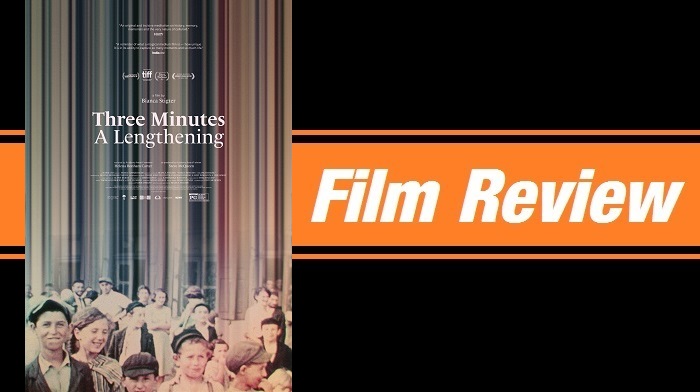
With “Three Minutes – A Lengthening”, Bianca Stigter has given us one of the most compelling documentaries of 2022. The film centers on three minutes of 16mm home movie footage from 1938, shot in the Jewish neighborhood of Nasielsk, Poland. These three brief minutes are full of smiles, joy, and laughter as members of this lively Jewish community enjoy the attention of the camera. But in a few short months, most of the people in the footage would be gone – victims of Nazi Germany’s systematic genocide of European Jews.

The weight of that truth hangs over “Three Minutes – A Lengthening”. Stigter’s approach makes sure it’s etched into our minds. At the same time, this isn’t a film solely fixated on the horrors that befell this community. It’s far more about memorializing them by piecing together these few fragments of their lives preserved on the film. It’s an effort to remember them; to let their lives speak beyond the abhorrent atrocities they faced at the hands of their barbaric oppressors. And while identifying the people proved mostly impossible, Stigter honors them through her deep reverence and forensic precision.

Image Courtesy of Super LTD

Stigter begins by playing the full video uninterrupted, without narration or voice-over of any kind. All we hear is the sound of the film running through a 16mm projector. It’s a sobering three minutes. I watched this opening three times before continuing the movie, and in that time several noticeable faces stuck with me. The old bearded gentleman leaning up against the wall. The rambunctious lad sticking his tongue out at the camera. The two manly chaps standing stoically on the left side of the frame. The young girl in a pale red dress with a well-combed bob and a big smile. And several others. I immediately started wondering about them. Who were they? What were their stories? And sadly, were they among the very few who survived?

From there the movie chronicles the search for answers about the town and the people we see. Interestingly, the movie never strays from the actual footage itself. We never see the narrator (a superb Helena Bonham Carter) nor do we see the small handful of contributors. We simply hear their voices as we continually watch those solemn three minutes. But it’s not in a continual loop. Stigter freezes frames, rewinds clips, zooms in on details, etc., all in her efforts to glean whatever information she can. Often that requires examining every inch of the frame: the door posts, the trees, the clothing patterns and fabrics. It all helps paint a clearer picture of the community.

A key voice in the film is that of Glenn Kurtz, the man who discovered the three-minute celluloid in a closet in Florida. Nearly aged passed the point of saving, Glenn donated the film to U.S. Holocaust Memorial Museum where it was restored and digitized. Over time we learn the film was shot by his grandfather, an American named David Kurtz, who in 1938 took a trip to Europe. After stops in Paris, London, Amsterdam, and Geneva (among other places), David took a detour to Poland to visit his hometown of Nasielsk.

Image Courtesy of Super LTD

We learn that Nasielsk, some 30 miles north of Warsaw, is where David Kurtz shot the eponymous three minutes of footage. In 1938, Nasielsk had a population of 7,000 of whom 3000 were Jews. But by 1942, less than 100 of the town’s Jewish population would be alive. The deportation of the Nasielsk Jews is shared in a grim and stomach-churning eyewitness account. It adds even more potency to the three minutes of film we’ve come to intimately know by that point in the movie.

While watching “Three Minutes – A Lengthening” you can’t help but notice its nods to the power of filmmaking, the importance of historical research, and the unequaled treasure of memory. All of those things are profoundly realized throughout the film’s compact 111 minutes. But the people on that small 16mm reel are always the centerpiece. Stigner never loses sight of that, and as a result we don’t lose sight of it either. “Three Minutes – A Lengthening” is out now in select theaters.

VERDICT – 4.5 STARS