REVIEW: “Wake Up Dead Man: A Knives Out Mystery” (2025)

Despite making striking and subversive indies, trippy star-driven science-fiction, and a massive franchise blockbuster, writer-director Rian Johnson has found his comfort zone in the cinematic world of whodunits. His 2019 film “Knives Out” was a surprise hit, as was his 2022 sequel, “Glass Onion”. Now he’s back with a third mystery, “Wake Up Dead Man”, and it just might be the best of the bunch.

Written and directed by Johnson, “Wake Up Dead Man” follows the same basic blueprint as its predecessors. There’s a murder, an unsolvable mystery, an all-star lineup of suspects, and the return of the charismatic super sleuth, Benoit Blanc (Daniel Craig). His latest case takes him to the sleepy little town of Chimney Rock in upstate New York where a controversial priest has been murdered in the middle of his church’s Good Friday service. It thrusts us and our famed detective into a religious setting that Johnson explores with earnest curiosity.

Image Courtesy of Netflix

Josh O’Connor continues his remarkable year playing Rev. Jud Duplenticy, a young priest who is reassigned to a new parish after punching out one of his deacons. He’s sent to Our Lady of Perpetual Fortitude in Chimney Rock to assist the polarizing Monsignor Jefferson Wicks (Josh Brolin). Rev. Jud has went from a boxer from the streets to a faithful and driven young priest. But the vain and domineering Monsignor Wicks sees Rev. Jud as a threat to his authority, setting up some early tension with lasting effects.

Making the noble Rev. Jud’s new position even more challenging is the church’s congregation – a small group of regulars who are notably bitter, self-absorbed, and fiercely loyal to Wicks. There’s the town doctor (Jeremy Renner) whose wife recently left him; a smart yet resentful attorney (Kerry Washington); a failed politician turned wannabe YouTuber (Daryl McCormack); a former cellist (Cailee Spaeny) now struggling with a crippling illness; and a once popular sci-fi writer (Andrew Scott) whose book sales have tanked.

Other significant players include Martha Delacroix (Glenn Close), Wicks’ right-hand church lady who handles the bookkeeping, plays the organ, launders the vestments, and so on. And then there is Samson Holt (Thomas Haddon Church), the church’s longtime groundskeeper who has a thing for Martha. All languish in their own personal states of misery which is only made worse by the fear-wielding Wicks.

As he’s done before, Johnson does a fine job defining his characters. While some could use a tad more depth, Johnson sets them up nicely for the story’s key event – the murder of Monsignor Wicks. It happens during the church’s Good Friday service with all of the above players in attendance. With so many suspects and no plausible explanation, the case proves to be more than the town’s police chief, Geraldine Scott (Mila Kunis) can handle.

Image Courtesy of Netflix

Enter private detective Benoit Blanc, with his exaggerated Southern drawl, blaring panache, and a haughty cynicism towards religion that he quickly makes known. He waltzes in with a blasé air of case-solving self-assurance. But he’s brought down to earth with a murder that instantly leaves him stumped. Blanc’s rationalism and Rev. Jud’s spirituality leads to an amusing partnership. Johnson’s script turns the skeptic and the disciple into a Holmes and Watson of sorts, at least until the mystery takes a ‘miraculous’ turn.

As it all unfolds, Johnson keeps us routinely off balance with a steady wave of new clues, shaky alibis, and surprising revelations. There’s a mischievousness in Johnson’s storytelling which leads to some of the film’s funniest moments. But he also offers an even-handed assessment of fanaticism versus faith from a perspective that neither proselytizes nor condemns. And all through another cadre of colorful characters who feel right at home in Johnson’s latest and possible best Knives Out to date.

VERDICT – 4 STARS

REVIEW: “Wicked: For Good” (2025)

With “Wicked: For Good”, the deconstruction of L. Frank Baum’s classic 1900 children’s novel (“The Wonderful Wizard of Oz”) and its 1939 film adaptation mercifully comes to an end. Beginning with 2024’s smash-hit “Wicked”, this big-budgeted two-parter from director Jon M. Chu is based on Stephen Schwartz’s 2003 stage musical, which itself was loosely based on Gregory Maguire’s 1995 novel. The first film had its moments before falling off in the second half. “Wicked: For Good” never gets on its feet, becoming a grueling test of your patience and endurance.

“Wicked: For Good” has a plethora of problems that become more pronounced over the course of its endless 137 minutes. In their defense, screenwriters Winnie Holzman and Dana Fox had a lot to wrangle together. But their bloated story crumbles under the weight of the source material’s revisionism and reverence for the beloved 1939 film. Chu tries to make something of it, but what he delivers lacks the humor and charm of its predecessor. Even worse, there is no cohesive vision, either narratively or visually.

Following the events of the first movie, the emerald-skinned Elphaba (Cynthia Erivo) retreats into hiding while the formerly plucky but now drably inert Glinda (Ariana Grande) obliviously does the bidding of the tyrannical Wizard (Jeff Goldblum) and his ambitious ally, Madame Morrible (a terribly miscast Michelle Yeoh). But Elphaba’s goal of exposing the Wizard brings her and Glinda back together, although in ways neither were anticipating.

Image Courtesy of Universal Pictures

In the world of “Wicked”, Oz is a land oppressed by the blandest authoritarian regime. Far removed from the benevolent leader in the original story, this Oz is ran by a weakly defined dictator with a special knack for animal cruelty. As for the citizens, they’re mostly gullible cattle who eat up every bit of propaganda they’re fed. It makes for an Oz that’s more draconian than fantastical. Even the iconic Yellow Brick Road is portrayed as the product of destroyed ecosystems and forced animal labor.

These changes all work to portray Elphaba as a product of the system, which eventually leads her to become the Wicked Witch of the West. The film is relentless in stressing her victimhood in order to make her a sympathetic crusader against the Wizard’s tyranny. But it becomes such a driving focus that Chu forgets more essential things such as coherent storytelling and necessary character development.

As for Grande, her character takes a big hit in the second film. It’s hard to know how the movie wants us to feel about Glinda. She spends much of the film turning a blind eye to the nefarious deeds happening around her. And she gets off with no real sense of reckoning with her own complicity. So we’re left with two conclusions – she’s either dumb as a post or she’s lacks moral courage. Either way, Grande is left to do what she can with an underserved character. And this naturally affects her scenes with Erivo, leaving both actresses struggling to reignite their chemistry from part one.

Even worse is the shortchanging of certain side characters. Take Fiyero (Jonathan Bailey), the captain of the Wizard’s guard and the half-baked love interest of both Glinda and Elphaba. And Nessarose (Marissa Bode), Elphaba’s half-sister who now governs Munchkinland. Both are meant to play significant roles in Elphaba’s story yet huge chunks of their own stories are missing. Both are trapped within horrible storylines, but it’s Bailey who’s dealt the worst hand, including a hysterically bad love scene that plays like a cheap music video.

Image Courtesy of Universal Pictures

And if all of that wasn’t enough, there is the shoehorning of Dorothy Gale into the story. This is where the retconning and honoring collide the most. Without question, there’s the tug of nostalgia with the glimpses we get of Dorothy, despite her face always being obscured. But her presence muddies the already mangled script. And it gets even worse with the absurdly contrived and shockingly shallow attempts at origin stories for the Tin Man, Scarecrow, and the Cowardly Lion.

Hampered by one aggravating problem after another, “Wicked: For Good” is a scattershot sequel that never gets on track. Its story erratically bounces all over the place while throwing in bizarre twists with practically no build-up. And nothing in this world feels fleshed out, especially the characters, whose actions often feel arbitrary rather than purposeful. The clumsiness leads to convolution, making it a difficult movie to sit through.

There are some occasionally attractive compositions where the emerald greens collide with the pastel pinks. But the funky cinematography too often makes the ‘Wonderful World of Oz’ look surprisingly fake. And I haven’t even mentioned the music, mainly because there’s not a memorable song in the entire film. So Erivo and Grande are left showing their spectacular range with songs that leave no lasting impression whatsoever. Thats emblematic of “Wicked: For Good” as a whole. It’s a dull and forgettable experience that’s much more messy than magical.

VERDICT – 1.5 STARS

REVIEW: “The Woman in Cabin 10” (2025)

Part mystery, part suspense, part psychological thriller – The Woman in Cabin 10” is a Netflix Original that wears several hats but doesn’t look completely comfortable in any of them. It’s a movie that starts off strong and sets itself up well. But it comes unglued in the second half, largely due to a ludicrous mid-movie twist which paves the way to an even crazier ending (and not the good kind of crazy).

The Woman in Cabin 10” is based on a 2016 novel of the same name by Ruth Ware. It’s directed by Simon Stone whose previous film was 2021’s underrated “The Dig”. Working from a script he co-wrote with Joe Shrapnel and Anna Waterhouse, Stone begins with a fairly intriguing premise that has plenty of room for mystery. But what could have been a taut, unnerving thriller suddenly devolves into a hokey mess of recycled clichés, implausible twists, and endless gaslighting.

Image Courtesy of Netflix

Keira Knightley plays Laura “Lo” Blacklock, an award-winning journalist working for the popular British daily newspaper The Guardian. Having recently endured a poorly explained and barely explored traumatic experience, Laura’s boss (an underused Gugu Mbatha-Raw) wants her to take some time off. Instead, Laura chooses a new assignment that seems like a good mix of work and relaxation.

A wealthy Norwegian shipping heiress, Anne Lyngstad Bullmer (Lisa Loven Kongsli) has stage 4 leukemia and her husband Richard (Guy Pearce) is setting up a foundation in her name. Richard is treating Anne and the new foundation’s board members to a three-day cruise aboard their swanky luxury yacht, finishing the trip at a fundraising gala in a remote part of Norway. Richard, an admirer of Laura’s work, invites her to come along and cover it all in order to “raise awareness”. She eagerly agrees.

Most of the movie takes place on the billionaire’s extravagant ship, the Aurora Borealis. There Laura is introduced to a variety of characters from guests to staff to crew members, many who are meant to be possible suspects until they aren’t. Most of her time is spent with the special guests – a small group of snooty one-percenters that includes an obnoxious socialite (Daniel Ings), an alcoholic gallery owner (Hannah Waddingham), Anne’s personal doctor (Art Malik), and so on.

Besides Laura, the only other out-of-place guest is her photographer ex-boyfriend Ben (David Ajala) who’s there to shoot the event. Despite their history, Ben is a welcomed reprieve from the pampered people of privilege. But even his actions turn weird and unexplainable, all in an effort to add him to the suspect pool. And why do we have a suspect pool? Late one night, Laura wakes to a scream, a splash, and what looks like a woman’s body in the dark waters. Laura is convinced she saw what she saw. But with everyone accounted for, no one believes her.

Image Courtesy of Netflix

Laura becomes a pariah onboard as the movie teases us with what she may or may not have seen. But the story takes an ill-advised turn at around the halfway mark. It’s ignited by a preposterous reveal that sees this potentially sleek and savvy genre-bender turn into trite, impossible to buy silliness. It ends up fumbling a good concept which leads to everything completely falling apart. Its clumsy and absurd finish only makes things worse.

Having two overqualified Academy Award nominees certainly looks nice on the credits. But neither Knightley or Pearce can push their characters through the deflating second-half where logic evaporates and predictability sets in. Thematically, the film teases an ‘eat the rich’ examination, but it falls by the wayside like so much else. It’s one of several backend frustrations that makes “The Woman in Cabin 10” fall well short of its Agatha Christie and Alfred Hitchcock inspirations. “The Woman in Cabin 10” is now streaming on Netflix.

VERDICT – 2 STARS

REVIEW: “War of the Worlds” (2025)

Prime Video’s “War of the Worlds” from director Rich Lee is a science-fiction thriller that attempts to put a modern spin on the 1898 H.G. Wells novel of the same name. It employs the screenlife style of visual storytelling where nearly everything plays out on the screens of computers, smartphones, tablets, televisions, etc. It’s an interesting approach to the classic story. Unfortunately it utterly crumbles under the weight of its own astonishing clumsiness.

Made during the COVID-19 era, “War of the Worlds” sees Ice Cube playing William Bradford, a Domestic Terrorist Analyst for the Department of Homeland Security. His job description is somewhat of a mystery, but basically he alone has full access to the globe’s digital systems. He sits alone at his computer in his DHS office, watching surveillance feeds, hacking into security cameras, listening in on cell phone conversations, monitoring people’s credit card accounts, and playing a cat-and-mouse game with a mysterious hacker named “Disruptor”.

Image Courtesy of Universal Pictures

When not serving as the government’s intrusive eyes, William uses his high-tech access to spy on his two kids. He constantly chides his son Dave (Henry Hunter Hall) who recently graduated college but spends most of his time at home playing video games rather than finding a job. He’s even more worried about his pregnant daughter Faith (Iman Benson) who is only a few weeks away from having her baby. It’s all part of this underdeveloped family angle that’s shoehorned in during some of the weirdest times.

As the controlling William secretly watches his daughter drink coffee and monitors her heart rate through her iPhone, the earth is shaken as countless meteors rip through the atmosphere and crash to the surface. Out of them crawl massive alien machines dubbed Tripods which immediately wrecking havoc all across the globe. William instantly finds himself caught in between his government duty and protecting his family.

Rather than giving us a thrilling visual depiction of the alien invasion, we watch it with William through a series of grainy low-resolution videos that are broken up by snippets of generic news reports and footage of soldiers running around in full soldier mode. In a sense it’s bold and (if it had been surrounded by good material) it could have been dramatically effective. But when viewed through the film’s lone gimmick, the invasion only feels threatening from a distance.

But the movie’s problems extend much further than that. The story is haphazardly thrown together and it features more cheap shortcuts than meaningful plot turns. Meanwhile watching Ice Cube trying to sell us on him being a tech whiz is unintentional comedy in itself. He does what he can with the script, but seeing how he reaches certain conclusions can be hilarious. And he’s saddled with so much laughably bad dialogue that it is impossibly to take him seriously.

Image Courtesy of Universal Pictures

Ice Cube isn’t the only victim from the cast. No one else gets a fighting chance either. Eva Longoria gets nothing to do playing NASA scientist Sandra Salas. A wasted Clark Gregg plays NSA Director Donald Briggs (Clark Gregg) whose cartoonish villainy barely registers. Neither Hall or Benson get much help either. Both are shuttled around as the script calls for it, and both are caught in ludicrous family drama that always pops up at the worst times.

Despite its efforts, “War of the Worlds” is hampered by enormous plot holes, ridiculous conspiracies, an incredibly goofy second-half twist, and an unhealthy dose of shameless product placement. And it’s all coated in artery-clogging cheese that seals the fate of this bad and baffling misfire. There’s an admirable idea somewhere within it. But it’s barely discernible amid the waves of bad scenes that get more preposterous with each passing one. “War of the Worlds” is streaming exclusively on Prime Video.

VERDICT – 1.5 STARS

REVIEW: “Weapons” (2025)

Zach Cregger gained quite a following in 2022 with his surprisingly popular horror thriller “Barbarian”. All things considered, it was a shaky exercise, built on a really good idea but hampered by a few too many bad choices (especially in the final act). But it showcased enough vision and craftsmanship to make horror fans curious about what the interesting new filmmaker would do next.

We get our answer with the chilling and atmospheric “Weapons”. Best described as a horror mystery, “Weapons” reintroduces audiences to Cregger’s interest in unique forms of storytelling. This time it’s noticeably more cohesive and savvy. Serving as both writer and director, Cregger is once again working from a compelling original idea. And while his story has a few kinks, he delivers an incredibly well made feature that firmly holds your attention throughout.

Image Courtesy of Warner Bros. Pictures

The story’s terrifying premise is laid out in the first few minutes through a child’s opening narration. One night in the small town of Maybrook, at exactly 2:17 AM, 17 children rose from their beds, ran from their suburban homes, and disappeared into the night. Each were elementary students from teacher Justine Gandy’s class. Strangely, only one child from her class didn’t vanish. The event leaves the shocked community reeling. Meanwhile the police have no leads in the mysterious disappearances.

That was a month ago, according to the young narrator. Now the school is preparing to open back up, but the hurting and understandably frustrated parents are wanting answers. Many, including Archer Graff (Josh Brolin), blame Justine (Julia Garner), believing she knows more about the missing children than she is letting on. But amid the slew of accusations and threats, she vehemently proclaims her innocence.

From there the movie officially kicks off. Cregger uses a fractured narrative, breaking his story into segments, each concentrating on a different key character and their connections to the case. Each segment feeds us slivers of new information, slowly moving us towards its revealing final act. Aside from Justine and Archer, other characters getting chapters include a local cop, Paul (Alden Ehrenreich), the school’s principal, Andrew (Benedict Wong), a homeless drug addict named Anthony (Austin Abrams), and young Alex (Cary Christopher), the only student from Justine’s class who didn’t disappear.

We learn a lot about the characters through Cregger’s careful attention to detail. For example, we see the weight of stress on Justine who has become a pariah in her own town. It drives her to begin her own investigation into the disappearances. We see the heavy toll grief is taking on Archer which leads him to investigate Justine. We also see Alex’s struggles at school and at home which are made more challenging with the arrival of his great aunt Gladys (a deliciously unsettling Amy Madigan).

Image Courtesy of Warner Bros. Pictures

While the style of storytelling keeps things interesting, some character segments are considerably stronger than others. While they all undeniably connect to the overall mystery, a couple spend time on things that never feel especially relevant or even necessary. But that’s a small gripe compared to the film’s biggest issue – it’s abrupt and somewhat deflating ending. It’s not that the main story finishes on a bad note. It’s more Cregger’s choice to quite literally cut the lights with very little emotional payoff.

While it may not deliver the final moment the film rightfully earns, “Weapons” remains an absorbing feature marked by all-around superb acting and striking visual assurance from an ambitious filmmaker who’s not afraid to take big creative swings. Cregger’s small town diorama is vivid and authentic, serving as the perfect setting for his thematically dense and genre rich tale. As for the violence, it’s sparse but hits with gory force. And best of all, Cregger keeps his secrets and keeps us wondering – a rare feat in modern horror. It all equals a strong sophomore effort and a discernible step up for this fresh voice in the ever-growing world of horror. “Weapons” opens in theaters today.

VERDICT – 4 STARS

REVIEW: “Warfare” (2025)

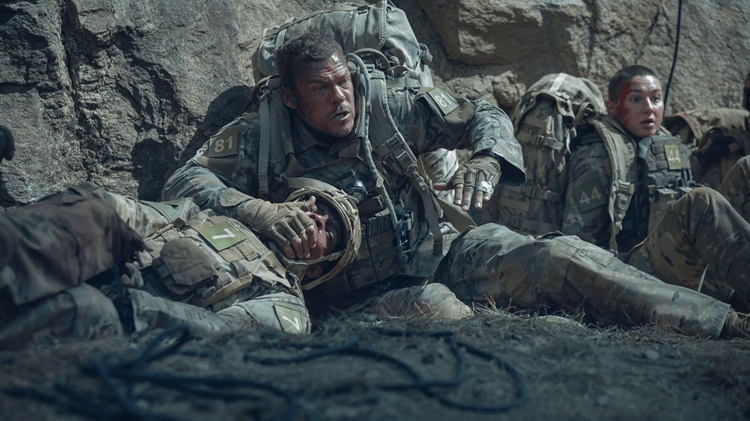
For decades war movies have come in all shapes and sizes. But only a handful of modern war movies have hit as hard as “Warfare” from Iraq War veteran Ray Mendoza. A former U.S. Navy SEAL, Mendoza writes and directs alongside Alex Garland (“Ex Machina”, “Civil War”) to deliver a raw and no frills feature based on his own personal memories. The results are harrowing, sobering, and eye-opening. And it makes for one of the most gripping experiences of the year.

Already heralded for its stunning realism, “Warfare” thrusts us into the grip of combat where bravery and brotherhood are the only means of survival. Before filming began, the cast underwent an intensive three week bootcamp that included weapons training, communications etiquette, and tactical maneuvers. It pays off in some really big ways, adding a striking layer of authenticity that help Mendoza and Garland immerse us deeper into the true-to-life world they’re recreating.

Image Courtesy of A24

The story of “Warfare” is as straightforward as its title. There are no sweeping character arcs, no dense plot, no artificial drama. Set in 2006 during the Iraq War, the movie follows Navy SEAL team Alpha One also known as the Bushmasters. The team are ordered to take up a sniper position on the top floor of a home they commandeer in Ramadi. From there they are to monitor a market place just down the street that’s believed to be a gathering place for insurgents.

One the many effective elements in “Warfare” is in how it presents the moment by moment realities these soldiers face. We’re immediately shown that not every second of a mission is guns blazing. In fact, Mendoza and Garland use their early scenes to emphasize the lull of surveillance and intelligence gathering. Yet they ramp up the tension with subtle references to the danger these young men are in. And when a hand grenade is tossed into their building, the intensity quickly goes from a simmer to a boil.

Things only ratchet up from there as “Warfare” grounds us in the efforts of the platoon to evacuate amid a hail of small arms fire from the converging insurgents. With unflinching effort, Mendoza and Garland put us side by side with the soldiers, making us feel the ferocity of combat without sacrificing verisimilitude for sensationalism. They avoid the usual war movie tropes – no chest-pounding bravado, no “tell my wife I love her” moments, no big inspirational speeches. Every heart-stopping second feels rooted in reality.

Capturing the real-time events is aided by the film’s impressively stacked cast that includes Will Poulter, D’Pharaoh Woon-A-Tai, Joseph Quinn, Charles Melton, Cosmo Jarvis, Michael Gandolfini, and Kit Connor among others. Each young actor clearly understands their assignment and fully commits to bringing their real-life characters to the screen as authentically as possible. They really shine in the second half as the mission falls apart and the “war is hell” adage takes full form.

Image Courtesy of A24

Equally impressive and just as vital is the technical craft, from the stunning cinematography to the concussive sound design. Both contribute to the overall visceral reaction the movie evokes, at times hitting like a sensory assault but in the most fitting way. Take the scene where an IED is suddenly detonated. The sound of the blast rattled my theater and the disorientation of the aftereffects underscores the chaos. Both leave such an impact.

Those who tend to view war movies through the prism of politics may be discouraged to find that “Warfare” isn’t interested in sermonizing or editorialization. That’s not to say there isn’t plenty that we can conclude from the moral murkiness that unfolds onscreen. But the movie’s focus remains on the men in uniform, and for 93 minutes we follow them through the trenches of warfare where we’re inspired by acts of heroism yet grieved at the human cost. It’s the latter that makes “Warfare” such a gut punch.

VERDICT – 4.5 STARS