
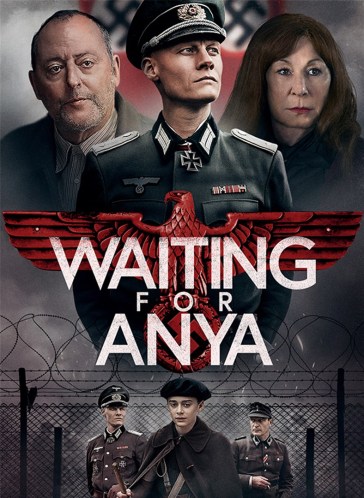
 The World War 2 drama “Waiting for Anya” comes from a 1990 British children’s novel written by Michael Morpurgo (who also penned “War Horse”). It follows a happy young shepherd boy who is forced to grow up too soon after the ripple effect of the war makes its way to his quiet village. Directed and co-written by Ben Cookson, this film adaptation has young people in mind, so those expecting an visceral and detailed study on the horrors of the Holocaust could be disappointed.
The story is set in the mountain village of Lescun in the southern most region of France. It’s 1942 and as the Nazis occupy Paris and began rounding up Jews throughout the north, the more isolated south go about their daily routines, unaffected by the war or its atrocities. Cookson’s camera relishes in the beauty of the Pyrenees, painting an idyllic portrait of country living. But as many of the villagers carry on life-as-usual, little do they know the war has already touched their community.
Our point-of-view comes through the tender observations of Jo (played by Noah Schnapp of “Stranger Things”). He has been given the responsibility of tending his family’s sheep after his father (Gilles Marini), a French soldier, is captured by the Germans and thrown into a POW camp. After a scary brush with a black bear, Jo runs into a kind but mysterious stranger named Benjamin (Frederick Schmidt).
Jo learns that Benjamin is a Jew who escaped from a train bound for a concentration camp with his young daughter Anya. The two were separated and Benjamin now hides out on a remote farm helping his widowed mother-in-law Horcada (Anjelica Huston) smuggle Jewish children across the border into Spain. His hopes are that one day his daughter will be among the children sent their way.
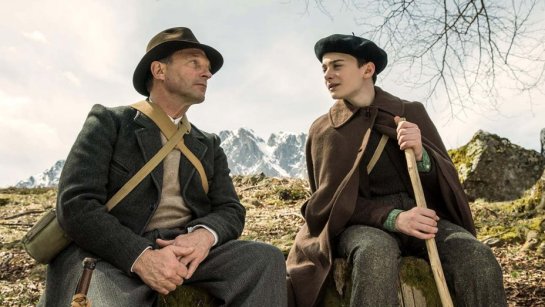
Photo Courtesy of Vertical Entertainment
As Germany gets wind of Jews being moved across the border, they dispatch a small platoon of soldiers who occupy the village and begin patrolling the nearby mountain paths. Obviously this threatens Benjamin and the children he is tasked with leading to safety. It also brings the realities of war to Jo’s front door in a way that changes his life forever.
In addition to Oscar-winner Huston several other familiar faces show up adding to the collection of good performances. The always reliable Jean Reno plays Jo’s percipient and seasoned grandfather while Thomas Kretschmann plays a German officer with some semblance of a conscience following his own personal family tragedy. But it comes down to Schnapp and his ability to sell us on his character. While there are times where he could inject more emotion, as a whole he provides us a solid anchor.
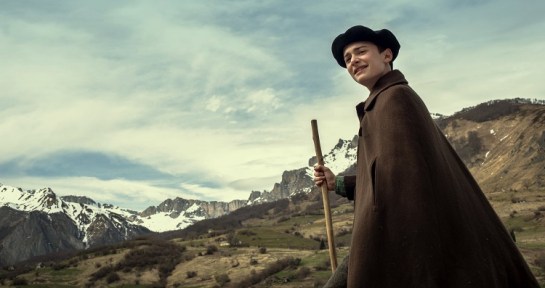
Photo Courtesy of Vertical Entertainment
On its surface “Waiting for Anya” is an heartfelt and well-meaning wartime drama. At its core it is a study of humanity as seen through a pair of young eyes. It’s about growing up, finding courage, and doing the right thing in the face of unspeakable evil. The story begins with a terrified shepherd boy running from a bear and leaving his helpless sheep behind. It’s a rather obvious but earnest metaphor for what he becomes – a courageous young man who risks his life to help the helpless.
When it comes to the Holocaust there have been few age-appropriate film examinations for young viewers. “Waiting for Anya” helps fill that void. Some are sure to see the film as too sanitized and not harsh enough in its depictions. But Cookson tells a very specific story that doesn’t need to visually emphasize the horrors. Instead their effects are felt through a story which may sag a little in the middle but ultimately pays off.
VERDICT – 3.5 STARS














 Keith & the Movies