REVIEW: “The Water Diviner”

WATER poster

Russell Crowe has long been one of film’s most reliable actors. His work has earned him the reputation for giving strong and steady performances. This has allowed him to dabble in a number of different movie types and genres. But the 51-year old Oscar-winning Australian has watched his career truly flourish in period pieces covering everything from the Roman Empire to 1950s Los Angeles. Regardless of the time period or setting, Crowe always seems perfectly cast.

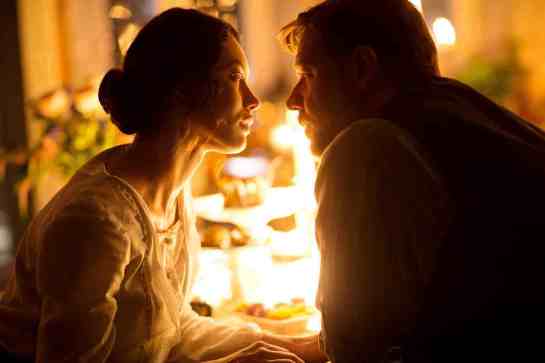
“The Water Diviner” places Crowe in 1919 following the end of World War I. He plays Joshua Connor, a farmer and water diviner living on the rugged Australian Outback. I knew practically nothing about the practice of water ‘divining’ but the film takes care of that in a fine opening sequence. From there we learn that recently Joshua’s life has been as hard as the ground he works. His three sons were presumed killed during the Battle of Gallipoli and his emotionally fractured wife Eliza (Jacqueline McKenzie) found it impossible to cope with the loss.

The grieving yet determined Joshua sets out to keep a promise to his wife – to find his sons and bring their bodies back home for burial. Along the way he is tortured by painful flashbacks, but his search is also assisted by guiding visions. He also encounters several key people along the way. He meets Ayshe (Olga Kurylenko), a war widow raising her son and running a hotel in Constantinople. Jai Courtney shows up playing an Australian officer tasked with finding lost Australian soldiers left on the battlefields. But the greatest help comes from an unexpected source, Major Hasan (Yılmaz Erdoğan), a Turkish officer deeply sympathetic to Joshua’s plight.

WATER1

Crowe not only stars in the film but makes his directorial debut. His direction may not instantly mirror that of an auteur, but it’s clear he is no novice and he understands the craft. In many ways Crowe’s approach hearkens back to a classic form of directing. We see it in much of his structural and camera decisions but also in the simplicity of the direction. I also think Crowe should be commended for giving the film a grand, near epic look and feel despite having a less than epic budget. The budget restrictions show themselves in the handful of action sequences but overall it feels like a sweeping, expansive story.

“The Water Diviner” is an entertaining and emotionally satisfying drama but it has sparked some intense controversy. Many people were offended by the film’s failure to address the Armenian genocide. Some pretty heavy allegations were hurled at Crowe and boycotts were called for. But were those feelings justified? Is this the type of film that demands the genocide be addressed? While offering the utmost respect for those effected by the slaughter, I would argue the answer to both questions is no.

“The Water Diviner” doesn’t aim to be a historically thorough film. The story takes place after the war and the central focus is on a father’s loss of his three sons. In many ways the film highlights the futility of war and the devastating personal costs that follow. Crowe shows the post-war through several different perspectives while never taking a side or forming any conclusion. But all of that serves as a backdrop. It’s truly a story of loss and a father coping the best way he can while also struggling with his complicity in his son’s fate. That is the emotional current that drives the film which is why I think the controversy is unwarranted.

Crowe’s direction is solid but even more could be said about his performance. I feel Crowe is sometimes overlooked because we know he is always going to give a strong performance. In this film he is the linchpin and the emotion center. I always enjoy Kurylenko and she is good here. Unfortunately her character is restricted to a fairly obvious side story. Not so for Yılmaz Erdoğan. The Turkish actor and filmmaker gives us an incredibly compelling character and he tells so much through his tired, war-weary eyes.

Some may consider “The Water Diviner” to be a bit too melodramatic and some may struggle with the film’s shifts in tone. Others may get caught up in the well-publicized controversy. Instead I found myself caught up in the story that lies at the heart of the film and I was completely invested in the central character. Russell Crowe has given us a fine movie that once again spotlights his talents as an actor while also introducing us to his talents as a director. It definitely impressed me and he has certainly earned more opportunities behind the camera.

VERDICT – 4.5 STARS

TEST star

REVIEW: “What We Do in the Shadows”

SHADOWS poster

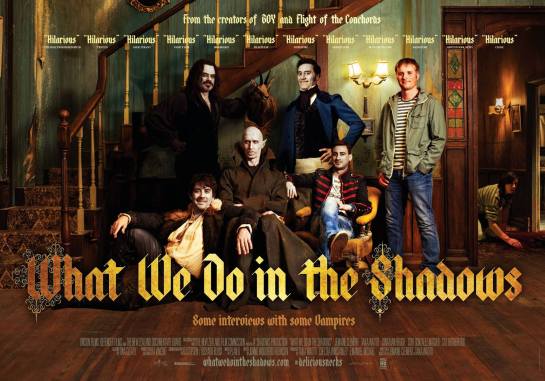
These days good comedies are a rarity which makes finding one all the more special. The genre’s landscape is overloaded with obnoxious raunchy comedies and shallow Sandler-esque toilet humor. If you aren’t a fan of those two brands finding an enjoyable modern comedy may be a chore. But “What We Do in the Shadows” is one of the rare exceptions – a highly original comedy that is also smart in its open embrace of absurdity.

Calling the film “smart” may be stretch for some, but I think the filmmakers are devilishly perceptive. Co-writers, co-directors, and co-stars Taika Waititi and Jemaine Clement are very well aware of the type of humor they are employing. The Wellington, New Zealand duo create a concept so ridiculous on the surface yet pulsing with focused energy and a satiric edge. It shows smarts in its concept, smarts in its execution, smarts in its structure, and perhaps most importantly smarts in its ability to maintain a genuinely funny premise from start to finish.

SHADOW1

While pondering a way to describe the film I kept coming back to ‘a vampire mockumemtary meets “The Real World”. It presents itself as a found-footage reality show and/or documentary. The first thing we see is a cheap, grainy production graphic from “The New Zealand Documentary Board”. From there we are immediately injected into the world of four vampires living together in a Wellington flat. Our perspective is through the lens of a documentarian’s camera.

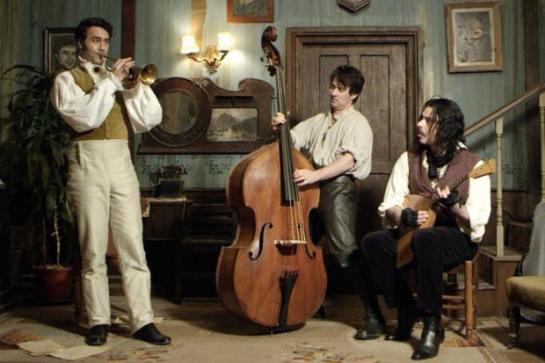
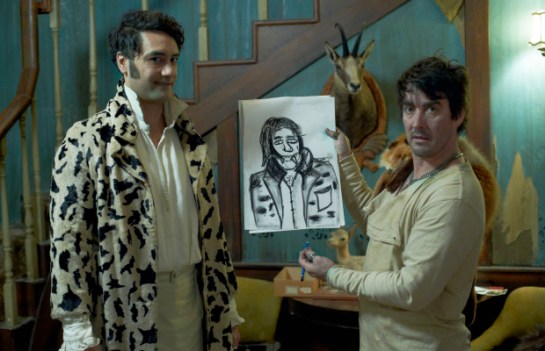
First we are introduced to the four vampires. The 379 year-old Viago (Waititi) is a good-hearted 16th century neat-freak. Vladislov (Clement) is an 862 year-old medieval fashionista. Deacon (Jonathan Brugh) is the youngster of the bunch – 183 years-old and a bit of a rebel. And then there is 8,000 year-old Petyr (Ben Fransham) who hisses more than speaks and has an uncanny resemblance to Count Orlok from “Nosferatu”. All four are uniquely funny which makes their quirky camaraderie a real treat.

It doesn’t take long to recognize the vibe Waititi and Clement are shooting for. The dry, deadpan humor. The constant awareness and conversations with the camera. The straight-faced approaches by the actors regardless of a scene’s nuttiness. All of it contributes to a movie which genuinely feels like a reality show or a documentary. It just happens to be spotlighting vampire roommates from different eras with very limited connections to the modern world outside their doors.

SHADOW2

Occasionally they go out to enjoy a socially awkward night on the town. Other times we see them having a “flat meeting” to discuss house duties. There are an assortment of camera confessionals talking about everything from lost loves to frustrations with roommates to favorite torture practices. And there are several funny bits after the boys are introduced to the wonders of YouTube, eBay, and Skype. Most of these scenes are given to us in pinches which are the perfect portions. They also toss in a very small handful of side characters who serve the story nicely.

“What We Do in the Shadows” is such a breath of fresh air. It’s a comedy that consistently delivers laughs without clinging to unfunny cliches or the hot current genre trends. Rarely does the movie miss a beat and its cleverness shows itself in a host of ways. It is subtly subversive, subtly satirical, and openly absurd. Waititi and Clement craft one very funny movie that clearly isn’t a film for the movie masses. I can see some people rolling their eyes and some people dismissing it altogether. I found it to be a hysterical reminder that there are comedies willing to do their own thing and do it very well.

VERDICT – 4.5 STARS

TEST star

REVIEW: “Words and Pictures”

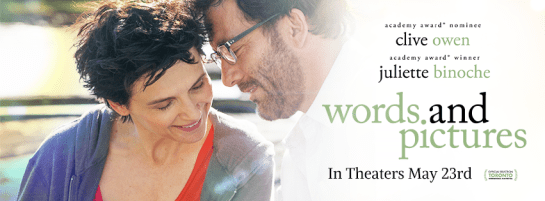
WordsPoster

Whenever you see a movie starring Clive Owen and Juliette Binoche you should automatically have a certain bit of excitement and expectation. These are two top level performers who have some of the most natural acting sensibilities. The two come together in the 2014 romantic drama “Words and Pictures”. The film is directed by 74-year old Australian Fred Schepisi. I wasn’t familiar with Schepisi’s work so while looking through his filmography the one film that stood out was the 1987 Steve Martin romantic comedy “Roxanne”.

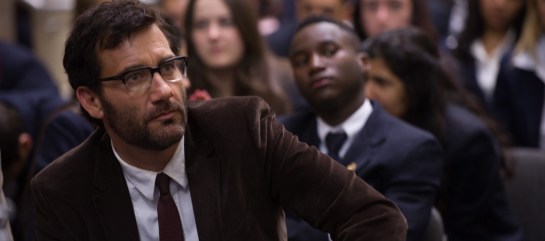
The film is set in Maine. Jack Marcus (Owen) is a language and writing teacher at a prominent college prep school. He has been a successful writer and poet and has been successful as an educator. But it doesn’t take long to see that he has his own demons. First there is his strained relationship with his son. Then there is his self-destructive alcoholism that begins to bleed over into his job performance. He soon finds his teaching gig in jeopardy pending a school administration review.

WORDS1

Binoche plays Dina Delsanto. She arrives at the school to serve as the new art teacher. She is an accomplished artist who has seen her career take a difficult turn due to her painful and worsening rheumatoid arthritis. Her frustrations with her conditions sometimes cause friction with her new students, but she genuinely seeks to increase their knowledge and love for art.

As you can probably guess the two teachers meet and Dina’s first impression of the smug Jack isn’t a great one. Dina wants nothing to do with him. Jack views his playful agitations as his own weird sign of affection. The two strong personalities clash over practically everything from their art forms to the prospects of a possible relationship. Owen and Binoche have a good chemistry and as you watch them you begin to hope that the walls between them will soften. These are two fabulous lead performances.

WORDS2

Writer Gerald Di Pego tosses in a few unique dramatic elements which keeps the film interesting. His script is also smart enough to let his two wonderful leads act. But at the same time the story does end up following a fairly familiar blueprint. It sets itself up to be truly different but in the second half you’ll notice several things that feel all too familiar. Even the ending seems too neat and polished. It never kills the movie, but it would have been interesting to see some of the more unique directions this story could have gone.

Still there is enough here to like and I enjoyed “Words and Pictures”. Its main draw is Clive Owen and Juliette Binoche – two performers I never grow tired of watching. They make this film automatically worth your time. And even though the story isn’t that ambitious or new, the film has its moments that really work. It can be romantic, funny, and genuinely heartfelt. It also gives us characters we can actually care about. Those pluses outweigh the snags which keep it from being even better.

VERDICT – 3.5 STARS

REVIEW: “White House Down”

WHD poster

Who would have thought that 2013 would be the year of the ‘terrorists take over the White House’ action movie? Well, that is if two movies about a White House terrorist takeover warrants such a title. The first of these films was “Olympus has Fallen”, a straightforward old school action picture that I liked due to its clear idea of what it wanted to be. Now we get “White House Down” – a mess of a film that lacks the focus and material to be memorable or even slightly worth watching.

“White House Down” is a bad movie. It’s filled with one contrivance after another and it hasn’t an original bone in its entire 130 life-draining minutes. I actually had to look up the running time because it felt like a 3 hour movie. It’s slow, laborious, and director Roland Emmerich never seems to know when to pull the plug. It would be fine if the story was engaging or the action was exhilarating. Unfortunately it isn’t either of those things, and an action movie that lacks excitement already has one strike against it.

WHD1

The story is pretty basic. Channing Tatum plays John Cale, A US Capitol police officer with aspirations of joining the President’s Secret Service team. He’s a divorced father on the outs with his daughter Emily (Joey King). So he tries to win her over by taking her to the White House where he is interviewing for a position. Unfortunately he picks a day when a group of politically correct terrorists take control of the White House, kill a bunch of people, unveil their master plan, yada yada yada. I think you get the drift. Jaime Foxx plays President James Sawyer and forms the film’s ‘buddy cop’ team with Tatum. Maggie Gyllenhaal plays a Secret Service head. Jason Clarke, James Woods, Richard Jenkins, and Lance Reddick are also present.

For the most part the performances are terrible. Tatum is as unconvincing as ever and his attempts at being a cool macho-type don’t work. Jaimee Foxx probably gives the worst performance. At times he shows slight bits of believability but then he destroys it with some goofy line or ridiculous delivery. Jason Clarke runs around like a madman and seems wildly miscast. Reddick is laugh-out-loud bad as a stiff and grunting General. Gyllenhaal may give the best performance of the group but even she is eventually smothered by the weak material.

WHD2

As bad as the performances are it’s the script that is the biggest problem. It’s hard to believe that James Vanderbilt, the man who wrote “Zodiac” from 2007, penned this garbage. The jokes are hokey, the reveals are predictable, and the dialogue is sometimes painful to endure. And then there is Roland Emmerich who has a history with inflated underachieving action pictures. He misses nearly every target he aims for. He drags scenes out too long. He wallows in corny melodrama. And the action (his bread and butter) falls flat. With the exception of one sequence, which entertains despite its silliness, Emmerich’s action is repetitive, hackneyed, and not the least bit exciting.

I do get the argument that “White House Down” isn’t aspiring to new things and it’s just trying to be an old-school action romp. Heck I used that same defense with “Olympus Has Fallen”. But this movie stretches my tolerance level for dopey dialogue, dull action, and poor filmmaking in general. None of the characters have appeal and the movie is littered with poor performances. This was a $150 million mess and I have to believe Columbia Pictures could have gotten a better movie with that kind of money.

VERDICT – 1.5 STARS

REVIEW: “The Way, Way Back”

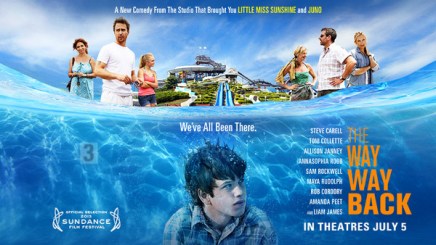
WAY WAY BACK Poster

I love it when a movie really surprises me. Such was the case with “The Way, Way Back”. This one-half comedy and one-half drama is a wonderful and entertaining stew that caught me off guard. Written and directed by the team of Nat Faxon and Jim Rash, “The Way, Way Back” is a warm and authentic coming-of-age picture. It’s a smart and funny film that at times dances close to cliché but then always turns and goes in a more smart and believable direction. It really worked for me.

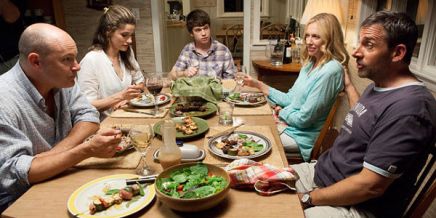
Liam James plays Duncan, a sullen and awkward 14-year old who is trapped in a world of selfish, adolescent adults. He is forced to accompany his divorced mother Pam (Toni Collette), her jerk of a boyfriend Trent (Steve Carell), and his daughter Steph (Zoe Levin) on a vacation to Trent’s summer home in a small New England beach town. Duncan’s life is full of complications. He is disconnected from his emotionally needy mother and at constant odds with the annoying and disingenuous Trent. Then there are the assortment of oddball characters from his new summer neighborhood none of which give him a feeling of belonging.

WAY WAY1

But things change a bit when Duncan meets Owen (Sam Rockwell), a laid back water park manager. Owen takes a liking to Duncan and actually connects with him on a level that the struggling teen desperately needs. Rockwell is fabulous here and he gives arguably the funniest performance of the year. He’s obviously a naturally funny guy and you’ll swear you’re watching improvisation as he delivers one quick-witted funny line after another. Faxon and Rash along with Maya Rudolph have small roles as fellow water park employees and they round out what becomes Duncan’s sanctuary. It’s where feels free. It’s where he feels he belongs.

One of the film’s great strengths is that the story is told almost entirely from Duncan’s perspective. We see his perception of dysfunctional adults, broken marriages, and juvenile behavior from those who should be anchors of support. It really is the adults who are the irresponsible and objectionable ones. As one equally frustrated young character describes it – “It’s spring break for adults” and not in a good way. But there are always cleverly injected bits of humor that keeps the tone a tad lighter than it may sound. Much like their previous Oscar-winning work on “The Descendants”, Rash and Faxon’s script takes on serious life situations and laces them with subtle bits of comedy. It’s great writing that will have you laughing one minute and feeling deep empathy the next.

WAY WAY 3

This is a character-driven movie and the performances don’t disappoint. The relatively unknown Liam James is just what the lead role needed. He’s restrained and grounded which allows for so much truth to flow from the character. I also really liked Steve Carell in a role that is drastically different from what we’re used to seeing him do. It’s interesting that the biggest comedian in the entire cast has the most serious role in the film. Allison Janney is a lot of fun as a spacey next door neighbor and Rob Corddry and Amanda Peet are delightfully insufferable as two of Trent’s close friends.

The story of an insecure socially displaced youth isn’t new, but often times it’s told using the same overused formulas and contrivances. “The Way, Way Back” doesn’t exactly carve a new path but it does stay out of the usual trappings. It’s refreshingly honest and surprisingly funny. There are also some fabulous characters brought to life through some good acting led by Rockwell. His performance was a real eye-opener for me. The soundtrack, the perfect pacing, etc. As I said, it’s a wonderful and entertaining stew and I was hooked from the first scene. What a nice surprise.

VERDICT – 4.5 STARS

REVIEW: “When Harry Met Sally…”

HARRY POSTERBoth Billy Crystal and Meg Ryan will always be remembered for their individual strings of popular movies in the late 1980s and through the 1990s. While neither has held onto their box office popularity past that point, no one can deny what a great run they had. And during that time arguably their best film was a picture they did together, the 1989 romantic comedy “When Harry Met Sally…”.

I’ve watched this film several times but not since my VHS copy became extinct. Now I’ve revisited the movie and what a treat to learn that it still holds up after almost 15 years. It still features that same sharp wit. It still has those laugh-out-loud moments. It still has the perfect amount of romance. But most importantly, it still features two main characters that we connect with and genuinely care about.

It’s the story of Harry Burns (Crystal) and Sally Albright (Ryan) and the unique winding road their relationship travels. They first meet in 1977, both fresh out of school at the University of Chicago. Harry is dating a friend of Sally’s who encourages the two to share a drive back to New York City. During the drive the two share a number of conversations particularly their drastically different philosophies on relationships. After some hearty disagreements, they finally arrive in New York City and gladly go their separate ways.

The film then jumps ahead 5 years to when Harry and Sally bump into each other at the airport. Both are at different stages in their lives and their attitudes about relationships have slightly evolved. Later we jump ahead another 5 years to another chance meeting. Again their situations have changed and the evolution of their relationship philosophies is obvious. Harry is still witty and neurotic but he isn’t as cocky and sure of himself as he is when we first meet him. Sally starts off as peppy and exuberant but later we find her more credulous and naive. This is the heart of the film – watching these two people with seemingly warped views of relationships transform under the weight of reality. And all while the one true path to happiness may be right under their noses.

HARRY1

For me there are many reasons this film works so well. First is Nora Ephron’s Oscar nominated screenplay. It’s smart, razor sharp, and unflinching in its grounded portrayal of its characters. Much of that is thanks to contributions made by Crystal and Ryan but overall this is Ephron’s baby and she nails it. Credit also goes to director Rob Reiner. This was during a period when Reiner was making better films and much of it was taken from his life as a divorced single man. It’s solid filmmaking, something that can’t be said about many of his more recent movies.

And then there are the performances from Billy Crystal and Meg Ryan. It would have all fallen apart if the characters weren’t so easy to connect with. Crystal and Ryan draw us in the first moments we meet them. There is also a wonderful and charming chemistry between the two. You can’t help but get caught up in Crystal’s dry humor and Ryan’s infectious smile. They are so believable and you never doubt the authenticity of these two people. They are perfectly cast.

At times “When Harry Met Sally…” seems to draw out its one big question (will Harry and Sally ever get together?) longer than necessary and some people may get bogged down in the numerous back-and-forths between the different characters. But for me after all these years it’s still a fine romantic comedy that knows how to handle its characters and their situations. It’s a story of two lost souls who put their faith in their own wrong views of love while a much easier answer may be right before them. That’s a story I can get into.

VERDICT – 4 STARS