REVIEW: “Woman of the Hour” (2024)

Anna Kendrick makes her directorial debut and stars in “Woman of the Hour”, a well-made thriller based on the real-life crimes of sex offender and serial killer Rodney Alcala. Dubbed the Dating Game Killer, Alcala has been directly linked to eight murders. But it’s believed that his true number of victims may be as high as 130. He was arrested in July 1979 and sentenced to death. In 2021, Alcala died of natural causes at the age of 77 while still in prison.

Kendrick’s film examines Alcala’s killing spree through several different perspectives. She chronicles different murders, making stops in 1971 New York City, 1977 Wyoming, and for the majority of the film 1978 Los Angeles. That’s where we meet Sheryl Bradshaw (played by Kendrick), a struggling actress who is about to give up on her big Hollywood dreams. Out of options, Sheryl’s agent casts her to appear on The Dating Game in hopes of getting her some much needed exposure.

Image Courtesy of Netflix

For those who don’t know, The Dating Game was a corny but popular game show where a young woman sitting behind a partition would ask silly questions to three bachelors sitting on the other side. After three rounds she would choose one bachelor as the winner. The show would then send the couple on an all-expense paid date.

On September 13, 1978 Cheryl Bradshaw made her appearance on The Dating Game. And among her three bachelors was none other than Rodney Alcala. By that time he had already raped and murdered several of his victims and been convicted of sexual assault. But somehow the show’s producers had missed his criminal record. It’s chilling footage to watch especially considering that Alcala not only appeared on the show but won the competition.

Kendrick and screenwriter Ian McDonald recreate that surreal broadcast, pulling from several first-hand testimonies while adding some fictional twists of their own. Most of their additions work to build the film’s statement on societal misogyny – a message which quickly and at times clumsily becomes obvious. But Kendrick maintains a steady sense of unease, having already established Alcala as a vicious killer leading up to their fateful encounter.

Alcala is played by Daniel Zovatto who conceals a killer’s brute evil underneath a psychopathic charm. Alcala’s methods were well thought out and he often preyed on innocence and vulnerability. We watch him lure in his victims by posing as a professional fashion photographer. Alcala then convinces them to let him shoot them for his portfolio. Once alone, he would rape and murder them.

Image Courtesy of Netflix

The film gives Zovatto plenty of space to mine Alcala’s menace, but it’s Kendrick’s own performance as Sheryl (note the slight name change) that offers the most clarity. It’s seen most in one brilliantly directed and acted encounter she and Zovatto share in a restaurant. It’s intense and terrifying and it shrewdly relays the themes Kendrick is most interested in.

“Woman of the Hour” shines a spotlight on Anna Kendrick who delivers not only another well-calibrated performance but an assured directorial debut. She shows a firm control of her subject matter, capturing a harrowing sense of danger while steering clear of sensationalism or exploitation. Though a little too on-the-nose at times, her commentary on the everyday dangers of being a woman in a predatory society adds a compelling layer. Her two aims don’t always gel, but they highlight Kendrick’s ambition and willingness to take chances.

VERDICT – 3.5 STARS

REVIEW: “The Wait” (2024)

Written and directed by F. Javier Gutierrez, “The Wait” (also known by its Spanish title (“La espera”) is a transfixing fusion of folk horror and Greek tragedy. It’s laced with elements from classic Westerns and dark fantasy. At times it resembles an absorbing morality tale and at other times a gritty revenge thriller. What’s impressive is how seamlessly its pieces fit together. And all because of Gutierrez’s meticulous craftsmanship and laser focus.

Set in 1970, the story follows a family man named Eladio (Victor Clavijo) who moves his wife Marcia (Ruth Diaz) and 10-year-old son Floren (Moisés Ruiz) to the parched Andalusian countryside after taking a job tending a hunting estate owned by the wealthy and powerful Don Francisco (Pedro Casablanc). Three years pass and Eladio begins preparing Floren to take on more responsibilities around the place. But things aren’t as agreeable with the disillusioned Marcia who misses her life in the city.

One day Eladio is approached by a local named Don Carlos (Manuel Morőn) who organizes area hunts for his wealthy clientele. Don Carlos is in a pickle. He has overbooked an upcoming hunt and wants Eladio to add three additional hunting stands to the property, raising the total to thirteen. But that would go against Don Francisco’s strict orders. So Eladio turns down a generous bribe and sticks to his principles. But Don Carlos secretly pays Marcia a visit and tells her of his offer. She immediately begins pressuring her husband, even calling him a coward for not taking the money.

Against his better judgment, Eladio gives in to Marcia and accepts Don Carlos’ offer. From the very moment he does we know he’s going to regret it. Almost immediately a sense of dread creeps in, and after a tragic chain of events, Eladio loses the two things he holds dearest – his wife and son. It leaves him all alone on the property, overcome with sorrow, haunted by visions, and tormented by guilt.

Gutierrez pushes Eladio to the brink of madness and the stoic Clavijo captures his descent with startling clarity. His searing performance conveys volumes, mostly through expression and physicality rather than dialogue. The pride and confidence that once filled his eyes is replaced by a cold emptiness. Grief fuels his anguish, but it’s a fit of drunken rage and its ensuing violence that sends him careening over a psychological edge.

The movie’s wicked second half takes a near primal turn as Gutierrez leans heavily on his film’s folk horror element. It ventures into the macabre and surrealistic to the point that we often question what’s on screen. Are the things we see real or are they grim manifestations from a troubled mind? Thankfully Gutierrez never allows Eladio to fully lose his grasp of reality. He’s kept grounded by clues that point to a mystery he’s determined to solve. It’s a mystery that drives the movie to its allegorically rich and painfully potent ending.

“The Wait” is a movie that truly earns its title. It’s a slow-burn in the best of ways, patiently plowing its themes and examining its main character’s psyche. The rugged rural landscapes form a fittingly harsh backdrop while intense close-ups makes even the everyday minutia a means to immerse us in this unforgiving world. It all works together in harmony to make this dark and twisted genre-bender worth every second of our investment. “The Wait” is out now on VOD.

VERDICT – 4 STARS

REVIEW: “White Bird” (2024)

The 2017 coming-of-age family film “Wonder” was a surprise hit both with critics and at the box office. It was based on a 2012 children’s novel of the same name by R. J. Palacio which spawned several other books including a 2019 graphic novel titled “White Bird: A Wonder Story”. Now it too has received the big screen treatment in a tender yet powerful new film directed by Marc Forster (“Monster’s Ball”, “Finding Neverland”, “A Man Called Otto”).

“White Bird” serves as a spin-off sequel that follows the character Julian Albans (Bryce Gheisar), the repentant bully from “Wonder”. The story (adapted by screenwriter Mark Bomback) sees 15-year-old Julian attending a new private school, Yates Academy following the events of the previous film. In an effort to fit in, he has adopted a passive approach, “Don’t be mean, don’t be nice. Be normal.”

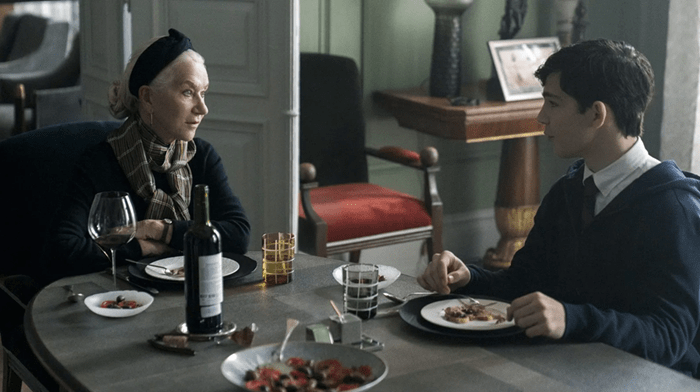
One day after school Julian arrives home to find his grandmother, Sara (Helen Mirren) visiting from Paris. She’s a renowned artist who is in town to be featured in a local museum’s retrospective highlighting her work. With Julian’s parents out for the evening, Sara sits down with her grandson to catch up. As she listens to him talk about his passivity, Sara is reminded of her own childhood which she has long chosen not to talk about. She makes the decision to tell Julian about her past in hopes of steering him away from a potentially regretful path.

Image Courtesy of Lionsgate

From there we are taken to a flashback which makes up the majority of the movie. It’s where we’re introduced to a young Sara, earnestly and sensitively played by Ariella Glaser. It’s August, 1942 and Sara seems to have a wonderful life. Her father (Ishai Golan) is a surgeon and her mother (Olivia Ross) is a mathematics professor. They’re a loving and close-knit Jewish family living in a cozy French village.

The starry-eyed Sara sees the world through a comfortable and naive lens. Her days are mostly spent indulging her love for clothes, drawing, and hanging out with her equally oblivious friends. She stays out of anything that man invade her comfort zone including turning a blind eye to a bullied classmate with polio named Julien (Orlando Schwerdt). In reality, Sara and her family live under the shadow of Nazi occupation. The Germans had already marched into Paris, but their presence in the villages has been minimal.

But that changes seemingly overnight. Her mother is promptly fired from the university and local stores begin denying service to Jews. But reality truly sets in when Sara’s school day is interrupted by Nazi soldiers sent to roundup Jewish students. After a harrowing escape attempt goes terribly wrong, Sara finds help from the most unexpected source.

Image Courtesy of Lionsgate

Julien discovers Sara hiding and sneaks her out of town to his family’s farmhouse. His parents, Vivienne (Gillian Anderson) and Jean Paul (Jo Stone-Fewings) hide her in their barn, out of sight of their nosey Nazi sympathizing neighbors. As days turn to weeks and weeks turn to months, Sara and Julien grow closer. Their budding relationship helps form the heart of the movie. But the threat of being discovered is always looming, adding a steady tension that is palpable yet never overplayed.

Throughout the film’s swift two hours, Forster maintains a good grip on his premise and subject matter. It’s a tricky task, but he finds the right balance between a poignant coming-of-age story and a serious-minded Holocaust drama. Much of his world is shown through the eyes of children yet he never trivializes or downplays the gravity of what’s happening. Nor does he use the heaviness of history to manipulate his audience. Instead, the emotions he brings out are authentic and earned.

“White Bird” navigates its solemn subjects with an open-hearted optimism, incisively exploring its themes of kindness, cruelty, forgiveness, and sacrifice. The film doesn’t say anything especially new, but it head-on confronts the cycles of hatred that have long plagued humanity. It leads to a powerful and forever relevant message that is enriched by top-to-bottom terrific performances and a director who never takes his finger off the human pulse. “White Bird” opens in theaters on October 4th.

VERDICT – 4 STARS

REVIEW: “Wolfs” (2024)

If you ever needed evidence that the movie industry has changed, look no further than “Wolfs”. This new action comedy comes with a $200 million budget and is illuminated by the sheer star wattage of its two A-list leads, George Clooney and Brad Pitt. Those used to be the ideal ingredients for a robust big screen release. But not so with “Wolfs”. Instead (minus a very brief and limited theatrical run), “Wolfs” is releasing on AppleTV+. As I said, the industry has changed.

Much of the early conversations surrounding “Wolfs” have centered on its hefty budget, namely the salaries paid to the two stars (several outlets have reported $35 million each while Clooney has denied the figures). Either way, the movie will need to earn its money back without the aid of a theater release. It’s certainly possible, although for people like me, figuring up revenue generated on streaming services is akin to advanced calculus.

Image Courtesy of Apple Original Films

“Wolfs” is directed by Jon Watts whose most notable big screen credits are his three Spider-Man movies for Marvel Studios. Here he crafts a story that sees Clooney and Pitt playing two competing New York City fixers who are forced to work together over the course of one long winter night. There’s not much in terms of inspiration and the movie has its fair share of lulls. But the two stars pack enough individual charisma and comic chemistry to keep the movie afloat.

The movie opens in a $10,000 a night luxury penthouse where a prominent district attorney (Amy Ryan) finds herself in a pickle. In the middle of a rowdy fling, her much younger lover (Austin Abrams) winds up dead. Desperate to have her mess “cleaned” in order to avoid a reputation-killing scandal, the DA calls a number she was given in case she ever found herself in need. On the other end is a fixer played by Clooney (we never get his name) who specializes in handling such things. He immediately heads to the hotel.

Once he arrives he goes straight to work but is interrupted by another fixer played by Pitt (we never get his name either) who has been called to “clean up” the same mess. Against their wishes, the two are forced to work together. But what should be a simple job turns into a nightmare after they discover a backpack hidden behind a dresser containing $250,000 worth of heroin. Even worse, the dead body they’re supposed to dispose isn’t dead at all.

Image Courtesy of Apple Original Films

The majority of the movie follows our two fixers as they sort out who the drugs belong to and how they need to handle their college-aged tag-along. As they do, Watts offers up plenty of banter, much of which revolves around their mutual distrust and lone-wolf mentalities. Clooney and Pitt spit out several decent zingers but spend a lot of time lazily cursing on cue. Yet they remain effortlessly compatible on screen – a muscle they have previously flexed in their three Ocean’s films and other collaborations.

Still, great hair and million-dollar smiles from two former Sexiest Man Alive honorees can only carry a movie so far. A cluttered story, a few dull patches, and some comic misfires keep “Wolfs” from being the satisfying crowd-pleaser it could’ve been. But it’s still George Clooney and Brad Pitt – two actors who emanate charm and charisma. And when you put them on screen together, you have the kind of chemistry that makes overlooking shortcomings a little bit easier. “Wolfs” premieres today on AppleTV+.

VERDICT – 3 STARS

REVIEW: “The Watchers” (2024)

Ishana Night Shyamalan, daughter of director, producer, and screenwriter M. Night Shyamalan, makes her directorial debut with “The Watchers”, a supernatural horror film in the same vein as those often made by her famous father. In addition to directing, the also wrote the screenplay which is an adaptation of A. M. Shine’s 2021 novel of the same name. Much like you would expect, “The Watchers” is eerie, tense, and mysterious while also tossing in a few curveballs to keep things interesting. At least for a little while.

With “The Watchers”, Shyamalan weaves psychological and folk horror together into a movie that seems to draw from a number of inspirations. Her use of camera, location, and music are impressive and she’s able to build and sustain some unnerving atmosphere. Where she struggles is in her character work and in landing her finish. She introduces several cool ideas and tries to add emotional depth to our protagonist. But they never quite resonate the way they need too.

Image Courtesy of Warner Bros. Pictures

Set in western Ireland, Dakota Fanning plays a 28-year-old American named Mina. She’s a lost soul who is still hanging onto the pain of her mother’s death some 15 years earlier. Despite the pleas from her worried sister back in the States, Mina has stayed abroad, settling in Ireland where she works at a small specialty pet shop. Shyamalan introduces some intriguing emotional conflict within Mina that manifests itself in some unusual behavior. But most of that is left unexplored, with the exception of a few brief sequences that don’t really do them justice.

While transporting a rare bird to a zoo in Belfast, Mina finds herself on a winding dirt road deep within a dense, sprawling, and mostly uncharted forest (note: when in a movie never trust a GPS). Suddenly her car and every other electronic device she has goes dead. As is often the case in movies like this, not all of her actions make sense and she soon finds herself on foot and lost with night quickly approaching. Terrifying sounds begin echoing from the shadows. But then Mina spots an older woman named Madeline (Olwen Fouéré) who leads her to a bunker she calls “The Coup”. Inside Mina meets two other strangers, Ciara (Georgina Campbell) and Daniel (Oliver Finnegan).

Image Courtesy of Warner Bros. Pictures

Once sealed inside, Madeline has the group of four line up in front of a massive two-way mirror. She explains that each night mysterious yet deadly creatures called Watchers gather on the other side to observe them. We learn the Watchers are nocturnal and retreat into giant holes in the ground during the day. The four can venture outside after sunrise, but must stay inside the Coup when the sun goes down if they want to live. Madeline is clearly the leader. But after several days Mina grows more and more suspicious and begins to challenge Madeline’s strict rules.

Tensions grow, secrets are revealed, and the humans eventually come face-to-face with the creepy ravenous creatures. But the road throughout is full of plot holes and too much is left unexplained, making it difficult to really commit to what we’re seeing. I don’t mind being left with a few questions. But when they’re at the expense of the story’s cohesion, well, it can really bring a movie down. Such is the case with “The Watchers”, a film that starts on a promising note with a cool buildup and some impressive first-time directing. But Shyamalan leaves too many loose ends and there’s not enough of a payoff to help us look past them. “The Watchers” is in theaters now.

VERDICT – 2.5 STARS

REVIEW: “Wonka” (2023)

Director Paul King’s “Wonka” sets out to tell the origin story of none other than Willy Wonka, the popular chocolatier from Roald Dahl’s beloved 1964 novel “Charlie and the Chocolate Factory”. The story (co-written by King and Simon Farnaby from a story conceived by King) follow Willy’s challenging early days in Europe. King has called his film a companion piece to Mel Stuart’s 1971 film “Willy Wonka & the Chocolate Factory”. You can certainly feel that connection.

I don’t have much of a history with the Wonka character or the previous two movies. I’ve seen them both but never felt the same affection that many do. And that’s why “Wonka” was such a pleasant surprise. It turns out to be a delightful fantasy film for the entire family that features a terrific ensemble, great production design, good humor, and even better musical numbers. Oh, and there’s the hysterical Hugh Grant who quite honestly steals every single scene he’s in (and that is no exaggeration).

The film kicks off with a fabulous opening number as Willy Wonka (an affable and energetic Timothée Chalamet) arrives in a European coastal town with very little money but a really big dream. He desperately wants to open his own chocolate shop in the town’s famed Galeries Gourmet. There he hopes to make the finest magical chocolates to share with the world. But as he quickly learns, that’s easier said than done.

Image Courtesy of Warner Bros. Pictures

The wide-eyed Willy is a dreamer at heart. He prides himself in being a magician and an inventor. But his true passion is chocolate – something handed down to him by his late mother (played in flashbacks by Sally Hawkins). Unfortunately the ambitious but gullible Willy doesn’t have a good grasp of the real world and is immediately duped by the devious Mrs. Scrubitt (Olivia Colman) and her lunkheaded goon Bleacher (Tom Davis). Under the guise of kindness, the pair offer Willy a room for the night but trick him into signing a binding contract (always read the fine print) that confines him to labor in her basement laundry.

Willy joins several others who also failed to read the fine print. He takes a liking to the small group of coerced laborers, especially a resourceful orphan girl named Noodle (Calah Lane). The two have a great rapport and the brother-sister dynamic that develops is one of the sweetest (bad pun intended) ingredients in the film.

Noodle helps Willy slip out of his confinement so he can begin selling his chocolate. But he runs into bigger challenges than mean old Mrs. Scrubitt. It turns out there is a cartel of chocolate shop owners (played with hilarious over-the-top panache by Paterson Joseph, Matt Lucas, and Matthew Baynton) intent on squashing any competition. They ensure their chocolate dominance through bribes to the crooked sweet-toothed police chief (Keegan Michael Key) and an equally corrupt local cleric (Rowan Atkinson).

Image Courtesy of Warner Bros. Pictures

Then there’s the nagging issue of the small green-haired orange-skinned man who keeps slipping in and stealing Willy’s chocolates. He identifies himself as an Oompa-Loompa and he’s played by the riotously starchy Hugh Grant. It’s such a wildly absurd pairing (Grant and Oompa-Loompa) but it works so well thanks to the effortlessly droll veteran actor. He had me smiling every time he popped up on screen.

The ‘overcoming adversity’ tale that follows sticks close to formula as Willy the confectioner and his new friends go head-to-head with the choco-conglomerate. Yet King (best known for his terrific “Paddington” films) infuses the movie with his own charming effervescent style of storytelling, slyly navigating through some surprisingly dark themes with a warm and genial spirit. And to his credit, King gets the tone just right, whether he’s submerging us in his sugar-coated fantasy, tenderly touching our emotions, or playfully venturing into full heist movie territory.

As for the music (and yes, “Wonka” is very much a musical), none of Neil Hannon’s original songs will stick in your mind. But that’s not to say they’re bad. In fact the songs are perfectly in tune with the storytelling and the smile-inducing musical set pieces offer entertaining rushes of vibrant creativity. And kudos to Chalamet who does a great job balancing all that’s asked of him. He’s a nice fit for a story that smoothes off most of the Dahl’s sharp edges and embraces the childlike sense of wonder that makes this movie such a treat. “Wonka” is in theaters now.

VERDICT – 4 STARS