REVIEW: “Waltair Veerayya” (2023)

There’s a lot to like about the new Teluga-language action-comedy “Waltair Veerayya”. Directed by Bobby Kolli, the movie takes some big swings and has an even bigger vision. There are bursts of good action, several compelling characters, and a spare laugh or two. And it leans heavy on its big star, Chiranjeevi, giving plenty of screen time to the popular actor, producer, and former politician. For die-hard Chiranjeevi fans, that’s probably enough to have a good time. But it doesn’t cloak the film’s flaws which unfortunately are too big to overlook.

For starters, “Waltair Veerayya” is a little too ambitious. I like the idea behind it and I certainly don’t knock its scope. But Kolli (who co-wrote the script with Kona Venkat and L. Chakravarthy Reddy) can’t bring it all together in a cohesive way. It’s especially evident in the messy and scattershot second half that gets bogged down in seemingly endless backstory that zaps the movie of its energy. The story structure is clever, but connecting the dots becomes more of a chore that enjoyable.

But its biggest issue comes in the awkward and jarring shifts in tone. The movie really struggles nailing down an identity, haphazardly hopping back-and-forth between blood-splattering violence, playfully romantic dance numbers, grim tragedies, and stretches of silly slapstick. It’s a pretty bold and challenging move to try and incorporate all of those things into your movie. But if they don’t come together well, you end up with a film constantly at odds with itself. Sadly, that’s often the case with “Waltair Veerayya”.

Those are issues I never could shake, but that doesn’t mean the movie is a dud. In fact, there were several moments where Kolli had me fully onboard with what he was doing. And while the second half is messy, the way Kolli brings it together in the final act gives you a better appreciation of what he was going for. Minus a few slow patches (mostly with the attempts at comedy), the first half is especially good at setting up the story and introducing key characters. It definitely sets things on the right track.

When a Malaysian drug lord named Michael Caesar (Prakash Raj) sends his henchmen to Vizag to bust his younger brother Solomon (Bobby Simha) out of jail, it ends in a gruesome police station massacre. The inspector in charge, Seethapathi (Rajendra Prasad) is relieved of his duty, but remains determined that justice be served. So he hires a notorious smuggler Waltair Veerayya (Chiranjeevi) to travel to Malaysia and extradite Caesar back to India to pay for his crimes.

It’s a good setup, but it’s not without its hiccups. Every so often, the movie gets sidetracked with these wacky scenes that almost play like sketch comedy. The feel so detached from the crime story at the movie’s center. Worst of all, they make it hard to get a grasp on who Waltair Veerayya is supposed to be. One minute he’s a gritty, intimidating, violent force; the next he’s a bumbling oaf. Not only do these scenes clash with the story, but they almost play like a showcase for Chiranjeevi rather than a tale of Waltair Veerayya.

Still, Chiranjeevi has plenty of charisma, and whenever the movie is focused, he makes for a good protagonist. The film is also helped by some good and sturdy supporting work. Seasoned actor Prakash Raj is no stranger to ‘bad guy’ roles, and he’s a perfect fit here. Shruti Haasan is terrific as a hotel guest relations manager who may not be who she claims to be. And Ravi Teja brings a needed swagger to the second half playing Police Commissioner Vikram Sagar who we learn has a special connection with Veerayya.

Aside from some rocky storytelling and a wildly inconsistent tone, “Waltair Veerayya” can still be entertaining. There are plenty of twists, turns, and double-crosses. There’s enough stylishly choreographed action to keep things lively, and the dance numbers (on their own) are enjoyable. If only it all gelled. If only the grim and violent didn’t clash with the silly and whimsical. If only it did as well telling its story as it did showcasing its star. “Waltair Veerayya” is now showing in select theaters.

VERDICT – 2.5 STARS

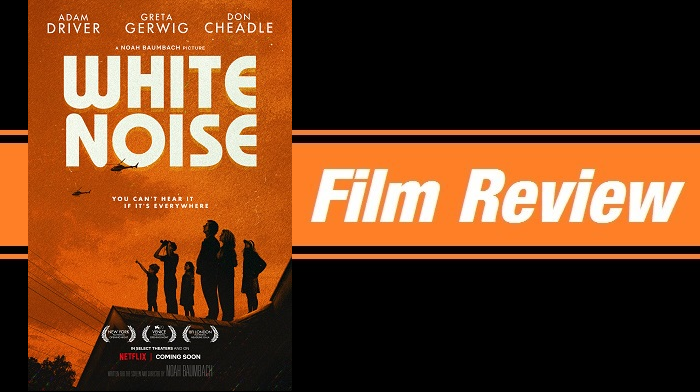
REVIEW: “White Noise” (2022)

(CLICK HERE to read my full review in the Arkansas Democrat-Gazette)

DISCLOSURE: I’m a full-on unapologetic Noah Baumbach apologist. I love his movies, even the ones that don’t quite hit their marks. His latest, “White Noise” may be the cake-topper. I say “may” because this is movie that is impossible for me to unpack and process in a day, a week, probably even a month. It’s adapted from the 1985 novel by Don DeLillo which many have declared to be “unfilmable”. Yet Baumbach hits it head-on, following up his critically acclaimed “Marriage Story” with something so audacious it’s sure the challenge audiences.

With DeLillo’s book, what was called prophetic now feels contemporary. Baumbach uses his third film for Netflix as a valiant attempt to corral the novel’s many big ideas and make cinematic sense of it all. Consumerism, academia, pharmaceuticals, man-made disasters, paranoia, death – it all finds its way into the story. To capture DeLillo’s vision, Baumbach employs bits of Spielberg, a touch of Fellini, even a scene that calls back to Godard. But its Baumbach’s own unique comedy-laced signature that makes the movie work despite it sometimes getting lost in the chaos.

Image Courtesy of Netflix

“White Noise” isn’t subtle with its bevy of themes, and it expresses them in every imaginable way, from giddy silliness to dark-hearted cynicism. Its a manic, tone-defying approach that in many ways gives the movie its offbeat identity. At the same time, it sends the story in so many directions that you’re left searching for some kind of connecting tissue (both narratively and thematically). I found there to be enough for me, but I can see where others might grow impatient. Yet Baumbach stays the course, telling his postmodern epic and cultural deconstruction in a style truly all his own.

Sporting a big gut and hideous haircut, a transformed Adam Driver plays Jack Gladney who lives with his upper-middle-class family in an easy-going Ohio college town. Jack is a professor at the liberal arts university called College on the Hill where he teaches a questionably titled course called Hitler Studies. His wife Babette (the always great Greta Gerwig), with her poodle-permed hair and deflecting smile, works with senior citizens at a local center. This ever so slightly neurotic couple have each been married three times prior. The apprehensive teen Denise (a really good Raffey Cassidy) and her kind-hearted kid sister Steffie (May Nivola) are Babette’s. The brainy Heinrich (Sam Nivola) belongs to Jack. And they have one son together.

It doesn’t take long for Baumbach to hit his stride. The early scenes showing the bustling Gladney household puts a vibrant and often hilarious spin on 1980s domesticity. Jack and Babette have a loving yet quirky relationship that’s highlighted by even quirkier exchanges. Take their mutual obsessions with death and the unhealthy amount of time they spend debating who would suffer most if the other were to die first. Then you have their individual idiosyncrasies, such as Jack’s impulse to downplay literally everything and Babette’s high anxiety which leads to her popping mystery pills on the sly.

Baumbach extends his playful jesting to academia through the scenes with Jack at the university. We get a good taste whenever he’s hanging out with his colorful blend of fellow professors, none better than Don Cheadle’s Murray Siskind. He’s a crackpot intellectual who is obsessed with Elvis, sees movie car crashes as an expression of “joy” and “American optimism”, finds Babette’s hair to be “important”, and develops societal theories based on his experiences at the neighborhood supermarket. He often sounds inane, but he may be the smartest person of the bunch.

Image Courtesy of Netflix

But then the entire movie is jolted after a train derailment just outside of town leads to what local officials call an “Airborne Toxic Event”. An evacuation order goes out, sending Jack and his family, along with the rest of the town, frantically fleeing the dark billowing cloud. More questions of death and mortality surface, we get several outrageous and sometimes out-of-the-blue twists, and Baumbach’s signature humor seems to get more and more sporadic. Yet the film maintains its offbeat allure. And regardless of how messy things get (especially in the final act), I loved putting in the work to try and make sense of it all.

With its bigger budget and broader scope, “White Noise” sees Noah Baumbach venturing into some new directions. I love seeing that from any filmmaker. Those who have followed his career know Baumbach’s character-driven strengths, and to no surprise that’s an area where “White Noise” excels. But Baumbach gives us plenty to relish that is outside his normal comfort zone. And then sometimes he just mixes it all together to give us something completely new. Like the unforgettable end credits sequence – a supermarket dance number for the ages that is the perfect punctuation mark for a movie that marches to its own wacky beat. “White Noise” premieres December 30th on Netflix.

VERDICT – 4.5 STARS

REVIEW: “The Whale” (2022)

The buzz for Darren Aronofsky’s “The Whale” has been deafening with most of the excitement swirling around Brendan Fraser’s lead performance. As a long-time appreciator of Fraser, it’s nice to see him back on screen with a meaty attention-getting role. I just wish he was attached to a better movie. As it is, “The Whale” sinks under its heavy theatrics, some frustrating character treatment, and occasions of off-putting insensitivity.

Penned by Samuel D. Hunter who’s adapting his own 2012 play, this stagy chamber piece is a hard movie to grasp. “The Whale” has enough baked-in subject matter to prompt quite a response, and it has a way of making us root for it. But getting past some of its questionable choices and shaky storytelling proved to be a big ask. Even worse, there’s a dull but nagging falseness to the film that no amount of melodrama could fully numb. And while Aronofsky demands our empathy (more so than earning it), his film can be as mean-spirited as it is heartbreaking.

Fraser dons pounds of latex and makeup to play a morbidly obese man with congestive heart failure named Charlie. At 600 pounds, Charlie can barely get around and is home-ridden. He teaches college classes from his couch via Zoom, but hides his appearance from his online students by saying his laptop camera is broken. Even worse, Charlie has sunken into a deep depression following the death of his partner, a former student he ran off with, deserting his wife and eight-year-old daughter. The combination of grief and guilt has driven Charlie to eat himself to death.

The entire film takes place in Charlie’s dark stuffy house which contributes to its staginess. But Fraser holds our attention through a performance that features more than just a physical transformation. He’s also the movie’s emotional core. But for someone who is in nearly every scene, it’s surprising how little we learn about Charlie from Charlie. Instead, Aronofsky leans on four supporting characters who stop by the house from time to time. It shortchanges Fraser by forcing him to sit back, watch, and react to the speechifying of others.

Easily the most interesting of the supporting characters is Liz (Hong Chau), Charlie’s lone friend and personal nurse. She’s irritable nearly to the point of being annoying early in the film. But we get a better grasp of her once the reasons for her frustrations surface. It’s a little different for Ellie (Sadie Sink), Charlie’s estranged daughter who’s still bitter because he abandoned her and her mother Mary (Samantha Moon). Sink is a terrific young actress, but Aronofsky keeps her stuck in one gear – perpetually angry and cruel to the point of being a bit robotic. It isn’t until her final scene that she’s actually given a chance to lower the temperature and show another side of her character.

The most poorly conceived character of the bunch is Thomas (Ty Simpkins), a door-to-door missionary who makes Charlie his own personal redemption project. Thomas belongs to some vague non-denominational church called New Life which is custom-made to be Aronofsky’s punching bag. It’s too easy of a target. But where Thomas’ story really goes off the rails is in the second half when Aronofsky introduces all sorts of corny, overwrought family drama. Thomas quickly goes from fairly interesting to annoying.

“The Whale” is weighed down by a few other frustrations. Take how the supporting characters unload their stories through glaringly staged monologues or confessions (their “big moments”). Or how the movie beats us to a pulp with its heavy-handed messaging rather than revealing it organically. You won’t find an ounce of subtlety anywhere.

But worst of all is how Fraser’s performance is sometimes lost under the heavy latex and makeup. Not due to anything he’s doing, but because Aronofsky’s gawking at the actor’s transformation sometimes veers too close to heartless voyeurism. There are times when the film seems to look at Charlie with disgust, which is at odds with its bigger message of finding a person’s beauty and goodness within. And no amount of hokey sentiment and emotional manipulation can fully earn our empathy, especially during the moments when the movie doesn’t seem to have any. “The Whale” is now showing in select theaters.

VERDICT – 2 STARS

REVIEW: “Weird: The Al Yankovic Story” (2022)

Easily one of the more unique success stories in music entertainment is that of Alfred Matthew Yankovic. Born October 23, 1959, this polka-loving accordion-playing kid from Downey, California would become a five-time Grammy winner with six platinum and four gold records to his credit. Over his extraordinary 46-year career, “Weird Al” (who he would become known as) has parodied songs from Michael Jackson, Nirvana, Madonna, Joan Jett, Coolio, and Lady Gaga among others while also finding success as a record producer, actor, and children’s author.

So naturally a star like Weird Al needs his own music biopic, right? Well he gets one…sort of…with “Weird: The Al Yankovic Story”. But rather than tell his true-life story, “Weird” is a full-on unabashed parody of the Hollywood biopic formula that has become so wildly popular today. This wacky and at times utterly hysterical creation leans heavy into the music/celebrity biopic tropes. There’s the ambitious dreamer, the meteoric rise to stardom, the seduction of fame, the crushing fall, and the inevitable ascension from the ashes. But you’ve never seen it exaggerated quite like this.

But here’s the thing, most of what we get in “Weird” is absolutely malarkey – outlandish fiction conceived from the minds of co-writers Eric Appel and Weird Al Yankovic himself. And while it may not make for the most accurate account, this outright ridiculous spoof is loaded with laughs, especially the first half which is some of the funniest material I’ve seen all year. There are tidbits of truth scattered throughout (Al was introduced to the accordion by a door-to-door salesman; his mother did forbid him from listening to Dr. Demento; Coolio wasn’t too happy with Al’s “Gangsta’s Paradise” parody, etc.). But don’t take too much of what you see seriously.

Image Courtesy of Roku

None other than Daniel Radcliffe is tasked with filling the Weird one’s shoes, and he turns out to be a great fit. His big glasses, curly mop, two-piece mustache, and loud Hawaiian shirts certainly nail the appearance. But it’s Radcliffe’s unshakable earnestness that’s the icing on the cake. Regardless of how ludicrous things get, he always sells us on his character’s sincerity. It’s quite the performance – odd, funny, strangely empathetic, and 100% committed.

But before the baton is handed to Radcliffe, Appel (who also directs the film) carries us back in time to highlight some key not-so-real moments from Al’s youth. We see his struggles with his uptight mother, Mary (Julianne Nicholson) and his temperamental (and borderline deranged) father, Nick (Toby Huss). Al’s mother doesn’t condone what he listens to, especially the Dr. Demento radio show, his favorite. Meanwhile his father sees all of his interests as a complete waste of time. Instead, Nick believes his son should be working at the town’s hilariously indistinct factory (there is a joke there) with all the other ‘real’ men.

That doesn’t make for an easy road to stardom, but Al’s desire to make music is insatiable. He becomes a closet accordion player, hiding his real self from his disapproving father. But when things get a little too wild at a teen polka party (as they tend to do at teen polka parties), Al’s love for the accordion is exposed. It causes a rift between him and his family leading to Al leaving home as quickly as he can.

Image Courtesy of Roku

But in one magical (and utterly absurd) moment of inspiration, Al Yankovic’s dream is set on a path to reality. While hanging out and making sandwiches for his three roommates, he hears the 1979 pop hit “My Sharona” from The Knack. Suddenly Al grabs his accordion and plays as the words “Oh, my little hungry one, hungry one. Open up a package of My Bologna” streams through his lips. “Dude I’ve got chills“, expresses one of his awestruck pals. And a star is born. Soon Al is playing his first gig at a rough-and-tumble biker bar where none other than Dr. Demento (Rainn Wilson) hears his act. Smitten, Demento takes Al on as his protégé, introducing him to a wild assortment of other eccentric entertainers and (more importantly) playing his music on his radio show.

The entire first half is filled with one funny bit after another. It’s a farcical assembly line of hilarious conversations and outrageous dialogue, and all spoken with straight-faced conviction. It features a cavalcade of funny cameos including Jack Black, Conan O’Brien, Lin-Manuel Miranda, Patton Oswalt, David Dastmalchian, Quinta Brunson, Will Forte, and even Weird Al himself. The zany first half culminates in a whirlwind romance with a gum-smacking Madonna (a scene-stealing Evan Rachel Wood who looks as if she stepped right off the “Desperately Seeking Susan” set).

The second half isn’t quite as snappy, and its better gags are a bit more sporadic. But it still has its moments, especially as the movie goes completely over the top with the silliness. Appel’s insistence on never taking anything seriously (even when it looks like he’s taking something serious) keeps things light. Yet the movie has an unexpected amount of heart underneath its goofy veneer in large part thanks to Radcliffe. He gives us just enough of a real character to care which turns out to be all we need. That’s because most of our time will be spent laughing at just how bonkers Weird Al’s not-so-true story gets. “Weird: The Al Yankovic Story” premieres tomorrow, November 4th exclusively on The Roku Channel.

VERDICT – 4 STARS

REVIEW: “The Woman King” (2022)

Viola Davis brings heart and ferocity the the historical action-drama “The Woman King”. It’s an exciting stride forward for director Gina Prince-Bythewood whose last film was the 2020 superhero misfire “The Old Guard”. Here she’s working with better material and a considerably larger scale which she utilizes to the fullest in telling this remarkable story centered around a female warrior regiment known as the Agojie.

Set in 1823, “The Woman King” take place in the West African kingdom of Dahomey where the Agojie serve as fierce protectors of their lands under their young yet wise King, Ghezo (John Boyega). Written by Dana Stevens from a story she conceived with Maria Bello, the film sees the always great Davis playing General Nanisca, the esteemed leader of the Agojie. But it’s the well developed supporting characters who make this such a compelling watch.

Image Courtesy of Sony Pictures

Prince-Bythewood puts a lot of effort into immersing us in the Dahomey kingdom and culture. She does a good job creating a striking sense of place and setting, especially during the first half. While world building is key, even more time is spent on the characters. Davis’ stoic Nanisca is the anchor, but just as much time is spent with young Nawi (Thusa Mbedu). We see a lot of the story through Nawi’s eyes, from her troubled past to her training to be an Agojie. Mbedu’s performance is full of energy and heart. But the biggest scene-stealer is Lashana Lynch as Amenza, a tenacious Agojie warrior who takes Nawi under her wing. Whether it’s her charisma or her physicality, she’s a magnetic presence.

Some may be surprised at just how much attention is given to the world and the characters, especially after seeing the action-heavy trailer. But that’s not to say we don’t get to see these warrior’s fight. The film opens with an intense battle in a Mahi village between the Agojie and the Oyo, establishing a conflict that escalates as the movie progresses. They meet again later and of course there’s the climactic showdown. The combat is fierce and skillfully shot, although held back a bit by the PG-13 rating.

From there, we’re given a lot to navigate as the story introduces several branching subplots. It’s at its best during Nawi’s training which is where most of the characters and relationships are fleshed out. And there are good scenes of regional tension following the influx of European slave traders and the pact they’ve made with the complicit Oyo Empire.

Image Courtesy of Sony Pictures

But not all of the subplots work as well. To give a face to the slavers, we get Santo (Hero Fiennes Tiffin), a smarmy caricature of privilege who just recently took over his father’s slave-trading operation. He feels like a late addition to the script and is too flimsy to be taken seriously. Then there’s Malik (Jordan Bolger), the hunky biracial son of a printer, complete with flowing locks and six-pack abs. A not-so-convincing attraction springs up between him and Nawi, but their relationship never gets above room temperature. And we also get a third act twist that’s fine but a tad too convenient.

The movie ends with a climax that’s formulaic down to its very last beat (if you’ve seen epics like this, you’ll know right where it’s heading). Yet I was with it, mainly because of the exceptional character work in the first half. I was connected to these warriors as they fought for their freedom and against injustice. Thanks to Prince-Bythewood, Stevens, and some truly superb performances, I cared deeply about these fierce, courageous women. And when that’s the case, it’s a lot easier to look past the blemishes. “The Woman King” is out now in theaters.

VERDICT – 3.5 STARS

REVIEW: “Where the Crawdads Sing” (2022)

Based on the wildly popular 2018 novel by Delia Owens, “Where the Crawdads Sing” is a romantic coming-of-age murder mystery set in the marshes of North Carolina. Directed by Olivia Newman, this big screen adaptation stars the immensely talented Daisy Edgar-Jones (so good in the deliciously wicked horror thriller “Fresh” from earlier this year). I haven’t read the book, but the premise is rich with potential. And Edgar-Jones is a young actress with a big future ahead, assuming she’s given the right roles to shine.

Unfortunately, “Where the Crawdads Sing” doesn’t give Edgar-Jones the kind of material that really emphasizes her talent. To be clear, there’s nothing at all wrong with her performance. In fact, she’s a big reason why certain parts of the movie work as well as they do, But she’s handcuffed by a role that has her spending too much time as an observer, often looking on with a doe-eyed innocence and naivety. Her character is the story’s centerpiece and she definitely evolves over the course of the movie. But I can think of several ways a story like this could have better utilized its lead.

However, despite those limitations, Edgar-Jones’ ability to pick up the movie and carry it on her back is a testament to her acting prowess. She quietly conveys both vulnerability and resilience; a deep longing and a strong female spirit. Most importantly, she’s able to make us care for her character, Kya Clark, a resourceful young woman who has grown up in a world of rejection and abandonment. It’s a heartbreaking story, and although it relies too much on soapy melodrama and dutiful box-checking, Edgar-Jones is a strong anchor who keeps us invested even as we’re questioning much of what we see.

Image Courtesy of Sony Pictures

Written by Lucy Alibar (“Beasts of the Southern Wild”), the story unfolds across two timelines. In 1969, Kya is arrested and charged with the murder of Chase Andrews (Harris Dickinson), the son of a prominent family in the small North Carolina town of Barkley Cove. His body was found at the base of fire tower where he had fallen several stories to his death. Despite an alarming lack of evidence, Kya is apprehended and put on trial. While the townsfolk in Barkley Cove are quick to brand Kya guilty, she finds an ally in a sympathetic retired lawyer named Tom Milton (the always reliable David Strathairn) who takes her case out of the goodness of his own heart.

The second timeline sets out to explore Kya’s past, beginning with her turbulent childhood and continuing up to the events just prior to her arrest. As a child, she and her family lived in a shack deep in the marshlands some five miles from Barkley Cove. Kya’s father (Garret Dillahunt) was an abusive man who routinely beat her mother (Ahna O’Reilly) and her siblings. One by one starting with her ma, her family members left, leaving her alone with her father. One morning she woke up to find him gone too. Left to fend for herself, Kya leans on everything she has learned living in the marsh to survive.

Kya’s resourcefulness helps her build a quiet reclusive life for herself in the marsh. Her lone contacts in the ‘real world’ are Jumpin (Sterling Macer, Jr.) and his wife Mabel (Michael Hyatt), a kindly black couple who own a dockside general store. Though routinely confronted by the not-so-subtle prejudices of the Barkley Cove folks, Jumpin and Mabel maintain a quiet dignity. Kya trades them freshwater mussels for sacks of grits, candles, and gas for her boat motor. They may not always need what Kya brings in, but they never let her know it. Kya certainly doesn’t get that kind of compassion from the other locals. To them she’s know as “marsh girl” and they’ve built an entire area legend about her out of gossip and lies.

Image Courtesy of Sony Pictures

Things seem to take a turn for Kya when she connects with an outgoing neighbor named Tate (Taylor John Smith). The two hit it off and soon a sweet but cheesy room-temperature romance blooms. That is until Tate heads off to college in Chapel Hill. He pledges he’ll return soon. But as Kya watches him ride off in his boat, you get the sense that she knows he’s not coming back. Months pass and Kya catches the eye of Chase Andrews, a popular cornball preppy from town. And is where the movie takes a serious dive.

Kya and Chase haven’t a spark of chemistry, and their scenes together are dry and flat. Even worse, Chase is such an obvious slimeball that Kya’s willingness to so easily toss aside her self-sufficiency and discernment is frustrating. Again, it’s an issue with the writing that undermines the characters, especially Kya. Of course we know from the earliest scene that Chase ends up dead which leads to the courtroom scenes that, despite Strathairn’s earnest and convincing presence, fail to serve up any real suspense.

“Where the Crawdads Sing” has as much tragedy (and water) as a Nicholas Sparks movie (not necessarily a good thing). It’s too mushy in spots and some of the second half story mechanics are hard to buy. Yet there are still bright spots in Newman’s direction, in Edgar-Jones’ performance, and in the film’s visuals which pictures the marshland setting through a more romanticized lens. But when all squashed together, the results are uneven, stripped down, and too squeaky clean. It’ll leave you wishing for the kind of movie this could have been. “Where the Crawdads Sing” is out now in theaters.

VERDICT – 2.5 STARS