REVIEW: “Where the Crawdads Sing” (2022)

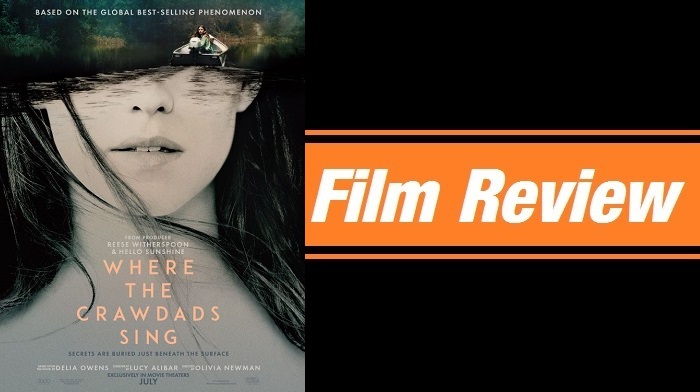
Based on the wildly popular 2018 novel by Delia Owens, “Where the Crawdads Sing” is a romantic coming-of-age murder mystery set in the marshes of North Carolina. Directed by Olivia Newman, this big screen adaptation stars the immensely talented Daisy Edgar-Jones (so good in the deliciously wicked horror thriller “Fresh” from earlier this year). I haven’t read the book, but the premise is rich with potential. And Edgar-Jones is a young actress with a big future ahead, assuming she’s given the right roles to shine.

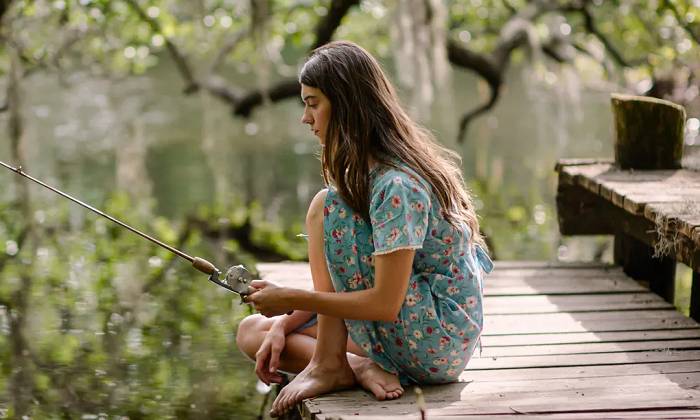
Unfortunately, “Where the Crawdads Sing” doesn’t give Edgar-Jones the kind of material that really emphasizes her talent. To be clear, there’s nothing at all wrong with her performance. In fact, she’s a big reason why certain parts of the movie work as well as they do, But she’s handcuffed by a role that has her spending too much time as an observer, often looking on with a doe-eyed innocence and naivety. Her character is the story’s centerpiece and she definitely evolves over the course of the movie. But I can think of several ways a story like this could have better utilized its lead.

However, despite those limitations, Edgar-Jones’ ability to pick up the movie and carry it on her back is a testament to her acting prowess. She quietly conveys both vulnerability and resilience; a deep longing and a strong female spirit. Most importantly, she’s able to make us care for her character, Kya Clark, a resourceful young woman who has grown up in a world of rejection and abandonment. It’s a heartbreaking story, and although it relies too much on soapy melodrama and dutiful box-checking, Edgar-Jones is a strong anchor who keeps us invested even as we’re questioning much of what we see.

Image Courtesy of Sony Pictures

Written by Lucy Alibar (“Beasts of the Southern Wild”), the story unfolds across two timelines. In 1969, Kya is arrested and charged with the murder of Chase Andrews (Harris Dickinson), the son of a prominent family in the small North Carolina town of Barkley Cove. His body was found at the base of fire tower where he had fallen several stories to his death. Despite an alarming lack of evidence, Kya is apprehended and put on trial. While the townsfolk in Barkley Cove are quick to brand Kya guilty, she finds an ally in a sympathetic retired lawyer named Tom Milton (the always reliable David Strathairn) who takes her case out of the goodness of his own heart.

The second timeline sets out to explore Kya’s past, beginning with her turbulent childhood and continuing up to the events just prior to her arrest. As a child, she and her family lived in a shack deep in the marshlands some five miles from Barkley Cove. Kya’s father (Garret Dillahunt) was an abusive man who routinely beat her mother (Ahna O’Reilly) and her siblings. One by one starting with her ma, her family members left, leaving her alone with her father. One morning she woke up to find him gone too. Left to fend for herself, Kya leans on everything she has learned living in the marsh to survive.

Kya’s resourcefulness helps her build a quiet reclusive life for herself in the marsh. Her lone contacts in the ‘real world’ are Jumpin (Sterling Macer, Jr.) and his wife Mabel (Michael Hyatt), a kindly black couple who own a dockside general store. Though routinely confronted by the not-so-subtle prejudices of the Barkley Cove folks, Jumpin and Mabel maintain a quiet dignity. Kya trades them freshwater mussels for sacks of grits, candles, and gas for her boat motor. They may not always need what Kya brings in, but they never let her know it. Kya certainly doesn’t get that kind of compassion from the other locals. To them she’s know as “marsh girl” and they’ve built an entire area legend about her out of gossip and lies.

Image Courtesy of Sony Pictures

Things seem to take a turn for Kya when she connects with an outgoing neighbor named Tate (Taylor John Smith). The two hit it off and soon a sweet but cheesy room-temperature romance blooms. That is until Tate heads off to college in Chapel Hill. He pledges he’ll return soon. But as Kya watches him ride off in his boat, you get the sense that she knows he’s not coming back. Months pass and Kya catches the eye of Chase Andrews, a popular cornball preppy from town. And is where the movie takes a serious dive.

Kya and Chase haven’t a spark of chemistry, and their scenes together are dry and flat. Even worse, Chase is such an obvious slimeball that Kya’s willingness to so easily toss aside her self-sufficiency and discernment is frustrating. Again, it’s an issue with the writing that undermines the characters, especially Kya. Of course we know from the earliest scene that Chase ends up dead which leads to the courtroom scenes that, despite Strathairn’s earnest and convincing presence, fail to serve up any real suspense.

“Where the Crawdads Sing” has as much tragedy (and water) as a Nicholas Sparks movie (not necessarily a good thing). It’s too mushy in spots and some of the second half story mechanics are hard to buy. Yet there are still bright spots in Newman’s direction, in Edgar-Jones’ performance, and in the film’s visuals which pictures the marshland setting through a more romanticized lens. But when all squashed together, the results are uneven, stripped down, and too squeaky clean. It’ll leave you wishing for the kind of movie this could have been. “Where the Crawdads Sing” is out now in theaters.

VERDICT – 2.5 STARS

REVIEW: “Windfall” (2022)

Now here’s an interesting trio: Jason Segel, Lily Collins, and Jesse Plemons. The three come together in the Charlie McDowell directed “Windfall”, a new thriller that premiered this past weekend on Netflix. Written for the screen by Justin Lader and Andrew Kevin Walker, “Windfall” is a typical COVID-19 era production – the tiny cast, the single location setting, etc. But like several of these films, “Windfall” starts strong but cant keep its momentum. It runs out of steam in the middle before picking it up in the final 15 minutes.

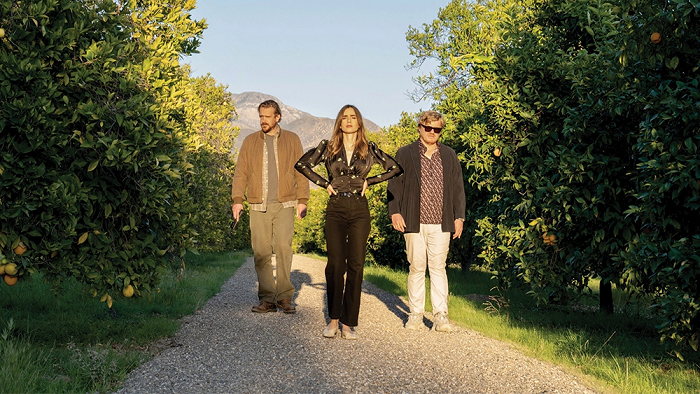
The movie opens with a man (Segel) lounging outside of a secluded vacation home that’s nestled among a quiet sun-soaked orange orchard. A long swimming pool stretches across the cozy back patio; beautiful mountains are painted across the horizon. He sits, enjoying the view and a big glass of orange juice. He strolls through the orchard; he relaxes by the pool. And then things get weird.

The more we watch this guy the clearer it becomes that he doesn’t belong in this house. He slings his glass across the back yard without a care. He pees in the shower. He wipes his finger prints off of the door knobs. As you might have guessed, he’s actually robbing the place. But just as he’s about to split, he’s caught by surprise when a vehicle pulls up outside. It’s the home’s owner – a billionaire tech company CEO (Plemons) and his wife (Collins). The burglar attempts to slip out unnoticed, but he’s spotted leading to the film’s central tension.

Image Courtesy of Netflix

The remainder of the movie sticks with the three on the property as the borderline inept robber holds the well-to-do couple hostage while trying to figure a way out of his mess. Along the way we get to know these three dramatically different people to varying degrees (interestingly, none of them are ever given names). The robber remains mostly a mystery, and for better of worse his identity and his motivations remained veiled. The wife seems to love her pampered and privileged life. But over time, as layers of her character are peeled back, there’s another side to her that eventually comes to the surface.

That leaves the pompous, self-absorbed, and condescending CEO. He’s the kind of guy whose mug is plastered on the covers of magazines like “Wealth” and “Front & Center” which he mounts on the wall of his vacation home just so he never forgets his “importance”. He’s clearly the movie’s villain, and he’s clearly who McDowell wants us to hate. He also checks off many of the boxes for the kind of social commentary the movie tries to speak on.

So far so good, but after the introductions McDowell has a hard time keeping up the energy. The movie sort of sits in neutral, waiting for the inevitable ending which you can kinda see coming if you watch close enough. But it’s the slow build towards that ending that holds “Windfall” back. The performances are good as Segel, Collins, and Plemons make the most of what they’re given. But the commentary is uninspired and barely explored. And the vague hints of tension aren’t enough to make this throwback thriller as good as it could have been. “Windfall” is now streaming on Netflix.

VERDICT – 2.5 STARS

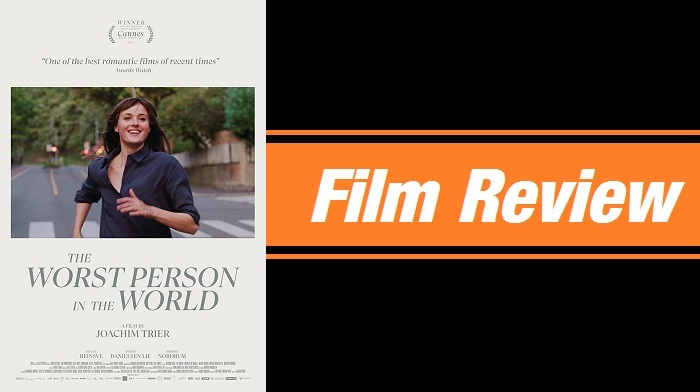
REVIEW: “The Worst Person in the World” (2021)

(CLICK HERE for my full review in the Arkansas Democrat-Gazette)

“The Worst Person in the World” has earned a lot of praise for Norwegian director Joachim Trier. This slyly romantic drama, laced with some wily dark comedy, is considered the third film in Trier’s unintentional “Oslo Trilogy” (following 2006’s “Reprise” and 2011’s “Oslo, August 31st”). The film has earned accolades galore during its festival run including a Best Actress win at Cannes for its electric star Renate Reinsve. And now it sits with Oscar nominations for Best International Feature and Best Original Screenplay.

Trier and his frequent screenwriting partner Eskil Vogt use a novelistic structure consisting of twelve short chapters, book-ended by a prologue and an epilogue. The centerpiece of their story is a free-spirited young woman named Julie (Reinsve) who Trier follows from chapter to chapter with an almost obsessive fascination. He chronicles Julie’s transition from her twenties to her thirties with an episodic rhythm meant to mirror the fickle ebb and flow of her life.

Our first shot of Julie sees her in a sleek black dress, standing on a balcony gazing over Oslo’s Akerselva River. She finishes off a cigarette and checks her phone as the piano chords from the dinner party she’s attending fades away. We’re left with a painterly image of a young woman lost in her thoughts. It may seem like a rather frivolous moment, but there’s a lot baked into it. It’s a portrait of a burdened woman begging the question “What’s next?” but terrified at the thought of one day asking “What if?”.

Image Courtesy of NEON

That lingering conflict is woven throughout the film’s 128-minute running time as Julie constantly wrestles with what she really wants in life. Along the way she experiences periods of potential happiness. But she’s quick to run away – partially out of fear, partially out of her commitment to some vision of fulfillment that the movie never really clarifies. Perhaps it’s due to Julie’s own ambivalence. Or maybe its a lack of interest from the filmmakers. Sometimes its hard to tell.

Julie’s early years are little more than a sketch. A seemingly all-knowing narrator hurries us through her time as a medical student where, despite being near the top of her class, she drops out and begins studying psychology. But that’s short lived as she abandons it for photography. New hair colors and boyfriends come and go as frequently as her career choices. And she ends up working in an Oslo bookstore just to make ends meet.

But the film slows down a bit when Julie meets Aksel (Anders Danielsen Lie), a 44-year-old underground cartoonist (I didn’t know that was a thing) who immediately takes a liking to her. Trier skips the formalities and soon Julie is moving into Aksel’s apartment. There’s a genuine chemistry between the two even if their individual pieces don’t quite click into place. But the 15-year age difference looms overhead like a dark cloud and is seen most in their conversations over children. Aksel wants kids. So does Julie…eventually…maybe…just not now.

Image Courtesy of NEON

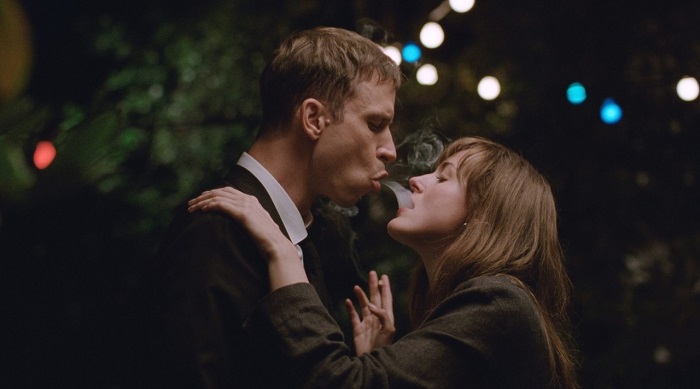
As inevitable cracks start to form in their relationship, Julie is reacquainted with those nagging feelings of restlessness and doubt. Soon her mind and heart are once again wandering which leads to her locking eyes with a similarly adrift barista named Eivind (Herbert Nordrum). What follows is a night-long meet-cute where the two dance around the bounds of “cheating” on their significant others without ever committing the act (or so they convince themselves). Needless to say, for Julie this adds more complexity, more uncertainty, and more messiness.

As Trier maneuvers us through several years in the life of Julie, the experience can be both exhilarating and occasionally frustrating. There are moments when the organic and rich conversations bring to mind Ingmar Bergman’s masterful “Scenes from a Marriage”. Other times it plays like a shrewd deconstruction of “Annie Hall”. Yet the strict chapter-to-chapter structure leaves so much off screen. And many facets of Julie’s character feel underdeveloped making it even more of a challenge to fully understand her.

Thankfully there’s the beguiling Renate Reinsve who shines as the movie’s heart and soul, making it easier to look past the shortcomings. Even if the movie never fully fleshes Julie out, Reinsve lures us in with her energy, charm, and sincerity. And despite how we feel about Julie’s choices, Reinsve earns our empathy and keeps us invested in her character who, blemishes and all, is a far cry from the person the film’s irony-rich title suggests. “The Worst Person in the World” in now showing in select theaters.

VERDICT 3.5 STARS

Sundance Review: “When You Finish Saving the World” (2022)

Sundance is no stranger to highly anticipated directorial debuts. This year it’s Jesse Eisenberg with his new film “When You Finish Saving the World”. The movie is based on Eisenberg’s own award-winning 2020 audio drama of the same name which revolves around a mother and her son separated by the ever widening generational gap between them. Starring the always terrific Julianne Moore and rising star Finn Wolfhard, this was one of the most intriguing films on the Sundance program.

Already backed by A24, “When You Finish Saving the World” has an interesting premise and features the kind of snappy wry humor you would imagine coming from Jesse Eisenburg. At the same time, there’s a toxicity to this small yet well conceived drama that will make it a tough watch for some audiences. Most of our time is spent with two characters who can be endearing but are almost always insufferable.

In fairness, that doesn’t make “When You Finish Saving the World” a bad movie. It gets back to that age-old discussion about the necessity of “likable” characters. I’ve said it before, I’ve never demanded “likable” characters. Doing so would dramatically limit the kinds of stories I allow myself to be told. But Eisemberg’s characters, Evelyn (Moore) and Ziggy (Wolfhard) aren’t one-note and they aren’t easily categorized. They have layers. It’s just that peeling them back isn’t particularly pleasant.

To be so at odds, Evelyn and Ziggy have several things in common. They’re just from two completely opposite worlds. They’re both condescending and narcissistic. Both are stubborn and strong-willed to a fault. And neither can understand the other nor do they put much effort into trying.

Image Courtesy of Sundance

Evelyn has a poorly veiled obsessive personality and she believes her way of doing things is THE right way. She loves classical music and relishes her position as the head of a domestic abuse shelter. To Evelyn, she’s doing the kind of work that “matters”. Ziggy is brash, self-centered and impertinent, often lashing out at his parents in ways that would have left me grounded for a decade. He writes and plays his own songs which he describes as “classic folk rock with alternative influences”. He then livestreams them for his 20,000 followers on a YouTube-like platform called High-Hat.

Eisenberg puts a lot of effort into showing this daughter/son clash of ideals and values. But while they live in their own generational bubbles, there are attempts on both parts the bridge the gap. Ziggy seeks his mom’s help with impressing a left-wing activist classmate named Lila (Alisha Boe). Evelyn invites her son to come do some part-time work at her shelter. Neither attempt goes well.

The movie is helped along by a collection of interesting performances, particularly from its two leads. Moore wonderfully portrays a woman doing everything she can to hide her unhappiness. She puts up a facade of confidence and fulfillment, but it cracks and crumbles as the movie progresses. Wolfhard nicely juggles Ziggy’s many contradictions. He’s cocky and obnoxious at home, but elsewhere he’s awkward and often oblivious. We also get a scene-stealing Jay O. Sanders as the husband and father who often finds himself caught in the middle of Evelyn and Ziggy’s warfare.

There’s a lot to like about “When You Finish Saving the World”. You can tell that Eisenberg has a good sense for creating characters and telling their stories. With splashes of satire mixed with deep human drama, his behind-the-camera debut is both intimate and ambitious. Yet there’s that lingering toxic element that always keeps the two lead characters at arms length. It makes it hard for us to feel either empathy or sympathy. And by the time their repressed charm and compassion finally comes into view, the caustic back-and-forths have taken their toll.

VERDICT – 3 STARS

Sundance Review: “Watcher” (2022)

A young couple moves into a new apartment in Bucharest, Romania just as news of a serial killer sweeps across the city. That’s the surface level setup for director and co-writer Chloe Okuno’s “Watcher”. But underneath its genre exterior is a clever and shrewdly made exploration of fear, isolation, and a woman’s need to be heard and believed. Those are the things Okuno is most interested in bringing to light.

This psychological slow-burn stars Maika Monroe as Julia, a former actress who leaves New York City and follows her husband Francis (Karl Glusman) to Bucharest following his recent job promotion. While she puts on a good show, you can’t help but sense Julia’s anxiety as she tries to adjust to her new surroundings. It’s a piece of cake for Francis who knows the language and plugs right in at work. But it’s harder for Julia, who doesn’t know anyone in Bucharest and doesn’t speak Romanian.

While Francis works long hours at his new job, Julia spends most of her time alone. She tries getting out and exploring the city. But without fail, the language barrier always comes into play. She can’t talk with her loud and abrasive landlady. She can’t understand the television reports of a suspected serial killer on the loose. Even standing in a group with Francis and his Romanian-speaking colleagues leaves her feeling like an outsider.

Among Okuno’s many good choices was the decision not to use subtitles. Romanian is spoken a lot in the film, and every word of it is subtitle-free. It’s a smart move that goes hand-in-hand with Okuno’s desire to put us in Julia’s headspace; to enable us to feel what she feels. For Okuno, the film’s visual language is essential to representing Julia’s state of mind. There are some clever tricks with the lensing and framing that create vast, seemingly empty spaces that emphasize Julia’s growing feelings of isolation. There are also interesting uses of color to convey mood and an increasing sense of dread.

The more time Julia spends alone, the more she withdraws. Fear and paranoia set in after she begins noticing a man from the apartment building across the street watching her from his fifth floor window. All she can see is a silhouette, but she’s soon convinced her watcher is the same man as the one who has been creepily following her around town (played by the always captivating Burn Gorman). Her fears are exacerbated after a woman is found murdered in their neighborhood – a death that is later attributed to the serial killer known as “The Spider”. A shaken Julia shares her suspicions with Francis who quickly brushes it off as “stress”.

Another of Okuno and her co-writer Zack Ford’s good choices was the decision not to paint Francis as the proverbial ‘bad guy’. In fact he’s quite the opposite. He genuinely loves and cares for Julia. At the same time, you want to hurl your shoe at the screen each time he attempts to explain away her unease. And he doesn’t even know he’s doing it. You could say he’s oblivious to his own condescension.

But Julia wants answers and before long she becomes the watcher, determined to connect the man stalking her to the shadowy figure in the window. This is where inspirations like Hitchcock, Polanski, and Lynch really come into focus. Yet even as the movie begins playing more with genre in the second half, it keeps us firmly planted in Julia’s head. It’s a tricky balance which works in large part thanks to Monroe who offers the right mix of vulnerability and fortitude.

“Watcher” is an eye-opening and artful directorial debut for Chloe Okuno who uses her deceptively simple premise to challenge those quick to doubt and dismiss female victims. Shot on location in Bucharest, the film uses the city’s beauty as both inviting and terrifying. DP Benjamin Kirk Nielsen, production designer Nora Dumitrescu, and composer Nathan Halpern all work in unison to ensure that we feel the same loneliness and dread as Julia. Ultimately that’s the key. Okuno wants her audience to enjoy the thriller genre dressing. But it’s the moody reflective psychodrama she wants us to sink our teeth into.

VERDICT – 4 STARS

REVIEW: “The Wasteland” (2022)

The slow-boiling, atmosphere-heavy psychological horror film “The Wasteland” is among the first of Netflix’s 2022 offerings. It’s also a great way to kick off the movie year especially for horror fans. Set in 19th century Spain, the movie’s rich period setting brings with it a distinct folk horror flavor. But the psychological edge is just as potent, and it’s examination of heavy themes such as fear and isolation leave a strong impression.

Horror is a tricky thing these days. The genre can’t be narrowed down or painted with broad strokes. And while too many creepers come across as derivative and old hat, there are still filmmakers who are constantly finding new ways to use horror. “The Wasteland” certainly falls among the latter.

Image Courtesy of Netflix

Directed by David Casademunt from a script he wrote with Fran Menchón and Martí Lucas, “The Wasteland” begins by telling us of consecutive wars in Spain that drove many people to isolate themselves in an effort to escape the “violence and madness”. We’re then immediately taken to a vast barren moor where a small stone house sits alone in the middle of nowhere. It’s where young Diego (Asier Flores) lives with his stern and rigid father, Salvador (Roberto Álamo) and his gentle and tender mother Lucia (Imma Cuesta).

Salvador is a sad and distant man, determined to prepare his son for the harshness of the outside world. There are only bad people out there, he explains to his son. He also tells of a beast which feeds on the fears of its victims. “Once you see the beast”, he ominously warns Diego, “you’re doomed forever.” Lucia scolds her husband for scaring the young boy with such tales. But Salvador’s solemn eyes and the tall posts draped in tattered cloth that he’s built around their property gives you the uncomfortable sense he believes it.

Things take a turn after a rickety boat floats up in a nearby stream. Aboard lies a man, bloody and unconscious. After the man dies (in one of the film’s more shocking moments), Salvador finds a picture in the stranger’s pocket. Its of the man and his family. It leads an already troubled Salvador to make a rash decision and take the stranger back to his family, leaving his own to fend for themselves while he’s gone.

As days turn to weeks, Diego watches as his mother begin to drift away, seeing things lurking in the shadows or behind bushes. Does she now see the beast? And as the security Diego once had in his mother starts to fade, will he too be terrorized by the fear-consuming creature?

Image Courtesy of Netflix

Casademunt poses these questions by slyly making us feel a part of this slowly deteriorating family. Through his sharp pacing, smart visual choices, and Balter Gallart’s fantastic production design, we’re able to feel the same isolation and fear they feel. It mostly comes through young Diego’s eyes whose perspective is raw, emotional, and sincere. But it also comes through the camera – the exquisite framing as well as the crafty use of focus, shadows, and angles.

There are other touches that soak us in atmosphere and sustain the film’s foreboding mood. Little details such as the eerie wood-carved toy figures or the macabre nursery rhymes and children’s songs Lucia sings to Diego. But it comes back to examining fear and feelings of lonliness and isolation. It’s a tough subject especially during this pandemic era we still find ourselves in. But Casademunt uses horror to explore it all in a way that should impress viewers whether they’re fans of the genre or not. “The Wasteland” is now showing on Netflix.

VERDICT – 4 STARS