REVIEW: “Watchmen” (2009)

WATCHmenpost

“Watchmen”, the critically acclaimed comic book limited series from the creative duo of writer Alan Moore and artist Dave Gibbons, was always something I admired more than I loved. But there’s no denying the mark it left on the industry. Told through twelve issues that were published from September 1986 through October 1987, “Watchmen” was a complex sociopolitical story that director Terry Gilliam once called “unfilmable”. Yet 20th Century Fox, Universal, Paramount, and finally DC Comics sister-company Warner Brothers all took their shot at a big screen adaptation.

“Watchmen” eventually went to Zack Snyder whose bold style made him both perfect for the material and a question mark. There was no doubt he could create a visually immersive world fitting of Moore’s vision. But could he wrangle together Moore’s fascinating yet complicated narrative? For the most part yes, but much like the highly esteemed comic series, that too is complicated.

WATCH2

Image Courtesy of Warner Brothers

The film is a dystopian neo-noir that skips along an alternate reality timeline. The bulk of the film takes place in 1985 at the height of the Cold War. Nuclear paranoia hangs over the globe as the United States and the Soviets wave their sizable nuclear arsenals at one another while a doomsday clock ticks down to the projected Armageddon. Meanwhile costumed heroes, who for years impacted world events from the Vietnam War to Watergate, have been forced into retirement by the government. So the hero-less world sits and waits for what seems like its inevitable doomsday.

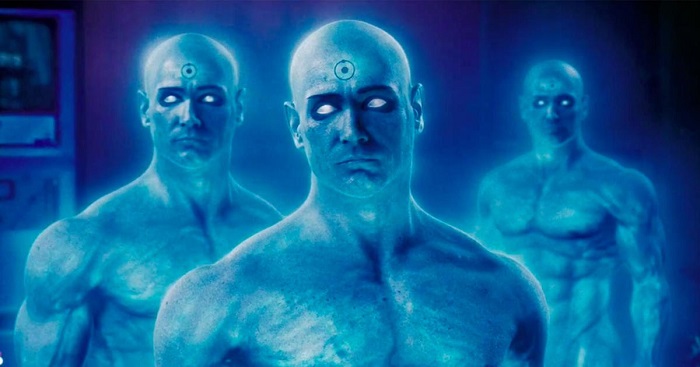
That’s a really broad summary of the backstory and setting which actually plays a significant role in the film. Numerous references to the past and meaningful flashbacks take us as far back as 1939 to introduce us to a superhero team called the Minutemen. A montage tells us of their glory days and their tragic demise. At one point we stop in 1959 to witness a lab accident that transforms nuclear physicist Jon Osterman (Billy Crudup) into the glowing blue matter-bending Doctor Manhattan. We learn of the formation of the next wave of crimefighters called the Watchmen who are forced to disband in 1977 after “costume adventuring” is ruled illegal. This is just some of the table-setting and world-building that packs weight on this densely plotted story.

Back to 1985, reverberations from the past are constantly being felt and some old wounds are opened up when a former Watchmen named The Comedian (Jeffrey Dean Morgan) is beat to a pulp and thrown to his death from his top floor apartment. His murder barely leaves a mark with his former teammates save for Rorschach (Jackie Earle Haley), a part masked vigilante and part sociopath who operates like a hard-boiled 1940’s private detective. Rorschach’s investigation leads him to believe that someone from their past is targeting the Watchmen. So he sets out to warn his ex-partners, Silk Spectre (Malin Åkerman) whose mother was an original member of the Minutemen, Nite Owl (Patrick Wilson) who still struggles to find his place in a post-Watchmen society, Ozymandias (Matthew Goode), a billionaire entrepreneur and the world’s smartest man, and the unintentionally cold apathetic Doctor Manhattan who is preoccupied with something a tad more….global.

The film’s central story quickly turns into a murder mystery with a handful of interesting twists and a few conspiracies to unearth along the way. But there’s much more going on which Snyder along with screenwriters David Hayter and Alex Tse manage to fit it with varying degrees of success. The movie shines brightest as a gritty and cerebral deconstruction of the now lucrative superhero genre. It also questions our real-life concept of “heroes” and challenges several societal constructs. And while there is no overtly political message, it does examine political power and how quickly it can be swayed in one direction or another. All of these things were fundamental to Moore’s series and Snyder makes sure they’re present in his film as well.

WATCH1

Image Courtesy of Warner Brothers

But while Snyder has brought this “unfilmable” story to the screen in the best way imaginable, he still can’t entirely keep it from feeling a bit cramped even at 160 minutes. Part of it is due to his faithfulness to the source material. While a couple of changes were made to the story and some action scenes extended, Snyder generally sticks to the look, themes, and tone of the comic. But this means pouring a lot in and covering a ton of ground some of which is inevitably shortchanged. And that same allegiance to the material means he covers some things the movie could have done without. For instance a certain romance springs up between two key characters that is a big part of the story. They aren’t the most convincing pairing mainly because the movie wastes time on sex scenes that could have been better used elsewhere in their relationship. But these scenes were in the comic so…..

Still I can’t overstate the challenge of bringing “Watchmen” to the screen which makes what Snyder has done here all the more impressive. His filmmaking strengths are vividly on display as “Watchmen” looks incredible and the world he visualizes is compelling and immersive. The characters are given a surprising amount of attention and the performances are strong (maybe a quibble of two with Matthew Goode but that’s it). Still, this is a jam-packed movie that gives you lots of plot often with little time to process what you’re given. There is a 215-minute “Ultimate Cut” out there that may solve some of these problems, but I’ll let you find that out for yourselves.

VERDICT – 3.5 STARS

3-5-stars

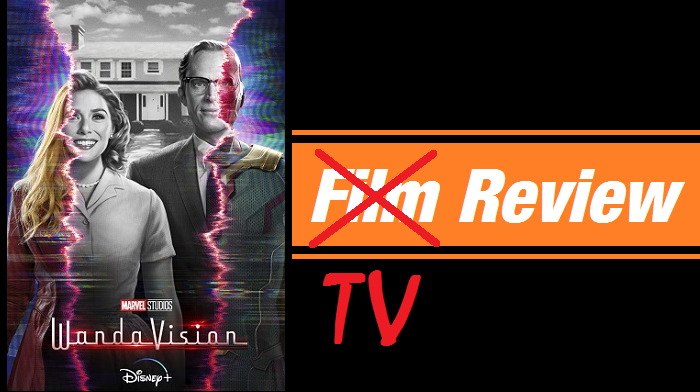
REVIEW: “WandaVision” (2021)

WANDAposter

I think it’s safe to say that we have reached a point to where everything Marvel Studios touches turns to gold. You could say one reason is because the mastermind behind the MCU Kevin Feige and his team of creators have defined the superhero movie genre for an entire generation. For better or for worse, Marvel has set a standard so high that many audiences reject (almost out of compulsion) any other unique vision or approach to the genre. Don’t believe me? Ask the DCEU. Movies like the groundbreaking “Wonder Woman” and “Shazam!” (which you could argue is the most MCU movie of their entire catalog) aside, much of the DCEU has been met with at least some resistance (and in many cases tons).

But not so for Marvel. Part of it is due to the allegiance of dedicated fans (and in some cases critics) who heartily embrace anything (and I do mean anything) the studio does. But it’s also because Marvel has been synonymous with quality and they’ve truly done something incredible with the MCU. While they aren’t always scrutinized the way they could be, MCU films are routinely good and always entertaining. They’ve done well casting their characters and picking the big screen stories they want to tell.

WANDAVISION

Image Courtesy of Marvel Studios

After all they have done to change the superhero blockbuster landscape, now they look to do the same to episodic streaming. “WandaVision” marks the first of several limited streaming series coming to Disney+. Its story is told over nine episodes and the series was advertised as something we’ve never seen before from the MCU. We were also told it would have major repercussions for Phase Four (or whatever Marvel is calling this) and future storylines. The series brings together two second-tier characters from the Marvel films (and two of my favorites from the comics) and in a snap moved them higher up on the MCU food chain. But that doesn’t mean “WandaVision” is without flaws.

The series was presented in a half-hour television sitcom format with Matt Shakman directing each. It was given a hefty budget which becomes more obvious the deeper we get into the story. But most importantly, the series brings back the two stars from the MCU movies, Elizabeth Olsen as Wanda Maximoff and Paul Bettany as Vision. Obviously seeing them both together in a post-“Endgame” story raises a TON of questions and adds even more appeal. Olsen and Bettany had good chemistry in the movies but here they really shine, even as the show’s sitcom gimmick starts to wear thin.

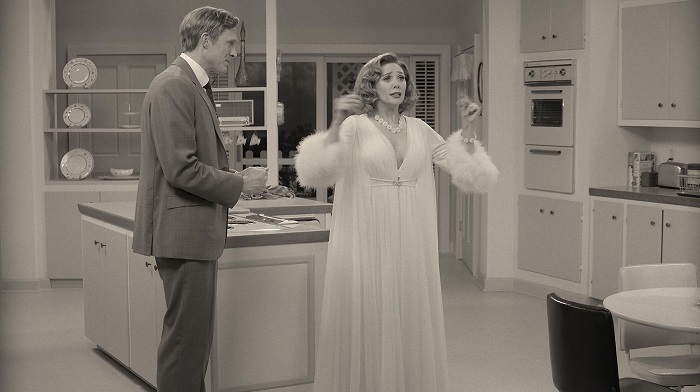
“WandaVision” is built on a big central mystery so getting too far into the plot could potentially spoil its effect. Essentially the setup is this: mere weeks after the events of “Avengers: Endgame” Wanda and Vision are living a happy suburban life in the small idyllic town of Westview, New Jersey. In an effort to fit in, both hide their identities from their neighbors and townsfolk. But here’s the catch, their life plays out like a TV sitcom complete with opening credits and laugh tracks. Each episode (minus the final two) is set in a new decade which the sitcom framework conveys. For example, episode 1 is presented in 4:3 black-and-white and is riffing on 1950’s television, specifically “The Dick Van Dyke Show” with a dash of “Leave it to Beaver”. Episode 2 moves to the 1960’s evoking “I Love Lucy”. Episode 3 shifts to color and has a “The Brady Bunch” vibe. And so on…

WANDA2

Image Courtesy of Marvel Studios

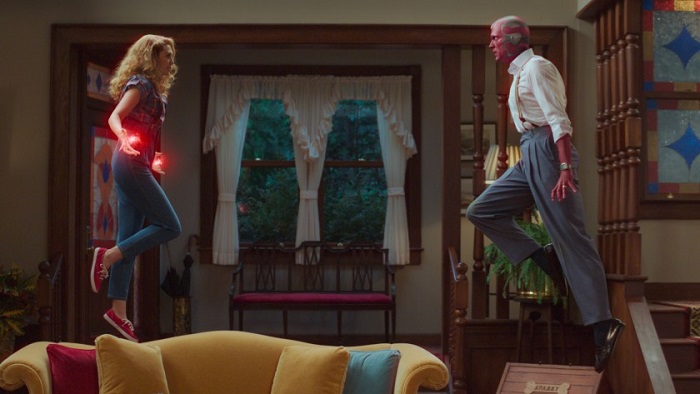
At first this comical conceit is a lot of fun, but it slowly and steadily runs out of gas especially when Wanda and Vision begin noticing something is off in their seemingly television-perfect life together. Whether it’s the behavior from the reoccurring characters who pop back up in every decade (none better than Kathryn Hahn’s quintessential nosy neighbor Agnes), Wanda’s instant pregnancy, or creepy unexplainable visions. The mystery of what’s going on in Westview quickly becomes the most interesting component of the show. Yet “WandaVision” sticks with the nostalgic sitcom gag all the way through episode 7. And when over half of these roughly 30 minute episodes is spent laughing and nodding at decades of sitcom history it leaves little time to dig into the much more compelling elements of the story.

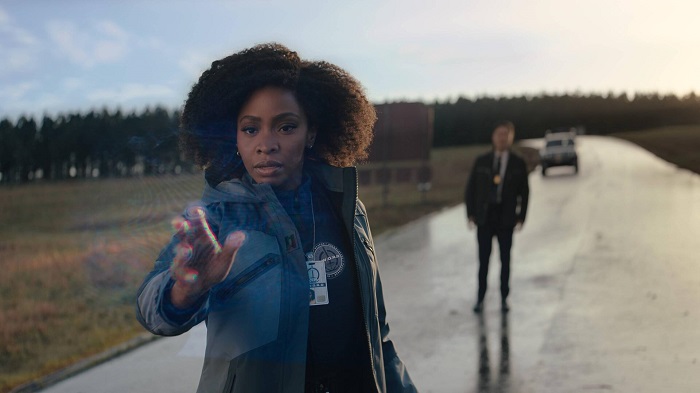
In fairness, the sitcom bits aren’t arbitrary. The show does eventually connect them and add context to their existence. In other words they make sense. But on a week-by-week basis they do account for a lot of the running time. The scraps are given to agents of S.W.O.R.D. who set up a base outside of Westview to monitor what’s going on there. They’re led by the blandly antagonistic Director Hayward (Josh Stamberg). These scenes also feature three returning MCU side characters: the equally bland FBI Agent Jimmy Woo (Randall Park), a returning but inconsequential Darcy Lewis (Kay Dennings), and one of the show’s most intriguing pieces Monica Rambeau (Teyonah Paris). Monica was the adorable little girl from “Captain Marvel”. Now she’s grown up and clearly has a big future ahead in the MCU.

The last two episodes are the longest and finally give us some needed answers while revealing who has been pulling all of the strings. This is the series at its best, wrapping up some story angles, leaving others wide open, and introducing some ‘magical’ new elements into the MCU that is sure to have some long-lasting impact. It also features an eye-popping final showdown that truly is unlike anything the MCU has done before. It’s where the show’s bigger budget can be seen the most.

WANDAVISION

Image Courtesy of Marvel Studios

Not everything wraps up quite so nicely. A couple of characters just up and vanish in the final episode (at least one has an excuse we can halfway buy). There’s also the unavoidable question of where are Wanda’s friends from the Avengers? Yes Thor is in space, Cap is old, etc. But no one saw what was going on or felt the need to check on Wanda? Also the finale exposes a certain mid-series surprise appearance to be nothing more than a shameless attention-grab. It earned Marvel plenty of headlines and online chatter but weakly ended as a lame anatomy joke reminiscent of something you would see on Beavis and Butthead.

Hiccups aside, “WandaVision” still accomplishes what it sets out to do: 1) Show that streaming episodic television is an exciting an effective means of telling fresh MCU stories and filling out their large sprawling universe. 2)  It fleshes out Wanda and Vision, not so much their backstories but their relationship which is the true centerpiece of the series. “WandaVision” adds a much-needed layer of humanity between them that earns our empathy and makes them big players moving forward. 3) It moves the MCU forward in a meaningful way and with potentially far-reaching implications. All together “WandaVision” may not be the most seamless television series experience. But it does expand the Marvel Cinematic Universe in an exciting way while setting the table for the slew of other Marvel streaming shows on the horizon. “WandaVision” is streaming now on Disney+.

VERDICT – 3.5 STARS

3-5-stars

REVIEW: “Wonder Woman 1984” (2020)

WWposterr

2020 began with a number of exciting blockbusters scheduled for release. But then COVID-19 hit leading to one disappointing postponement after another. Warner Bros. was bold enough to test the big screen waters in early September with Christopher Nolan’s big budget mindbender “Tenet”. But its sagging box office numbers showed other studios that many anxious moviegoers simply weren’t comfortable returning to the theaters. That proved to be the final nail in the coffin for 2020 Hollywood tent-poles.

Well, it was ‘almost’ the final nail. “Wonder Woman 1984” was still slated for a Christmas Day release but in this crazy year nothing is for certain. And then came the earth-shaking announcement that Warner Bros. would be releasing its entire lineup of delayed 2020 movies throughout 2021 in theaters and on the HBO Max streaming platform on the same day. They went on to say the move was kicking off with “WW84” on December 25th. And just like that one of the year’s most anticipated blockbusters was only a few weeks away.

Making a sequel to 2017’s “Wonder Woman” was never going to be easy. Minus its bombastic CGI-heavy finale, the first film is easily in the top-tier of the superhero genre. It was a movie that entertained and inspired; one that felt remarkably fresh yet captured the essence of its comic book source material. It was wonderfully directed by Patty Jenkins who became the first woman to direct a major American superhero flick. And of course it starred the impeccably cast Gal Gadot who instantly became Wonder Woman, not just for a new generation but for old die-hards as well.

WW1

Image Courtesy of Warner Bros.

All of that brings me to the long-awaited sequel, “Wonder Woman 1984”. Most of the key ingredients for a fun and exhilarating follow-up are back. It again sees Patty Jenkins directing and co-writing. It sees Gal Gadot returning as the film’s titular character. It still inspires and in its own unique way still feels fresh. But sadly this time around too many things don’t click. Too many good ideas simply don’t come together. And it can’t quite reach its own lofty ambitions. In the end “WW84” left me fascinated yet baffled; entertained but ultimately disappointed.

“Wonder Woman 1984” is a strange movie. I don’t know how else to put it. It’s strange in terms of story, in terms of structure, in terms of tone. It tries to do so much but it struggles to balance it all. So we end up getting its ideas in segmented chunks. First we get a lengthy prologue set in Themyscira. Next it spends time having fun with its main story’s 1980’s setting. Then it reintroduces Chris Pine’s Steve Trevor who does the ‘fish out of water’ thing. Then it takes its serious turn leading to its inevitable action-packed finish. The nostalgic 80’s playfulness and quirky sense of humor is pretty much restricted to the first half and then all but vanishes in the film’s more serious second leg.

After the prologue which is basically there to lay out the story’s main theme, the timeline shifts to 1984. Diana Prince (Gadot) now works as a head anthropologist at the Smithsonian Institute in Washington D.C. She still fights crime on the side as Wonder Woman but keeps a low profile (somehow no one has noticed her? No one?). Some of the film’s more moving moments are when it emphasizes Diana’s loneliness. Despite her prominent position at the museum and a beauty untouched by age that grabs the attention of countless men (crappy ones included), Diana remains isolated and heartbroken, still feeling the loss of her boyfriend Steve from decades earlier.

WW2

Image Courtesy of Warner Bros.

Diana sympathetically befriends a sheepish new co-worker named Barbara Minerva (Kristen Wiig). Her character is a fairly familiar one for people who have watched superhero movies. She’s awkward and insecure; a bit nerdy and basically overlooked by everyone other than Diana. Think Jamie Foxx’s Electro or Uma Thurman’s Poison Ivy. While discussing a believed-to-be worthless rock, Diana and Barbara unwittingly trigger the stone’s wish-granting properties. Diana wishes that Steve was alive while Barbara wishes she had Diana’s beauty and strength, not knowing that Diana was actually a super-powered Amazon.

One person who does know the stone’s power is failing businessman and television huckster Maxwell Lord (Pedro Pascal). He manipulates Barbara and is able to secure the stone for himself. He then wishes to be the very embodiment of the stone giving him the power to grant people’s wishes and taking whatever he wants as payment. Pascal makes for a deliciously campy megalomaniac especially in his early scenes. Unfortunately he loses some of his appeal once the film tosses aside its sense of humor.

Wiig is really good channeling the two sides of Barbara. She delivers several good laughs as the timid yet slyly charming outcast and then has a blast as the super confident “apex predator” who grows more and more enamored with her new self. Meanwhile Diana’s wish comes true when Steve’s soul returns in another man’s body. Visually we basically see what Diana sees in her heart which means we see Chris Pine. There are so many obvious questions about this that the movie avoids. Basically Pine is here for comic relief and only in the later scenes does he become something more than a punchline. Ultimately his value as a character is seen in how he changes Diana. How his very presence brings her the joy and happiness she’s been missing. And how the thought of losing him is more than she can bear. So while Pine is clowning it’s Gadot who gives us our emotional connection.

WW3

Image Courtesy of Warner Bros.

The story takes its serious turn as Lord becomes obsessed with gaining (of course) more power. “Why not more? Why not wish for more?” He begins targeting world leaders, granting their wishes then broadsiding them with his demands (the film has some fun dabbling in the world politics of 1984). And the further he pushes his lust for control the closer society comes to a full-on collapse. Sadly Wiig gets back-burned during most of this with Barbara basically reserved for action scene duty and not much more. And then there is the ending. Absolutely no spoilers here, but let’s just say it leaves glaring questions that seem like oversights rather than narrative choices.

In one sense I absolutely love the look of the film. Some of the DC movies have been criticized for their dark and gloomy palettes. Not this one. “WW84” is bright and vibrant. Its colors pop off the screen in ways fitting of its neon-loving 80’s setting. But then you get to the special effects, a head-scratching mixed bag of bad character design (sorry Cheetah) to jarringly obvious CGI. It stands out most when Diana is running at super high speeds. Her motions are strangely out of whack, as if she were running in place on a stage and then digitally added to the scene. While there isn’t a ton of action in “WW84”, we do get a couple of exciting scenes, one in a shopping mall and one in the White House, that helps overlook the rougher stuff.

To be clear I did like “WW84”. I like its big-hearted and hopeful message. I still love Patty Jenkins. I still think Gal Gadot is some of the best casting in the entire superhero genre. She carries the movie with an effortless grace. It’s some of the moving parts and the shaky structure around her that unavoidably leaves this feeling like a letdown. Still, there is real entertainment value in breezy big-budget escapism especially after a year like 2020. “WW84” certainly supplies that. But after the greatness of the first film, don’t blame us for expecting more. “Wonder Woman 1984” premieres Christmas day in theaters and on HBO Max.

VERDICT – 3 STARS

3-stars

REVIEW: “Wild Mountain Thyme” (2020)

THYMEposter

You’ll be hard-pressed to find a more enjoyable actress than Emily Blunt (Don’t believe me? Just watch some of her interviews). She instantly brings a certain smile-inducing energy to “Wild Mountain Thyme”, the new not-so-romantic dramedy from writer and director John Patrick Shanley. The film is based on Shanley’s Broadway play “Outside Mullingar” and it packs a handsome cast. But it digs itself into a hole so deep that neither the gorgeous Irish landscapes or Mrs. Blunt herself can dig it out.

For generations the Reillys and the Muldoons have lived side-by-side, their sprawling farms separated by stone fences, a few tree lines, and two very annoying gates. Through the years the old neighbors have had their share of spats. But these days it’s mostly playful jousting between the two widowed family heads, Tony Reilly (Christopher Walken) and Aoife Muldoon (Dearbhla Molloy). Both are in their 70s and both are aware that they’ll soon be the ones handing down their family’s properties.

THYME2

Image Courtesy of Bleeker Street

For Aoife it’s pretty cut-and-dried. Her more-than-capable daughter Rosemary (Blunt) will inherit and run their farm. On the Reilly side it’s a little more complicated. Tony has kept his son Anthony (Jamie Dornan) in Ireland with the promise that he’ll one day inherit their family’s land. But now the patriarch’s not so sure his shy and slightly oafish son is cut out to carry the Reilly family mantle. In addition to being a tad dense, Anthony has this unusual inability to let himself love and a general fear of happiness. It’s a quirk with Dornan’s character that grows more irritating over time.

The first half of the film plays around with the question of whether or not Anthony will get the farm. The second half is all about his incomprehensible relationship with Rosemary. Since they were children growing up on neighboring properties Rosemary has loved Anthony. And for some inexplicable reason she’s still waiting for the oblivious lunkhead to finally love her back. It puts Blunt in a tough spot. She’s shackled to a character who simply can’t move forward because her entire story arc hinges on Anthony snapping out of his fog.

Things shake up a little when Anthony’s pampered American cousin Adam (John Hamm) shows up. He’s a New York money manager who doesn’t quite understand the Irish’s ways (not that the movie represents them well) but he does set his eye on Rosemary. In reality he’s a flimsy and shallow character who’s only there to move the story to its inevitable finish. And in a weird way you may find yourself rooting for Adam. At least he gives Rosemary something to do other than miserably fawn over Anthony. Meanwhile Anthony mostly mopes around the farm and Dornan’s dry, sterile performance doesn’t do the character any favors.

THYME1

Image Courtesy of Bleeker Street

Yes the film eventually tries to explain Anthony’s built-in apprehension, but it culminates in a seemingly endless final 15 minutes which is funny considering how the rest of the movie races from point to point skimming over huge chunks of story. As for the much talked about Irish accents, this south Arkansas native is no expert, but some of them do seem….off. I mean I love Christopher Walken, but his shaky come-and-go Irish-ish accent is pretty entertaining (in the unintentionally funny sense).

The real shame of it is “Wild Mountain Thyme” has moments of real heart and humor. The sweeping Golden era score and the lush rolling scenery makes for a near magical setting. It ends up being a movie you want to root for. But it speeds through so much of the story, shortchanges so many characters, and relies so heavily on a truly annoying lead (sorry Mr. Dornan). It may pass for lightweight escapism for some, but I never could shake the feeling of disappointment. “Wild Mountain Thyme” releases December 11th in theaters and on VOD.

VERDICT – 2 STARS

2-stars

REVIEW: “Waiting for the Barbarians” (2020)

BARBposter

Set within an unnamed territory, an unnamed Magistrate oversees a remote outpost for an unnamed empire. This shrewdly calculated ambiguity has a steady presence throughout “Waiting for the Barbarians”, the new film and English-language debut from Columbian director Ciro Guerra. It’s ambiguous for a reason – to sharpen the relevance for today by not assigning or restricting what we witness to a specific time or nation. Through a broad yet clear lens Guerra indicts both the practices of the past and the mindsets of the present.

“Waiting for the Barbarians” is an adaptation of J. M. Coetzee’s 1980 novel which explored the ugliness of imperialism and its lasting influence on modern thought. Coetzee also wrote the screenplay (his first) which patiently unwraps the story through its ruminative rhythm and well-tuned characters. And even as its dense early table-setting gives way to the quieter yet more visualized tragedy of the second half, the sense of pertinence is ever-present. And let’s be honest, it doesn’t hurt to have Mark Rylance, Johnny Depp, and Robert Pattinson fleshing our your characters.

Rylance plays the well-meaning magistrate and if there ever was an actor who exuded gentle, unfeigned integrity it’s Rylance. His Magistrate manages the frontier settlement with an air of peaceful passivity. He’s content with his life there, quietly collecting and cataloging old area artifacts while occasionally mediating minor squabbles among locals. He carries himself admirably and is convinced that his benevolence makes him a welcomed presence. However, good intentions and feelings of self-fulfillment blind him to a glaring hypocrisy which he’s eventually forced to reckon with.

BARB2

Photo Courtesy of Samuel Goldwyn Films

Everything changes with the arrival of Colonel Joll (Depp), a member of the Empire’s security force who has been sent to inspect the outpost and investigate alleged unrest on the outskirts of the frontier. We see hints of Depp’s patented eccentricity in his rigidly upright posture, stony-faced demeanor, and steampunkish sunglasses (they’re all the rage back home). But it’s Depp’s words that reveal the most about his character. Joll speaks with an icy malice, coldly absorbing the Magistrate’s initial hospitality before getting down to the business of his visit.

Joll begins rounding up and questioning local nomads with the avidity of an authoritarian, torturing those deemed to be “barbarians” by his superiors. No scene captures Joll’s dry and calloused ruthlessness better than his chilling explanation of the “patience and pressure” approach to interrogation (hint: far more emphasis is on pressure). “Pain is truth. All else is subject to doubt.” And just like that Guerra and Coetzee put a spotlight on the real barbarians. Meanwhile all the Magistrate can do is helplessly watch.

Joll and his soldiers depart almost as quickly as they arrive leaving the Magistrate to handle the mess they left behind. But it’s not as though he has clean hands. The almost messianic overtones of the early scenes fade as the Magistrate’s complicity, though subtle and seemingly benign, are brought to light. And as much as he wants to disassociate himself from Joll’s terror, he slowly begins to see that (though cut from a different cloth) he and Joll do the biddings of same master.

BARB3

Photo Courtesy of Samuel Goldwyn Films

As a form of self-instituted penance the Magistrate takes in an indigenous woman ravaged by Joll’s brutality (she’s opaquely played by Gana Bayarsaikhan). He nurses her back to health, but more as a balm for his own bruised conscience rather than for her well-being. It’s only when he’s jolted out of his guilt-stricken haze that he finally does the right thing. But in doing so he sparks the ire of the Empire and finds himself under the boot of the very authority he once represented.

Coetzee’s deliberately paced script gives the actors plenty of room to leave their marks. While Depp instantly grabs your attention with his convincingly sinister presence, it’s Rylance who carries the emotional workload. With a soft-spoken and heartfelt authenticity, his performance manages to secure our sympathy and pity. He’s gives us a man on a journey, who eventually finds his conviction, and willingly pays a price for it. Pattinson gets a small but effective role as young officer who’s clearly a product of the Empire. By the time he comes around, good and evil have been clearly defined.

Isn’t that what war is about?” a young officer brashly asks the appalled Magistrate, “compelling a choice on someone who would not otherwise make it?” The ugliness of the question highlights the deep-rooted metaphor at the core of “Waiting for the Barbarians”. Underneath cinematographer Chris Menges’ stunning sun-blasted desert landscapes and some key performances lies a stinging rebuke of the past, a mirror to the present, and a warning of the future. It’ll be too broad and figurative for some, but I loved its willingness to trust the viewer. And the near apocalyptic final shot only adds to the title’s richness. “Waiting for the Barbarians” premieres this Friday in select theaters and on VOD.

VERDICT – 4.5 STARS

4-5-stars

REVIEW: “Wasp Network” (2020)

WASPposter

“Wasp Network” was going to be a tough movie to make for any filmmaker wanting to stick reasonably close to the facts. That’s because the actual true story is a tangled web of characters, organizations, and allegiances. For that reason French writer-director Olivier Assayas deserves a ton of credit for sticking close to the true account even though it makes his movie a little difficult to keep up with.

Without question “Wasp Network” will resonate more with those who either remember or read up on the real events that inspired it. In its own way it tells the story of the Cuban Five, a group of men sent to Miami by the Cuban government to infiltrate anti-Castro exile factions in the 1990s. Some of these groups sought simply to inspire the Cuban people to stand up against Castro’s regime. But others were terrorist outfits funded by drug money and targeting Cuba’s tourist industry. The Cuban Five were to spy on the various groups and report the findings to the Cuban government.

WASP2

Photo Courtesy of Netflix

Taking from a 2011 Fernando Morais book “The Last Soldiers of the Cold War”, Assayas attempts to cover a lot of ground. His structure feels episodic, focusing big chunks of his film on individual players and then weaving the numerous narrative threads together in a tangled yet fascinating final act. Sometimes his storytelling seems more didactic than dramatic as it straightforwardly lays out the facts. Yet it has a palpable emotional center, putting as much emphasis on the personal sacrifices and consequences as the politics of his story.

A terrific Édgar Ramírez provides our entry point, reminding us of how good an actor he is when given quality material. He plays René González, a pilot in Havana who swipes a plane and defects to Miami leaving behind his wife Olga (Penélope Cruz) and their young daughter Irma (Carolina Peraza Matamoros). René begins a new life in the States, joining a covert anti-Castro group to help other defectors boating over from Cuba. Meanwhile Olga is left alone and struggling to put food on the table. This moral haze hangs over much of the film’s first half.

The next person we meet is Juan Pablo Roque (Wagner Moura), a pilot himself and high-profile Cuban celebrity. He too defects, actually swimming from Cuba to Guantanamo Bay. Once granted asylum he moves to Miami and joins the exile group. Unlike René, Juan Pablo lives a lavish lifestyle winning over and marrying a young beauty named Ana Margarita (Ana de Armas). But she (and we) soon learn that Juan Pablo is a man of many secrets.

The third key player is Gerardo Hernandez (Gael Garcia Bernal) who works directly with the Cuban government. He’s sent to Miami to oversee the Wasp Network’s infiltration of the militant groups. Of the three he’s the one we learn the least about. Bernal’s performance is solid, but his character could have used more attention. Ultimately it’s René who resonates most. His story packs the most personal stakes in large part thanks to Cruz’s Olga who ends up being our emotional anchor. De Armas doesn’t fare as well. Her performance is excellent, but its hard to tell if Assayas is most interested in her as a character or as eye candy.

WASP3

Photo Courtesy of Netflix

Things ramp up when the exile group’s goals fully come into focus. We get tense scenes revealing drug smuggling from Columbia. Assayas even covers the 1997 Havana hotel bombings. Even more layers are added when the CIA gets involved and we get defectors among the defectors. It certainly makes things harder to follow and keeping a running tab on who’s who is a challenge. At the same time the craft behind the camera is evident and there are several visual choices to admire.

I can’t deny the film’s faults, especially for those with no familiarity with the true events whatsoever. So take my advice – do some quick reading on the backstory before watching. It will lessen the confusion and open up a lot of what Assayas is doing. With “Wasp Network” it’s fair to say he may have bitten off more than he can chew. But I appreciate the ambition and I’m glad he took the route he did rather than playing it safe.

VERDICT – 3.5 STARS

3-5-stars