
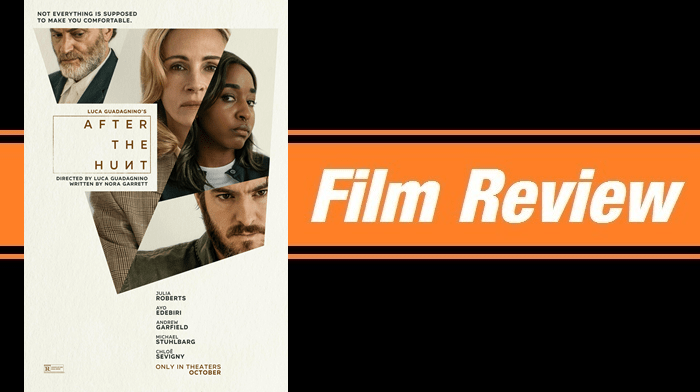
Luca Guadagnino puts aside some of his usual preoccupations in his latest feature “After the Hunt”. Known for his provocative fixations on sensuality, desire, and obsession, the enigmatic filmmaker can often get hung up on his own interests to the detriment of his characters and storytelling. There are remnants of that in “After the Hunt”. But it mostly feels like an interesting departure for Guadagnino, although one not without its own self-induced problems.
Guadagnino amasses a compelling ensemble led by Julia Roberts who’s given her most savory role in years. She plays Alma Imhoff, a highly regarded philosophy professor at Yale University. Alma is a complex woman of stature in the world of male-dominated academia. From one angle she’s an intimidating and impenetrable intellectual who relishes being the center of attention. From another angle she’s a troubled woman concealing her personal pain and bottling up anything resembling emotions.
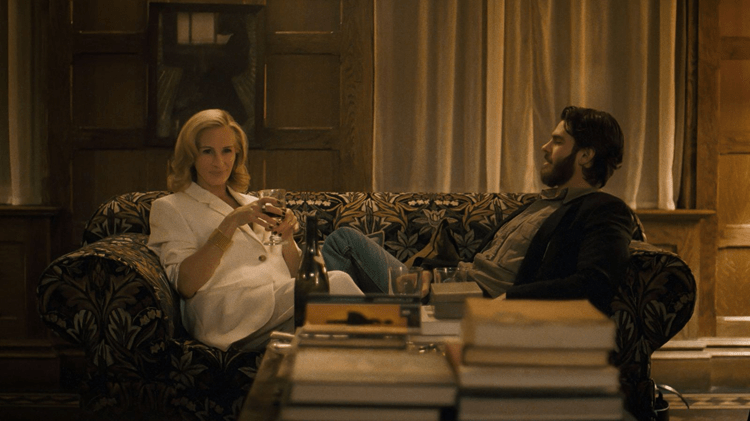
Alma’s tightly self-controlled world is shaken after her student and protégé Maggie Resnick (Ayo Edebiri) accuses Alma’s colleague and close friend Hank Gibson (Andrew Garfield) of sexual assault. The alleged transgression happened after a dinner party at Alma’s home. Hank admits to Alma that he walked Maggie home and even went up to her apartment for a nightcap. But he fiercely denies he assaulted Maggie.
There are dubious layers to Alma and Hank’s relationship that raises a number of questions. Professionally, both are pillars in the university’s philosophy department and they are the two finalists for the school’s lone tenure spot. Away from work they are uncomfortably close, to the point of kindling suspicions in Alma’s passive yet internally frustrated husband Frederik (played by a perfectly tuned Michael Stuhlbarg).
Alma’s relationship with Maggie proves to be equally complex but for much different reasons. She enjoys Maggie’s adoration and takes pride in being considered a mentor. But the two immediately clash over how to handle her accusations. Alma’s view is shaped by her own history, especially within the patriarchal construct. It causes her to be cold and unsympathetic, often thinking more about self-preservation and consequences than condemnation. Maggie shamelessly hides her real self behind various marginalized identities. In reality she’s dishonest, opportunistic and manipulative which quickly calls her credibility into question.
Guadagnino and screenwriter Nora Garrett make Alma their focus, following the character as she navigates the #MeToo minefield between the untrustworthy Maggie and the boozy flirt Hank. As they do, the filmmakers sling us into a thematic whirlwind of power dynamics, victimization, privilege, academia, support systems, culture shifts, and generational divides. Their storytelling strikes a peculiar balance between empathizing with Ivy League elites and excoriating them. But make no mistake, the film’s overall tenor ranges from morally murky to downright dastardly, with only a few measures of grace sprinkled in.

Guadagnino and Garrett forsake ‘nice and tidy’ for something that challenges audiences willing to engage with the film on its own terms. There is an intentional ambiguity woven throughout the story that forces us to reckon with our own perceptions. Yet a later scene nearly undercuts that aim as Guadagnino seems to tip the scales in one direction. It’s a frustrating inclusion that obstructs the filmmaker’s intentions without fully derailing them.
“After the Hunt” is a technically savvy and narratively enthralling drama, anchored by awards-worthy performances from Roberts, Garfield, and Stuhlbarg, while offering a bold take on a sensitive subject that sparked a cultural flashpoint. The movie isn’t without flaws, such as a key plot point hinging on an absurd moment of pure happenstance. And an ending that leaves us questioning some things more than wrestling with them. Still Guadagnino impresses with his latest – an intelligent and guileful feature that’s both riveting and challenging.
VERDICT – 3.5 STARS

 Keith & the Movies