
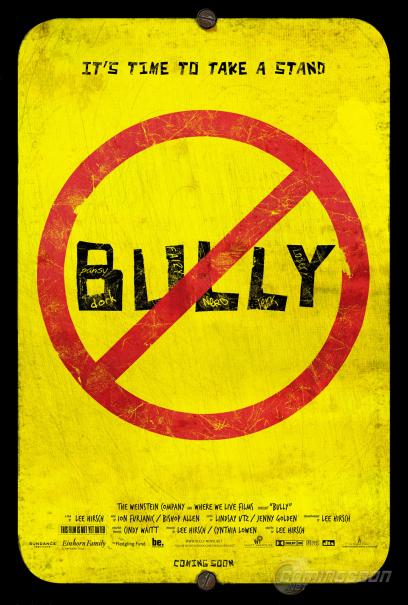
By now I’m sure you’ve heard of the war between Lee Hirsch’s documentary “Bully” and the Motion Picture Association of America. After viewing the film the MPAA decided to give it an R rating, a decision that raised the ire of the filmmakers, Harvey Weinstein of The Weinstein Company, advocacy groups, and even many celebrities. The MPAA gave “Bully” the R rating due to “some language”, more specifically the seven “f words” found in the film. Weinstein countered by threatening to release the film unrated. But this left him with several problems including the fact that most big movie theater chains have policies against showing unrated pictures. The MPAA stood its ground. Since then, “Bully” has been granted a PG-13 rating after editing out three of the seven “f words”.
But who was right? Was there grounds to be upset over the R rating? Was the MPAA simply doing its job? Those angered by the MPAA’s decision noted that the film’s potential social impact would be greatly hurt by the R rating. One protest group stated “Because of the R rating, most kids won’t get to see this film. No one under 17 will be allowed to see the movie, and the film won’t be allowed to be screened in American middle schools or high schools.” (This is only partially true. ANY child can see an R rated movie. The only difference is they must be accompanied by an adult). MPAA head honcho Joan Graves countered by pointing out the ratings association’s responsibility is to inform parents of content. She said “In the case of ‘Bully,’ the ratings system has worked exactly as it is supposed to: Parents have been kept informed of the content of each version of the film, and they have been given the information they need to make moviegoing decisions on behalf of their kids.”
While I have had my fair share of gripes about the MPAA, I tend to side with them on this one. I don’t want the MPAA judging a film’s social impact or a filmmaker’s intentions. I want them rating movies based on the content found in the movies. They need to have a standard by which they judge content so that parents and moviegoers who don’t want to see or hear those things have a grounded point of reference. Some have objected saying “How does a movie like “Bully” with its instances of profanity get the same rating as a violent and grisly film like “Saw”? They point to that as one of the flaws of the current ratings system. But I don’t think you can compare movies like that. There needs to be a standard for violence, a standard for sexual content/nudity, and a standard for vulgarity/profanity. Have consistent standards and grant ratings based on how movies meet those standards.
But that also touches on some of the MPAA’s glaring failures. In many ways their lack of consistency has given people ammunition to use against them. The MPAA has given so many movies a PG-13 rating that’s had tons more profanity that what we find in “Bully”. I could give you so many examples. Just this year take a movie like “Chronicle”. It has over 60 uses of profanity. “Tower Heist” has almost 100 uses of profanity. Yet both of these pictures were granted a PG-13 rating simply because they kept their “f-bombs” to two or less. For some warped reason the MPAA sees three “f-bombs” in a movie considerably more serious than a film with 100 uses of every other bit of foul language. It’s this absurd reasoning that has breached the trust between the MPAA and many parents and moviegoers.
That kind of inconsistency could very well be what brought on this battle between “Bully” and the MPAA. On the flip side, Weinstein and company know the guidelines and shouldn’t be surprised when the MPAA doesn’t base their rating on the political and social message of the film. I also have a hard time believing those three “f-bombs” were crucial to the movie therefore editing them out without making it into a big issue shouldn’t have been a problem. I’m glad the MPAA didn’t cave in. I want them to have a standard and I want them to stick to it. But there lies another problem. They haven’t stuck to it and no one can argue that their standards could certainly use a little fine-tuning.
 Keith & the Movies