

The delightfully eccentric artistry and craft of Wes Anderson is on full display with “The Wonderful Story Of Henry Sugar”, the first film in a four-part series of shorts adapted from the works of Roald Dahl. Written, directed, and produced by Anderson, the 38-minute short film is based on Dahl’s 1977 story of the same name. It’s soaked in the filmmaker’s signature style which turns out to be a perfect fit for Dahl’s flavorful verbiage.
“The Wonderful Story of Henry Sugar” is some of Anderson’s most visually striking work to date. He uses a distinctly theatrical approach in staging scenes and in ushering the audience from one scene to the next – utilizing elaborate moving sets, sumptuously painted backdrops, and richly detailed dioramas. And of course it’s all bathed in Anderson’s unique storybook color palette.
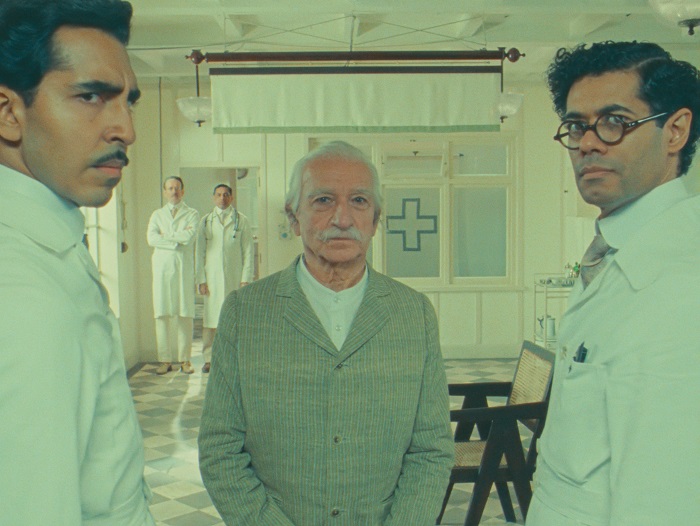
As for the storytelling, Anderson sticks close to Dahl’s own words, pruning it a bit to seamlessly flow with his on-screen vision. The film stars a handful of Anderson reliables who each serve as both characters and narrators. They peer straight into the camera, addressing the audience directly while delivering the fast-paced dialogue with astonishing precision and fluidity.
Ralph Fiennes plays a version of Dahl himself who gives us an introduction to his story from inside his cramped but cozy “writing hut” (later Fiennes shows up as a policeman in one of the film’s funniest bits). A delightfully wry Benedict Cumberbatch plays the titular Henry Sugar, a self-involved and unashamedly bad gambler who finds himself consumed with the contents of a book he swipes while visiting a rich friend’s estate.
The book contains the story Imdad Khan (Ben Kingsley), a man who claimed to have the ability to see without using his eyes. Within the small volume Khan recounts his meeting with an old mystic who taught him how to see things with his mind rather than eyes. Unyielding in his desire to get ahead, Henry sees an opportunity. If he can study the book and learn the ancient skill, he could use it to win (cheat) at the blackjack table.

While every performance hits just the right note, Dev Patel may steal the show. He plays Dr. Chatterjee who chronicles his encounters with Imdad Khan. Together with his colleague Dr. Marshall (an equally fantastic Richard Ayoade), the two find themselves in utter awe and unable to explain the strange man’s ability. Patel is an absolute riot, meticulously detailing every impression and emotion they felt yet doing so in the most deadpan way imaginable. He’s hilarious.
Anderson’s story within a story within a story structure is ingenious and he pulls it off to near miraculous perfection. It’s fascinating to watch as he takes such specific usages of visuals, narrative, and performance and caramelizes them into something so precise and flavorful. Overall this is a far cry from the filmmaker’s more understated(ish) earlier work. Yet nothing here is done for mere eccentricity’s sake. There’s such a wonky harmony between Dahl’s words and Anderson’s profoundly unique style which makes this quirky short film such a delight. “The Wonderful Story Of Henry Sugar” is now streaming on Netflix.
VERDICT – 4.5 STARS

 Keith & the Movies
Oh yes!
It’s such a delight. I liked all four shorts but this was my fav.
I liked this too! I still need to check out the other shorts. For some reason I didn’t think they were all releasing at the same time.
I like the others. This is the longest and also my favorite. The others run about 17 minutes long each.
Man, I really want to see this but right now. I don’t have Netflix at the moment because of some of financial issues my sister is dealing with as my mother can’t access to anything at the moment.
Hey I get what you’re saying. Life always finds ways of influencing what we can or can do at the moment. See them when you can and let me know what you think.
I’ve seen all 4 of these 17-minute vignettes. I very much like this one and The Rat Catcher, but the other two, although technically flawless, just didn’t float my boat. I can’t blame Wes Anderson for what Roald Dahl wrote, but Anderson *did* choose to build vignettes based on them. There is a mean-spiritedness to them that totally misses the essential kind heart that is the kernel of all Roald Dahl stories. I haven’t read the stories but maybe I need to in order to see what Anderson missed in them.
I loved all four but this one is easily my favorite. I like the darker and more serious message of The Swan and found The Ratcatcher to be a hoot. Poison tickled me for a number of reasons.
Keith are you going to do write-ups on the other ones also? I hope so.
I’m hoping to. Gotta slow down and find time. I may do all three together in one post. Haven’t quite figured it out yet.