
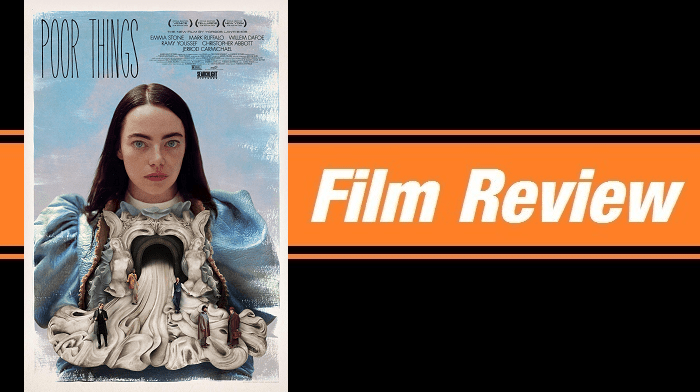
For me Yorgos Lanthimos is something like a taste I have yet to acquire. His latest, “Poor Things” won’t do much to change that. If anything it only reinforces my feelings towards a filmmaker with extraordinary talent, but whose cinematic self-obsessions often wring the meaning out of the movies he makes. Never before has that been more true than with “Poor Things”, yet another self-satisfying exercise where indulgence and excess masquerades as daring and subversive.
Working from a head-scratching screenplay by Tony McNamara, Lanthimos wastes no time plunging us deep into his bizarre world. It’s one that visually lets him stretch his creative self as far as he ever has. The early scenes are stunning, shot in crisply detailed black-and-white and full of wacky off-kilter imagery. Some of it is incredibly creative; some of it is downright funny (a bulldog with a goose’s head???). The production design is exquisite, shifting from Victorian elegance with a dash of steampunk to the more glaring artifice of elaborate studio stage creations. DP Robbie Ryan and production designers Shona Heath and James Price are the film’s biggest assets.
But as is too often the case, Lanthimos tends to get carried away. In “Poor Things” some of his visual flourishes have particular purposes specifically it terms of perspective. Others are done repeatedly for no discernible reason whatsoever. Lanthimos’ penchant for immoderation extends to his near gluttonous delight in pushing the envelope. Here we see an almost childlike preoccupation with body horror and gratuitous sex, most of which comes across as more attention-hungry and narcissistic.
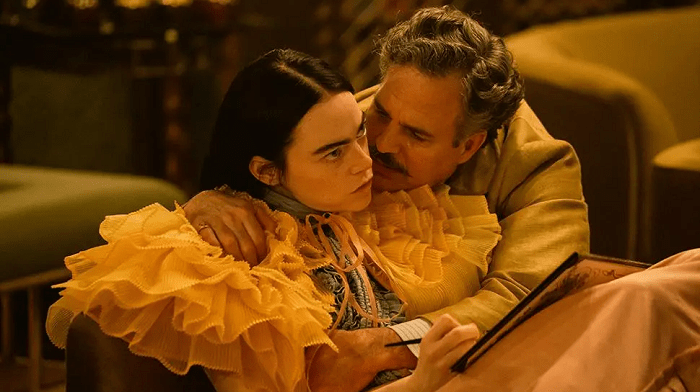
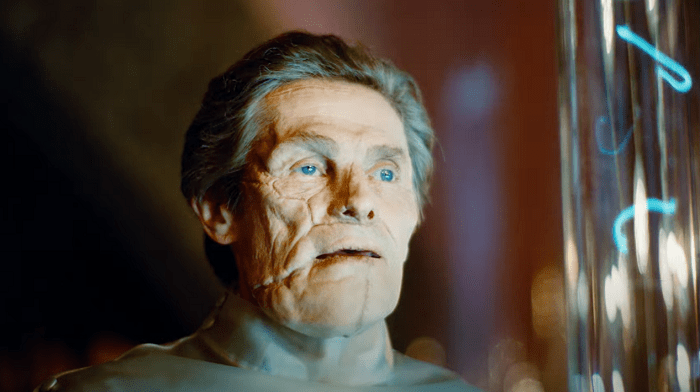
Set in a time that mixes the past with the otherworldly, “Poor Things” spins a Frankensteinesque yarn. In London, a scar-faced mad scientist named Dr. Godwin Baxter (the always refreshing Willem Dafoe) secretly retrieves the dead body of a pregnant woman who committed suicide. In a rather macabre experiment (I’ll spare you the details), Godwin reanimates the corpse and names her Bella (Emma Stone). Bella’s toddler mind and adult body have yet to synchronize, but her intelligence is increasing at a rapid rate which leads to several of the film’s funnier absurdities.
In need of help Godwin hires one of his medical students, the meek and demure Max McCandles (Ramy Youssef) as his assistant. Max’s job is to observe and meticulously document Bella’s progress. It requires following her around with pencil and notepad, collecting data such as nutritional intake and growth of vocabulary. Max, a starstruck fan of Godwin, doesn’t fully understand Bella. He’s first told she has a brain injury but quickly learns the morbid truth.
With little explanation why, Max soon becomes infatuated with Bella, eventually making a pact with Godwin to marry her. There’s so much that could have been said here about the insidious nature of controlling men, both father figures and suitors. But Lanthimos is fine with alluding to it. Instead he’s much more interested in introducing Bella to sex. And its sex that immediately becomes a focal point for Lanthimos. It fuels much of his storytelling. And it both shapes and defines the film’s warped idea of freedom, agency, and empowerment.
This is best seen with the sudden appearance of a lawyer named Duncan Wedderburn (Mark Ruffalo). He’s a sniveling lecherous cad who pops up and then two scenes later is whisking Bella away on a debauchery-filled trip around the world. It’s here that the story’s intents are both clarified and undermined. What’s meant to be a coming-of-age tale of liberation and self-discovery is more of a shallow impression of womanhood marked by the director’s obsession with his own batty and bawdy style. So much so that it prompted a woman who watched with me to deem it “insulting“.
Though being touted as bold and courageous, Stone’s scenes of pure brilliance (and there are several) are diminished by Lanthimos who too often turns her into sexual fodder for his camera. There are countless scenes where she’s made into little more than a spectacle for the male gaze – scenes where she’s put into one graphic sexual situation after another, all in the misleading name of freedom and discovery. Lanthimos gets so caught up in leering at Stone that he sabotages the messages he’s trying to promote.
There are so many potent issues that “Poor Things” could have confronted. There’s so much that could have been said about misogyny, patriarchy, societal expectations, and the female experience. Instead it shallowly skims over such things, investing more into its director’s unbridled lust for shock and showmanship. Somewhere within this intemperate backfire are the pieces for a really good movie – one that doesn’t see female empowerment and liberation through such a narrow lens.
For a while it’s easy to get caught up in the visual artistry, the extravagant staging, and the smattering of good laughs. In many ways the film is a technical marvel, and some of the gags are laugh-out-loud hilarious. But once you see what’s underneath the silly and shiny veneer, the frustrating reality of what this could have been sets in. “Poor Things” hits select theaters December 8th.
VERDICT – 2 STARS

 Keith & the Movies
Sounds like he should just go do pornography and stop pretending to be an auteur.
He seems to be a filmmaker enamored with his own perceived edginess and style and everything else takes a backseat. There is so much that could have been done with this adaptation. Sadly…
Noooo I’m so excited for this! I normally like him as a filmmaker though I have strongly disliked some of his work before. I’ll have to see where I land with this.
I was so frustrated by this because it’s a premise that is open to all kinds of good commentary. Instead it’s so over the top in its efforts to push the envelope. The I found Lanthimos’ use of Stone to be pretty degrading. It’s kinda the point within the story, but when it feels like the filmmaker is treating her the same way….
Go and watch it. He doesn’t know what on earth he is talking about. The film is amazing
Couldn’t disagree more with everything. The film is a masterpiece
And disagreeing is fine. There are lots of people who agree with you.
I do want to see this as I love Yorgos’ films as I just love how odd they are.
For me his movies are hit-or-miss. Weird for sure, but you can see him trying SOOO hard. I’m in the minority with this one.
After that, I don’t think I will ever watch anything else of his. It’s a cheap and lazy way to portray a strong female coming of age story. I’ve always heard of you curse it means you don’t have much of a vocabulary. Well if you have to show that much sex to show how a woman is in control of her body, I don’t feel like you can write very well. This was just showing sex to show sex. Apparently I’m not the target audience.
It’s hard not to see Bella (and in turn Stone) as little more than an object for his gaze. Yes, it wraps it up in pretty visuals and cool effects. Yes, he teases some meaningful themes. But it all is smothered by his more self-serving obsessions. Some may be able to look beyond it. I sure couldn’t.
My wife and I just saw a trailer for this a couple of weeks ago before a film. We both looked at each other after it ended and said…”nope.” I feel for Emma. Perhaps not the best choice of roles…
It definitely has its fans. As you can tell I’m not one. I don’t blame you at all for skipping it.
We skipped it…until we didn’t. Against our better judgement…we saw Poor Things yesterday. While I will praise the acting, for both of us the film came across as a messy exercise in mixed messages.
I’m really baffled that it is getting so much awards consideration. I know a segment of moviegoers like pretty much anything Lanthimos does. I’m come to realize that I’m the exact opposite. LOL
I saw Poor Things yesterday and could not agree with this review more. I am absolutely baffled by reviewers who call this film feminist or praise Emma Stone’s performance. We live in a time when as people are watching this movie, female soldiers are being brutalised, raped and murdered. The objectification of women’s bodies has serious ramifications. Male writers and directors have a responsibility to educate themselves before they attempt to tell stories about women. Thank you for this review and for being an ally 🙂
I’ve been a bit baffled by the response to Poor Things. I think Lanthimos gets cut too much slack.
Thanks for this review. I really needed to find someone that felt the way I did after seeing this. There‘s some great acting and funny moments, and I was entertained – but the more I’ve thought about it the more I find I have issues with so much of it. One thing in particular is the sexualisation of Bella as she progresses through what is essentially her childhood – I found that creepy. The list goes on …
Thanks for reading and commenting. I had all sorts of problems with the film, some of which you allude to. It does have its moments, especially early on. But Lanthimos has such a shallow vision of empowerment and womanhood. And his gaze certainly creeps in and at times takes over this warped coming-of-age story.