
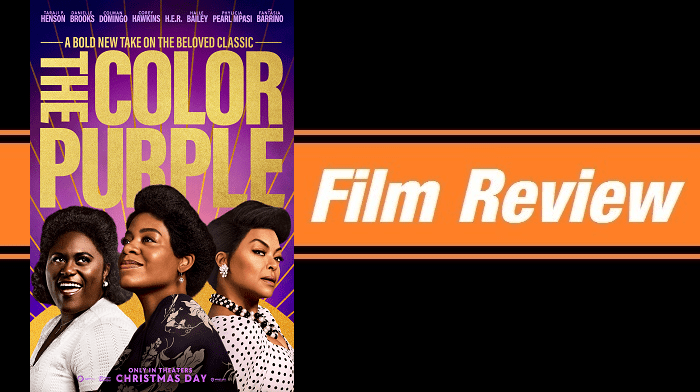
Director Blitz Bazawule and screenwriter Marcus Gardley team up to give us the second big screen adaption of Alice Walker’s 1982 novel “The Color Purple”. The first movie released in 1985 and was directed by Steven Spielberg. He returns alongside Quincy Jones, Oprah Winfrey, and Scott Sanders to produce this enchanting but flawed update that is heavily inspired by the long-running, Tony award-winning musical.
At its heart “The Color Purple” is a moving coming-of-age period drama and Bazawule captures that essence most impressively in the film’s first half. From its sweeping opening to the story’s midway point, the movie simmers with powerful storytelling and spectacular musical numbers. Sadly it stumbles in the second half. The rousing and heartfelt tunes are still there, but the storytelling feels rushed, even patched together in spots. Certain character arcs get shortchanged and there is one particular redemption angle that doesn’t feel earned at all.

The story of “The Color Purple” begins in the early 1900s and spans over several decades. In a small African-American community near the Georgia coast lives 14-year-old Celie (Phylicia Pearl Mpasi) and her sister Nettie (Halle Bailey). The two are inseparable and have a joyous relationship. But the sisters live with a dark secret. Their vile and abusive father (Deon Cole) rapes Celie and has impregnated her twice. He then took her two babies and traded them off for the best deal.
A couple of years pass and Celie’s father sells her to the cruel and ruthless Albert “Mister” Johnson (a chilling Colman Domingo). He’s a banjo plucking farmer who immediately puts her to work cleaning his house and raising his kids. Mister is as violent as her father, and the physical abuse is only outdone by the psychological torment. Nettie moves in for a bit which offers Celie a welcomed respite. But when she’s forced to fight off Mister’s sexual advances, he throws her out leading Nettie to go far away.
As years go by Celie (now played by former American Idol winner Fantasia Barrino in her feature film debut) remains trapped under Mister’s rule with no real means of escape. Several more characters are thrown into the mix including Mister’s weak-minded son Harpo (Corey Hawkins), the great Louis Gossett Jr. as Mister’s crusty father, the scene-steaming firecracker Sofia (Danielle Brooks), and even David Allen Grier as a singing preacher.
And then Shug Avery (Taraji P. Henson) comes to town, a rowdy and popular blues singer who happens to be Mister’s former mistress. He’s still smitten with her despite claiming Celie as his wife. Yet rather than become rivals, Celie and Shug form a bond than only intensifies after Celie reveals the years of abuse she has endured from Mister. Shug is a striking presence but she sucks out most of the air from every scene she’s in. It’s not Henson’s fault, she’s quite good in the role. It’s more the writing and direction that at times can make her such an overpowering force.
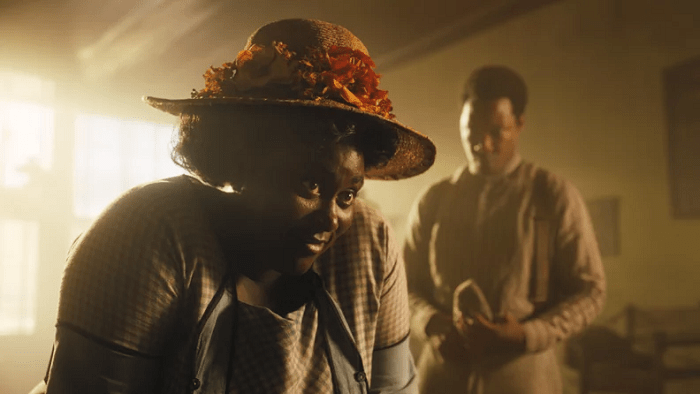
Over time I found myself less interested in Shug’s role and much more compelled by several other characters. Take Danielle Brooks’ Sofia, a veritable powder keg of righteous energy. It’s a big character and Brooks gives an equally big performance. But she steals so many scenes and belts out some of the film’s very best songs. I also wanted more of Squeak (played by R&B singer H.E.R.), Harpo’s second wife who has her own compelling story although most of it is left offscreen.
That leads (again) to the films’s biggest problem – it leaves too much off the screen specifically in the second half. That’s where Bazawule and Gardley seem to lose focus before rushing everything to a conclusion. Things like the above mentioned redemption angle that’s too thinly sketched and hurried to believe. Or Shug’s tense relationship with her father that’s mentioned several times but is barely explored. Perhaps 30 more minutes would have allowed time to fill in its holes. As it is “The Color Purple” is a frustrating tale of two halves – one half that’s among the very best cinema I’ve seen all year and the other half that can’t see it through to the end. “The Color Purple” hits theaters December 25th.
VERDICT – 3 STARS

 Keith & the Movies
Oprah showed up on Colbert in a glitzy purple outfit one night just to announce the movie would open on Christmas and give away tickets to see it. What a disappointment that it isn’t quite up to snuff 😦 Alice Walker’s book was excellent.
I’m telling you, I was LOVING it through the first half. Sooo good. But boy that second half was so frustrating.
1992 novel? I still haven’t seen the Spielberg version so I have no reason to see this though I’m aware that Spielberg omitted things in his film version because he wasn’t comfortable with aspects of the book.
Typo. Thanks for pointing it out.👍🏼
The Color Purple as a story has always struggled in the second half IMO, both the Spielberg movie and the book did for me anyways. I’m still curious how this will work as a musical, but I’m not surprised to see it still has that issue. I’ll still be there in theaters to watch.
Thats really interesting to hear. It has been a long time since I saw Spielberg’s film and I’ve never read the book. To hear they struggle in the second act is something!
Purple’s my favourite colour 💜
Fantastic review! Still looking forward to seeing this as a huge fan of the book by Alice Walker. Love Spielberg’s movie as well. My review of Spielberg’s film:
Thanks so much. And thanks for sharing the link. I really want to revisit Spielberg’s