
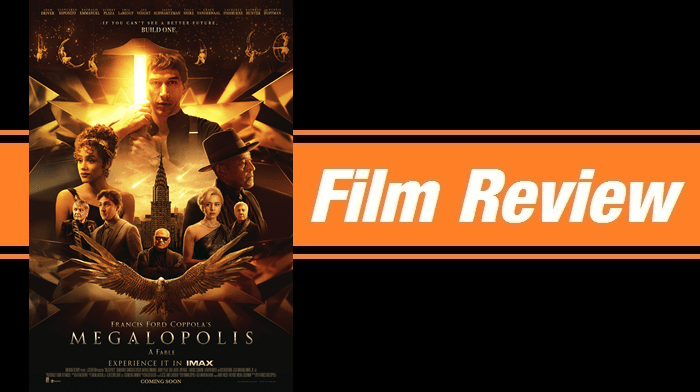
It looks as if the most polarizing movie of 2024 may be from one of the greatest American filmmakers of all-time. Five-time Academy Award winner and New Hollywood legend Frances Ford Coppola lets his cinematic imagination run wild in “Megalopolis”, a hard to categorize but altogether captivating experience that is sure to be unlike anything else you’ll encounter in a movie theater this year.
Coppola’s initial idea for “Megalopolis” had its genesis way back in 1977. Six years later he began putting together a script. By 1989 Coppola was scouting locations and planning shoots. But the film was eventually shelved. It was revived in 2001 with Coppola going as far as doing table reads with potential actors. But after the 9/11 terror attacks, the movie was once again put on hold. During the years that followed, Coppola determined to self-finance his movie. In 2019 he put up $120 million of his own money and after navigating the COVID-19 pandemic, production finally began in 2021.
“Megalopolis” is as demanding as it is rewarding. It’s a movie that doesn’t allow itself to be easily consumed like the usual big screen product. There is nothing routine about its style, structure, or story. Rather it’s made to be experienced, absorbed, considered, and reconsidered. It’s meant to sweep you away with its audacity and grandiosity while provoking you to wander outside of your ideological comfort zone. It means to impress you with its extravagance, perplex you with its incoherence, yet stimulate you with its artistic fervor and deep-rooted convictions.
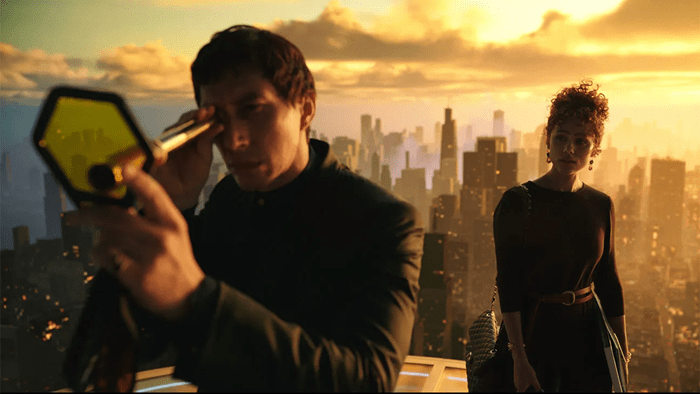
It’s vital that you don’t venture into “Megalopolis” expecting conceptual precision or even narrative cohesion. Don’t look for an involving plot, well-defined stakes, or even one singular vision. It’s a movie that thrusts us into the mind of its creator where we witness a plethora of profoundly personal ideas that bounce off each other in fits of indulgent madness. Coppola knows all of this and apparently foreknew the responses. It’s probably why he later added the subtitle “A Fable” – to help shape expectations and curb misconceptions.
At the same time, “Megalopolis” is very much an imaginative tour de force that sees Coppola working free of anyone’s rules, including his own. It’s an operatic tale full of pseudo-Shakespearean prose designed to be Coppola’s direct voice to us. Through his characters (some avatars and some metaphors) he shares his fears, pleads his cases, issues dire warnings, and plants seeds of hope. Meanwhile his astounding visual language reveals someone who is just as concerned with saving cinema as he is with saving civilization.
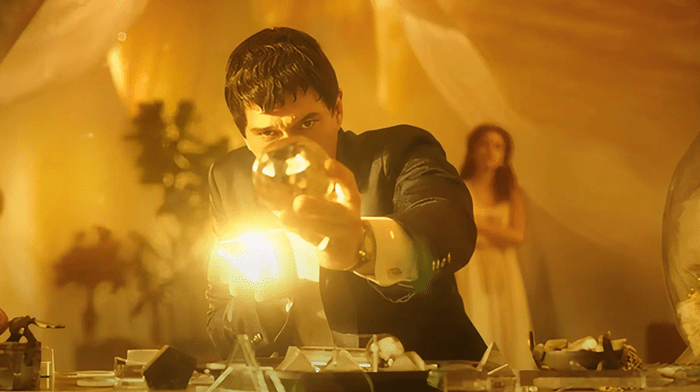
Coppola’s story is set in the collapsing metropolis of New Rome, a fascinating retro-futurist fusion of New York City with ancient Rome. It’s a sprawling place where poverty, crime, and corruption has crushed a once thriving city. Visionary architect Cesar Catilina (played by a spellbinding Adam Driver) is called upon to reimagine and transform a huge segment of New Rome. He calls his audacious city-within-the-city Megalopolis. It’s envisioned as a prosperous state-of-the-art utopia; a pure architectural and technological wonder, unmatched in its beauty and abundance.
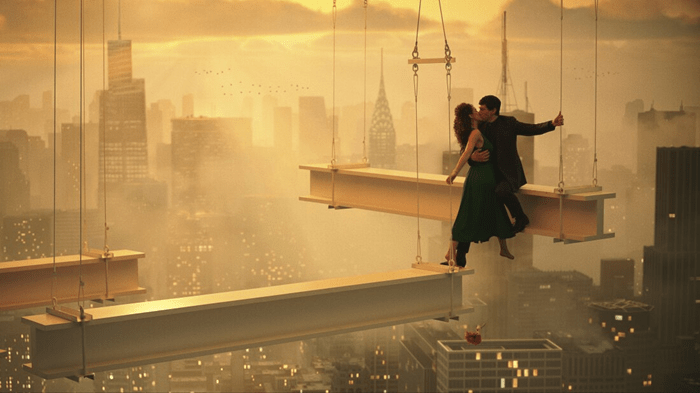
To realize his vision, Cesar has discovered a powerful and imperishable material called Megalon. Its source is a mysterious story all its own, but it grants Cesar the ability to manipulate space and time. There are those who understandably fear its power. But Cesar has learned how to harness it in ways that allow him to bring to life the magnificent constructs from his mind.
But Cesar immediately gets pushback from New Rome’s mayor, Franklyn Cicero (Giancarlo Esposito) who is perfectly content with the status quo. Franklyn vehemently opposes what he perceives to be Cesar’s vanity project, preferring more practical means of renewal such as building a new casino (because that’s sure to put a spiraling city back on its feet). The power struggle between Cesar and Franklyn sets up a central conflict that drives much of the drama.
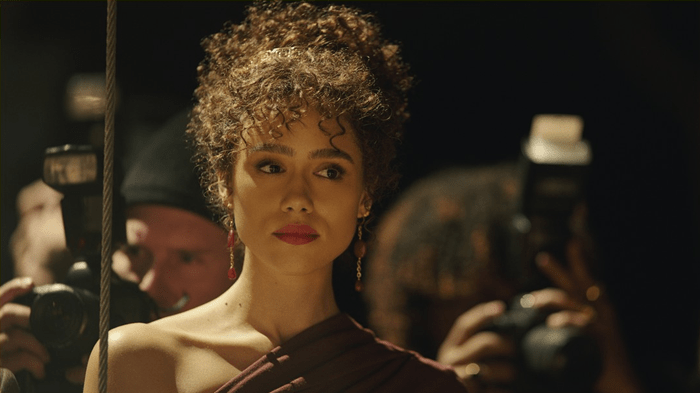
Things get even more complicated for the bitter rivals after Cesar falls in love with Julia (a luminous Nathalie Emmanuel), a pampered but well-centered socialite who happens to be the mayor’s daughter. She finds herself torn between the two men she loves and their competing visions. Emmanuel is both a radiant and grounding presence, often serving as our window into Coppola’s world.
Meanwhile a colorful cadre of supporting players help complete Coppola’s opus. Aubrey Plaza plays Wow Platinum, a television news personality whose lust for power trumps any desire for a good story. Soured by rejection from Cesar, she sets her sights on the rich and much older bank executive, Hamilton Crassus III (Jon Voight). Then you have Shia LaBeouf as the envious and depraved Clodio Pulche, a lewd deviant turned populist power-player driven by his disdain for his cousin, Cesar. Laurence Fishburne plays Cesar’s loyal assistant, driver, and personal historian while Dustin Hoffman plays Franklyn’s reliable fixer.
While most of the performances are top-notch, Plaza and LaBeouf prove to be problematic. They both veer wildly over-the-top, often seeming as if they’re working in an entirely different movie. Without question, their characters are inherently hedonistic and flamboyant, and Coppola lets his two stars off their leashes to leave no question about their debauchery. But they go too big, leaving them feeling out of place, even in a movie that’s big on theatrics.
The sheer range of techniques employed by DP Mihai Mălaimare Jr. give “Megalopolis” a dreamlike quality that’s fitting for a movie of such cosmic ambition. Detailed compositions melding long lens and digital backdrops, soul-baring closeups, classic iris shots, kaleidoscopic effects – they’re all used to immerse us but also to inform. For example, the visuals are sometimes noticeably gaudy – an intentional choice used to emphasize the gold-plated facades of the rich and pampered whose hollow lives are marked by privilege and excess.
As his central theme of crumbling empires takes form, Coppola surrounds it with stories of love of all kinds: love of family, love of self; love of art, love of power; love of advancement, love of decadence; love for creating, love for destroying. In the process he offers us a daring perspective on our modern world through an experience conceived from heartfelt concern, shaped by classical influences, and delivered with unflinching earnestness. It’s a broad and bulky endeavor, at times almost buckling under its own creative weight. But it never collapses due to Coppola’s belief in his message and his go-anywhere willingness when it comes to sharing it.
I’ve heard it said that art shouldn’t aim to satisfy the masses, but to express the heart of the artist. Obviously there’s a fine line when it comes to movies, and for my money Coppola walks it like a tightrope. His “Megalopolis” is as breathtaking as it is bewildering; as compelling as it is confounding. It doesn’t hold hands or pander. Nor does it submit to expectations. Yes, at times it’s erratic and untethered. It takes wild swings, some of which miss their marks. But it is undeniably the work of a man’s heart and soul, and you feel it in every trenchant soliloquy and every eye-catching image.
I feel it goes without saying, but “Megalopolis” won’t be for everyone. While the movie has its champions, it has just as many vocal detractors who have wasted no time tearing it apart. Interestingly, people said similar things about Coppola’s “Apocalypse Now” when it first released. But since then, time has spoken much differently. I’m not calling “Megalopolis” the new “Apocalypse Now”, but could it have the same fate? Call me crazy, but I wouldn’t be surprised. “Megalopolis” is in theaters now.
VERDICT – 4.5 STARS

 Keith & the Movies
Will have to be done, looks amazing.
The reactions are all over the place, from people calling it a masterpiece to others taking weird satisfaction in openly mocking it. Obviously I loved it, but it’s not for everybody.
I’m still not sure about this. I love Francis but I don’t know. I’m still on the fence about seeing this. I appreciate his ambition but I’m very unsure.
As I wrote, it’s not for everyone. Unfortunately much of the criticism doesn’t even attempt to go beyond the surface. Coppola is a much better filmmaker than that.
True although I much prefer the work of his daughter. 😊
I’m a big fan of hers too
This definitely needs to be seen
Absolutely!
Keith, I saw the movie last night. I think your review was excellent but a couple of other things crossed my mind, not knowing at the time the long gestation period that Coppola went through to create this movie. That probably invalidates my immediate thought that the setting and the timing of the release may have somehow had something to do with the upcoming presidential election. Thoughts?
That’s an interesting thought and you could certainly be right. But honestly I don’t think so, especially after hearing Coppola’s comments at the Cannes panel. It’s really worth watching if you get a chance. It’s available on YouTube if interested.
Thanks so for reading and the kind words.
I’m actually watching an interview with Coppola by Tom Power where he admits the film is relative to the political environment in America today and the timing of the release close to the election is coincidental, although relative..
Definitely relative. Actually I would argue it would relative dating back 15 years or so when the nastiness of politics really took a turn. That speaks very highly about the movie.
I was all set to see this over the weekend, then my husband read Drew Magary’s review of it (which is pretty hilarious, NGL) and refused to go lol
It’s easily the most polarizing movie of the year. I get a lot of criticisms out there. But some have been very harsh and surface-level. I think Coppola has a lot more on his mind.
Oddly enough, I liked this movie. It’s definitely not for everyone. There were 3 of us in the audience, 2 of us stayed, and one walked out. The message was powerful, but the reference to the classical antiquity of the Roman Empire was a little hard to follow.
I actually watched this third time last night. I sat in an empty theater pretty sad that no one else was seeing it.
I have one casting correction to make. Talia Shire just wasn’t imperious enough, severe enough. The words were there, but not the screen presence. I was thinking better with Helen Mirren, or Meryl, I think they’d have pulled that off better.
I can see that. 👍🏼
Pingback: The Top 10 Films of 2024 |